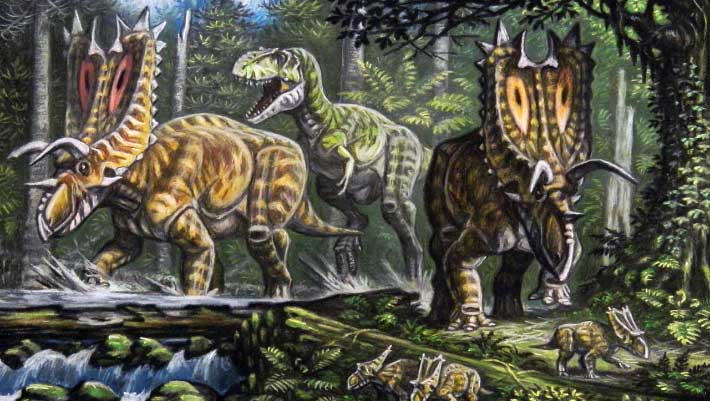
Dinosauria

Taxon

285 image(s) · 193 Actualités

Voir la fiche

Galerie d'images

A replica of MIWG 1530, the holotype of the indeterminate archosaur Yaverlandia bitholus. As seen from two angles.
Taxons Yaverlandia

A replica of MIWG 1530, the holotype of the indeterminate archosaur Yaverlandia bitholus. As seen from two angles.

holotype Dinosauria Maniraptora Yaverlandia
Wyoming Dinosaur Center
Taxons Medusaceratops

Wyoming Dinosaur Center

Dinosauria Medusaceratops
Menefeeceratops is a genus of ceratopsid dinosaur from the Menefee Formation in the United States. It is is believed to have been approximately 4 m long, and had two large horns above the eyes like other ceratopsians. Menefeeceratops was one of the earliest and most basal known members of the ceratopsids, and the oldest known centrosaurine. Its age and location was instrumental in helping to understand the evolution and diversification of the centrosaurine dinosaurs.

Menefeeceratops is a genus of ceratopsid dinosaur from the Menefee Formation in the United States. It is is believed to have been approximately 4 m long, and had two large horns above the eyes like other ceratopsians. Menefeeceratops was one of the earliest and most basal known members of the ceratopsids, and the oldest known centrosaurine. Its age and location was instrumental in helping to understand the evolution and diversification of the centrosaurine dinosaurs.

États-Unis Ceratopsia Ceratopsidae Dinosauria +3
Reconstruction of the skull of Spinops sternbergorum gen. et sp. nov. from the Campanian of Dinosaur Provincial Park, southern Alberta, in right lateral view. Preserved elements are stippled; missing portions are dotted and modeled after Centrosaurus apertus.
Taxons Spinops

Reconstruction of the skull of Spinops sternbergorum gen. et sp. nov. from the Campanian of Dinosaur Provincial Park, southern Alberta, in right lateral view. Preserved elements are stippled; missing portions are dotted and modeled after Centrosaurus apertus.

Campanien Centrosaurus Dinosauria Spinops +1
Ceratopsipes goldenensis Lockley & Hunt, 1995 - ceratopsian dinosaur trackway in the Cretaceous of Colorado, USA.
Ceratopsians are the "horned dinosaurs".  They were large, quadrupedal, herbivorous dinosaurs having a beaked skull and a frill - an extension of bone behind the skull that partially covered the neck.  Ceratopsian dinosaurs are known from the Jurassic and Cretaceous.  The last members of the group died out at the Cretaceous-Tertiary boundary, 65 million years ago.
Seen here is a ceratopsian dinosaur trackway.  Ceratopsian footprints are very rare.  The best examples are in Colorado's Laramie Formation, a nonmarine, coastal plain to deltaic succession of mostly mixed siliciclastic sedimentary rocks - sandstones, siltstones, claystones, and coals.  The footprints here consist of convex bulges on the basal surfaces of structurally-tilted sandstone beds.
The ichnospecies Ceratopsipes goldenensis was named based on footprints at this locality.  The trackmaker was very likely Triceratops, the # 1 most famous ceratopsian dinosaur.


From on-site signage:
Triceratops Tracks
Several tracks of Triceratops, or a closely related horned dinosaur were first discovered in this area and named Ceratopsipes goldenensis (meaning tracks of a horned dinosaur from Golden).  By happy coincidence, the first Triceratops known to science also comes from the greater Denver area near 13th Avenue and Federal Blvd.  Growing to a length of almost 25 feet, Triceratops and other members of the horned dinosaur family were herbivorous animals that roamed in herds.  Their trademark horns and frills that covered their necks probably served for defense.  A replica Triceratops skull is on display in the clubhouse at the Fossil Trace Golf Club.
These tracks (identified by small signs) help us understand that Triceratops walked with a narrow gait and erect front limbs  than with a wide, sprawling gait as previously depicted.  In 1887, the first Triceratops bones known to science were also discovered locally at a site near 13th Avenue and Federal Boulevard in Denver.
Nearby one may see many other traces of life such as burrows, probably made by invertebrates and impressions of plant debris.  Note that you are looking at all tracks and traces from the underside - in negative aspect - what one might call a worm’s eye view.  All of these trace fossils indicate that the Golden area once had a warm, temperate to subtropical climate.


Classification: Animalia, Chordata, Vertebrata, Reptilia, Archosauria, Dinosauria, Ornithischia, Marginocephalia, Ceratopsia, Ceratopsidae
Stratigraphy: Laramie Formation, Maastrichtian Stage, upper Upper Cretaceous
Locality: outcrop along Triceratops Trail, Parfet Prehistoric Preserve, southern side of the town of Golden, Colorado, USA (~vicinity of 39° 44' 35.24" North latitude, 105° 13’ 09.69" West longitude)


Some info. from:

Lockley & Hunt (1995) - Ceratopsid tracks and associated ichnofauna from the Laramie Formation (Upper Cretaceous: Maastrichtian) of Colorado.  Journal of Vertebrate Paleontology 15: 592-614.
Taxons Ceratopsipes

Ceratopsipes goldenensis Lockley & Hunt, 1995 - ceratopsian dinosaur trackway in the Cretaceous of Colorado, USA. Ceratopsians are the "horned dinosaurs". They were large, quadrupedal, herbivorous dinosaurs having a beaked skull and a frill - an extension of bone behind the skull that partially covered the neck. Ceratopsian dinosaurs are known from the Jurassic and Cretaceous. The last members of the group died out at the Cretaceous-Tertiary boundary, 65 million years ago. Seen here is a ceratopsian dinosaur trackway. Ceratopsian footprints are very rare. The best examples are in Colorado's Laramie Formation, a nonmarine, coastal plain to deltaic succession of mostly mixed siliciclastic sedimentary rocks - sandstones, siltstones, claystones, and coals. The footprints here consist of convex bulges on the basal surfaces of structurally-tilted sandstone beds. The ichnospecies Ceratopsipes goldenensis was named based on footprints at this locality. The trackmaker was very likely Triceratops, the # 1 most famous ceratopsian dinosaur. From on-site signage: Triceratops Tracks Several tracks of Triceratops, or a closely related horned dinosaur were first discovered in this area and named Ceratopsipes goldenensis (meaning tracks of a horned dinosaur from Golden). By happy coincidence, the first Triceratops known to science also comes from the greater Denver area near 13th Avenue and Federal Blvd. Growing to a length of almost 25 feet, Triceratops and other members of the horned dinosaur family were herbivorous animals that roamed in herds. Their trademark horns and frills that covered their necks probably served for defense. A replica Triceratops skull is on display in the clubhouse at the Fossil Trace Golf Club. These tracks (identified by small signs) help us understand that Triceratops walked with a narrow gait and erect front limbs than with a wide, sprawling gait as previously depicted. In 1887, the first Triceratops bones known to science were also discovered locally at a site near 13th Avenue and Federal Boulevard in Denver. Nearby one may see many other traces of life such as burrows, probably made by invertebrates and impressions of plant debris. Note that you are looking at all tracks and traces from the underside - in negative aspect - what one might call a worm’s eye view. All of these trace fossils indicate that the Golden area once had a warm, temperate to subtropical climate. Classification: Animalia, Chordata, Vertebrata, Reptilia, Archosauria, Dinosauria, Ornithischia, Marginocephalia, Ceratopsia, Ceratopsidae Stratigraphy: Laramie Formation, Maastrichtian Stage, upper Upper Cretaceous Locality: outcrop along Triceratops Trail, Parfet Prehistoric Preserve, southern side of the town of Golden, Colorado, USA (~vicinity of 39° 44' 35.24" North latitude, 105° 13’ 09.69" West longitude) Some info. from: Lockley & Hunt (1995) - Ceratopsid tracks and associated ichnofauna from the Laramie Formation (Upper Cretaceous: Maastrichtian) of Colorado. Journal of Vertebrate Paleontology 15: 592-614.

os États-Unis Crétacé Jurassique +6
Ornithischian dinosaur Stenopelix valdensis Meyer, 1857, holotype (GZG 741/2, formerly GPI Gö 741−2), from the Obernkirchen Sandstone (Early
Cretaceous: Berriasian), near Bückeburg, Niedersachsen, Germany. A. Large sandstone slab. B. Interpretative outline drawing of large latex cast (prepared
from large sandstone slab), showing majority of postcranial skeleton in dorsal view. C. Small sandstone slab. D. Interpretative outline drawing of small la−
tex cast (prepared from small sandstone slab), showing sacrum and caudals, pelvic region and partial hindlimbs in ventral view. For clarity elements in and
around the sacral region have not been labelled—these areas are shown in greater detail in Fig. 3. Roman numerals II–IV correspond to respective digits.

Abbreviations: mt, metatarsals; f, femur; ?, unidentified element.
Taxons Stenopelix

Ornithischian dinosaur Stenopelix valdensis Meyer, 1857, holotype (GZG 741/2, formerly GPI Gö 741−2), from the Obernkirchen Sandstone (Early Cretaceous: Berriasian), near Bückeburg, Niedersachsen, Germany. A. Large sandstone slab. B. Interpretative outline drawing of large latex cast (prepared from large sandstone slab), showing majority of postcranial skeleton in dorsal view. C. Small sandstone slab. D. Interpretative outline drawing of small la− tex cast (prepared from small sandstone slab), showing sacrum and caudals, pelvic region and partial hindlimbs in ventral view. For clarity elements in and around the sacral region have not been labelled—these areas are shown in greater detail in Fig. 3. Roman numerals II–IV correspond to respective digits. Abbreviations: mt, metatarsals; f, femur; ?, unidentified element.

dessin Allemagne Berriasien Crétacé +8
Holotype of Ferrisaurus sustutensis, RBCM P900, on display in the Okanagan Heritage Museum exhibition Dinosaurs of BC, June-September 2024.
Taxons Ferrisaurus

Holotype of Ferrisaurus sustutensis, RBCM P900, on display in the Okanagan Heritage Museum exhibition Dinosaurs of BC, June-September 2024.

musée holotype Dinosauria Ferrisaurus
Goyocephale lattimorei in the exhibition "Dinosaures. Tresors del desert de Gobi" ("Dinosaurs. Treasures of Gobi Desert") in CosmoCaixa, Barcelona.
Taxons Goyocephale

Goyocephale lattimorei in the exhibition "Dinosaures. Tresors del desert de Gobi" ("Dinosaurs. Treasures of Gobi Desert") in CosmoCaixa, Barcelona.

Dinosauria Goyocephalia
Diagram featuring the holotype skull (ZPAL MgD-I/105) of Tylocephale gilmorei in left lateral view. Scale bar equals 5 cm (50 mm). Based on Maryańska & Osmólska, 1974,[1] and Sullivan, 2006.[2]
References

↑ (1974). "Pachycephalosauria, a new suborder of ornithischian dinosaurs". Palaeontologica Polonica (30): 45−102.

↑ (2006). "A taxonomic review of the Pachycephalosauridae (Dinosauria: Ornithischia)". New Mexico Museum of Natural History and Science Bulletin (35): 347–365.
Taxons Tylocephale

Diagram featuring the holotype skull (ZPAL MgD-I/105) of Tylocephale gilmorei in left lateral view. Scale bar equals 5 cm (50 mm). Based on Maryańska & Osmólska, 1974,[1] and Sullivan, 2006.[2] References ↑ (1974). "Pachycephalosauria, a new suborder of ornithischian dinosaurs". Palaeontologica Polonica (30): 45−102. ↑ (2006). "A taxonomic review of the Pachycephalosauridae (Dinosauria: Ornithischia)". New Mexico Museum of Natural History and Science Bulletin (35): 347–365.

écaille musée Mexique holotype +6
Holotype (MTM V 2009.192.1) of Ajkaceratops kozmai .mw-parser-output .smallcaps{font-variant:small-caps}Ősi et al., 2010 (Dinosauria: Ceratopsia), fused rostral and premaxillae, in lateral view, length of scale bar = 1 cm.
Taxons Ajkaceratops

Holotype (MTM V 2009.192.1) of Ajkaceratops kozmai .mw-parser-output .smallcaps{font-variant:small-caps}Ősi et al., 2010 (Dinosauria: Ceratopsia), fused rostral and premaxillae, in lateral view, length of scale bar = 1 cm.

écaille holotype Ajkaceratops Ceratopsia +1
Fossil of Lurdusaurus, an ornithopod dinosaur
Took the photo at Musee d'Histoire Naturelle, Brussels
Taxons Lurdusaurus

Fossil of Lurdusaurus, an ornithopod dinosaur Took the photo at Musee d'Histoire Naturelle, Brussels

fossile Dinosauria Lurdusaurus
Notohypsilodon comodorensis, an elasmarian ornithopod dinosaur.
Taxons Notohypsilophodon

Notohypsilodon comodorensis, an elasmarian ornithopod dinosaur.

Dinosauria Elasmaria Notohypsilophodon
Braincase of WSC 10058, holotype of Ornatops 
Braincase of Ornatops incantatus in digital 3D model in right lateral (A and C) and left lateral (D and F) views, with enlarged images of the right (B) and left (E) auditory regions.

Credit: McDonald AT, Wolfe DG, Freedman Fowler EA, Gates TA. 2021. A new brachylophosaurin (Dinosauria: Hadrosauridae) from the Upper Cretaceous Menefee Formation of New Mexico. PeerJ 9:e11084 https://doi.org/10.7717/peerj.11084
Taxons Ornatops

Braincase of WSC 10058, holotype of Ornatops Braincase of Ornatops incantatus in digital 3D model in right lateral (A and C) and left lateral (D and F) views, with enlarged images of the right (B) and left (E) auditory regions. Credit: McDonald AT, Wolfe DG, Freedman Fowler EA, Gates TA. 2021. A new brachylophosaurin (Dinosauria: Hadrosauridae) from the Upper Cretaceous Menefee Formation of New Mexico. PeerJ 9:e11084 https://doi.org/10.7717/peerj.11084

Mexique Crétacé holotype Dinosauria +3
The hadrosaurid dinosaur Wulagasaurus dongi gen. et sp. nov. from the Upper Cretaceous Yuliangze Formation at the Wulaga quarry, China.

A. Holotype GMH W184, right dentary in lateral (A1) and medial (A2) views. B. GMH W217, right dentary in lateral (B1) and medial (B2) views.
Taxons Wulagasaurus

The hadrosaurid dinosaur Wulagasaurus dongi gen. et sp. nov. from the Upper Cretaceous Yuliangze Formation at the Wulaga quarry, China. A. Holotype GMH W184, right dentary in lateral (A1) and medial (A2) views. B. GMH W217, right dentary in lateral (B1) and medial (B2) views.

Chine Crétacé holotype Dinosauria +3
Malefica is a hadrosaurid dinosaur from the Late Cretaceous of Texas in the United States. Like other hadrosaurs, Malefica was herbivorous, processing plant matter with their broad beaks and battery of teeth in the back of the mouth. It could grow to around 6 m in length, and weighed about 1 t. The discovery of Malefica helped to understand the distribution of hadrosaurs in Cretaceous North America, as well as evolutionary lineages between basal hadrosaurs and the more derived saurolophids.
Taxons Malefica

Malefica is a hadrosaurid dinosaur from the Late Cretaceous of Texas in the United States. Like other hadrosaurs, Malefica was herbivorous, processing plant matter with their broad beaks and battery of teeth in the back of the mouth. It could grow to around 6 m in length, and weighed about 1 t. The discovery of Malefica helped to understand the distribution of hadrosaurs in Cretaceous North America, as well as evolutionary lineages between basal hadrosaurs and the more derived saurolophids.

États-Unis Crétacé Crétacé supérieur Dinosauria +5
Dentary of the hadrosauroid dinosaur Fylax thyrakolasus gen. et sp. nov. (IPS-36338, holotype) from the uppermost Maastrichtian Fontllonga-R locality; in posterior (A1), medial (A2), dorsal (A4), anterior (A5), lateral (A6), and ventral (A7) views. A detailed lingual view of the tooth crowns appears in A3.
Taxons Fylax

Dentary of the hadrosauroid dinosaur Fylax thyrakolasus gen. et sp. nov. (IPS-36338, holotype) from the uppermost Maastrichtian Fontllonga-R locality; in posterior (A1), medial (A2), dorsal (A4), anterior (A5), lateral (A6), and ventral (A7) views. A detailed lingual view of the tooth crowns appears in A3.

dent Maastrichtien holotype Dinosauria +1
1 2 3 4 5 6 7 8 9 10 11 12 13 14 15 16 17 18

Actualités

Parasaurolophus: Beast of the Week
Parasaurolophus : Bête de la semaine
crête Crétacé Crétacé supérieur spécimen Canardia Dinosauria Parasaurolophus
Cette semaine, nous allons nous intéresser à un dinosaure à bec de canard très populaire.  Dites bonjour à Parasaurolophus !  Le parasaurolophus était un herbivore qui vivait dans ce qui est aujourd'hui l'Amérique du Nord à la fin du Crétacé, il y a environ 77 à 73 millions d'années.  Le parasaurolophus mesurait environ 9,1 mètres de long du bec à la queue, mais certains spécimens incomplets montrent qu'ils étaient un peu plus grands.  Parasaurolophus est surtout connu pour sa longue crête incurvée qui s'est développée à l'arrière de sa tête, givi
21/12/2025 prehistoricbeastoftheweek ⚙ Traduction automatique
Des scientifiques ont découvert une horloge cachée dans des coquilles d'œufs de dinosaures
fossile Dinosauria
Les chercheurs ont découvert que les coquilles d’œufs fossilisées de dinosaures contiennent une horloge naturelle qui peut révéler l’époque où vivaient les dinosaures. La technique fournit des âges étonnamment précis et pourrait révolutionner la façon dont les sites fossilifères du monde entier sont datés.
21/12/2025 sciencedaily ⚙ Traduction automatique
Des monstres marins géants vivaient dans les rivières à la fin de l'ère des dinosaures
dent alimentation prédateur Dinosauria Mosasaurus isotope
Les mosasaures géants, autrefois considérés comme des prédateurs strictement océaniques, ont peut-être passé leur dernier chapitre à rôder dans les rivières d'eau douce aux côtés de dinosaures et de crocodiles. Une dent massive trouvée dans le Dakota du Nord, analysée à l'aide de techniques isotopiques chimiques, révèle que certains mosasaures se sont adaptés aux systèmes fluviaux à mesure que les mers se rafraîchissaient progressivement vers la fin de l'ère des dinosaures. Ces énormes reptiles, peut-être aussi longs qu'un bus, semblent avoir chassé près de la surface, se nourrissant peut-être même de dinosaures noyés.
15/12/2025 sciencedaily ⚙ Traduction automatique
Une momie de dinosaure retrouvée avec des sabots et une crête cachée
crête écaille film Dinosauria Edmontosaurus
Les scientifiques ont reconstitué le profil le plus complet et le plus réaliste d’Edmontosaurus annectens grâce à un processus de préservation extraordinaire appelé modèle d’argile, dans lequel un mince film d’argile a capturé la peau, les écailles, les pointes et même les sabots du dinosaure en trois dimensions. En combinant des «momies» récemment fouillées, une imagerie avancée et une reconstruction artistique, les chercheurs ont révélé une haute crête, une seule rangée de pointes de queue, de délicates écailles ressemblant à des cailloux et, ce qui est le plus remarquable, le plus ancien sabot connu.
30/11/2025 sciencedaily ⚙ Traduction automatique
Edmontosaurus: Beast of the Week
Edmontosaurus : la bête de la semaine
Crétacé Crétacé supérieur Canardia Dinosauria Edmontosaurus Hadrosauria
Aujourd’hui, nous examinons l’un des dinosaures à bec de canard les plus grands et les mieux étudiés.  Entrez Edmontosaure!  Edmontosaurus annectens dans les aquarelles de Christopher DiPiazza.Edmontosaurus était un dinosaure hadrosaure (« à bec de canard ») qui pouvait atteindre au moins 39 pieds (12 mètres) de long du bec à la queue et qui vivait à la fin du Crétacé dans ce qui est aujourd'hui l'ouest de l'Amérique du Nord.  Il existe actuellement deux espèces reconnues dans le genre, Edmontosaurus regalis et Edmontosaurus annect.
29/11/2025 prehistoricbeastoftheweek ⚙ Traduction automatique
1 2 3 4 5 6 7 8 9 10 11 12 13 14 15 16 17 18 19 20 21 22 23 24 25 26 27 28 29 30 31 32 33 34 35 36 37 38 39