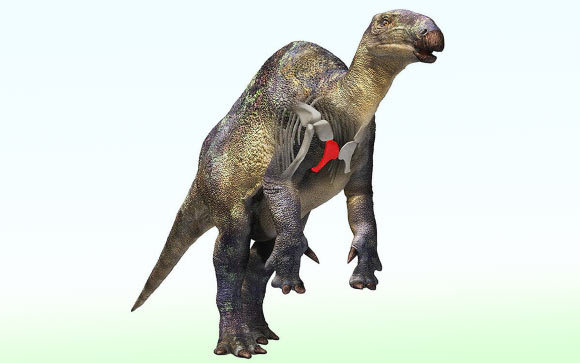
Dinosauria

Taxon

285 image(s) · 193 Actualités

Voir la fiche

Galerie d'images

Ареал карнозавров

Ареал карнозавров

Dinosauria Tetanurae
Reconstruction of the theropod dinosaur Tachiraptor admirabilis. Artwork created with graphite and colored pencils. Author: Edwin Chávez "Disfrasaurio".

Reconstruction of the theropod dinosaur Tachiraptor admirabilis. Artwork created with graphite and colored pencils. Author: Edwin Chávez "Disfrasaurio".

Averostra Dinosauria Tachiraptor
Ceratosaurus nasicornis reconstruction. Matches proportions shown in Gregory S. Paul (The Princeton Field Guide to Dinosaurs, 2010, p. 84)

Ceratosaurus nasicornis reconstruction. Matches proportions shown in Gregory S. Paul (The Princeton Field Guide to Dinosaurs, 2010, p. 84)

Averostra Ceratosauria Dinosauria
Sketch-drawing of the vertebrate faunal assemblage of the Lisowice site (modified from Niedźwiedzki)10. (a) Large, theropod-like predatory archosaur (Smok wawelski); (b) large temnospondyl amphibian (Cyclotosaurus sp.); (c) small predatory dinosaurs (Neotheropoda indet.); (d) temnospondyl amphibian (Gerrothorax sp.); (e) small basal crocodylomorph (Crocodylomorpha indet.); (f) small diapsid (Choristodere-like animal); (g) hybodont sharks (Polyacrodus and Hybodus); (h) coelacanth fish; (i) dipnoan fish (Ptychoceratodus sp.); (j) actinopterygian fish; (k) gigantic dicynodont; (l) dinosauriforms or early dinosaurs (Dinosauriformes indet. or Dinosauria indet.); (m) small lepidosauromorphs (Sphenodontia indet.); (n) pterosaurs (Pterosauria indet.); (o) early mammaliaform (Hallautherium sp.).

Sketch-drawing of the vertebrate faunal assemblage of the Lisowice site (modified from Niedźwiedzki)10. (a) Large, theropod-like predatory archosaur (Smok wawelski); (b) large temnospondyl amphibian (Cyclotosaurus sp.); (c) small predatory dinosaurs (Neotheropoda indet.); (d) temnospondyl amphibian (Gerrothorax sp.); (e) small basal crocodylomorph (Crocodylomorpha indet.); (f) small diapsid (Choristodere-like animal); (g) hybodont sharks (Polyacrodus and Hybodus); (h) coelacanth fish; (i) dipnoan fish (Ptychoceratodus sp.); (j) actinopterygian fish; (k) gigantic dicynodont; (l) dinosauriforms or early dinosaurs (Dinosauriformes indet. or Dinosauria indet.); (m) small lepidosauromorphs (Sphenodontia indet.); (n) pterosaurs (Pterosauria indet.); (o) early mammaliaform (Hallautherium sp.).

dessin Dinosauria Neotheropoda Pterosauria
Diagram made to illustrate the debate over the hands of theropod dinosaurs and their alleged descendants, the birds ( Aves ). In the last years, the difference between the hands of theropods and birds have been an important thing when it comes question the theory that birds evolved from dinosaurs, even though some scientists may could refute it. In the diagram, a Neotheropoda ( 1 ), basal tetanurae ( 2 ), a coelurosaurian ( 3 ), the bird (?)Archaeopteryx ( 4 ) and modern bird ( 5 ).
In 1997, birdexpert Alan Feduccia at University of North Carolina discovered that birds develop hands with the digits II, III and IV ( see The Cincinnati Enquirer, 25 - 10 - 1997 ). This is in contrast with the hands of tetanurae, which seems to have the digits I, II and III. This make it almost impossible for dinosaurs and birds to be closely related, according to Feduccia.
Since the discovery by Feduccia, scientific research have came up with a possible explanation to the mystery of the dinosaur - bird hand difference, called The frame shift hypothesis ( see http://scienceblogs.com/tetrapodzoology/2009/06/limusaurus_is_awesome.php ). This hypothesis is based on a discovery which shows that although bird embryos develop the fingers II, III and IV, the genes which is coding for the external appearance of the digits seems to be from the fingers I, II and III. Based on this, scientists belive this: when neotheropods evolved into tetanurae, the losed digit I ( not digit IV, as earlier suggested ). During this process, the genes which coded for how the digits should looks like ( the number of phalanges, for example ) became refurnished ( see the color spots in th upper section in the diagram to understan ). The discovery of Limusaurus has been said to support this theory ( see https://www.livescience.com/animals/090617-dinosaur-hands.html ).
One thing is that may can be used to refute that Limusaurus should support the Frame shift hypothesis is that Limusaurus was a ceratosaurian, and is dated to be much younger than the oldest tetanurae's.
Also, some tetanure´s may had 4 digits' like the Archaeornithomimus ( see number 4 in the diagram ) ( see also http://dml.cmnh.org/1998Oct/msg00443.html and the Allosaurus hand in the image here: http://upload.wikimedia.org/wikipedia/commons/6/69/Allosaurus-mounted.jpg ). If this is the digits I, II, III and IV. If so, it shows that tetanurae had the digits I, II and III, and not II, II and IV, like birds.
For more in this debate, see text section to my picture Raptor-Archaeopteryx-bird hands differens.JPG at http://commons.wikimedia.org/wiki/File:Raptor-Archaeopteryx-bird_hands_differens.JPG.

Diagram made to illustrate the debate over the hands of theropod dinosaurs and their alleged descendants, the birds ( Aves ). In the last years, the difference between the hands of theropods and birds have been an important thing when it comes question the theory that birds evolved from dinosaurs, even though some scientists may could refute it. In the diagram, a Neotheropoda ( 1 ), basal tetanurae ( 2 ), a coelurosaurian ( 3 ), the bird (?)Archaeopteryx ( 4 ) and modern bird ( 5 ). In 1997, birdexpert Alan Feduccia at University of North Carolina discovered that birds develop hands with the digits II, III and IV ( see The Cincinnati Enquirer, 25 - 10 - 1997 ). This is in contrast with the hands of tetanurae, which seems to have the digits I, II and III. This make it almost impossible for dinosaurs and birds to be closely related, according to Feduccia. Since the discovery by Feduccia, scientific research have came up with a possible explanation to the mystery of the dinosaur - bird hand difference, called The frame shift hypothesis ( see http://scienceblogs.com/tetrapodzoology/2009/06/limusaurus_is_awesome.php ). This hypothesis is based on a discovery which shows that although bird embryos develop the fingers II, III and IV, the genes which is coding for the external appearance of the digits seems to be from the fingers I, II and III. Based on this, scientists belive this: when neotheropods evolved into tetanurae, the losed digit I ( not digit IV, as earlier suggested ). During this process, the genes which coded for how the digits should looks like ( the number of phalanges, for example ) became refurnished ( see the color spots in th upper section in the diagram to understan ). The discovery of Limusaurus has been said to support this theory ( see https://www.livescience.com/animals/090617-dinosaur-hands.html ). One thing is that may can be used to refute that Limusaurus should support the Frame shift hypothesis is that Limusaurus was a ceratosaurian, and is dated to be much younger than the oldest tetanurae's. Also, some tetanure´s may had 4 digits' like the Archaeornithomimus ( see number 4 in the diagram ) ( see also http://dml.cmnh.org/1998Oct/msg00443.html and the Allosaurus hand in the image here: http://upload.wikimedia.org/wikipedia/commons/6/69/Allosaurus-mounted.jpg ). If this is the digits I, II, III and IV. If so, it shows that tetanurae had the digits I, II and III, and not II, II and IV, like birds. For more in this debate, see text section to my picture Raptor-Archaeopteryx-bird hands differens.JPG at http://commons.wikimedia.org/wiki/File:Raptor-Archaeopteryx-bird_hands_differens.JPG.

Archaeopteryx Coelurosauria Dinosauria Neotheropoda +3
Cladogram of amniotes. Based on File:Cladogram Amniota A.jpg

Cladogram of amniotes. Based on File:Cladogram Amniota A.jpg

Coelurosauria Dinosauria Maniraptora Ornithischia +2
Cladogram of the former "Reptilia" (red)

Cladogram of the former "Reptilia" (red)

Coelurosauria Dinosauria Maniraptora Ornithischia +2
Dinosaur art by me!

Dinosaur art by me!

Dinosauria
The Chicago specimen of Archaeopteryx (PA 830), a well-preserved fossil highlighting the transitional features between non-avian dinosaurs and birds, housed at the Field Museum of Natural History.

The Chicago specimen of Archaeopteryx (PA 830), a well-preserved fossil highlighting the transitional features between non-avian dinosaurs and birds, housed at the Field Museum of Natural History.

musée fossile spécimen Archaeopteryx +2
Life representation of Bicharracosaurus dionidei

Life representation of Bicharracosaurus dionidei

Bicharracosaurus Dinosauria
A badly drew sketch of Brontoholus (a placeholder for when an actual paleoart of Brontotholus is made.

A badly drew sketch of Brontoholus (a placeholder for when an actual paleoart of Brontotholus is made.

paléoart Brontotholus Dinosauria
Archeology center interior Svilajnac

Archeology center interior Svilajnac

Dinosauria
Apex Stegosaurus Reconstruction drawn Jan, 7, 2025 by Adam Treviño

Apex Stegosaurus Reconstruction drawn Jan, 7, 2025 by Adam Treviño

Dinosauria Stegosauria
Anteavis

Anteavis

Anteavis Dinosauria
Dinosaur art by me!

Dinosaur art by me!

Dinosauria
A scientifically accurate reconstruction of the dinosaur Spinosaurus aegyptiacus.

A scientifically accurate reconstruction of the dinosaur Spinosaurus aegyptiacus.

Dinosauria Spinosauria
1 2 3 4 5 6 7 8 9 10 11 12 13 14 15 16 17 18

Actualités

Nouvelle figurine Helina du clan du feu cyberzoïque en stock
Dinosauria
La nouveauté 2026 de la figurine Cyberzoic Fire Clan Helina est en stock chez Everything Dinosaur.  Cette figure humaine articulée de gladiateur/chasseur fait partie de la passionnante série Cyberzoic, où le passé rencontre le futur. Le modèle mesure environ dix centimètres et demi et comprend deux têtes interchangeables. De plus, le chiffre comprend trois
11/07/2026 everythingdinosaur ⚙ Traduction automatique
Nouvelles figurines Haolonggood Pachyrhinosaurus en stock
écaille jouet Dinosauria Pachyrhinosaurus
Les deux nouvelles figurines Haolonggood Pachyrhinosaurus sont en stock chez Everything Dinosaur. Ces magnifiques modèles d'animaux préhistoriques à l'échelle 1:35 présentent des couleurs mises à jour. Les figurines populaires Haolonggood Lv Fang et Guo Sheng ont reçu un nouveau look. Ces remarquables modèles de dinosaures à cornes démontrent l’attention portée aux détails par Haolonggood. De plus, les nouvelles palettes de couleurs offrent
10/07/2026 everythingdinosaur ⚙ Traduction automatique
New Species of Long-Necked Dinosaur Identified in Thailand
Une nouvelle espèce de dinosaure à long cou identifiée en Thaïlande
Thaïlande Dinosauria Mamenchisauridae Uragasaurus nouvelle espèce
Des paléontologues travaillant dans le nord-est de la Thaïlande ont identifié une nouvelle espèce de dinosaure sauropode mamenchisauridé, offrant ainsi une nouvelle preuve qu'un groupe de sauropodes géants que l'on pensait autrefois presque exclusivement asiatiques parcourait également l'Asie du Sud-Est continentale. L'article Nouvelle espèce de dinosaure à long cou identifié en Thaïlande est apparu en premier sur Sci.News : Breaking Science News.
09/07/2026 sci-news ⚙ Traduction automatique
Nouvelle figurine de chevalier du feu du clan du feu cyberzoïque en stock
armure jouet Dinosauria
La spectaculaire figurine Cyberzoic Fire Clan Fire Knight est arrivée chez Everything Dinosaur.  Cette figurine humaine conçue pour accompagner les modèles d'animaux et de dragons préhistoriques cyberzoïques est fournie avec de multiples accessoires.  Par exemple, cette figurine articulée est livrée avec une armure supplémentaire, deux casques, une épée Claymore et un bouclier de combat.  Le passé et le futur se heurtent
08/07/2026 everythingdinosaur ⚙ Traduction automatique
New Jurassic Fossil Reveals How Birds Lost Their Dinosaur Tails
Un nouveau fossile jurassique révèle comment les oiseaux ont perdu leur queue de dinosaure
Chine Jurassique fossile Dinosauria Zhengheornis oiseau
Des paléontologues chinois ont décrit un petit oiseau jurassique jusqu'alors inconnu dont la queue courte offre de nouvelles preuves de la façon dont les premiers oiseaux ont troqué leur longue queue semblable à celle d'un dinosaure contre le coccyx compact qui aide les oiseaux vivants à voler. L'article Un nouveau fossile du Jurassique révèle comment les oiseaux ont perdu leurs queues de dinosaures est apparu en premier sur Sci.News : Breaking Science News.
07/07/2026 sci-news ⚙ Traduction automatique
1 2 3 4 5 6 7 8 9 10 11 12 13 14 15 16 17 18 19 20 21 22 23 24 25 26 27 28 29 30 31 32 33 34 35 36 37 38 39