←

Dinosauria

Taxon

300 image(s) · 316 Actualités

Voir la fiche

Galerie d'images

Map of the localities in the Bauru Basin where the sauropod dinosaurs were collected.
Taxons Ibirania

Map of the localities in the Bauru Basin where the sauropod dinosaurs were collected.

Dinosauria Ibirania
Brontotholus is a relatively large pachycephalosaurian dinosaur. Like all pachycephalosaurs, it was bipedal and sported the characteristic bony dome on top of its skull. Brontotholus grew to nearly 4 m in length, making it one of the largest known pachycephalosaurs, and the largest from the Campanian age.
Taxons Brontotholus

Brontotholus is a relatively large pachycephalosaurian dinosaur. Like all pachycephalosaurs, it was bipedal and sported the characteristic bony dome on top of its skull. Brontotholus grew to nearly 4 m in length, making it one of the largest known pachycephalosaurs, and the largest from the Campanian age.

Campanien Brontotholus Dinosauria Pachycephalosauria +1
Fossil samples – e.g. ‘primitive’ bony fish (1, 2), a skull of a temnospondyl ‘amphibian’ (probably a metoposauroid) in dorsal view (3), a skull of an archosaur of the crocodile lineage (probably a phytosaur) in palatal view (4), holotype of the “gliding reptile” Icarosaurus siefkeri [1] (5) and Atreipus-Grallator-type dinosaur tracks (bottom right) – from the Newark Supergroup, i.e. a series of mainly Late Triassic to Early Jurassic sedimentary rocks of eastern North America


↑ Edwin H. Colbert: A gliding reptile from the Triassic of New Jersey. American Museum Novitates, 2230. American Museum of Natural History, New York 1966, digitallibrary.amnh.org, cf. fig. 3 therein.
Taxons Atreipus

Fossil samples – e.g. ‘primitive’ bony fish (1, 2), a skull of a temnospondyl ‘amphibian’ (probably a metoposauroid) in dorsal view (3), a skull of an archosaur of the crocodile lineage (probably a phytosaur) in palatal view (4), holotype of the “gliding reptile” Icarosaurus siefkeri [1] (5) and Atreipus-Grallator-type dinosaur tracks (bottom right) – from the Newark Supergroup, i.e. a series of mainly Late Triassic to Early Jurassic sedimentary rocks of eastern North America ↑ Edwin H. Colbert: A gliding reptile from the Triassic of New Jersey. American Museum Novitates, 2230. American Museum of Natural History, New York 1966, digitallibrary.amnh.org, cf. fig. 3 therein.

musée Jurassique inférieur Jurassique Trias supérieur +9
Fossil of Pinacosaurus, an ankylosaurian  dinosaur
Took the photo at Musee d'Histoire Naturelle, Brussels

Fossil of Pinacosaurus, an ankylosaurian dinosaur Took the photo at Musee d'Histoire Naturelle, Brussels

fossile Ankylosauria Dinosauria Eopinacosaurus +1
Fossil of Pinacosaurus, an ankylosaurid dinosaur
Took the photo at Musee d'Histoire Naturelle, Brussels

Fossil of Pinacosaurus, an ankylosaurid dinosaur Took the photo at Musee d'Histoire Naturelle, Brussels

fossile Ankylosauridae Dinosauria Eopinacosaurus +1
Eopinacosaurus is an ankylosaurid dinosaur that was originally assigned to Pinacosaurus, until a 2026 analysis reassigned it as a distinct genus. Like all ankylosaurs, it was a heavily armored quadrupedal herbivore. Notable defensive adaptations include the characteristic tail club, as well as sizable horns protruding backward from the head.

Eopinacosaurus is an ankylosaurid dinosaur that was originally assigned to Pinacosaurus, until a 2026 analysis reassigned it as a distinct genus. Like all ankylosaurs, it was a heavily armored quadrupedal herbivore. Notable defensive adaptations include the characteristic tail club, as well as sizable horns protruding backward from the head.

Ankylosauria Ankylosauridae Dinosauria Eopinacosaurus +1
Norellraptor is a microraptorian dinosaur known from a specimen with exceptionally well-preserved feathers. Its discovery supports evidence that gliding and flight-related traits evolved independently in multiple dinosaur groups. Norellraptor had long feathers on its arms and legs, typical of microraptorians, resulting in a four-winged body plan.

Norellraptor is a microraptorian dinosaur known from a specimen with exceptionally well-preserved feathers. Its discovery supports evidence that gliding and flight-related traits evolved independently in multiple dinosaur groups. Norellraptor had long feathers on its arms and legs, typical of microraptorians, resulting in a four-winged body plan.

plume vol spécimen Dinosauria +2
Kayrasaurus is a therizinosaurian dinosaur that lived during the Early Cretaceous period in what is now China. At an estimated 3.6 m in total body length, it is the largest therizinosaur known from the Jehol Biota. Like other therizinosaurs, Kayrasaurus was a bipedal herbivore with large curved claws on each hand.

Kayrasaurus is a therizinosaurian dinosaur that lived during the Early Cretaceous period in what is now China. At an estimated 3.6 m in total body length, it is the largest therizinosaur known from the Jehol Biota. Like other therizinosaurs, Kayrasaurus was a bipedal herbivore with large curved claws on each hand.

griffe Chine Crétacé Crétacé inférieur +2
Muttaburrasaurus
The plants, animals and climate of the Australian continent have changed dramatically over long periods of time. Imagine this giant creature roaming the luxuriant wet forests that covered parts of the continent in the Cretaceous period, about 100-110 million years ago. The Muttaburrasaurus ambled along on all four legs or stood on its hind legs. Its large teeth were well adapted to eat tough vegetation such as the leathery foliage of the evergreen forests of Araucaria trees, ancient relatives of the bunya pine of south-eastern Queensland.
In 1963, grazier Doug Langdon discovered the fossilised bones of a dinosaur on his property near Muttaburra in central-west Queensland. It was one of the most complete dinosaur skeletons found in Australia. The bones belonged to a new species of ornithopod and palaeontologists named it Muttaburrasaurus langdoni.

Cast of Muttaburresaurus langdoni 1987 made by Queensland Museum, Brisbane National Museum of Australia
Taxons Muttaburrasaurus

Muttaburrasaurus The plants, animals and climate of the Australian continent have changed dramatically over long periods of time. Imagine this giant creature roaming the luxuriant wet forests that covered parts of the continent in the Cretaceous period, about 100-110 million years ago. The Muttaburrasaurus ambled along on all four legs or stood on its hind legs. Its large teeth were well adapted to eat tough vegetation such as the leathery foliage of the evergreen forests of Araucaria trees, ancient relatives of the bunya pine of south-eastern Queensland. In 1963, grazier Doug Langdon discovered the fossilised bones of a dinosaur on his property near Muttaburra in central-west Queensland. It was one of the most complete dinosaur skeletons found in Australia. The bones belonged to a new species of ornithopod and palaeontologists named it Muttaburrasaurus langdoni. Cast of Muttaburresaurus langdoni 1987 made by Queensland Museum, Brisbane National Museum of Australia

os musée Australie Crétacé +5
Montanoceratops cerorhynchus (Brown & Schlaikjer, 1942) - fossil ceratopsian dinosaur skeleton from the Cretaceous of Montana, USA. (MOR 542, Museum of the Rockies, Bozeman, Montana, USA)
The species name is sometimes incorrectly spelled "cerorhynchos".  The original publication spells it "cerorhynchus".  The genus name is sometimes incorrectly spelled "Montanaceratops".
Ceratopsians are the "horned dinosaurs".  They were large, quadrupedal, herbivorous dinosaurs having a beaked skull and a frill - an extension of bone behind the skull that partially covered the neck.  Ceratopsian dinosaurs are known from the Jurassic and Cretaceous.  The last members of the group died out at the Cretaceous-Tertiary boundary, 65 million years ago.
This is a partial skeleton of a juvenile Montanoceratops, a ceratopsian from the near-latest Cretaceous of western North America.  This type of ceratopsian lacked facial horns.


From exhibit signage:
Sixty-eight million years ago, when the horned dinosaurs Triceratops and Torosaurus inhabited the coastal plain near the inland ocean, primitive "horned" dinosaurs named Montanoceratops lived in uplands near the young Rocky Mountains.  These little protoceratopsians fed on plants with slicing teeth and narrow beaks similar to their giant three-horned relatives.


Classification: Animalia, Chordata, Vertebrata, Reptilia, Archosauria, Dinosauria, Ornithischia, Marginocephalia, Ceratopsia, Leptoceratopsidae
Stratigraphy: St. Mary River Formation, Maastrichtian Stage, Upper Cretaceous
Locality: Little Rocky Coulee, north of the town of Cut Bank, eastern Glacier County, northwestern Montana, USA


Info. at:

en.wikipedia.org/wiki/Montanoceratops
Taxons Montanoceratops

Montanoceratops cerorhynchus (Brown & Schlaikjer, 1942) - fossil ceratopsian dinosaur skeleton from the Cretaceous of Montana, USA. (MOR 542, Museum of the Rockies, Bozeman, Montana, USA) The species name is sometimes incorrectly spelled "cerorhynchos". The original publication spells it "cerorhynchus". The genus name is sometimes incorrectly spelled "Montanaceratops". Ceratopsians are the "horned dinosaurs". They were large, quadrupedal, herbivorous dinosaurs having a beaked skull and a frill - an extension of bone behind the skull that partially covered the neck. Ceratopsian dinosaurs are known from the Jurassic and Cretaceous. The last members of the group died out at the Cretaceous-Tertiary boundary, 65 million years ago. This is a partial skeleton of a juvenile Montanoceratops, a ceratopsian from the near-latest Cretaceous of western North America. This type of ceratopsian lacked facial horns. From exhibit signage: Sixty-eight million years ago, when the horned dinosaurs Triceratops and Torosaurus inhabited the coastal plain near the inland ocean, primitive "horned" dinosaurs named Montanoceratops lived in uplands near the young Rocky Mountains. These little protoceratopsians fed on plants with slicing teeth and narrow beaks similar to their giant three-horned relatives. Classification: Animalia, Chordata, Vertebrata, Reptilia, Archosauria, Dinosauria, Ornithischia, Marginocephalia, Ceratopsia, Leptoceratopsidae Stratigraphy: St. Mary River Formation, Maastrichtian Stage, Upper Cretaceous Locality: Little Rocky Coulee, north of the town of Cut Bank, eastern Glacier County, northwestern Montana, USA Info. at: en.wikipedia.org/wiki/Montanoceratops

os musée États-Unis Crétacé +17
14365- dinosaur 4155
Taxons Alioramus

14365- dinosaur 4155

Alioramus Dinosauria communication
Wyoming Dinosaur Center
Taxons Mymoorapelta

Wyoming Dinosaur Center

Dinosauria Mymoorapelta
Skeleton identified as Nemegtomaia by Greg Funston.[1] Central Museum of Mongolian Dinosaurs, Ulaanbaatar. Complete indexed photo collection at WorldHistoryPics.com.
Taxons Nemegtomaia

Skeleton identified as Nemegtomaia by Greg Funston.[1] Central Museum of Mongolian Dinosaurs, Ulaanbaatar. Complete indexed photo collection at WorldHistoryPics.com.

musée Dinosauria Nemegtomaia squelette
Leaellynasaura amicagraphica, dinosaur, skull. Holotype. [P 185991]
Taxons Leaellynasaura

Leaellynasaura amicagraphica, dinosaur, skull. Holotype. [P 185991]

musée holotype Dinosauria Leaellynasaura +1
Fossil specimen RTMP 82.19.23 - A lacrimal, postorbitals, squamosals, frontals, parietals, and braincase referred to Latenivenatrix mcmasterae, but formerly assigned to Stenonychosaurus inequalis (=Troodon inequalis). Described by 

Currie, 1985. "Cranial anatomy of Stenonychosaurus inequalis (Saurischia, Theropoda) and its bearing on the origin of birds." Canadian Journal of Earth Sciences, 22(1), 643-658.
5d-dinosaur-camp-day2-20120802-15.jpg
Taxons Latenivenatrix

Fossil specimen RTMP 82.19.23 - A lacrimal, postorbitals, squamosals, frontals, parietals, and braincase referred to Latenivenatrix mcmasterae, but formerly assigned to Stenonychosaurus inequalis (=Troodon inequalis). Described by Currie, 1985. "Cranial anatomy of Stenonychosaurus inequalis (Saurischia, Theropoda) and its bearing on the origin of birds." Canadian Journal of Earth Sciences, 22(1), 643-658. 5d-dinosaur-camp-day2-20120802-15.jpg

Canada fossile spécimen Dinosauria +7
Pelvis (fused ilia and pubes) of UALVP 48778, holotype of Hesperonychus elizabethae, from the late Campanian Dinosaur Park Formation of Alberta, Canada. Fossil collected by Dr. Elizabeth Nicholls. Prepared by Clive Coy. Digital photography by Nick Longrich. Additional digital editing by Nick Longrich.
Taxons Hesperonychus

Pelvis (fused ilia and pubes) of UALVP 48778, holotype of Hesperonychus elizabethae, from the late Campanian Dinosaur Park Formation of Alberta, Canada. Fossil collected by Dr. Elizabeth Nicholls. Prepared by Clive Coy. Digital photography by Nick Longrich. Additional digital editing by Nick Longrich.

bassin Canada Dinosaur Park Campanien +6
1 2 3 4 5 6 7 8 9 10 11 12 13 14 15 16 17 18 19

Actualités

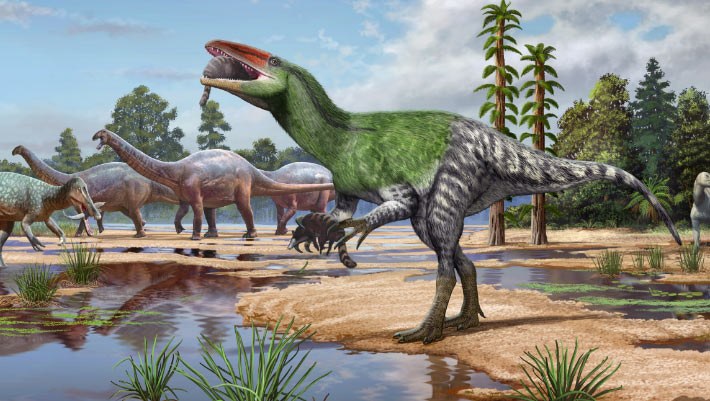
New Species of Predatory Dinosaur Identified in UK
Une nouvelle espèce de dinosaure prédateur identifiée au Royaume-Uni
musée Royaume-Uni Dinosauria Invictibellatrix Megaraptora nouvelle espèce
355 Une boîte crânienne fossilisée, conservée pendant un siècle dans les collections du Muséum d’histoire naturelle de Londres, a été identifiée comme appartenant au premier dinosaure mégaraptorien découvert en Europe – une lignée que l’on pensait jusqu’alors avoir principalement prospéré dans l’hémisphère sud. L’article « Une nouvelle espèce de dinosaure prédateur identifiée au Royaume-Uni » est paru initialement sur Sci.News : Actualités scientifiques.
14/10/2026 sci-news ⚙ Traduction automatique
Un fossile oublié révèle un redoutable dinosaure aux griffes géantes
griffe prédateur musée fossile Dinosauria Megaraptora
Un fossile vieux de 120 millions d'années oublié dans un musée depuis près d'un siècle a révélé un nouveau dinosaure terrifiant qui aurait pu être plus dangereux pour les humains qu'un T. rex. Ce prédateur de la taille d'un tigre fournit également la première preuve de la présence de mégaraptorans en Europe, aidant à expliquer comment ces mystérieux dinosaures sont finalement devenus de gigantesques chasseurs.
14/10/2026 sciencedaily ⚙ Traduction automatique
Commémoration de la Journée nationale des fossiles 2026 – Découvertes étonnantes du passé préhistorique de la Terre !
musée États-Unis fossile Dinosauria
Aujourd'hui (mercredi 14 octobre), Everything Dinosaur se joint aux passionnés de fossiles, aux scientifiques et aux musées pour célébrer la Journée nationale des fossiles 2026. Cet événement annuel organisé par les États-Unis souligne l'importance des fossiles et les informations remarquables qu'ils fournissent sur l'histoire de la vie sur Terre. Créée en 2010 par le National Park Service des États-Unis, la Journée nationale des fossiles encourage les gens
14/10/2026 everythingdinosaur ⚙ Traduction automatique
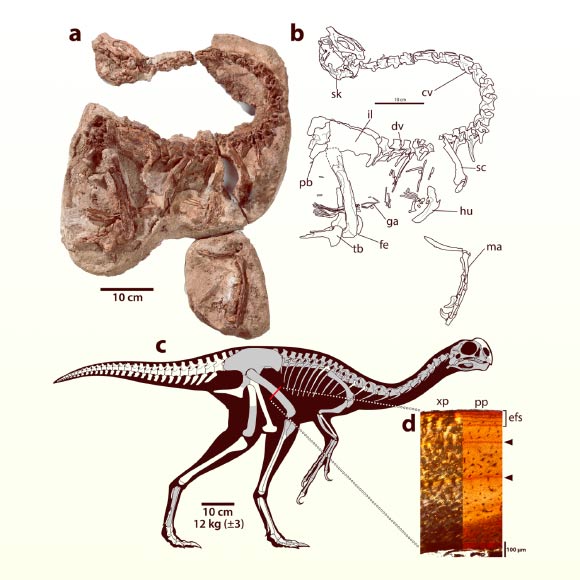
Small, Chicken-Like Dinosaur May Have Had a Jaw Built for Fruit
Un petit dinosaure ressemblant à un poulet aurait pu avoir une mâchoire construite pour les fruits
fossile Dinosauria Oviraptorosauria
Les fossiles du Montana montrent un petit oviraptorosaure avec une mâchoire qui glissait d'avant en arrière, une caractéristique partagée par les perroquets frugivores. L'article Un petit dinosaure ressemblant à un poulet aurait pu avoir une mâchoire construite pour les fruits est apparu en premier sur Sci.News : Breaking Science News.
13/10/2026 sci-news ⚙ Traduction automatique
La découverte d'un dinosaure vieux de 210 millions d'années révèle un monde perdu en Afrique
Zimbabwe Dinosauria découverte évolution
Un dinosaure âgé de 210 millions d'années récemment identifié au Zimbabwe aide les scientifiques à découvrir un écosystème préhistorique étonnamment distinct. La découverte suggère que d’anciennes différences climatiques pourraient avoir séparé les populations de dinosaures à travers l’Afrique australe, conduisant à des espèces uniques qui remettent en question les hypothèses antérieures sur leur évolution.
13/10/2026 sciencedaily ⚙ Traduction automatique
1 2 3 4 5 6 7 8 9 10 11 12 13 14 15 16 17 18 19 20 21 22 23 24 25 26 27 28 29 30 31 32 33 34 35 36 37 38 39 40 41 42 43 44 45 46 47 48 49 50 51 52 53 54 55 56 57 58 59 60 61 62 63 64