←

Dinosauria

Taxon

300 image(s) · 313 News

View page

Image gallery

Map of the localities in the Bauru Basin where the sauropod dinosaurs were collected.
Taxa Ibirania

Map of the localities in the Bauru Basin where the sauropod dinosaurs were collected.

Dinosauria Ibirania
Brontotholus is a relatively large pachycephalosaurian dinosaur. Like all pachycephalosaurs, it was bipedal and sported the characteristic bony dome on top of its skull. Brontotholus grew to nearly 4 m in length, making it one of the largest known pachycephalosaurs, and the largest from the Campanian age.
Taxa Brontotholus

Brontotholus is a relatively large pachycephalosaurian dinosaur. Like all pachycephalosaurs, it was bipedal and sported the characteristic bony dome on top of its skull. Brontotholus grew to nearly 4 m in length, making it one of the largest known pachycephalosaurs, and the largest from the Campanian age.

Campanian Brontotholus Dinosauria Pachycephalosauria +1
Fossil samples – e.g. ‘primitive’ bony fish (1, 2), a skull of a temnospondyl ‘amphibian’ (probably a metoposauroid) in dorsal view (3), a skull of an archosaur of the crocodile lineage (probably a phytosaur) in palatal view (4), holotype of the “gliding reptile” Icarosaurus siefkeri [1] (5) and Atreipus-Grallator-type dinosaur tracks (bottom right) – from the Newark Supergroup, i.e. a series of mainly Late Triassic to Early Jurassic sedimentary rocks of eastern North America


↑ Edwin H. Colbert: A gliding reptile from the Triassic of New Jersey. American Museum Novitates, 2230. American Museum of Natural History, New York 1966, digitallibrary.amnh.org, cf. fig. 3 therein.
Taxa Atreipus

Fossil samples – e.g. ‘primitive’ bony fish (1, 2), a skull of a temnospondyl ‘amphibian’ (probably a metoposauroid) in dorsal view (3), a skull of an archosaur of the crocodile lineage (probably a phytosaur) in palatal view (4), holotype of the “gliding reptile” Icarosaurus siefkeri [1] (5) and Atreipus-Grallator-type dinosaur tracks (bottom right) – from the Newark Supergroup, i.e. a series of mainly Late Triassic to Early Jurassic sedimentary rocks of eastern North America ↑ Edwin H. Colbert: A gliding reptile from the Triassic of New Jersey. American Museum Novitates, 2230. American Museum of Natural History, New York 1966, digitallibrary.amnh.org, cf. fig. 3 therein.

museum Early Jurassic Jurassic Late Triassic +9
Fossil of Pinacosaurus, an ankylosaurian  dinosaur
Took the photo at Musee d'Histoire Naturelle, Brussels

Fossil of Pinacosaurus, an ankylosaurian dinosaur Took the photo at Musee d'Histoire Naturelle, Brussels

fossil Ankylosauria Dinosauria Eopinacosaurus +1
Fossil of Pinacosaurus, an ankylosaurid dinosaur
Took the photo at Musee d'Histoire Naturelle, Brussels

Fossil of Pinacosaurus, an ankylosaurid dinosaur Took the photo at Musee d'Histoire Naturelle, Brussels

fossil Ankylosauridae Dinosauria Eopinacosaurus +1
Eopinacosaurus is an ankylosaurid dinosaur that was originally assigned to Pinacosaurus, until a 2026 analysis reassigned it as a distinct genus. Like all ankylosaurs, it was a heavily armored quadrupedal herbivore. Notable defensive adaptations include the characteristic tail club, as well as sizable horns protruding backward from the head.

Eopinacosaurus is an ankylosaurid dinosaur that was originally assigned to Pinacosaurus, until a 2026 analysis reassigned it as a distinct genus. Like all ankylosaurs, it was a heavily armored quadrupedal herbivore. Notable defensive adaptations include the characteristic tail club, as well as sizable horns protruding backward from the head.

Ankylosauria Ankylosauridae Dinosauria Eopinacosaurus +1
Norellraptor is a microraptorian dinosaur known from a specimen with exceptionally well-preserved feathers. Its discovery supports evidence that gliding and flight-related traits evolved independently in multiple dinosaur groups. Norellraptor had long feathers on its arms and legs, typical of microraptorians, resulting in a four-winged body plan.

Norellraptor is a microraptorian dinosaur known from a specimen with exceptionally well-preserved feathers. Its discovery supports evidence that gliding and flight-related traits evolved independently in multiple dinosaur groups. Norellraptor had long feathers on its arms and legs, typical of microraptorians, resulting in a four-winged body plan.

feather flight specimen Dinosauria +2
Kayrasaurus is a therizinosaurian dinosaur that lived during the Early Cretaceous period in what is now China. At an estimated 3.6 m in total body length, it is the largest therizinosaur known from the Jehol Biota. Like other therizinosaurs, Kayrasaurus was a bipedal herbivore with large curved claws on each hand.

Kayrasaurus is a therizinosaurian dinosaur that lived during the Early Cretaceous period in what is now China. At an estimated 3.6 m in total body length, it is the largest therizinosaur known from the Jehol Biota. Like other therizinosaurs, Kayrasaurus was a bipedal herbivore with large curved claws on each hand.

claw China Cretaceous Early Cretaceous +2
Muttaburrasaurus
The plants, animals and climate of the Australian continent have changed dramatically over long periods of time. Imagine this giant creature roaming the luxuriant wet forests that covered parts of the continent in the Cretaceous period, about 100-110 million years ago. The Muttaburrasaurus ambled along on all four legs or stood on its hind legs. Its large teeth were well adapted to eat tough vegetation such as the leathery foliage of the evergreen forests of Araucaria trees, ancient relatives of the bunya pine of south-eastern Queensland.
In 1963, grazier Doug Langdon discovered the fossilised bones of a dinosaur on his property near Muttaburra in central-west Queensland. It was one of the most complete dinosaur skeletons found in Australia. The bones belonged to a new species of ornithopod and palaeontologists named it Muttaburrasaurus langdoni.

Cast of Muttaburresaurus langdoni 1987 made by Queensland Museum, Brisbane National Museum of Australia
Taxa Muttaburrasaurus

Muttaburrasaurus The plants, animals and climate of the Australian continent have changed dramatically over long periods of time. Imagine this giant creature roaming the luxuriant wet forests that covered parts of the continent in the Cretaceous period, about 100-110 million years ago. The Muttaburrasaurus ambled along on all four legs or stood on its hind legs. Its large teeth were well adapted to eat tough vegetation such as the leathery foliage of the evergreen forests of Araucaria trees, ancient relatives of the bunya pine of south-eastern Queensland. In 1963, grazier Doug Langdon discovered the fossilised bones of a dinosaur on his property near Muttaburra in central-west Queensland. It was one of the most complete dinosaur skeletons found in Australia. The bones belonged to a new species of ornithopod and palaeontologists named it Muttaburrasaurus langdoni. Cast of Muttaburresaurus langdoni 1987 made by Queensland Museum, Brisbane National Museum of Australia

bone museum Australia Cretaceous +5
Montanoceratops cerorhynchus (Brown & Schlaikjer, 1942) - fossil ceratopsian dinosaur skeleton from the Cretaceous of Montana, USA. (MOR 542, Museum of the Rockies, Bozeman, Montana, USA)
The species name is sometimes incorrectly spelled "cerorhynchos".  The original publication spells it "cerorhynchus".  The genus name is sometimes incorrectly spelled "Montanaceratops".
Ceratopsians are the "horned dinosaurs".  They were large, quadrupedal, herbivorous dinosaurs having a beaked skull and a frill - an extension of bone behind the skull that partially covered the neck.  Ceratopsian dinosaurs are known from the Jurassic and Cretaceous.  The last members of the group died out at the Cretaceous-Tertiary boundary, 65 million years ago.
This is a partial skeleton of a juvenile Montanoceratops, a ceratopsian from the near-latest Cretaceous of western North America.  This type of ceratopsian lacked facial horns.


From exhibit signage:
Sixty-eight million years ago, when the horned dinosaurs Triceratops and Torosaurus inhabited the coastal plain near the inland ocean, primitive "horned" dinosaurs named Montanoceratops lived in uplands near the young Rocky Mountains.  These little protoceratopsians fed on plants with slicing teeth and narrow beaks similar to their giant three-horned relatives.


Classification: Animalia, Chordata, Vertebrata, Reptilia, Archosauria, Dinosauria, Ornithischia, Marginocephalia, Ceratopsia, Leptoceratopsidae
Stratigraphy: St. Mary River Formation, Maastrichtian Stage, Upper Cretaceous
Locality: Little Rocky Coulee, north of the town of Cut Bank, eastern Glacier County, northwestern Montana, USA


Info. at:

en.wikipedia.org/wiki/Montanoceratops
Taxa Montanoceratops

Montanoceratops cerorhynchus (Brown & Schlaikjer, 1942) - fossil ceratopsian dinosaur skeleton from the Cretaceous of Montana, USA. (MOR 542, Museum of the Rockies, Bozeman, Montana, USA) The species name is sometimes incorrectly spelled "cerorhynchos". The original publication spells it "cerorhynchus". The genus name is sometimes incorrectly spelled "Montanaceratops". Ceratopsians are the "horned dinosaurs". They were large, quadrupedal, herbivorous dinosaurs having a beaked skull and a frill - an extension of bone behind the skull that partially covered the neck. Ceratopsian dinosaurs are known from the Jurassic and Cretaceous. The last members of the group died out at the Cretaceous-Tertiary boundary, 65 million years ago. This is a partial skeleton of a juvenile Montanoceratops, a ceratopsian from the near-latest Cretaceous of western North America. This type of ceratopsian lacked facial horns. From exhibit signage: Sixty-eight million years ago, when the horned dinosaurs Triceratops and Torosaurus inhabited the coastal plain near the inland ocean, primitive "horned" dinosaurs named Montanoceratops lived in uplands near the young Rocky Mountains. These little protoceratopsians fed on plants with slicing teeth and narrow beaks similar to their giant three-horned relatives. Classification: Animalia, Chordata, Vertebrata, Reptilia, Archosauria, Dinosauria, Ornithischia, Marginocephalia, Ceratopsia, Leptoceratopsidae Stratigraphy: St. Mary River Formation, Maastrichtian Stage, Upper Cretaceous Locality: Little Rocky Coulee, north of the town of Cut Bank, eastern Glacier County, northwestern Montana, USA Info. at: en.wikipedia.org/wiki/Montanoceratops

bone museum United States Cretaceous +17
14365- dinosaur 4155
Taxa Alioramus

14365- dinosaur 4155

Alioramus Dinosauria communication
Wyoming Dinosaur Center
Taxa Mymoorapelta

Wyoming Dinosaur Center

Dinosauria Mymoorapelta
Skeleton identified as Nemegtomaia by Greg Funston.[1] Central Museum of Mongolian Dinosaurs, Ulaanbaatar. Complete indexed photo collection at WorldHistoryPics.com.
Taxa Nemegtomaia

Skeleton identified as Nemegtomaia by Greg Funston.[1] Central Museum of Mongolian Dinosaurs, Ulaanbaatar. Complete indexed photo collection at WorldHistoryPics.com.

museum Dinosauria Nemegtomaia skeleton
Leaellynasaura amicagraphica, dinosaur, skull. Holotype. [P 185991]
Taxa Leaellynasaura

Leaellynasaura amicagraphica, dinosaur, skull. Holotype. [P 185991]

museum holotype Dinosauria Leaellynasaura +1
Fossil specimen RTMP 82.19.23 - A lacrimal, postorbitals, squamosals, frontals, parietals, and braincase referred to Latenivenatrix mcmasterae, but formerly assigned to Stenonychosaurus inequalis (=Troodon inequalis). Described by 

Currie, 1985. "Cranial anatomy of Stenonychosaurus inequalis (Saurischia, Theropoda) and its bearing on the origin of birds." Canadian Journal of Earth Sciences, 22(1), 643-658.
5d-dinosaur-camp-day2-20120802-15.jpg
Taxa Latenivenatrix

Fossil specimen RTMP 82.19.23 - A lacrimal, postorbitals, squamosals, frontals, parietals, and braincase referred to Latenivenatrix mcmasterae, but formerly assigned to Stenonychosaurus inequalis (=Troodon inequalis). Described by Currie, 1985. "Cranial anatomy of Stenonychosaurus inequalis (Saurischia, Theropoda) and its bearing on the origin of birds." Canadian Journal of Earth Sciences, 22(1), 643-658. 5d-dinosaur-camp-day2-20120802-15.jpg

Canada fossil specimen Dinosauria +7
Pelvis (fused ilia and pubes) of UALVP 48778, holotype of Hesperonychus elizabethae, from the late Campanian Dinosaur Park Formation of Alberta, Canada. Fossil collected by Dr. Elizabeth Nicholls. Prepared by Clive Coy. Digital photography by Nick Longrich. Additional digital editing by Nick Longrich.
Taxa Hesperonychus

Pelvis (fused ilia and pubes) of UALVP 48778, holotype of Hesperonychus elizabethae, from the late Campanian Dinosaur Park Formation of Alberta, Canada. Fossil collected by Dr. Elizabeth Nicholls. Prepared by Clive Coy. Digital photography by Nick Longrich. Additional digital editing by Nick Longrich.

pelvis Canada Dinosaur Park Campanian +6
1 2 3 4 5 6 7 8 9 10 11 12 13 14 15 16 17 18 19

News

New CollectA Prehistoric Animal Models for 2027 (Part 3)
scale Dinosauria
Everything Dinosaur in collaboration with our friends at CollectA announce another new prehistoric animal figure for 2027.  A 1:10 scale Thylacoleo carnifex model will be introduced next year.  We estimate that this new "marsupial lion" figure is around fifteen centimetres in length.  The images (below) show the prototype, we think that the production model will
20/11/2026 everythingdinosaur
Exclusive Cyberzoic Jungle Saber Box Set – Only 500 Made!
United Kingdom Dinosauria
Everything Dinosaur is delighted to announce an exciting opportunity for collectors in the UK and Europe. The exclusive Cyberzoic Jungle Saber Box Set, created by Creative Beast Studio for MOTUFest 2026, can now be reserved through Everything Dinosaur. The Exclusive Cyberzoic Jungle Saber Box Set from Creative Beast Studio. Only 500 of these
19/11/2026 everythingdinosaur
This strange creature lived 309 million years ago, long before the dinosaurs
museum Dinosauria evolution
More than 300 million years ago, long before dinosaurs roamed Earth, the Chicago area was a steamy, swampy landscape teeming with bizarre creatures. Now, scientists at the Field Museum have identified a previously unrecognized species of ancient amphibian ancestor, revealing new clues about the evolution of frogs and salamanders.
18/11/2026 sciencedaily
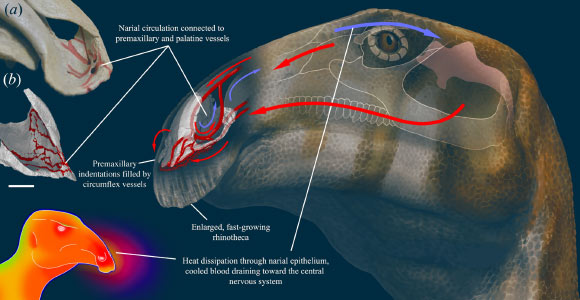
Duck-Billed Dinosaur’s Beak was as Complex as Bird’s
tooth Italy Canardia Dinosauria Tethyshadros bird
Tethyshadros insularis, an island-dwelling duck-billed dinosaur that lived 81 million years ago in what is now Italy, did not have a comb of tooth-like spikes at the tip of its snout, according to a new analysis. The post Duck-Billed Dinosaur’s Beak was as Complex as Bird’s appeared first on Sci.News: Breaking Science News.
18/11/2026 sci-news
Dinosaures : des traces de sang fossilisées agitent la communauté paléontologique
Dinosaurs: fossilized traces of blood agitate the paleontological community
fossil Dinosauria discovery
An international team claims to have identified, for the first time formally, traces of mineralized red blood cells in a 115 million year old dinosaur fossil. If this discovery is confirmed, the science of animals extinct since time immemorial could well experience a small revolution.
18/11/2026 sciencesetavenir ⚙ Auto-translated
1 2 3 4 5 6 7 8 9 10 11 12 13 14 15 16 17 18 19 20 21 22 23 24 25 26 27 28 29 30 31 32 33 34 35 36 37 38 39 40 41 42 43 44 45 46 47 48 49 50 51 52 53 54 55 56 57 58 59 60 61 62 63