←

Dinosauria

Taxon

300 image(s) · 313 News

View page

Image gallery

Sarcosaurus diagram of known material: reconstruction based on basal Ceratosaurs (such as Berberosaurus and Saltriovenator). The Skull was made to look more generic and less like more derived Ceratosaurs such as Ceratosaurus. "Liassaurus", referred to "cf. Sarcosaurus woodi" and is smaller than the holotype: material in light grey is preserved, but to what extent is uncertain as it is not figured.
References:
Carrano and Sampson (2004). "A review of coelophysoids (Dinosauria: Theropoda) from the Early Jurassic of Europe, with comments on the late history of the Coelophysoidea." N. Jb. Geol. Palaont. Mh., 2004(9): 537-558. (for figures of the material)
theropoddatabase.com/Coelophysoidea.htm#Sarcosauruswoodi (for measurements of "Liassaurus")

Allain, Ronan & Tykoski, Ronald & Aquesbi, Najat & Jalil, Nour-Eddine & Monbaron, Michel & Russell, Dale & Taquet, Philippe. (2007). An abelisauroid (Dinosauria: Theropoda) from the Early Jurassic of the High Atlas Mountains, Morocco, and the radiation of Ceratosaurs. Journal of Vertebrate Paleontology. 27. 10.1671/0272-4634(2007)27[610:AADTFT]2.0.CO;2. (for measurements for Berberosaurus)
Taxa Sarcosaurus

Sarcosaurus diagram of known material: reconstruction based on basal Ceratosaurs (such as Berberosaurus and Saltriovenator). The Skull was made to look more generic and less like more derived Ceratosaurs such as Ceratosaurus. "Liassaurus", referred to "cf. Sarcosaurus woodi" and is smaller than the holotype: material in light grey is preserved, but to what extent is uncertain as it is not figured. References: Carrano and Sampson (2004). "A review of coelophysoids (Dinosauria: Theropoda) from the Early Jurassic of Europe, with comments on the late history of the Coelophysoidea." N. Jb. Geol. Palaont. Mh., 2004(9): 537-558. (for figures of the material) theropoddatabase.com/Coelophysoidea.htm#Sarcosauruswoodi (for measurements of "Liassaurus") Allain, Ronan & Tykoski, Ronald & Aquesbi, Najat & Jalil, Nour-Eddine & Monbaron, Michel & Russell, Dale & Taquet, Philippe. (2007). An abelisauroid (Dinosauria: Theropoda) from the Early Jurassic of the High Atlas Mountains, Morocco, and the radiation of Ceratosaurs. Journal of Vertebrate Paleontology. 27. 10.1671/0272-4634(2007)27[610:AADTFT]2.0.CO;2. (for measurements for Berberosaurus)

Morocco Early Jurassic Jurassic holotype +8
Diamantinasaurus matildae gen. et sp. nov. (AODF 603)
A. Right side
B. Left side
(both silhouettes with sketched in bone parts of the material currently known at publishing date; scale bars: 5 x 5 = 25 m; complemented with height data here)
Taxa Diamantinasaurus

Diamantinasaurus matildae gen. et sp. nov. (AODF 603) A. Right side B. Left side (both silhouettes with sketched in bone parts of the material currently known at publishing date; scale bars: 5 x 5 = 25 m; complemented with height data here)

bone scale museum Diamantinasauria +1
* Wintonotitan wattsi gen. et sp. nov. (QMF 7292)
(Silhouette with sketched in bone parts of the material currently known at publishing date; scale bar: size unknown — not mentioned in original source)
Taxa Wintonotitan

* Wintonotitan wattsi gen. et sp. nov. (QMF 7292) (Silhouette with sketched in bone parts of the material currently known at publishing date; scale bar: size unknown — not mentioned in original source)

bone scale museum Dinosauria +1
Restoration of Asiaceratops salsopaludalis a ceratopsian dinosaur from the Late Cretaceous of Uzbekistan
Taxa Asiaceratops

Restoration of Asiaceratops salsopaludalis a ceratopsian dinosaur from the Late Cretaceous of Uzbekistan

Uzbekistan Cretaceous Late Cretaceous Asiaceratops +2
Skeletal reconstructions of Dinosaur Park Formation caenagnathids. Skeletal reconstructions of Citipes elegans (left), Chirostenotes pergracilis (middle), and Caenagnathus collinsi (right), showing variation in skeletal representation and body size. Previously referred material is indicated in white and newly referred material is indicated in red for each taxon. Blue asterisks indicate elements that have been histologically sampled for each taxon. Citipes elegans: dentaries, metatarsal IV; Chirostenotes pergracilis: dentaries, tibia; Caenagnathus collinsi: pubis.
Taxa Caenagnathus

Skeletal reconstructions of Dinosaur Park Formation caenagnathids. Skeletal reconstructions of Citipes elegans (left), Chirostenotes pergracilis (middle), and Caenagnathus collinsi (right), showing variation in skeletal representation and body size. Previously referred material is indicated in white and newly referred material is indicated in red for each taxon. Blue asterisks indicate elements that have been histologically sampled for each taxon. Citipes elegans: dentaries, metatarsal IV; Chirostenotes pergracilis: dentaries, tibia; Caenagnathus collinsi: pubis.

Dinosaur Park Caenagnathidae Caenagnathus Chirostenotes +3
Megapnosaurus is a coelophysid theropod dinosaur from the Early Jurassic Period of Africa. It was a lightly built bipedal carnivore that grew to just over 2 m long and 13 kg in body mass. Its close relation to Coelophysis has caused some confusion in classifying the genus - it had a slender build and curved S-shaped neck, but was more robust. Comparisons between the scleral rings of Megapnosaurus and modern birds and reptiles indicate that it may have been nocturnal.
Taxa Megapnosaurus

Megapnosaurus is a coelophysid theropod dinosaur from the Early Jurassic Period of Africa. It was a lightly built bipedal carnivore that grew to just over 2 m long and 13 kg in body mass. Its close relation to Coelophysis has caused some confusion in classifying the genus - it had a slender build and curved S-shaped neck, but was more robust. Comparisons between the scleral rings of Megapnosaurus and modern birds and reptiles indicate that it may have been nocturnal.

Early Jurassic Jurassic Coelophysidae Coelophysis +3
The nodosaurid dinosaur, Glyptodontopelta is mostly known from isolated osteoderms ("armor plates"). The specimen SMP VP-1580 (State Museum of Pennysylvania) is however, the most complete known specimen, comprising parts of the skull, hundreds of osteoderms and fragments. This specimen was discovered in 2003 by Warwick Fowler, in the Naashoibito Member of the Ojo Alamo Formation (Maatrichtian, Late Cretaceous) of the San Juan Basin, New Mexico, during an expedition led by Dr. Robert Sullivan.
Taxa Glyptodontopelta

The nodosaurid dinosaur, Glyptodontopelta is mostly known from isolated osteoderms ("armor plates"). The specimen SMP VP-1580 (State Museum of Pennysylvania) is however, the most complete known specimen, comprising parts of the skull, hundreds of osteoderms and fragments. This specimen was discovered in 2003 by Warwick Fowler, in the Naashoibito Member of the Ojo Alamo Formation (Maatrichtian, Late Cretaceous) of the San Juan Basin, New Mexico, during an expedition led by Dr. Robert Sullivan.

armor museum Mexico Denver +9
Tracks of the dinosaur Pseudotetrasauropus bipedoida.
Taxa Pseudotetrasauropus

Tracks of the dinosaur Pseudotetrasauropus bipedoida.

tracks Dinosauria Pseudotetrasauropus
Struthiomimus altus complete reconstruction in the Rocky Mountain Dinosaur Resource Center, Woodland Park, Colorado
Taxa Struthiomimus

Struthiomimus altus complete reconstruction in the Rocky Mountain Dinosaur Resource Center, Woodland Park, Colorado

Dinosauria Struthiomimus
Drawing of lectoholotype skull BMNH R.3386 (desigated by Weishampel et al., 1993)[1][2] of Limnosaurus transsylvanicus NOPCSA 1900 (later renamed Telmatosaurus transsylvanicus), a basal hadrosaurid dinosaur from the Late Maastrichtian (latest Upper Cretaceous) Sanpetru Formation of West Central Romania.
Taxa Telmatosaurus

Drawing of lectoholotype skull BMNH R.3386 (desigated by Weishampel et al., 1993)[1][2] of Limnosaurus transsylvanicus NOPCSA 1900 (later renamed Telmatosaurus transsylvanicus), a basal hadrosaurid dinosaur from the Late Maastrichtian (latest Upper Cretaceous) Sanpetru Formation of West Central Romania.

drawing Romania Cretaceous Maastrichtian +6
Magnoavipes sp. - dinosaur track from the Cretaceous of Colorado, USA. (replica; public display, Red Rocks Amphitheater visitor center, west of Denver, Colorado, USA)
Dinosaur Ridge, Colorado has numerous dinosaur fossils, including bones and tracks.  The most common track type at the site is Caririchnium leonardii, which was made by an iguanodontid dinosaur.  A less common track is this - a slender, three-toed print called Magnoavipes, which was made by a theropod dinosaur.
Stratigraphy: Dakota Sandstone, upper Lower Cretaceous

Provenance: eastern side of Dinosaur Ridge, Dakota Hogback, west of Denver, north-central Colorado, USA
Taxa Magnoavipes

Magnoavipes sp. - dinosaur track from the Cretaceous of Colorado, USA. (replica; public display, Red Rocks Amphitheater visitor center, west of Denver, Colorado, USA) Dinosaur Ridge, Colorado has numerous dinosaur fossils, including bones and tracks. The most common track type at the site is Caririchnium leonardii, which was made by an iguanodontid dinosaur. A less common track is this - a slender, three-toed print called Magnoavipes, which was made by a theropod dinosaur. Stratigraphy: Dakota Sandstone, upper Lower Cretaceous Provenance: eastern side of Dinosaur Ridge, Dakota Hogback, west of Denver, north-central Colorado, USA

bone United States Denver Cretaceous +7
Otozoum tracks in the Dinosaur State Park and Arboretum, Rocky Hill, Connecticut, USA. The exhibit sign reads: "These large negative tracks were made by a heavy animal that walked on four toes and had a short stride. It may have been a prosauropod. All of these tracks have rare skin impressions. This specimen was removed from the Portland Quarry in 1896. Donated by Wesleyan University."
Taxa Otozoum

Otozoum tracks in the Dinosaur State Park and Arboretum, Rocky Hill, Connecticut, USA. The exhibit sign reads: "These large negative tracks were made by a heavy animal that walked on four toes and had a short stride. It may have been a prosauropod. All of these tracks have rare skin impressions. This specimen was removed from the Portland Quarry in 1896. Donated by Wesleyan University."

skin United States Portland specimen +3
Halisaurus mosasaur, Wyoming Dinosaur Center, Thermopolis / 2006
Taxa Halisaurus

Halisaurus mosasaur, Wyoming Dinosaur Center, Thermopolis / 2006

United States Dinosauria Halisaurus
Cetiosaurus oxoniensis, "Rutland Dinosaur". New Walk Museum, Leicester. Tuesday, 17 July, 2012
Taxa Cetiosaurus

Cetiosaurus oxoniensis, "Rutland Dinosaur". New Walk Museum, Leicester. Tuesday, 17 July, 2012

museum United Kingdom Cetiosauria Dinosauria
Fossil bone of Procerosaurus exogyrarum, possible dinosaur from the Czech Republic. National Museum, Prague (2007).
Taxa Ponerosteus

Fossil bone of Procerosaurus exogyrarum, possible dinosaur from the Czech Republic. National Museum, Prague (2007).

bone museum Czech Republic fossil +3
Fossil of Pinacosaurus, an ankylosaurian  dinosaur
Took the photo at Musee d'Histoire Naturelle, Brussels
Taxa Eopinacosaurus

Fossil of Pinacosaurus, an ankylosaurian dinosaur Took the photo at Musee d'Histoire Naturelle, Brussels

fossil Ankylosauria Dinosauria Pinacosaurus
1 2 3 4 5 6 7 8 9 10 11 12 13 14 15 16 17 18 19

News

New CollectA Prehistoric Animal Models for 2027 (Part 3)
scale Dinosauria
Everything Dinosaur in collaboration with our friends at CollectA announce another new prehistoric animal figure for 2027.  A 1:10 scale Thylacoleo carnifex model will be introduced next year.  We estimate that this new "marsupial lion" figure is around fifteen centimetres in length.  The images (below) show the prototype, we think that the production model will
20/11/2026 everythingdinosaur
Exclusive Cyberzoic Jungle Saber Box Set – Only 500 Made!
United Kingdom Dinosauria
Everything Dinosaur is delighted to announce an exciting opportunity for collectors in the UK and Europe. The exclusive Cyberzoic Jungle Saber Box Set, created by Creative Beast Studio for MOTUFest 2026, can now be reserved through Everything Dinosaur. The Exclusive Cyberzoic Jungle Saber Box Set from Creative Beast Studio. Only 500 of these
19/11/2026 everythingdinosaur
This strange creature lived 309 million years ago, long before the dinosaurs
museum Dinosauria evolution
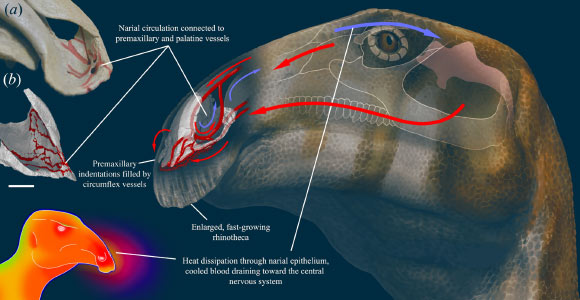
More than 300 million years ago, long before dinosaurs roamed Earth, the Chicago area was a steamy, swampy landscape teeming with bizarre creatures. Now, scientists at the Field Museum have identified a previously unrecognized species of ancient amphibian ancestor, revealing new clues about the evolution of frogs and salamanders.
18/11/2026 sciencedaily
Duck-Billed Dinosaur’s Beak was as Complex as Bird’s
tooth Italy Canardia Dinosauria Tethyshadros bird
Tethyshadros insularis, an island-dwelling duck-billed dinosaur that lived 81 million years ago in what is now Italy, did not have a comb of tooth-like spikes at the tip of its snout, according to a new analysis. The post Duck-Billed Dinosaur’s Beak was as Complex as Bird’s appeared first on Sci.News: Breaking Science News.
18/11/2026 sci-news
Dinosaures : des traces de sang fossilisées agitent la communauté paléontologique
Dinosaurs: fossilized traces of blood agitate the paleontological community
fossil Dinosauria discovery
An international team claims to have identified, for the first time formally, traces of mineralized red blood cells in a 115 million year old dinosaur fossil. If this discovery is confirmed, the science of animals extinct since time immemorial could well experience a small revolution.
18/11/2026 sciencesetavenir ⚙ Auto-translated
1 2 3 4 5 6 7 8 9 10 11 12 13 14 15 16 17 18 19 20 21 22 23 24 25 26 27 28 29 30 31 32 33 34 35 36 37 38 39 40 41 42 43 44 45 46 47 48 49 50 51 52 53 54 55 56 57 58 59 60 61 62 63