413 image(s) · 21 Actualités
Fossil of Santanadactylus pricei and Anhanguera santanae, an extinct pterosaur- Took the photo at Senckenberg Museum of Frankfurt
Lonchodraco giganteus comb. n. Lectotype NHMUK PV 39412 (Cenomanian / Turonian, Chalk Formation). A–F articulated anterior parts of the rostrum and mandible A right lateral view B respective line drawing C left lateral view D respective line drawing E anterior view F respective line drawing G associated scapulocoracoid in posterior view. Abbreviations: ch – choanae, cor – coracoid, d – dentary, dcr – dentary crest, m – maxillae, pl – palatine, pm – premaxillae, pmcr – premaxillaery crest, prid – palatal ridge, sca – scapula. Arrows indicate alveoli or teeth. Scale bar = 10 mm. Photos courtesy of The Natural History Museum.
Fossil specimen (IVPP V17903) of Corpulentapus lilasia on display at the Paleozoological Museum of China.
The Natural Science Museum at El Chocón, in the northwestern Argentine Patagonia (the Comahue region). Fossil of dinosaur
Anhui Geological Museum, Hefei. Complete indexed photo collection at WorldHistoryPics.com.
Caudipteryx zoui, Skelett - Untere Kreide - Liaoning/China - aufgenommen im Museum am Löwentor, Stuttgart
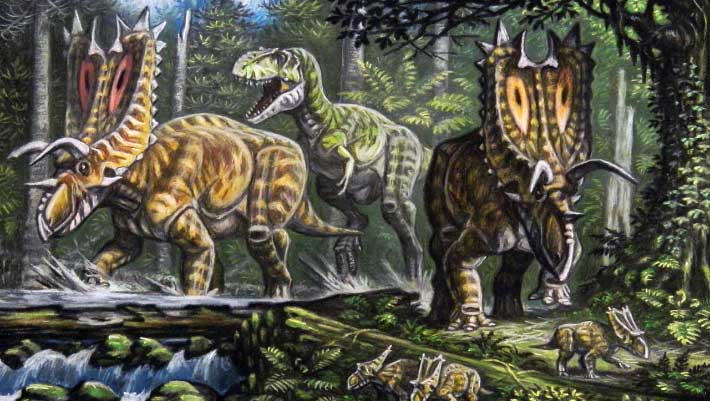
Achelousaurus horneri skull, collected in Glacier County, Montana, at the Museum of the Rockies in Bozeman, Montana. The Ceratopsidae are those dinosaurs with head frills. There are three large subgroups of Ceratopsidae: Centrosaurinae, Ceratopsinae, and Chasmosaurinae. The Triceratopsini are a "tribe" of the Chasmosaurinae -- a genus so vast that it gets the special name "tribe". The Pachyrhinosaurini are a "tribe" within the Centrosaurinae. Achelousaurus is a genus within the Pachyrhinosaurini. So far, only three skulls and some limited skeletal remains have been collected anywhere in the world -- and all of them in Montana. Their bony frills are quite similar to the Styracosaurus albertensis, although their other skull features (such as big bony bosses on the nose and behind the eyes) are not.
Skull cast of Liaoceratops yanzigouensis on display at the Baoding Natural History Museum.