←

musée

Type de contenu

415 image(s) · 34 Actualités

Galerie d'images

Skull of Globidens dakotensis in the Field Museum of Natural History.
Taxons Globidensini

Skull of Globidens dakotensis in the Field Museum of Natural History.

musée Globidens Globidensini crâne
Megaloolithus at the Museum d'Histoire Naturelle Aix-en-Provence. Eggs of titanosaurid, possibly Hypselosaurus priscus.
Taxons Megaloolithus

Megaloolithus at the Museum d'Histoire Naturelle Aix-en-Provence. Eggs of titanosaurid, possibly Hypselosaurus priscus.

musée Hypselosaurus Megaloolithus Titanosauridae
Elangatoolithidae fossil dinosaur eggs, from China. Exhibit in the Academy of Natural Sciences, 1900 Benjamin Franklin Parkway, Philadelphia, Pennsylvania, USA. Photography was permitted in this area of the museum without restrictions.
Taxons Elongatoolithidae

Elangatoolithidae fossil dinosaur eggs, from China. Exhibit in the Academy of Natural Sciences, 1900 Benjamin Franklin Parkway, Philadelphia, Pennsylvania, USA. Photography was permitted in this area of the museum without restrictions.

musée Chine États-Unis fossile +2
Fossil specimen of Ornithomimus sp. (TMP 1995.110.1), Royal Tyrrell Museum. This specimen was recovered from the middle Dinosaur Park Formation of Alberta, Canada.
Taxons Ornithomimidae

Fossil specimen of Ornithomimus sp. (TMP 1995.110.1), Royal Tyrrell Museum. This specimen was recovered from the middle Dinosaur Park Formation of Alberta, Canada.

musée Canada Allemagne Dinosaur Park +6
Uses https://commons.wikimedia.org/wiki/File:Dromaeosaurus_in_Canadian_Museum_of_Nature.jpg
File:Alaskan_troodont_Perot_Museum.jpg
File:Unenlagia_fossils.jpg
File:Talos_sampsoni.png
https://en.wikipedia.org/wiki/File:Velociraptor_Wyoming_Dinosaur_Center.jpg
https://en.wikipedia.org/wiki/Saurornitholestes
File:Buitreraptor-Deinonychus.jpg

File:Dakotaraptor_lateral_Wiki.jpg
Taxons Deinonychosauria

Uses https://commons.wikimedia.org/wiki/File:Dromaeosaurus_in_Canadian_Museum_of_Nature.jpg File:Alaskan_troodont_Perot_Museum.jpg File:Unenlagia_fossils.jpg File:Talos_sampsoni.png https://en.wikipedia.org/wiki/File:Velociraptor_Wyoming_Dinosaur_Center.jpg https://en.wikipedia.org/wiki/Saurornitholestes File:Buitreraptor-Deinonychus.jpg File:Dakotaraptor_lateral_Wiki.jpg

musée fossile Buitreraptor Dakotaraptor +8
Triceratops skeleton at the Smithsonian museum of Natural History
Taxons Marginocephalia

Triceratops skeleton at the Smithsonian museum of Natural History

musée Marginocephalia Triceratops squelette
Duck-billed dinosaurs at the Royal Ontario Museum. A Maiasaura skeleton is visible on the foreground, with two Maiasaura juveniles at the foot of the skeletal mount. On the background, flushing with the wall, there's the two-dimensional mount of a Gryposaurus specimen. The unidentified skull of another duck-billed dinosaur is visible on the low right corner of the photograph.
Taxons Hadrosauridae

Duck-billed dinosaurs at the Royal Ontario Museum. A Maiasaura skeleton is visible on the foreground, with two Maiasaura juveniles at the foot of the skeletal mount. On the background, flushing with the wall, there's the two-dimensional mount of a Gryposaurus specimen. The unidentified skull of another duck-billed dinosaur is visible on the low right corner of the photograph.

musée juvénile spécimen Dinosauria +5
Duck-billed dinosaurs at the Royal Ontario Museum. A Maiasaura skeleton is visible on the foreground, with two Maiasaura juveniles at the foot of the skeletal mount. On the background, flushing with the wall, there's the two-dimensional mount of a Gryposaurus specimen. The unidentified skull of another duck-billed dinosaur is visible on the low right corner of the photograph.
Taxons Hadrosauridae

Duck-billed dinosaurs at the Royal Ontario Museum. A Maiasaura skeleton is visible on the foreground, with two Maiasaura juveniles at the foot of the skeletal mount. On the background, flushing with the wall, there's the two-dimensional mount of a Gryposaurus specimen. The unidentified skull of another duck-billed dinosaur is visible on the low right corner of the photograph.

musée juvénile spécimen Dinosauria +5
Cast at Montshire Museum of Science
Taxons Eusauropoda

Cast at Montshire Museum of Science

musée moulage Eusauropoda
Banded fine-grained pyrite in shale from the Precambrian of Australia. (public display, Leadville Mining Museum, Leadville, Colorado, USA)
A mineral is a naturally-occurring, solid, inorganic, crystalline substance having a fairly definite chemical composition and having fairly definite physical properties.  At its simplest, a mineral is a naturally-occurring solid chemical.  Currently, there are over 4900 named and described minerals - about 200 of them are common and about 20 of them are very common.  Mineral classification is based on anion chemistry.  Major categories of minerals are: elements, sulfides, oxides, halides, carbonates, sulfates, phosphates, and silicates.
The sulfide minerals contain one or more sulfide anions (S-2).  The sulfides are usually considered together with the arsenide minerals, the sulfarsenide minerals, and the telluride minerals.  Many sulfides are economically significant, as they occur commonly in ores.  The metals that combine with S-2 are mainly Fe, Cu, Ni, Ag, etc.  Most sulfides have a metallic luster, are moderately soft, and are noticeably heavy for their size.  These minerals will not form in the presence of free oxygen.  Under an oxygen-rich atmosphere, sulfide minerals tend to chemically weather to various oxide and hydroxide minerals.
Pyrite is a common iron sulfide mineral (FeS2).  It’s nickname is “fool's gold”.  Pyrite has a metallic luster, brassy gold color (in contrast to the deep rich yellow gold color of true gold - www.flickr.com/photos/jsjgeology/sets/72157651325153769/), dark gray to black streak, is hard (H=6 to 6.5), has no cleavage, and is moderately heavy for its size.  It often forms cubic crystals or pyritohedrons (crystals having pentagonal faces).
Pyrite is common in many hydrothermal veins, shales, coals, various metamorphic rocks, and massive sulfide deposits.
The rock shown above consists of numerous bands of fine-grained pyrite interbedded with dark shale.  Published research has shown that the pyrite is diagenetic, formed by sulfate reduction from sulfate-bearing groundwater that moved along bedding planes of the Urquhart Shale host rocks (see Painter et al., 1999).  The sulfate source was evaporitic gypsum-anhydrite-barite in the same stratigraphic unit.
Stratigraphy: Urquhart Shale, Mount Isa Group, Mesoproterozoic, ~1655 Ma
Age of metamorphism: peak greenschist-facies metamorphism at ~1505 Ma during the Isan Orogeny
Locality: Mount Isa Mines, northwestern Queensland, northeastern Australia


Some info. from:
Kawasaki & Symons (2010) - Dating of Mesoproterozoic metamorphism in the Mount Isa and George Fisher Zn-Pb-Cu-Ag deposits, Australia, by paleomagnetism.  American Geophysical Union, Fall Meeting 2010, Abstract GP33C-0953.
Painter et al. (1999) - Sedimentologic, petrographic, and sulfur isotope constraints on fine-grained pyrite formation at Mount Isa Mine and environs, northwest Queensland, Australia.  Economic Geology 94: 883-912.


Photo gallery of pyrite:

www.mindat.org/gallery.php?min=3314
Intervalles Mesoproterozoic

Banded fine-grained pyrite in shale from the Precambrian of Australia. (public display, Leadville Mining Museum, Leadville, Colorado, USA) A mineral is a naturally-occurring, solid, inorganic, crystalline substance having a fairly definite chemical composition and having fairly definite physical properties. At its simplest, a mineral is a naturally-occurring solid chemical. Currently, there are over 4900 named and described minerals - about 200 of them are common and about 20 of them are very common. Mineral classification is based on anion chemistry. Major categories of minerals are: elements, sulfides, oxides, halides, carbonates, sulfates, phosphates, and silicates. The sulfide minerals contain one or more sulfide anions (S-2). The sulfides are usually considered together with the arsenide minerals, the sulfarsenide minerals, and the telluride minerals. Many sulfides are economically significant, as they occur commonly in ores. The metals that combine with S-2 are mainly Fe, Cu, Ni, Ag, etc. Most sulfides have a metallic luster, are moderately soft, and are noticeably heavy for their size. These minerals will not form in the presence of free oxygen. Under an oxygen-rich atmosphere, sulfide minerals tend to chemically weather to various oxide and hydroxide minerals. Pyrite is a common iron sulfide mineral (FeS2). It’s nickname is “fool's gold”. Pyrite has a metallic luster, brassy gold color (in contrast to the deep rich yellow gold color of true gold - www.flickr.com/photos/jsjgeology/sets/72157651325153769/), dark gray to black streak, is hard (H=6 to 6.5), has no cleavage, and is moderately heavy for its size. It often forms cubic crystals or pyritohedrons (crystals having pentagonal faces). Pyrite is common in many hydrothermal veins, shales, coals, various metamorphic rocks, and massive sulfide deposits. The rock shown above consists of numerous bands of fine-grained pyrite interbedded with dark shale. Published research has shown that the pyrite is diagenetic, formed by sulfate reduction from sulfate-bearing groundwater that moved along bedding planes of the Urquhart Shale host rocks (see Painter et al., 1999). The sulfate source was evaporitic gypsum-anhydrite-barite in the same stratigraphic unit. Stratigraphy: Urquhart Shale, Mount Isa Group, Mesoproterozoic, ~1655 Ma Age of metamorphism: peak greenschist-facies metamorphism at ~1505 Ma during the Isan Orogeny Locality: Mount Isa Mines, northwestern Queensland, northeastern Australia Some info. from: Kawasaki & Symons (2010) - Dating of Mesoproterozoic metamorphism in the Mount Isa and George Fisher Zn-Pb-Cu-Ag deposits, Australia, by paleomagnetism. American Geophysical Union, Fall Meeting 2010, Abstract GP33C-0953. Painter et al. (1999) - Sedimentologic, petrographic, and sulfur isotope constraints on fine-grained pyrite formation at Mount Isa Mine and environs, northwest Queensland, Australia. Economic Geology 94: 883-912. Photo gallery of pyrite: www.mindat.org/gallery.php?min=3314

musée Australie États-Unis Mésoprotérozoïque +5
This image shows a 2.1 billion year old rock containing black-banded ironstone. The rock weighs about 8.5 tons, and is approximately two meters high, three meters wide, and one meter thick. It was found in North America and belongs to the National Museum of Mineralogy and Geology, Dresden, Germany. The rock is located at +51°2'34.84" +13°45'26.67".
Intervalles Rhyacian

This image shows a 2.1 billion year old rock containing black-banded ironstone. The rock weighs about 8.5 tons, and is approximately two meters high, three meters wide, and one meter thick. It was found in North America and belongs to the National Museum of Mineralogy and Geology, Dresden, Germany. The rock is located at +51°2'34.84" +13°45'26.67".

musée Allemagne géologie
Skeletal mount of Gobisaurus domoculus on display at the Baoding Natural History Museum.
Taxons Gobisaurus

Skeletal mount of Gobisaurus domoculus on display at the Baoding Natural History Museum.

musée Gobisaurus
Dracovenator on display at the Royal Ontario Museum.
Taxons Dracovenator

Dracovenator on display at the Royal Ontario Museum.

musée Dracovenator
Skull cast of Liaoceratops yanzigouensis on display at the Baoding Natural History Museum.
Taxons Liaoceratops

Skull cast of Liaoceratops yanzigouensis on display at the Baoding Natural History Museum.

musée moulage Liaoceratops crâne
The Natural Science Museum at El Chocón, in the northwestern Argentine Patagonia (the Comahue region). Fossil of dinosaur
Taxons Skorpiovenator

The Natural Science Museum at El Chocón, in the northwestern Argentine Patagonia (the Comahue region). Fossil of dinosaur

musée Argentine fossile Dinosauria +1
historická budova Národního muzea v Praze - západní dvorana s proskleným stropem a kostrou dinosaura / historic building of the National Museum in Prague - West hall with glass ceiling and dinosaur skeleton
location: Prague, Czech Republic
author: Jan Helebrant
www.juhele.blogspot.com

license CC0 Public Domain Dedication
Taxons Amargasaurus

historická budova Národního muzea v Praze - západní dvorana s proskleným stropem a kostrou dinosaura / historic building of the National Museum in Prague - West hall with glass ceiling and dinosaur skeleton location: Prague, Czech Republic author: Jan Helebrant www.juhele.blogspot.com license CC0 Public Domain Dedication

musée Tchéquie Amargasaurus Dinosauria +1
1 2 3 4 5 6 7 8 9 10 11 12 13 14 15 16 17 18 19 20 21 22 23 24 25 26

Actualités

Les os géants d'un camarasaure exposés pour la première fois à Angoulême
os musée Camarasaurus Diplodocia découverte
Le musée d’Angoulême expose, à partir de vendredi 22 mai, les ossements d’un camarasaure, un cousin du diplodocus de 20 mètres de long. Une première, deux ans après leur découverte spectaculaire à Angeac-Charente (Charente).
22/05/2026 sciencesetavenir
Bonne Journée internationale des musées (2026)
musée Dinosauria communication
Aujourd'hui, c'est la Journée internationale des musées et, ici à Everything Dinosaur, nous souhaitons célébrer le travail incroyable réalisé par les musées du monde entier. Les musées contribuent à inspirer la curiosité, à encourager l’apprentissage et à connecter les gens avec la nature. Ils jouent également un rôle crucial dans l’éducation, la communication scientifique et la sensibilisation. Nous avons toujours aimé visiter les musées, notamment
18/05/2026 everythingdinosaur ⚙ Traduction automatique
Il construisait un mur dans son jardin… quand une silhouette vieille de 240 millions d’années apparaît
musée fossile
Destiné à devenir un simple bloc de construction, un morceau de grès récupéré dans une carrière australienne cache en réalité un secret vieux de 240 millions d’années. Oublié pendant des décennies dans les réserves d’un musée, ce fossile exceptionnel vient seulement de révéler l’existence d’une...
18/05/2026 futura-terre
Giant Tyrannosaur Fossil Found in New Mexico
Un fossile de tyrannosaure géant découvert au Nouveau-Mexique
musée Mexique fossile Dinosauria Tyrannosauridae Tyrannosaurus
Un grand dinosaure tyrannosauridé aurait pu rôder dans les plaines inondables de ce qui est aujourd'hui le Nouveau-Mexique il y a près de 74 millions d'années, selon une équipe de paléontologues de l'Université de Bath, de l'Université d'État du Montana et du Musée d'histoire naturelle et des sciences du Nouveau-Mexique. L'article Un fossile de tyrannosaure géant découvert au Nouveau-Mexique est apparu en premier sur Sci.News : Breaking Science News.
15/05/2026 sci-news ⚙ Traduction automatique
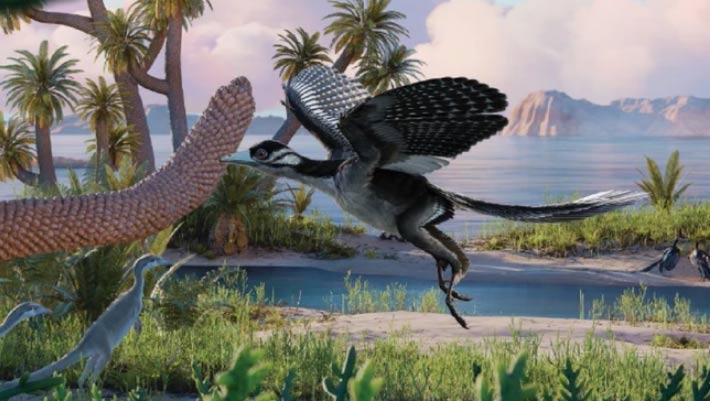
Paleontologists Reconstruct Ecology of Archaeopteryx
Des paléontologues reconstituent l'écologie de l'archéoptéryx
écologie musée fossile Archaeopteryx comportement étude
Une nouvelle étude complète réalisée par les paléontologues du Field Museum of Natural History rassemble les dernières preuves fossiles pour offrir le portrait le plus complet à ce jour de l’écologie, du comportement et de la vie quotidienne de l’Archaeopteryx. L'article Les paléontologues reconstruisent l'écologie de l'archéoptéryx apparaît en premier sur Sci.News : Breaking Science News.
08/05/2026 sci-news ⚙ Traduction automatique
1 2 3 4 5 6 7