musée

Type de contenu

411 image(s) · 18 Actualités

Galerie d'images

Montanoceratops cerorhynchus (Brown & Schlaikjer, 1942) - fossil ceratopsian dinosaur skeleton from the Cretaceous of Montana, USA. (MOR 542, Museum of the Rockies, Bozeman, Montana, USA)
The species name is sometimes incorrectly spelled "cerorhynchos".  The original publication spells it "cerorhynchus".  The genus name is sometimes incorrectly spelled "Montanaceratops".
Ceratopsians are the "horned dinosaurs".  They were large, quadrupedal, herbivorous dinosaurs having a beaked skull and a frill - an extension of bone behind the skull that partially covered the neck.  Ceratopsian dinosaurs are known from the Jurassic and Cretaceous.  The last members of the group died out at the Cretaceous-Tertiary boundary, 65 million years ago.
This is a partial skeleton of a juvenile Montanoceratops, a ceratopsian from the near-latest Cretaceous of western North America.  This type of ceratopsian lacked facial horns.


From exhibit signage:
Sixty-eight million years ago, when the horned dinosaurs Triceratops and Torosaurus inhabited the coastal plain near the inland ocean, primitive "horned" dinosaurs named Montanoceratops lived in uplands near the young Rocky Mountains.  These little protoceratopsians fed on plants with slicing teeth and narrow beaks similar to their giant three-horned relatives.


Classification: Animalia, Chordata, Vertebrata, Reptilia, Archosauria, Dinosauria, Ornithischia, Marginocephalia, Ceratopsia, Leptoceratopsidae
Stratigraphy: St. Mary River Formation, Maastrichtian Stage, Upper Cretaceous
Locality: Little Rocky Coulee, north of the town of Cut Bank, eastern Glacier County, northwestern Montana, USA


Info. at:

en.wikipedia.org/wiki/Montanoceratops
Taxons Montanoceratops

Montanoceratops cerorhynchus (Brown & Schlaikjer, 1942) - fossil ceratopsian dinosaur skeleton from the Cretaceous of Montana, USA. (MOR 542, Museum of the Rockies, Bozeman, Montana, USA) The species name is sometimes incorrectly spelled "cerorhynchos". The original publication spells it "cerorhynchus". The genus name is sometimes incorrectly spelled "Montanaceratops". Ceratopsians are the "horned dinosaurs". They were large, quadrupedal, herbivorous dinosaurs having a beaked skull and a frill - an extension of bone behind the skull that partially covered the neck. Ceratopsian dinosaurs are known from the Jurassic and Cretaceous. The last members of the group died out at the Cretaceous-Tertiary boundary, 65 million years ago. This is a partial skeleton of a juvenile Montanoceratops, a ceratopsian from the near-latest Cretaceous of western North America. This type of ceratopsian lacked facial horns. From exhibit signage: Sixty-eight million years ago, when the horned dinosaurs Triceratops and Torosaurus inhabited the coastal plain near the inland ocean, primitive "horned" dinosaurs named Montanoceratops lived in uplands near the young Rocky Mountains. These little protoceratopsians fed on plants with slicing teeth and narrow beaks similar to their giant three-horned relatives. Classification: Animalia, Chordata, Vertebrata, Reptilia, Archosauria, Dinosauria, Ornithischia, Marginocephalia, Ceratopsia, Leptoceratopsidae Stratigraphy: St. Mary River Formation, Maastrichtian Stage, Upper Cretaceous Locality: Little Rocky Coulee, north of the town of Cut Bank, eastern Glacier County, northwestern Montana, USA Info. at: en.wikipedia.org/wiki/Montanoceratops

os musée États-Unis Crétacé +10
Skeletal mount of Archaeoceratops, housed in Tamba Dinosaur Museum
Taxons Archaeoceratops

Skeletal mount of Archaeoceratops, housed in Tamba Dinosaur Museum

musée Archaeoceratops Archaeoceratopsidae Dinosauria
Skeletal mount of Archaeoceratops, housed in Tamba Dinosaur Museum
Taxons Archaeoceratopsidae

Skeletal mount of Archaeoceratops, housed in Tamba Dinosaur Museum

musée Archaeoceratops Archaeoceratopsidae Dinosauria
Muttaburrasaurus
The plants, animals and climate of the Australian continent have changed dramatically over long periods of time. Imagine this giant creature roaming the luxuriant wet forests that covered parts of the continent in the Cretaceous period, about 100-110 million years ago. The Muttaburrasaurus ambled along on all four legs or stood on its hind legs. Its large teeth were well adapted to eat tough vegetation such as the leathery foliage of the evergreen forests of Araucaria trees, ancient relatives of the bunya pine of south-eastern Queensland.
In 1963, grazier Doug Langdon discovered the fossilised bones of a dinosaur on his property near Muttaburra in central-west Queensland. It was one of the most complete dinosaur skeletons found in Australia. The bones belonged to a new species of ornithopod and palaeontologists named it Muttaburrasaurus langdoni.

Cast of Muttaburresaurus langdoni 1987 made by Queensland Museum, Brisbane National Museum of Australia
Taxons Muttaburrasaurus

Muttaburrasaurus The plants, animals and climate of the Australian continent have changed dramatically over long periods of time. Imagine this giant creature roaming the luxuriant wet forests that covered parts of the continent in the Cretaceous period, about 100-110 million years ago. The Muttaburrasaurus ambled along on all four legs or stood on its hind legs. Its large teeth were well adapted to eat tough vegetation such as the leathery foliage of the evergreen forests of Araucaria trees, ancient relatives of the bunya pine of south-eastern Queensland. In 1963, grazier Doug Langdon discovered the fossilised bones of a dinosaur on his property near Muttaburra in central-west Queensland. It was one of the most complete dinosaur skeletons found in Australia. The bones belonged to a new species of ornithopod and palaeontologists named it Muttaburrasaurus langdoni. Cast of Muttaburresaurus langdoni 1987 made by Queensland Museum, Brisbane National Museum of Australia

os musée Australie Crétacé +5
Holotype of Fona herzogae NCSM 33548 at the w:North Carolina Museum of Natural Sciences
Taxons Fona

Holotype of Fona herzogae NCSM 33548 at the w:North Carolina Museum of Natural Sciences

musée holotype Fona
Holotype scapula of Tienshanosaurus chitaiensis on display at the Paleozoological Museum of China.
Taxons Tienshanosaurus

Holotype scapula of Tienshanosaurus chitaiensis on display at the Paleozoological Museum of China.

musée Chine holotype Tienshanosaurus
Nigersaurus - 01 (possibly National Museum of Nature and Science, Tokyo)
Taxons Nigersaurus

Nigersaurus - 01 (possibly National Museum of Nature and Science, Tokyo)

musée Nigersaurus
Yunguisaurus liae, Zhejiang Museum of Natural History (Hangzhou)
Taxons Yunguisaurus

Yunguisaurus liae, Zhejiang Museum of Natural History (Hangzhou)

musée Yunguisaurus
"Eric", a near-complete opalized specimen of the plesiosaur Umoonasaurus at the Australian Museum
Taxons Umoonasaurus

"Eric", a near-complete opalized specimen of the plesiosaur Umoonasaurus at the Australian Museum

musée spécimen Plesiosauria Umoonasaurus
Paratype skull of Hamipterus tianshanensis on display at the Paleozoological Museum of China.
Taxons Hamipterus

Paratype skull of Hamipterus tianshanensis on display at the Paleozoological Museum of China.

musée Chine Hamipteridae Hamipterus +1
Paratype skull of Hamipterus tianshanensis on display at the Paleozoological Museum of China.
Taxons Hamipteridae

Paratype skull of Hamipterus tianshanensis on display at the Paleozoological Museum of China.

musée Chine Hamipteridae Hamipterus +1
Boreopterus sp., Liaoning Palaeontological Museum
Taxons Boreopterus

Boreopterus sp., Liaoning Palaeontological Museum

musée Boreopteridae Boreopterinae Boreopterus
Boreopterus sp., Liaoning Palaeontological Museum
Taxons Boreopteridae

Boreopterus sp., Liaoning Palaeontological Museum

musée Boreopteridae Boreopterinae Boreopterus
Boreopterus sp., Liaoning Palaeontological Museum
Taxons Boreopterinae

Boreopterus sp., Liaoning Palaeontological Museum

musée Boreopteridae Boreopterinae Boreopterus
Giganotosaurus skeleton mount at the Fernbank Museum of Natural History in Atlanta, Georgia.
Taxons Giganotosaurus

Giganotosaurus skeleton mount at the Fernbank Museum of Natural History in Atlanta, Georgia.

musée Géorgie Giganotosaurus squelette
Yangchuanosaurus shangyouensis skeleton displayed in Hong Kong Science Museum
Taxons Yangchuanosaurus

Yangchuanosaurus shangyouensis skeleton displayed in Hong Kong Science Museum

musée Yangchuanosaurus squelette
1 2 3 4 5 6 7 8 9 10 11 12 13 14 15 16 17 18 19 20 21 22 23 24 25 26

Actualités

Magnifique squelette fossile d'Eryops exposé
prédateur musée Permien fossile squelette
Quand j'étais enfant, l'un de mes animaux préhistoriques préférés était le géant temnospondyl Eryops.  Cela me fait toujours plaisir de tomber sur des fossiles de ce prédateur du Permien inférieur.  En effet, le simple fait de voir un squelette reconstruit me fait sourire.  Quand je suis au Musée d'Histoire Naturelle de Londres, j'essaie de prendre le temps d'observer l'Eryops megacephalus.
06/05/2026 everythingdinosaur ⚙ Traduction automatique
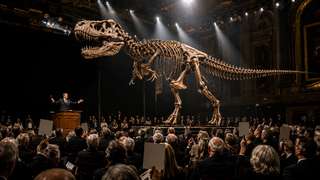
La plus ancienne feuille de cannabis ? Un musée fait une étonnante découverte
musée découverte
Le Musée d'histoire naturelle de Berlin a daté ce qui semble être l'empreinte d'une plante du genre Cannabis dans de la boue séchée.
22/04/2026 sciencesetavenir
Museum Fossil Reveals Triassic Crocodile Cousin with Powerful Jaws
Un fossile de musée révèle un cousin crocodile du Trias doté de mâchoires puissantes
mâchoire musée Trias supérieur Trias fossile spécimen tomographie nouvelle espèce
Les tomodensitogrammes d'un spécimen vieux de plusieurs décennies du Musée d'histoire naturelle de Yale Peabody montrent une nouvelle espèce de crocodylomorphe au museau court et aux mâchoires inhabituellement fortes, offrant un instantané rare de la spécialisation écologique à l'époque du Trias supérieur. Le post Museum Fossil révèle un cousin crocodile du Trias doté de mâchoires puissantes est apparu en premier sur Sci.News: Breaking Science News.
20/04/2026 sci-news ⚙ Traduction automatique
Épisode 174 : Une histoire des dinosaures en 50 fossiles
musée fossile spécimen Dinosauria
Le professeur Paul Barrett du Natural History Museum de Londres a récemment écrit A History of Dinosaurs in 50 Fossils. Nous en avons profité pour avoir un aperçu de ce que nous savons réellement sur les dinosaures et comment il est même possible de raconter leur histoire avec seulement 50 spécimens. Dans cet épisode, Paul discute de l'histoire [&hellip
15/04/2026 palaeocast ⚙ Traduction automatique
Ce « crocodile terroriste » de 31 pieds mangeait des dinosaures. Maintenant c'est de retour
prédateur musée États-Unis Dinosauria squelette
Un énorme « crocodile terroriste » de la taille d’un bus qui s’attaquait autrefois aux dinosaures a été ramené à la vie avec des détails époustouflants grâce au premier squelette complet scientifiquement précis de Deinosuchus schwimmeri. S'étendant sur plus de 9 mètres de long, cet ancien prédateur suprême régnait sur le sud-est des États-Unis il y a plus de 75 millions d'années. Les visiteurs peuvent désormais le voir de près au Tellus Science Museum, le seul endroit au monde à posséder cette réplique.
15/04/2026 sciencedaily ⚙ Traduction automatique
1 2 3 4