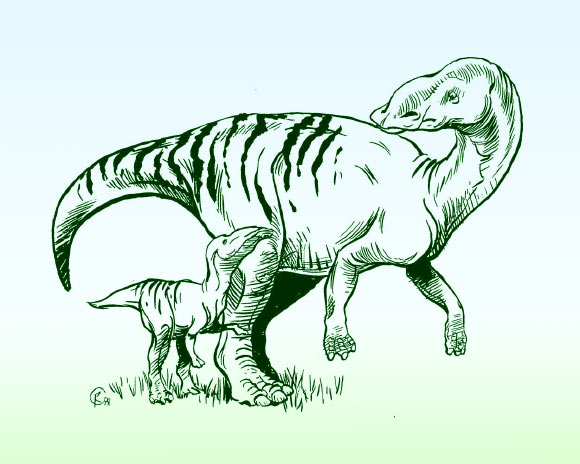
juvenile

Specimen nature

11 image(s) · 6 News

Image gallery

Illustration of an Elasmosaurus platyurus devouring a juvenile Tylosaurus while a Hesperornis swims by in the background, based on recent research on Elasmosaurid paleobiology which shows that they were far more raptorial than previously thought:
https://sobekswimmingpool.wordpress.com/2021/05/30/what-sea-dragons-ate-plesiosaur-diets-revised/

Illustration of an Elasmosaurus platyurus devouring a juvenile Tylosaurus while a Hesperornis swims by in the background, based on recent research on Elasmosaurid paleobiology which shows that they were far more raptorial than previously thought: https://sobekswimmingpool.wordpress.com/2021/05/30/what-sea-dragons-ate-plesiosaur-diets-revised/

juvenile Elasmosauridae Elasmosaurus Plesiosauria +1
Illustration of a juvenile Tyrannosaurus rex.
Most of this restoration is mostly inspired from the models of 1-year old Tyrannosaurus from the exhibition "T.rex: The Ultimate Predator" at American Museum of Natural History, New York (2019-2021).[1]
[2] and the juvenile Tarbosaurus MPC-D 107/7 (2-3 years old at death).[3]

References

↑ [1]

↑ [2]

↑ Tsuihiji T et.al (2011). "Cranial osteology of a juvenile specimen of Tarbosaurus bataar (Theropoda, Tyrannosauridae) from the Nemegt Formation (Upper Cretaceous) of Bugin Tsav, Mongolia". Journal of Vertebrate Paleontology 31(3): p. 497-517

Illustration of a juvenile Tyrannosaurus rex. Most of this restoration is mostly inspired from the models of 1-year old Tyrannosaurus from the exhibition "T.rex: The Ultimate Predator" at American Museum of Natural History, New York (2019-2021).[1] [2] and the juvenile Tarbosaurus MPC-D 107/7 (2-3 years old at death).[3] References ↑ [1] ↑ [2] ↑ Tsuihiji T et.al (2011). "Cranial osteology of a juvenile specimen of Tarbosaurus bataar (Theropoda, Tyrannosauridae) from the Nemegt Formation (Upper Cretaceous) of Bugin Tsav, Mongolia". Journal of Vertebrate Paleontology 31(3): p. 497-517

predator museum Mongolia Cretaceous +8
The National history museum in Milan, Italy. Fossil of a juvenile individual of Scipionyx samniticus. The fossil (to date the first of this species ever) preserves in an exceptional way clear traces of soft tissues - a rather rare event. Picture by Giovanni Dall'Orto, April 22 2007.
Taxa Scipionyx

The National history museum in Milan, Italy. Fossil of a juvenile individual of Scipionyx samniticus. The fossil (to date the first of this species ever) preserves in an exceptional way clear traces of soft tissues - a rather rare event. Picture by Giovanni Dall'Orto, April 22 2007.

tissue museum Italy fossil +2
A restoration of Rinconsaurus compared to a human ,

•  Based proportionally on fossil elements and skeletal reconstruction featured in the Rinconsaurus description,[1] with missing parts based on other titanosaur reconstructions. The remains of Rinconsaurus represent two adults and a juvenile all of which are incomplete; some of the proportions shown here, such as the neck, limb lengths, and skull shape are not certain.
•  Osteroderms are not yet known in Rinconsaurus.  The osteoderms shown here are based loosely on Mendozasaurus.[2] Osteoderms are known from at least 10 titanosaur genera spread across the family tree but it's not clear if all titanosaurs had them.[3] Titanosaur osteoderms are rare and their layout and position on the body are not certain. [4]
•  The colours and patterns, as with the majority of reconstructions of prehistoric creatures, are speculative.
•  Human silhouette approximately 180 cm tall.

NOTE: I often update my images. If you want to have any of my images on a website, please (if possible) don’t host/save it to the website server. I’d prefer it if the image's Wikimedia URL is used. This means that if I update an image, it will be updated on the site as well.  Thanks.   


References


↑ Coria, Jorge; B.J.G. Riga (2003). "Rinconsaurus caudamirus gen. et sp nov., a new titanosaurid (Dinosauria, Sauropoda) from the Late Cretaceous of Patagonia, Argentina". Revista Geologica de Chile 30 (2): 333–353. ISSN 0716-0208. Retrieved on 2007-05-21.

↑   González Riga B (2003) A new titanosaur (Dinosauria, Sauropoda) from the Upper Cretaceous of Mendoza, Argentina. Ameghiniana 40 (2) 

↑  Carrano, M.T. and D’Emic, M.D.  2015 'Osteoderms of the titanosaur sauropod dinosaur Alamosaurus sanjuanensis Gilmore, 1922'. Journal of Vertebrate Paleontology.

↑    Vidal D, Ortega F, Sanz JL (2014) Titanosaur Osteoderms from the Upper Cretaceous of Lo Hueco (Spain) and Their Implications on the Armor of Laurasian Titanosaurs. PLoS ONE 9(8): e102488. doi:10.1371/journal.pone.0102488
Taxa Rinconsaurus

A restoration of Rinconsaurus compared to a human , • Based proportionally on fossil elements and skeletal reconstruction featured in the Rinconsaurus description,[1] with missing parts based on other titanosaur reconstructions. The remains of Rinconsaurus represent two adults and a juvenile all of which are incomplete; some of the proportions shown here, such as the neck, limb lengths, and skull shape are not certain. • Osteroderms are not yet known in Rinconsaurus. The osteoderms shown here are based loosely on Mendozasaurus.[2] Osteoderms are known from at least 10 titanosaur genera spread across the family tree but it's not clear if all titanosaurs had them.[3] Titanosaur osteoderms are rare and their layout and position on the body are not certain. [4] • The colours and patterns, as with the majority of reconstructions of prehistoric creatures, are speculative. • Human silhouette approximately 180 cm tall. NOTE: I often update my images. If you want to have any of my images on a website, please (if possible) don’t host/save it to the website server. I’d prefer it if the image's Wikimedia URL is used. This means that if I update an image, it will be updated on the site as well. Thanks. References ↑ Coria, Jorge; B.J.G. Riga (2003). "Rinconsaurus caudamirus gen. et sp nov., a new titanosaurid (Dinosauria, Sauropoda) from the Late Cretaceous of Patagonia, Argentina". Revista Geologica de Chile 30 (2): 333–353. ISSN 0716-0208. Retrieved on 2007-05-21. ↑ González Riga B (2003) A new titanosaur (Dinosauria, Sauropoda) from the Upper Cretaceous of Mendoza, Argentina. Ameghiniana 40 (2) ↑ Carrano, M.T. and D’Emic, M.D. 2015 'Osteoderms of the titanosaur sauropod dinosaur Alamosaurus sanjuanensis Gilmore, 1922'. Journal of Vertebrate Paleontology. ↑ Vidal D, Ortega F, Sanz JL (2014) Titanosaur Osteoderms from the Upper Cretaceous of Lo Hueco (Spain) and Their Implications on the Armor of Laurasian Titanosaurs. PLoS ONE 9(8): e102488. doi:10.1371/journal.pone.0102488

limb description fossil juvenile +4
A restoration of Rinconsaurus compared to a human ,

•  Based proportionally on fossil elements and skeletal reconstruction featured in the Rinconsaurus description,[1] with missing parts based on other titanosaur reconstructions. The remains of Rinconsaurus represent two adults and a juvenile all of which are incomplete; some of the proportions shown here, such as the neck, limb lengths, and skull shape are not certain.
•  Osteroderms are not yet known in Rinconsaurus.  The osteoderms shown here are based loosely on Mendozasaurus.[2] Osteoderms are known from at least 10 titanosaur genera spread across the family tree but it's not clear if all titanosaurs had them.[3] Titanosaur osteoderms are rare and their layout and position on the body are not certain. [4]
•  The colours and patterns, as with the majority of reconstructions of prehistoric creatures, are speculative.
•  Human silhouette approximately 180 cm tall.

NOTE: I often update my images. If you want to have any of my images on a website, please (if possible) don’t host/save it to the website server. I’d prefer it if the image's Wikimedia URL is used. This means that if I update an image, it will be updated on the site as well.  Thanks.   


References


↑ Coria, Jorge; B.J.G. Riga (2003). "Rinconsaurus caudamirus gen. et sp nov., a new titanosaurid (Dinosauria, Sauropoda) from the Late Cretaceous of Patagonia, Argentina". Revista Geologica de Chile 30 (2): 333–353. ISSN 0716-0208. Retrieved on 2007-05-21.

↑   González Riga B (2003) A new titanosaur (Dinosauria, Sauropoda) from the Upper Cretaceous of Mendoza, Argentina. Ameghiniana 40 (2) 

↑  Carrano, M.T. and D’Emic, M.D.  2015 'Osteoderms of the titanosaur sauropod dinosaur Alamosaurus sanjuanensis Gilmore, 1922'. Journal of Vertebrate Paleontology.

↑    Vidal D, Ortega F, Sanz JL (2014) Titanosaur Osteoderms from the Upper Cretaceous of Lo Hueco (Spain) and Their Implications on the Armor of Laurasian Titanosaurs. PLoS ONE 9(8): e102488. doi:10.1371/journal.pone.0102488
Taxa Rinconsauria

A restoration of Rinconsaurus compared to a human , • Based proportionally on fossil elements and skeletal reconstruction featured in the Rinconsaurus description,[1] with missing parts based on other titanosaur reconstructions. The remains of Rinconsaurus represent two adults and a juvenile all of which are incomplete; some of the proportions shown here, such as the neck, limb lengths, and skull shape are not certain. • Osteroderms are not yet known in Rinconsaurus. The osteoderms shown here are based loosely on Mendozasaurus.[2] Osteoderms are known from at least 10 titanosaur genera spread across the family tree but it's not clear if all titanosaurs had them.[3] Titanosaur osteoderms are rare and their layout and position on the body are not certain. [4] • The colours and patterns, as with the majority of reconstructions of prehistoric creatures, are speculative. • Human silhouette approximately 180 cm tall. NOTE: I often update my images. If you want to have any of my images on a website, please (if possible) don’t host/save it to the website server. I’d prefer it if the image's Wikimedia URL is used. This means that if I update an image, it will be updated on the site as well. Thanks. References ↑ Coria, Jorge; B.J.G. Riga (2003). "Rinconsaurus caudamirus gen. et sp nov., a new titanosaurid (Dinosauria, Sauropoda) from the Late Cretaceous of Patagonia, Argentina". Revista Geologica de Chile 30 (2): 333–353. ISSN 0716-0208. Retrieved on 2007-05-21. ↑ González Riga B (2003) A new titanosaur (Dinosauria, Sauropoda) from the Upper Cretaceous of Mendoza, Argentina. Ameghiniana 40 (2) ↑ Carrano, M.T. and D’Emic, M.D. 2015 'Osteoderms of the titanosaur sauropod dinosaur Alamosaurus sanjuanensis Gilmore, 1922'. Journal of Vertebrate Paleontology. ↑ Vidal D, Ortega F, Sanz JL (2014) Titanosaur Osteoderms from the Upper Cretaceous of Lo Hueco (Spain) and Their Implications on the Armor of Laurasian Titanosaurs. PLoS ONE 9(8): e102488. doi:10.1371/journal.pone.0102488

limb description fossil juvenile +4
Juvenile Gorgosaurus TMP 2009.12.14 preserving stomach contents. Photographs of specimen in (A) right lateral view and (B) left anterolateral view. (C) Interpretive illustration of specimen in right lateral view. Skeleton consists of a nearly complete skull, the left side of the body and limbs, and a nearly complete pelvis. Red rectangle delineates location of stomach contents. (D) Histological photomicrograph of tibia showing the presence of five lines of arrested growths and two annuli (marked by asterisks), indicating that the individual was between 5 and 7 years old. Scale bars, 50 cm (A) to (C) and 1 mm (D).

Juvenile Gorgosaurus TMP 2009.12.14 preserving stomach contents. Photographs of specimen in (A) right lateral view and (B) left anterolateral view. (C) Interpretive illustration of specimen in right lateral view. Skeleton consists of a nearly complete skull, the left side of the body and limbs, and a nearly complete pelvis. Red rectangle delineates location of stomach contents. (D) Histological photomicrograph of tibia showing the presence of five lines of arrested growths and two annuli (marked by asterisks), indicating that the individual was between 5 and 7 years old. Scale bars, 50 cm (A) to (C) and 1 mm (D).

limb pelvis scale growth +6
Skeleton of WGSC SPC V 1304 (juvenile Brevicaudosaurus jiyangshanensis). A, photograph of the specimen in dorsal view. B, interpretive drawing.
Taxa Brevicaudosaurus

Skeleton of WGSC SPC V 1304 (juvenile Brevicaudosaurus jiyangshanensis). A, photograph of the specimen in dorsal view. B, interpretive drawing.

drawing juvenile specimen Brevicaudosaurus +1
Teratophoneus curriei, adult (left) and juvenile (right), on display at the Natural History Museum of Utah, Salt Lake City.
Taxa Teratophoneus

Teratophoneus curriei, adult (left) and juvenile (right), on display at the Natural History Museum of Utah, Salt Lake City.

museum juvenile Teratophoneus
Montanoceratops cerorhynchus (Brown & Schlaikjer, 1942) - fossil ceratopsian dinosaur skeleton from the Cretaceous of Montana, USA. (MOR 542, Museum of the Rockies, Bozeman, Montana, USA)
The species name is sometimes incorrectly spelled "cerorhynchos".  The original publication spells it "cerorhynchus".  The genus name is sometimes incorrectly spelled "Montanaceratops".
Ceratopsians are the "horned dinosaurs".  They were large, quadrupedal, herbivorous dinosaurs having a beaked skull and a frill - an extension of bone behind the skull that partially covered the neck.  Ceratopsian dinosaurs are known from the Jurassic and Cretaceous.  The last members of the group died out at the Cretaceous-Tertiary boundary, 65 million years ago.
This is a partial skeleton of a juvenile Montanoceratops, a ceratopsian from the near-latest Cretaceous of western North America.  This type of ceratopsian lacked facial horns.


From exhibit signage:
Sixty-eight million years ago, when the horned dinosaurs Triceratops and Torosaurus inhabited the coastal plain near the inland ocean, primitive "horned" dinosaurs named Montanoceratops lived in uplands near the young Rocky Mountains.  These little protoceratopsians fed on plants with slicing teeth and narrow beaks similar to their giant three-horned relatives.


Classification: Animalia, Chordata, Vertebrata, Reptilia, Archosauria, Dinosauria, Ornithischia, Marginocephalia, Ceratopsia, Leptoceratopsidae
Stratigraphy: St. Mary River Formation, Maastrichtian Stage, Upper Cretaceous
Locality: Little Rocky Coulee, north of the town of Cut Bank, eastern Glacier County, northwestern Montana, USA


Info. at:

en.wikipedia.org/wiki/Montanoceratops
Taxa Montanoceratops

Montanoceratops cerorhynchus (Brown & Schlaikjer, 1942) - fossil ceratopsian dinosaur skeleton from the Cretaceous of Montana, USA. (MOR 542, Museum of the Rockies, Bozeman, Montana, USA) The species name is sometimes incorrectly spelled "cerorhynchos". The original publication spells it "cerorhynchus". The genus name is sometimes incorrectly spelled "Montanaceratops". Ceratopsians are the "horned dinosaurs". They were large, quadrupedal, herbivorous dinosaurs having a beaked skull and a frill - an extension of bone behind the skull that partially covered the neck. Ceratopsian dinosaurs are known from the Jurassic and Cretaceous. The last members of the group died out at the Cretaceous-Tertiary boundary, 65 million years ago. This is a partial skeleton of a juvenile Montanoceratops, a ceratopsian from the near-latest Cretaceous of western North America. This type of ceratopsian lacked facial horns. From exhibit signage: Sixty-eight million years ago, when the horned dinosaurs Triceratops and Torosaurus inhabited the coastal plain near the inland ocean, primitive "horned" dinosaurs named Montanoceratops lived in uplands near the young Rocky Mountains. These little protoceratopsians fed on plants with slicing teeth and narrow beaks similar to their giant three-horned relatives. Classification: Animalia, Chordata, Vertebrata, Reptilia, Archosauria, Dinosauria, Ornithischia, Marginocephalia, Ceratopsia, Leptoceratopsidae Stratigraphy: St. Mary River Formation, Maastrichtian Stage, Upper Cretaceous Locality: Little Rocky Coulee, north of the town of Cut Bank, eastern Glacier County, northwestern Montana, USA Info. at: en.wikipedia.org/wiki/Montanoceratops

bone museum United States Cretaceous +10
Reconstruction and restoration of the skull of Eolambia.

(A) Skull reconstruction of Eolambia in left lateral view by the lead author. Bones in white are unknown, bones in dark grey are based primarily upon the adult holotype (CEUM 9758) or paratype (CEUM 5212), and bones in light grey are based primarily upon juvenile elements from the Eo2 and WS8 bonebeds. Sutures and points of contact between bones are marked in black. Scale bar equals 10 cm; scale is calibrated with the dentary of CEUM 9758. (B) Life restoration of the head of Eolambia by Lukas Panzarin. Abbreviations: an, angular; d, dentary; f, frontal; j, jugal; l, lacrimal; mx, maxilla; na, nasal; pd, predentary; pmx, premaxilla; po, postorbital; prf, prefrontal; q, quadrate; qj, quadratojugal; sa, surangular; sq, squamosal.
Taxa Eolambia

Reconstruction and restoration of the skull of Eolambia. (A) Skull reconstruction of Eolambia in left lateral view by the lead author. Bones in white are unknown, bones in dark grey are based primarily upon the adult holotype (CEUM 9758) or paratype (CEUM 5212), and bones in light grey are based primarily upon juvenile elements from the Eo2 and WS8 bonebeds. Sutures and points of contact between bones are marked in black. Scale bar equals 10 cm; scale is calibrated with the dentary of CEUM 9758. (B) Life restoration of the head of Eolambia by Lukas Panzarin. Abbreviations: an, angular; d, dentary; f, frontal; j, jugal; l, lacrimal; mx, maxilla; na, nasal; pd, predentary; pmx, premaxilla; po, postorbital; prf, prefrontal; q, quadrate; qj, quadratojugal; sa, surangular; sq, squamosal.

bone scale holotype juvenile +2
The official postcard (of the American Museum of Natural History) says this is a Barosaurus, and that "this unique freestanding mount is the only Barosaurus on view in the world". This was true until the installation of another Barosaurus specimen at the Royal Ontario Museum. The adult specimen pictured is AMNH 6341, classified as Barosaurus lentus. The juvenile specimen (AMNH 7530), originally classified as a juvenile Barosaurus, has since been reclassified as a specimen of Kaatedocus siberi.
Taxa Barosaurus

The official postcard (of the American Museum of Natural History) says this is a Barosaurus, and that "this unique freestanding mount is the only Barosaurus on view in the world". This was true until the installation of another Barosaurus specimen at the Royal Ontario Museum. The adult specimen pictured is AMNH 6341, classified as Barosaurus lentus. The juvenile specimen (AMNH 7530), originally classified as a juvenile Barosaurus, has since been reclassified as a specimen of Kaatedocus siberi.

museum juvenile specimen Barosaurus +1
Camarasaurus lentus (Marsh, 1889) sauropod dinosaur from the Jurassic of Utah, USA (public display, CM 11338, Carnegie Museum of Natural History, Pittsburgh, Pennsylvania, USA).
This is a near-complete juvenile sauropod dinosaur in the original fluvial sandstone matrix - such skeletons are extremely rare.
Classification: Animalia, Chordata, Vertebrata, Dinosauria, Sauropodomorpha, Camarasauridae
Stratigraphy: Brushy Basin Member, Morrison Formation, Upper Jurassic, 151 Ma
Locality: Carnegie Quarry, Dinosaur National Monument, northeastern Utah, USA


Sauropod dinosaurs were the largest terrestrial animals ever.  They all have the same basic body plan: large body with four walking legs, very long neck & tail, and a small head relative to body size.  Sauropods were herbivores, and are often perceived as holding their heads & necks up high to reach vegetation normally out of reach to other organisms.  Modern reconstructions of many sauropod species depict them with heads and necks held close to the horizontal, or at low angles above the horizontal.
Taxa Camarasaurus

Camarasaurus lentus (Marsh, 1889) sauropod dinosaur from the Jurassic of Utah, USA (public display, CM 11338, Carnegie Museum of Natural History, Pittsburgh, Pennsylvania, USA). This is a near-complete juvenile sauropod dinosaur in the original fluvial sandstone matrix - such skeletons are extremely rare. Classification: Animalia, Chordata, Vertebrata, Dinosauria, Sauropodomorpha, Camarasauridae Stratigraphy: Brushy Basin Member, Morrison Formation, Upper Jurassic, 151 Ma Locality: Carnegie Quarry, Dinosaur National Monument, northeastern Utah, USA Sauropod dinosaurs were the largest terrestrial animals ever. They all have the same basic body plan: large body with four walking legs, very long neck & tail, and a small head relative to body size. Sauropods were herbivores, and are often perceived as holding their heads & necks up high to reach vegetation normally out of reach to other organisms. Modern reconstructions of many sauropod species depict them with heads and necks held close to the horizontal, or at low angles above the horizontal.

museum United States Morrison Jurassic +10
Camarasaurus lentus (Marsh, 1889) sauropod dinosaur from the Jurassic of Utah, USA (public display, CM 11338, Carnegie Museum of Natural History, Pittsburgh, Pennsylvania, USA).
This is a near-complete juvenile sauropod dinosaur in the original fluvial sandstone matrix - such skeletons are extremely rare.
Classification: Animalia, Chordata, Vertebrata, Dinosauria, Sauropodomorpha, Camarasauridae
Stratigraphy: Brushy Basin Member, Morrison Formation, Upper Jurassic, 151 Ma
Locality: Carnegie Quarry, Dinosaur National Monument, northeastern Utah, USA


Sauropod dinosaurs were the largest terrestrial animals ever.  They all have the same basic body plan: large body with four walking legs, very long neck & tail, and a small head relative to body size.  Sauropods were herbivores, and are often perceived as holding their heads & necks up high to reach vegetation normally out of reach to other organisms.  Modern reconstructions of many sauropod species depict them with heads and necks held close to the horizontal, or at low angles above the horizontal.
Taxa Camarasauridae

Camarasaurus lentus (Marsh, 1889) sauropod dinosaur from the Jurassic of Utah, USA (public display, CM 11338, Carnegie Museum of Natural History, Pittsburgh, Pennsylvania, USA). This is a near-complete juvenile sauropod dinosaur in the original fluvial sandstone matrix - such skeletons are extremely rare. Classification: Animalia, Chordata, Vertebrata, Dinosauria, Sauropodomorpha, Camarasauridae Stratigraphy: Brushy Basin Member, Morrison Formation, Upper Jurassic, 151 Ma Locality: Carnegie Quarry, Dinosaur National Monument, northeastern Utah, USA Sauropod dinosaurs were the largest terrestrial animals ever. They all have the same basic body plan: large body with four walking legs, very long neck & tail, and a small head relative to body size. Sauropods were herbivores, and are often perceived as holding their heads & necks up high to reach vegetation normally out of reach to other organisms. Modern reconstructions of many sauropod species depict them with heads and necks held close to the horizontal, or at low angles above the horizontal.

museum United States Morrison Jurassic +10
Camarasaurus lentus (Marsh, 1889) sauropod dinosaur from the Jurassic of Utah, USA (public display, CM 11338, Carnegie Museum of Natural History, Pittsburgh, Pennsylvania, USA).
This is a near-complete juvenile sauropod dinosaur in the original fluvial sandstone matrix - such skeletons are extremely rare.
Classification: Animalia, Chordata, Vertebrata, Dinosauria, Sauropodomorpha, Camarasauridae
Stratigraphy: Brushy Basin Member, Morrison Formation, Upper Jurassic, 151 Ma
Locality: Carnegie Quarry, Dinosaur National Monument, northeastern Utah, USA


Sauropod dinosaurs were the largest terrestrial animals ever.  They all have the same basic body plan: large body with four walking legs, very long neck & tail, and a small head relative to body size.  Sauropods were herbivores, and are often perceived as holding their heads & necks up high to reach vegetation normally out of reach to other organisms.  Modern reconstructions of many sauropod species depict them with heads and necks held close to the horizontal, or at low angles above the horizontal.
Taxa Camarasaurinae

Camarasaurus lentus (Marsh, 1889) sauropod dinosaur from the Jurassic of Utah, USA (public display, CM 11338, Carnegie Museum of Natural History, Pittsburgh, Pennsylvania, USA). This is a near-complete juvenile sauropod dinosaur in the original fluvial sandstone matrix - such skeletons are extremely rare. Classification: Animalia, Chordata, Vertebrata, Dinosauria, Sauropodomorpha, Camarasauridae Stratigraphy: Brushy Basin Member, Morrison Formation, Upper Jurassic, 151 Ma Locality: Carnegie Quarry, Dinosaur National Monument, northeastern Utah, USA Sauropod dinosaurs were the largest terrestrial animals ever. They all have the same basic body plan: large body with four walking legs, very long neck & tail, and a small head relative to body size. Sauropods were herbivores, and are often perceived as holding their heads & necks up high to reach vegetation normally out of reach to other organisms. Modern reconstructions of many sauropod species depict them with heads and necks held close to the horizontal, or at low angles above the horizontal.

museum United States Morrison Jurassic +10
Camarasaurus lentus (Marsh, 1889) sauropod dinosaur from the Jurassic of Utah, USA (public display, CM 11338, Carnegie Museum of Natural History, Pittsburgh, Pennsylvania, USA).
This is a near-complete juvenile sauropod dinosaur in the original fluvial sandstone matrix - such skeletons are extremely rare.
Classification: Animalia, Chordata, Vertebrata, Dinosauria, Sauropodomorpha, Camarasauridae
Stratigraphy: Brushy Basin Member, Morrison Formation, Upper Jurassic, 151 Ma
Locality: Carnegie Quarry, Dinosaur National Monument, northeastern Utah, USA


Sauropod dinosaurs were the largest terrestrial animals ever.  They all have the same basic body plan: large body with four walking legs, very long neck & tail, and a small head relative to body size.  Sauropods were herbivores, and are often perceived as holding their heads & necks up high to reach vegetation normally out of reach to other organisms.  Modern reconstructions of many sauropod species depict them with heads and necks held close to the horizontal, or at low angles above the horizontal.
Taxa Morosauridae

Camarasaurus lentus (Marsh, 1889) sauropod dinosaur from the Jurassic of Utah, USA (public display, CM 11338, Carnegie Museum of Natural History, Pittsburgh, Pennsylvania, USA). This is a near-complete juvenile sauropod dinosaur in the original fluvial sandstone matrix - such skeletons are extremely rare. Classification: Animalia, Chordata, Vertebrata, Dinosauria, Sauropodomorpha, Camarasauridae Stratigraphy: Brushy Basin Member, Morrison Formation, Upper Jurassic, 151 Ma Locality: Carnegie Quarry, Dinosaur National Monument, northeastern Utah, USA Sauropod dinosaurs were the largest terrestrial animals ever. They all have the same basic body plan: large body with four walking legs, very long neck & tail, and a small head relative to body size. Sauropods were herbivores, and are often perceived as holding their heads & necks up high to reach vegetation normally out of reach to other organisms. Modern reconstructions of many sauropod species depict them with heads and necks held close to the horizontal, or at low angles above the horizontal.

museum United States Morrison Jurassic +10

News

New Study Suggests Juvenile Maiasaura Ate Different Food to Adults
tooth feeding fossil juvenile Hadrosauria Maiasaura study
A newly published scientific paper has provided fresh insights into the feeding habits of the famous hadrosaur Maiasaura peeblesorum. Analysis of tooth wear in juvenile Maiasaura compared to adult hadrosaurs suggests that young Maiasaura fed differently from fully grown animals. Researchers examined dental wear associated with Maiasaura peeblesorum fossil teeth.  Dietary insights may help to
13/05/2026 everythingdinosaur
Dinosaurs May Have Fed Their Young a Special Diet, Study Suggests
tooth juvenile Dinosauria Hadrosauria Maiasaura study
An analysis of wear on the fossilized teeth of the hadrosaurian dinosaur Maiasaura peeblesorum indicates their juveniles may have eaten softer, more nutritious food than adults, hinting at advanced parental care among dinosaurs. The post Dinosaurs May Have Fed Their Young a Special Diet, Study Suggests appeared first on Sci.News: Breaking Science News.
11/05/2026 sci-news
Scientists thought this was a young T. rex. They were wrong
bone growth predator fossil juvenile Dinosauria Nanotyrannus
A long-running dinosaur mystery may finally be solved: Nanotyrannus, once dismissed as just a teenage T. rex, appears to have been its own distinct species after all. Scientists analyzed a tiny throat bone from the original fossil and discovered growth patterns showing the animal was already mature, not a juvenile giant-in-the-making. This smaller predator—about half the size of a full-grown T. rex—likely roamed alongside its famous cousin, adding a new layer of complexity to prehistoric ecosyst
16/04/2026 sciencedaily
Haolong: Beast of the Week
China Cretaceous Early Cretaceous juvenile specimen Dinosauria Haolong
 This week we'll be checking out a newly described dinosaur that is so unique, it completely changes what we think we knew about dinosaur skin!  Enter Haolong dongi!Haolong was a plant-eating dinosaur that lived in what is now Liaoning, China, during the Early Cretaceous period, about 112.5 million years ago.  The only specimen on record measures about 8 feet (2.45m) from beak to tail but was a juvenile when it died so the species likely grew larger.  The genus name translates from Chinese to "S
08/03/2026 prehistoricbeastoftheweek
Scientists compared dinosaurs to mammals for decades but missed this key difference
predator juvenile Dinosauria mammals
Baby dinosaurs weren’t coddled like lion cubs or elephant calves—they were more like prehistoric latchkey kids. New research suggests that young dinosaurs quickly struck out on their own, forming kid-only groups and surviving without much parental help, while their massive parents lived entirely different lives. Because juveniles and adults ate different foods, faced different predators, and moved through different parts of the landscape, they may have functioned almost like separate species wit
27/02/2026 sciencedaily
1 2