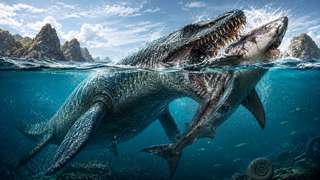
prédateur

Comportement & Physiologie

13 image(s) · 48 Actualités

Galerie d'images

Alioramus altai skull in the exhibit, T. rex, The Ultimate Predator, in the American Museum of Natural History (with permission by Ben Miller).
Taxons Alioramini

Alioramus altai skull in the exhibit, T. rex, The Ultimate Predator, in the American Museum of Natural History (with permission by Ben Miller).

prédateur musée Alioramini Alioramus +1
Phylogenetic relationships, chronostratigraphic, and paleoecological implications of M. intrepidus. a Graphic illustrating temporal range of North American tyrannosauroids including species-level range prior to the discovery of M. intrepidus, extension of current range, and hypothesized range based on isolated teeth12. The current gap in the North American tyrannosauroid record spans from the Tithonian to the Aptian. Faunal composition of Late Cretaceous ecosystems was established between the Albian and Turonian, as recognized by the stratigraphic appearance of major clades (see refs. 7,12 and references therein). b generalized phylogenetic relationships of Tyrannosauroidea, showing the appearance of select traits related to cursoriality in tyrannosaurs that are newly optimized as a result of the discovery of M. intrepidus. Tree topology follows this study using the modified dataset of Carr and colleagues27. Coelurus and Tanycolagreus are grafted as basal tyrannosauroids following Brusatte and colleagues5. c Stratigraphic distribution of Allosauria in North America (incl. Megaraptora but see ref. 70 for alternative hypotheses regarding this clade) documents overlap with M. intrepidus in early Late Cretaceous ecosystems leading to (d) refined calibration on the origin of late diverging tyrannosauroids and clade-level faunal turnover within apex predator roles throughout the Late Jurassic–Late Cretaceous of North America. Colored polygons are stylized call-outs and are not intended to reflect two-dimensional data. Temporal data corresponding to this figure are available in Supplementary Table 5
Taxons Coelurus

Phylogenetic relationships, chronostratigraphic, and paleoecological implications of M. intrepidus. a Graphic illustrating temporal range of North American tyrannosauroids including species-level range prior to the discovery of M. intrepidus, extension of current range, and hypothesized range based on isolated teeth12. The current gap in the North American tyrannosauroid record spans from the Tithonian to the Aptian. Faunal composition of Late Cretaceous ecosystems was established between the Albian and Turonian, as recognized by the stratigraphic appearance of major clades (see refs. 7,12 and references therein). b generalized phylogenetic relationships of Tyrannosauroidea, showing the appearance of select traits related to cursoriality in tyrannosaurs that are newly optimized as a result of the discovery of M. intrepidus. Tree topology follows this study using the modified dataset of Carr and colleagues27. Coelurus and Tanycolagreus are grafted as basal tyrannosauroids following Brusatte and colleagues5. c Stratigraphic distribution of Allosauria in North America (incl. Megaraptora but see ref. 70 for alternative hypotheses regarding this clade) documents overlap with M. intrepidus in early Late Cretaceous ecosystems leading to (d) refined calibration on the origin of late diverging tyrannosauroids and clade-level faunal turnover within apex predator roles throughout the Late Jurassic–Late Cretaceous of North America. Colored polygons are stylized call-outs and are not intended to reflect two-dimensional data. Temporal data corresponding to this figure are available in Supplementary Table 5

prédateur Albien Aptien Crétacé +12
Pliosaurus (Luskhan itilensis) lived on the territory of the Volga region in the Hauterivian age of the Early Cretaceous period. Discovered in 2002 by G.N. Uspensky on the banks of the Volga near the village of Slantsevy Rudnik. This is the most complete pliosaurus skeleton found in Russia. This pliosaurus was not a predator and preferred to feed on fish and cephalopods.

Pliosaurus (Luskhan itilensis) lived on the territory of the Volga region in the Hauterivian age of the Early Cretaceous period. Discovered in 2002 by G.N. Uspensky on the banks of the Volga near the village of Slantsevy Rudnik. This is the most complete pliosaurus skeleton found in Russia. This pliosaurus was not a predator and preferred to feed on fish and cephalopods.

prédateur Russie Crétacé Crétacé inférieur +5
Huaxiazhoulong is a fairly large ankylosaurid dinosaur, at around 6 m in length. It was a robust quadruped with a beak and teeth adapted for processing its herbivorous diet. Huaxiazhoulong had an armor of osteoderms, and the characteristic ankylosaurid tail club which was likely used in defense against predators, as well as intraspecific combat.
Taxons Huaxiazhoulong

Huaxiazhoulong is a fairly large ankylosaurid dinosaur, at around 6 m in length. It was a robust quadruped with a beak and teeth adapted for processing its herbivorous diet. Huaxiazhoulong had an armor of osteoderms, and the characteristic ankylosaurid tail club which was likely used in defense against predators, as well as intraspecific combat.

armure défense prédateur Ankylosauridae +2
Crommium angustatum Grateloup, 1827 fossil snail shell (apical view) from the Oligocene of France. (42 mm across at its widest)
Of all the molluscs, the gastropods (snails) have made the most ecological adaptations.  They can be found in almost all fundamental environments: marine, freshwater, terrestrial.  Most gastropods live in the ocean, and have a single, asymmetrically coiled, external shell of calcium carbonate (CaCO3 - usually aragonite).  The hard calcareous shell is the most easily fossilized part of the gastropod.  The soft parts of a snail (the “slug” portion) include a well developed head having eyes, tentacles, and a mouth, and a well developed, strong, muscular foot used principally for locomotion.  The shell is carried upright on the snail’s back, or is partially dragged behind.  When threatened by a predator, many snails can retract their soft parts into the shell’s interior for protection.
Many fossil snails in the Paleozoic rock record are often not well preserved, or are preserved as internal molds.  The original aragonite of many gastropod shells is not stable on geologic time scales, and often recrystallizes or dissolves completely away.  Fossil snail shells in Mesozoic and Cenozoic rocks are usually better preserved.
Classification: Animalia, Mollusca, Gastropoda, Naticoidea, Ampullinidae
Age: Rupelian Stage (Stampian Stage), Lower Oligocene

Locality: Gaas, Landes Department, Aquitaine, southwestern France

Crommium angustatum Grateloup, 1827 fossil snail shell (apical view) from the Oligocene of France. (42 mm across at its widest) Of all the molluscs, the gastropods (snails) have made the most ecological adaptations. They can be found in almost all fundamental environments: marine, freshwater, terrestrial. Most gastropods live in the ocean, and have a single, asymmetrically coiled, external shell of calcium carbonate (CaCO3 - usually aragonite). The hard calcareous shell is the most easily fossilized part of the gastropod. The soft parts of a snail (the “slug” portion) include a well developed head having eyes, tentacles, and a mouth, and a well developed, strong, muscular foot used principally for locomotion. The shell is carried upright on the snail’s back, or is partially dragged behind. When threatened by a predator, many snails can retract their soft parts into the shell’s interior for protection. Many fossil snails in the Paleozoic rock record are often not well preserved, or are preserved as internal molds. The original aragonite of many gastropod shells is not stable on geologic time scales, and often recrystallizes or dissolves completely away. Fossil snail shells in Mesozoic and Cenozoic rocks are usually better preserved. Classification: Animalia, Mollusca, Gastropoda, Naticoidea, Ampullinidae Age: Rupelian Stage (Stampian Stage), Lower Oligocene Locality: Gaas, Landes Department, Aquitaine, southwestern France

écaille locomotion prédateur France +6
Crommium angustatum Grateloup, 1827 fossil snail shell (apical view) from the Oligocene of France. (42 mm across at its widest)
Of all the molluscs, the gastropods (snails) have made the most ecological adaptations.  They can be found in almost all fundamental environments: marine, freshwater, terrestrial.  Most gastropods live in the ocean, and have a single, asymmetrically coiled, external shell of calcium carbonate (CaCO3 - usually aragonite).  The hard calcareous shell is the most easily fossilized part of the gastropod.  The soft parts of a snail (the “slug” portion) include a well developed head having eyes, tentacles, and a mouth, and a well developed, strong, muscular foot used principally for locomotion.  The shell is carried upright on the snail’s back, or is partially dragged behind.  When threatened by a predator, many snails can retract their soft parts into the shell’s interior for protection.
Many fossil snails in the Paleozoic rock record are often not well preserved, or are preserved as internal molds.  The original aragonite of many gastropod shells is not stable on geologic time scales, and often recrystallizes or dissolves completely away.  Fossil snail shells in Mesozoic and Cenozoic rocks are usually better preserved.
Classification: Animalia, Mollusca, Gastropoda, Naticoidea, Ampullinidae
Age: Rupelian Stage (Stampian Stage), Lower Oligocene

Locality: Gaas, Landes Department, Aquitaine, southwestern France

Crommium angustatum Grateloup, 1827 fossil snail shell (apical view) from the Oligocene of France. (42 mm across at its widest) Of all the molluscs, the gastropods (snails) have made the most ecological adaptations. They can be found in almost all fundamental environments: marine, freshwater, terrestrial. Most gastropods live in the ocean, and have a single, asymmetrically coiled, external shell of calcium carbonate (CaCO3 - usually aragonite). The hard calcareous shell is the most easily fossilized part of the gastropod. The soft parts of a snail (the “slug” portion) include a well developed head having eyes, tentacles, and a mouth, and a well developed, strong, muscular foot used principally for locomotion. The shell is carried upright on the snail’s back, or is partially dragged behind. When threatened by a predator, many snails can retract their soft parts into the shell’s interior for protection. Many fossil snails in the Paleozoic rock record are often not well preserved, or are preserved as internal molds. The original aragonite of many gastropod shells is not stable on geologic time scales, and often recrystallizes or dissolves completely away. Fossil snail shells in Mesozoic and Cenozoic rocks are usually better preserved. Classification: Animalia, Mollusca, Gastropoda, Naticoidea, Ampullinidae Age: Rupelian Stage (Stampian Stage), Lower Oligocene Locality: Gaas, Landes Department, Aquitaine, southwestern France

écaille locomotion prédateur France +6
Crommium angustatum Grateloup, 1827 fossil snail shell (abapertural view) from the Oligocene of France. (57 mm tall)
Of all the molluscs, the gastropods (snails) have made the most ecological adaptations.  They can be found in almost all fundamental environments: marine, freshwater, terrestrial.  Most gastropods live in the ocean, and have a single, asymmetrically coiled, external shell of calcium carbonate (CaCO3 - usually aragonite).  The hard calcareous shell is the most easily fossilized part of the gastropod.  The soft parts of a snail (the “slug” portion) include a well developed head having eyes, tentacles, and a mouth, and a well developed, strong, muscular foot used principally for locomotion.  The shell is carried upright on the snail’s back, or is partially dragged behind.  When threatened by a predator, many snails can retract their soft parts into the shell’s interior for protection.
Many fossil snails in the Paleozoic rock record are often not well preserved, or are preserved as internal molds.  The original aragonite of many gastropod shells is not stable on geologic time scales, and often recrystallizes or dissolves completely away.  Fossil snail shells in Mesozoic and Cenozoic rocks are usually better preserved.
Classification: Animalia, Mollusca, Gastropoda, Naticoidea, Ampullinidae
Age: Rupelian Stage (Stampian Stage), Lower Oligocene

Locality: Gaas, Landes Department, Aquitaine, southwestern France

Crommium angustatum Grateloup, 1827 fossil snail shell (abapertural view) from the Oligocene of France. (57 mm tall) Of all the molluscs, the gastropods (snails) have made the most ecological adaptations. They can be found in almost all fundamental environments: marine, freshwater, terrestrial. Most gastropods live in the ocean, and have a single, asymmetrically coiled, external shell of calcium carbonate (CaCO3 - usually aragonite). The hard calcareous shell is the most easily fossilized part of the gastropod. The soft parts of a snail (the “slug” portion) include a well developed head having eyes, tentacles, and a mouth, and a well developed, strong, muscular foot used principally for locomotion. The shell is carried upright on the snail’s back, or is partially dragged behind. When threatened by a predator, many snails can retract their soft parts into the shell’s interior for protection. Many fossil snails in the Paleozoic rock record are often not well preserved, or are preserved as internal molds. The original aragonite of many gastropod shells is not stable on geologic time scales, and often recrystallizes or dissolves completely away. Fossil snail shells in Mesozoic and Cenozoic rocks are usually better preserved. Classification: Animalia, Mollusca, Gastropoda, Naticoidea, Ampullinidae Age: Rupelian Stage (Stampian Stage), Lower Oligocene Locality: Gaas, Landes Department, Aquitaine, southwestern France

écaille locomotion prédateur France +6
Illustration of a juvenile Tyrannosaurus rex.
Most of this restoration is mostly inspired from the models of 1-year old Tyrannosaurus from the exhibition "T.rex: The Ultimate Predator" at American Museum of Natural History, New York (2019-2021).[1]
[2] and the juvenile Tarbosaurus MPC-D 107/7 (2-3 years old at death).[3]

References

↑ [1]

↑ [2]

↑ Tsuihiji T et.al (2011). "Cranial osteology of a juvenile specimen of Tarbosaurus bataar (Theropoda, Tyrannosauridae) from the Nemegt Formation (Upper Cretaceous) of Bugin Tsav, Mongolia". Journal of Vertebrate Paleontology 31(3): p. 497-517

Illustration of a juvenile Tyrannosaurus rex. Most of this restoration is mostly inspired from the models of 1-year old Tyrannosaurus from the exhibition "T.rex: The Ultimate Predator" at American Museum of Natural History, New York (2019-2021).[1] [2] and the juvenile Tarbosaurus MPC-D 107/7 (2-3 years old at death).[3] References ↑ [1] ↑ [2] ↑ Tsuihiji T et.al (2011). "Cranial osteology of a juvenile specimen of Tarbosaurus bataar (Theropoda, Tyrannosauridae) from the Nemegt Formation (Upper Cretaceous) of Bugin Tsav, Mongolia". Journal of Vertebrate Paleontology 31(3): p. 497-517

prédateur musée Mongolie Crétacé +8
Alioramus altai skull in the exhibit, T. rex, The Ultimate Predator, in the American Museum of Natural History (with permission by Ben Miller).

Alioramus altai skull in the exhibit, T. rex, The Ultimate Predator, in the American Museum of Natural History (with permission by Ben Miller).

prédateur musée Alioramini Alioramus +1
The theropod skull displays the distinctive features of this apex predator, including a long, robust snout, conical teeth, and strong jaw muscles adapted for gripping and tearing prey.
Taxons Rajasaurus

The theropod skull displays the distinctive features of this apex predator, including a long, robust snout, conical teeth, and strong jaw muscles adapted for gripping and tearing prey.

prédateur proie Rajasaurus crâne
The Maastrichtian, Transylvanian giant azhdarchid pterosaur Hatzegopteryx sp. preys on the rhabdodontid iguanodontian Zalmoxes. Because large predatory theropods are unknown on Late Cretaceous Haţeg Island, giant azhdarchids may have played a key role as terrestrial predators in this community.

The Maastrichtian, Transylvanian giant azhdarchid pterosaur Hatzegopteryx sp. preys on the rhabdodontid iguanodontian Zalmoxes. Because large predatory theropods are unknown on Late Cretaceous Haţeg Island, giant azhdarchids may have played a key role as terrestrial predators in this community.

prédateur proie Crétacé Crétacé supérieur +8
Bones and remains of prehistoric animals
A massive marine lizard and apex predator, growing to length of 14 m (46 ft).[1]

Bones and remains of prehistoric animals A massive marine lizard and apex predator, growing to length of 14 m (46 ft).[1]

os prédateur Tylosaurus
Early Triassic marine vertebrate apex predators during the Griesbachian to Smithian interval (left) and the Spathian to Anisian interval (right). Predators not exactly to scale; see text and Tables S1–S2 for details on body size and stratigraphic occurrence. Marine vertebrate apex predators: 1, Wantzosaurus (trematosaurid ‘amphibian’); 2, Fadenia (eugeneodontiform chondrichthyan); 3, Saurichthys (actinopterygian ambush predator); 4, Rebellatrix (fork-tailed actinistian); 5, Hovasaurus (‘younginiform’ diapsid reptile); 6, Birgeria (fast-swimming predatory actinopterygian); 7, Aphaneramma (trematosaurid ‘amphibian’); 8, Bobasatrania (durophagous actinopterygian); 9, hybodontoid chondrichthyan with durophagous (e.g. Acrodus, Palaeobates) or tearing-type dentition (e.g. Hybodus); 10, e.g., Mylacanthus (durophagous actinistian); 11, Tanystropheus (protorosaurian reptile); 12, Corosaurus (sauropterygian reptile); 13, e.g., Ticinepomis (actinistian); 14, Mixosaurus (small ichthyosaur); 15, large cymbospondylid/shastasaurid ichthyosaur; 16, neoselachian chondrichthyan; 17, Omphalosaurus skeleton (possible durophagous ichthyosaur); 18, Placodus (durophagous sauropterygian reptile).
Taxons Corosaurus

Early Triassic marine vertebrate apex predators during the Griesbachian to Smithian interval (left) and the Spathian to Anisian interval (right). Predators not exactly to scale; see text and Tables S1–S2 for details on body size and stratigraphic occurrence. Marine vertebrate apex predators: 1, Wantzosaurus (trematosaurid ‘amphibian’); 2, Fadenia (eugeneodontiform chondrichthyan); 3, Saurichthys (actinopterygian ambush predator); 4, Rebellatrix (fork-tailed actinistian); 5, Hovasaurus (‘younginiform’ diapsid reptile); 6, Birgeria (fast-swimming predatory actinopterygian); 7, Aphaneramma (trematosaurid ‘amphibian’); 8, Bobasatrania (durophagous actinopterygian); 9, hybodontoid chondrichthyan with durophagous (e.g. Acrodus, Palaeobates) or tearing-type dentition (e.g. Hybodus); 10, e.g., Mylacanthus (durophagous actinistian); 11, Tanystropheus (protorosaurian reptile); 12, Corosaurus (sauropterygian reptile); 13, e.g., Ticinepomis (actinistian); 14, Mixosaurus (small ichthyosaur); 15, large cymbospondylid/shastasaurid ichthyosaur; 16, neoselachian chondrichthyan; 17, Omphalosaurus skeleton (possible durophagous ichthyosaur); 18, Placodus (durophagous sauropterygian reptile).

écaille prédateur Anisien Early Triassic +6
Early Triassic marine vertebrate apex predators during the Griesbachian to Smithian interval (left) and the Spathian to Anisian interval (right). Predators not exactly to scale; see text and Tables S1–S2 for details on body size and stratigraphic occurrence. Marine vertebrate apex predators: 1, Wantzosaurus (trematosaurid ‘amphibian’); 2, Fadenia (eugeneodontiform chondrichthyan); 3, Saurichthys (actinopterygian ambush predator); 4, Rebellatrix (fork-tailed actinistian); 5, Hovasaurus (‘younginiform’ diapsid reptile); 6, Birgeria (fast-swimming predatory actinopterygian); 7, Aphaneramma (trematosaurid ‘amphibian’); 8, Bobasatrania (durophagous actinopterygian); 9, hybodontoid chondrichthyan with durophagous (e.g. Acrodus, Palaeobates) or tearing-type dentition (e.g. Hybodus); 10, e.g., Mylacanthus (durophagous actinistian); 11, Tanystropheus (protorosaurian reptile); 12, Corosaurus (sauropterygian reptile); 13, e.g., Ticinepomis (actinistian); 14, Mixosaurus (small ichthyosaur); 15, large cymbospondylid/shastasaurid ichthyosaur; 16, neoselachian chondrichthyan; 17, Omphalosaurus skeleton (possible durophagous ichthyosaur); 18, Placodus (durophagous sauropterygian reptile).
Taxons Corosauridae

Early Triassic marine vertebrate apex predators during the Griesbachian to Smithian interval (left) and the Spathian to Anisian interval (right). Predators not exactly to scale; see text and Tables S1–S2 for details on body size and stratigraphic occurrence. Marine vertebrate apex predators: 1, Wantzosaurus (trematosaurid ‘amphibian’); 2, Fadenia (eugeneodontiform chondrichthyan); 3, Saurichthys (actinopterygian ambush predator); 4, Rebellatrix (fork-tailed actinistian); 5, Hovasaurus (‘younginiform’ diapsid reptile); 6, Birgeria (fast-swimming predatory actinopterygian); 7, Aphaneramma (trematosaurid ‘amphibian’); 8, Bobasatrania (durophagous actinopterygian); 9, hybodontoid chondrichthyan with durophagous (e.g. Acrodus, Palaeobates) or tearing-type dentition (e.g. Hybodus); 10, e.g., Mylacanthus (durophagous actinistian); 11, Tanystropheus (protorosaurian reptile); 12, Corosaurus (sauropterygian reptile); 13, e.g., Ticinepomis (actinistian); 14, Mixosaurus (small ichthyosaur); 15, large cymbospondylid/shastasaurid ichthyosaur; 16, neoselachian chondrichthyan; 17, Omphalosaurus skeleton (possible durophagous ichthyosaur); 18, Placodus (durophagous sauropterygian reptile).

écaille prédateur Anisien Early Triassic +6

Actualités

Une nouvelle espèce d’énorme mosasaure est décrite
prédateur Campanien Crétacé Crétacé supérieur fossile Mosasaurus Tylosaurus nouvelle espèce
Une espèce géante de Tylosaurus nouvellement nommée a été nommée par les chercheurs.  La nouvelle espèce de Tylosaurus a été érigée sur la base de fossiles trouvés dans le nord du Texas. Cet énorme prédateur régnait sur les mers anciennes il y a environ 80 millions d’années (stade faunique campanien du Crétacé supérieur).  L'article scientifique a été publié dans le Bulletin of the American
26/05/2026 everythingdinosaur ⚙ Traduction automatique
Des scientifiques découvrent le prédateur marin géant Tylosaurus rex qui terrorisait les océans anciens
prédateur fossile Mosasaurus Tylosaurus découverte évolution
Un nouveau prédateur marin colossal nommé Tylosaurus rex a été identifié à partir de fossiles trouvés au Texas, révélant un chasseur brutal de 43 pieds de long qui régnait sur les océans anciens il y a 80 millions d'années. Cette découverte présente non seulement l'un des plus grands mosasaures jamais connus, mais bouleverse également les idées de longue date sur l'évolution de ces reptiles marins.
23/05/2026 sciencedaily ⚙ Traduction automatique
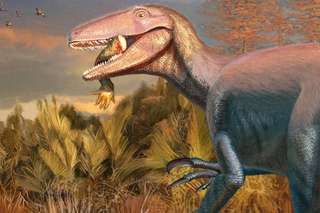
On sait enfin pourquoi le T. rex avait de si petits bras, et la réponse est brutale
membre prédateur Tyrannosaurus étude
Pendant des décennies, les minuscules bras du Tyrannosaurus rex ont intrigué les paléontologues. Comment un prédateur aussi gigantesque a-t-il pu évoluer avec des membres antérieurs si réduits ? Une nouvelle étude apporte aujourd’hui un début de réponse et elle pourrait bien concerner plusieurs...
20/05/2026 futura-terre
Mystery of Tyrannosaurus rex’s Tiny Arms May Finally Have an Answer
Le mystère des petits bras du Tyrannosaurus rex pourrait enfin avoir une réponse
os mâchoire prédateur proie Dinosauria Tyrannosaurus
Les paléontologues de l'University College de Londres et de l'Université de Cambridge affirment que les bras minuscules des grands dinosaures prédateurs ont évolué aux côtés de têtes massives et de mâchoires broyantes, ce qui suggère que les anciens prédateurs comptaient de plus en plus sur la morsure plutôt que sur la saisie de leurs proies. L’article Le mystère des petits bras du Tyrannosaurus rex pourrait enfin avoir une réponse apparaît en premier sur Sci.News : Breaking Science News.
20/05/2026 sci-news ⚙ Traduction automatique
Les petits bras du T. rex pourraient avoir évolué pour une raison étonnamment brutale
mâchoire membre chasse prédateur proie Dinosauria crâne
Pourquoi le T. rex avait-il des bras si petits ? Les scientifiques pensent désormais que c’est parce que sa tête géante est devenue l’outil de chasse ultime. Dans plusieurs groupes de dinosaures, des crânes plus forts et des mâchoires écrasantes ont évolué parallèlement à des membres antérieurs rétrécis, en particulier chez les prédateurs chassant d'énormes proies. En d’autres termes, une fois que la morsure est devenue suffisamment mortelle, les bras ont peut-être cessé d’avoir de l’importance.
20/05/2026 sciencedaily ⚙ Traduction automatique
1 2 3 4 5 6 7 8 9 10