Galerie d'images
Toutes les images de la base — taxons, formations et intervalles géologiques.
⚠ La fonctionnalité de récupération des images est en cours de test, des images non pertinentes peuvent apparaître.
4,274 image(s)

Cladogram of the former "Reptilia" (red)
Cladogram of the former "Reptilia" (red)


The Chicago specimen of Archaeopteryx (PA 830), a well-preserved fossil highlighting the transitional features between non-avian dinosaurs and birds, housed at the Field Museum of Natural History.


A badly drew sketch of Brontoholus (a placeholder for when an actual paleoart of Brontotholus is made.
A badly drew sketch of Brontoholus (a placeholder for when an actual paleoart of Brontotholus is made.


Apex Stegosaurus Reconstruction drawn Jan, 7, 2025 by Adam Treviño


Fossil of Anhanguera, an extinct reptile-- Took the photo at Natural History Museum, London

A cast replica of a skeletal mount of the prehistoric pterosaur Anhanguera blittersdorffi on display at Melbourne Museum in Victoria, Australia.

Life restoration of the Brazilian ornithocheiroid pterosaur Anhanguera blittersdorffi. Digital painting; credit Matt Martyniuk.

Anhanguera blittersdorffi holotype (MN 4805-V) in lateral view.

Model of an Anhanguera circling over the Acrocanthosaurus skeleton and its prey.

Anhanguera skeleton, North American Museum of Ancient Life.

A photograph of partial specimen American Museum of Natural History (AMNH) 22555, skull without mandible, of Anhanguera sp. (formerly often assigned to Anhanguera santanae),[1] from the Early Cretaceous Romualdo Formation (former Romualdo Member of the Santana Formation) of NE Brazil in right lateral view.

A photograph of partial specimen American Museum of Natural History (AMNH) 22555, anterior dorsal vertebrae, dorsal ribs and partial shoulder girdle (at least right scapula) of Anhanguera sp. (formerly often assigned to Anhanguera santanae),[1] from the Early Cretaceous Romualdo Formation (former Romualdo Member of the Santana Formation) of NE Brazil in dorsal view.

A photograph of partial specimen American Museum of Natural History (AMNH) 22555, posterior dorsal vertebrae, and the sacrum and pelvis (both iliae, and right ischium and pubis) of Anhanguera sp. (formerly often assigned to Anhanguera santanae),[1] from the Early Cretaceous Romualdo Formation (former Romualdo Member of the Santana Formation) of NE Brazil in dorsal view.


Spinosaurus ile Giganotosaurus ve Tyrannosaurus boyut kıyaslaması

A Spinosaurus illustration based on a work by Bugboy52.4. https://commons.wikimedia.org/wiki/File:Spinosaurus_skeleton.svg


A scientifically accurate reconstruction of the dinosaur Spinosaurus aegyptiacus.


Reconstrucuon of Bagaraatan ostromi gen. et sp. n. from the ?mid-Maastrichtian Nemegt Formation of Nemegt, Mongolia.

Caudal vertebrae in Begaraaten ostromi gen. et sp. n. from the ?mid-Maastrichtian Nemegt Formation at Nemegt, Mongolia. A-E. Preserved caudals lst-l3th (A-C) and 1Sth-20th (D, E) in lateral view. F. Anterlor view of 1st preserved caudal with articulated part of spine of preceding caudal. G. Anterior view of I I th preser-ved caudal. Scale bar 2 crn.

Posterior part of left mandible of Bagaraatan ostromi, stereophotographs. in lateral, posterior, dorsal, and medial views. Scale bar - 2 cm.

Model of Atlascopcosaurus in JuraPark, Solec Kujawski, Poland


Comparisons of Victorian ornithopod maxillae in lateral view and schematics, showing dorsalmost extent of the maxillary ramus (indicated by large arrows): (1) Galleonosaurus dorisae n. gen. n sp., holotypic left maxilla (NMV P229196); (2) Atlascopcosaurus loadsi Rich and Rich, 1989, left maxilla (NMV P157390); (3) cast of original holotypic left maxilla of Atlascopcosaurus loadsi (NMV P166409). alv = alveolus; bur = buccal ridge; lpf = lateral palatine flange of maxilla; m#’ = maxillary tooth position (from posterior end) and replacement number; ml = medial lamina of maxilla; mra = maxillary ramus; nvt = neurovascular tract; plp = posterolateral process of maxilla; pmp = posteromedial process of maxilla; sal = supralveolar lamina of maxilla. Scale bars = 10 mm.


The Tyrannosaurus rex, Dromaeosaurus, Triceratops, and Struthiomimus diorama in the Third Planet exhibit at the Milwaukee Public Museum in Milwaukee, Wisconsin (United States).

The Tyrannosaurus rex, Dromaeosaurus, Triceratops, and Struthiomimus diorama in the Third Planet exhibit at the Milwaukee Public Museum in Milwaukee, Wisconsin (United States).

The Tyrannosaurus rex, Dromaeosaurus, Triceratops, and Struthiomimus diorama in the Third Planet exhibit at the Milwaukee Public Museum in Milwaukee, Wisconsin (United States).

Triceratops mounted skeleton at Los Angeles Museum of Natural History, Los Angeles, United States of America

Detalle del mural de Jonathan Morillas (Doger) del año 2015 en el número 2 de la calle Pinillos, barrio de Lagunillas, Málaga, España. El mural presenta un paisaje prehistórico con un grupo de dinosaurios. En la imagen, tres pequeños tiranosaurios junto a un triceratops con diplodocus y pterosaurios al fondo.https://www.instagram.com/p/4ko3Tsq_IL][1]


Close-up of the traumatic lesion observed in the right squamosal bone of Big John, a fossilized specimen of the dinosaur species Triceratops horridus. This image shows plaque-like deposition of reactive bone (white arrows) and lytic lesions (black arrows) on the surface around the lesion. These suggest that the lesion was surrounded by newly-formed bone and, therefore, had started to heal. This image was originally published as Figure 1c in the following journal article: Ruggero D’Anastasio, Jacopo Cilli, Flavio Bacchia, Federico Fanti, Giacomo Gobbo & Luigi Capasso (2022) Histological and chemical diagnosis of a combat lesion in Triceratops Scientific Reports, 12, 3941 (2022). DOI: 10.1038/s41598-022-08033-2 This article was published with the following license: "This article is licensed under a Creative Commons Attribution 4.0 International License, which permits use, sharing, adaptation, distribution and reproduction in any medium or format, as long as you give appropriate credit to the original author(s) and the source, provide a link to the Creative Commons licence, and indicate if changes were made. The images or other third party material in this article are included in the article's Creative Commons licence, unless indicated otherwise in a credit line to the material. If material is not included in the article's Creative Commons licence and your intended use is not permitted by statutory regulation or exceeds the permitted use, you will need to obtain permission directly from the copyright holder. To view a copy of this licence, visit http://creativecommons.org/licenses/by/4.0/." Figure 1c is published without a credit line and, therefore, falls under the article's CC BY 4.0 licence.

Bench with triceratops carving, Drumheller, Alberta, 2025-07-13; located outside the Drumheller Valley Town Hall

Bench with triceratops named Effie (Euphemia), Drumheller, Alberta, 2025-07-13

Modell eines Triceratops horridus am Niedersächsischen Landesmuseum Hannover im Schnee

Reconstruction of three Elasmosaurus hunting Hesperornis. From Osborn, H. F. (1917). The origin and evolution of life, on the theory of action, reaction and interaction of energy.

Illustration of an Elasmosaurus platyurus devouring a juvenile Tylosaurus while a Hesperornis swims by in the background, based on recent research on Elasmosaurid paleobiology which shows that they were far more raptorial than previously thought: https://sobekswimmingpool.wordpress.com/2021/05/30/what-sea-dragons-ate-plesiosaur-diets-revised/

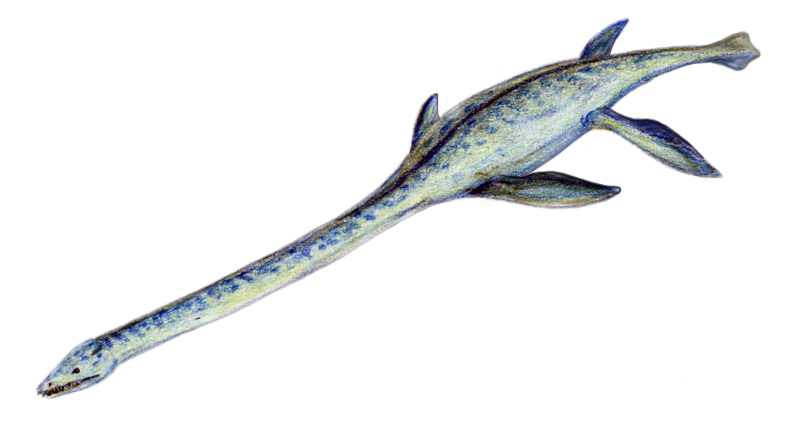
Elasmosaurus platyurus, plesiosaurian from Late Cretaceous (Campanian) of North America

Elasmosaurus platyurus, plesiosaurian from Late Cretaceous (Campanian) of North America




Extinct monsters London :Chapman & Hall,1896. biodiversitylibrary.org/page/14893531 Extinct Monsters London :Chapman & Hall,1896. www.biodiversitylibrary.org/item/51560


Shri rapax 3D skeletal reconstruction by Alex Pritchard of Dinosaur Skeletons.

Dorsal vertebra of platecarpus, a cretaceous. Mosasaur from the Niobrara Chalk of Kansas etc. General Collections Keywords: prehistoric archaeology; Paleopathology; Moodie, Roy Lee

Ichthyosaur Skeleton, Platypterygius longmani, in The Museum and Art Gallery of the Northern Territory at Darwin.

Remake of the original picture of the Drzewica Formation. Terrestrial environment of the Pliensbachian-Toarcian boundary of Fennoscandinavia Inland environment of the Bornholm Coast, nearby the German realm of the Ciechocinek Formation. Includes Ciechocinek Formation (Lower Toarcian, Bones) and Drzwica Formation (Latest Pliensbachian, Footprints) Fauna Sorthat Formation environment, fluvial influenced mainland with Cheirolepidaceae and Bennetitales as dominant flora Dinosaurs are based on material found on various locations of Northern Germany, and Footprints of the underliying Drzewica Formation at the Holy Cross Mountains, connected with Bornholm at the time. Dinosaur Species appeared: Megalosauripus isp. Large Footprints (+65 cm) found on the Drzewica Formation. There is a dorsal vertebrae on the German Margin of the Ciechocinek Formation assigend to Megalosauria (Huene, 1966). Gravisauria spp. representing the Grimmen Sauropod reported on 2014, as a taxon related with Tazoudasaurus. Barapasaurus-like footprints are know from the Drzewica Formation. Coelophysoidea spp. based on coeval Anchisauripus tracks from the Holy Cross Mountains. Basal Ornithischan, related to Eocursor, based on a crouching trace (Gerard Dariusz Gierlinski, Martin G. Lockley, Grzegorz Niedźwiedzki:2009). Massospondylidae spp. based on Otozum-like tracks.