←

spécimen

Nature du spécimen

204 image(s) · 23 Actualités

Galerie d'images

Holotype fossil specimen SMNS 12591 of Procompsognathus
Taxons Procompsognathinae

Holotype fossil specimen SMNS 12591 of Procompsognathus

fossile holotype spécimen Procompsognathinae +1
Dentaries of selected European rhabdodontomorphs in dorsal and lateral views. (A) Obelignathus septimanicus, holotype MDE D30, right dentary from the 'Grès à Reptiles' Formation, Montouliers (France); (B) Mochlodon vorosi holotype MTM V 2010.105.1, left dentary from the Csehbánya Formation, Iharkút (Hungary; mirrored); (C) Mochlodon suessi, lectotype PIUW 2349/2, right dentary from the Grünbach Formation, Muthmannsdorf (Austria); (D) Zalmoxes robustus holotype NHMUK R3392, right dentary from the Sinpetru Formation, Sânpetru (Romania); (E) Rhabdodon priscus, lectotype MPLM 30, left dentary from the Marnes Rouges Inférieures Formation, la Nerthe (France; mirrored drawing after Matheron; outline based on specimens MPLM 30 and MPLM 31, size estimation based on Matheron and Brinkman); (F) Zalmoxes shqiperorum holotype NHMUK R4900, right dentary from the Sinpetru Formation of Sânpetru (Romania; outline based on the specimen UBB NVZ1-1).

Dentaries of selected European rhabdodontomorphs in dorsal and lateral views. (A) Obelignathus septimanicus, holotype MDE D30, right dentary from the 'Grès à Reptiles' Formation, Montouliers (France); (B) Mochlodon vorosi holotype MTM V 2010.105.1, left dentary from the Csehbánya Formation, Iharkút (Hungary; mirrored); (C) Mochlodon suessi, lectotype PIUW 2349/2, right dentary from the Grünbach Formation, Muthmannsdorf (Austria); (D) Zalmoxes robustus holotype NHMUK R3392, right dentary from the Sinpetru Formation, Sânpetru (Romania); (E) Rhabdodon priscus, lectotype MPLM 30, left dentary from the Marnes Rouges Inférieures Formation, la Nerthe (France; mirrored drawing after Matheron; outline based on specimens MPLM 30 and MPLM 31, size estimation based on Matheron and Brinkman); (F) Zalmoxes shqiperorum holotype NHMUK R4900, right dentary from the Sinpetru Formation of Sânpetru (Romania; outline based on the specimen UBB NVZ1-1).

dessin Autriche France Hongrie +8
Composite skeletal reconstruction of Lewisuchus admixtus, all specimens overlap

Composite skeletal reconstruction of Lewisuchus admixtus, all specimens overlap

spécimen Lewisuchus
(A) Present day map of Australia with the town of Lightning Ridge indicated by the star. (B) Regional map of the Lightning Ridge region showing localities (where known) for specimens described in this text. Sealed (solid black lines) and unsealed roads (dashed lines) are indicated. The ephemeral Coocoran Lake is marked with a dotted blue line. (C) Correlative stratigraphy of the major Cretaceous depositional basins and geological units discussed in this study. The ornithopod icon and arrow indicate the approximate level of the Griman Creek Formation from which the current material pertains. Informal units are in quotation marks. Maps in (A) and (B) redrawn and modified from Bell et al. (2016) and Opal Fields—Lightning Ridge Region map produced by the NSW Department of Mineral Resources, respectively. Stratigraphy based on Toslini, McLoughlin & Drinnan (1999) and Cook, Bryan & Draper (2013). Ornithopod silhouette created by Caleb M. Brown and used under the Creative Commons Attribution-ShareAlike 3.0 Unported license.

(A) Present day map of Australia with the town of Lightning Ridge indicated by the star. (B) Regional map of the Lightning Ridge region showing localities (where known) for specimens described in this text. Sealed (solid black lines) and unsealed roads (dashed lines) are indicated. The ephemeral Coocoran Lake is marked with a dotted blue line. (C) Correlative stratigraphy of the major Cretaceous depositional basins and geological units discussed in this study. The ornithopod icon and arrow indicate the approximate level of the Griman Creek Formation from which the current material pertains. Informal units are in quotation marks. Maps in (A) and (B) redrawn and modified from Bell et al. (2016) and Opal Fields—Lightning Ridge Region map produced by the NSW Department of Mineral Resources, respectively. Stratigraphy based on Toslini, McLoughlin & Drinnan (1999) and Cook, Bryan & Draper (2013). Ornithopod silhouette created by Caleb M. Brown and used under the Creative Commons Attribution-ShareAlike 3.0 Unported license.

Australie Griman Creek Crétacé spécimen +3
Eubrontes dinosaur track from the Jurassic of Connecticut, USA.
Trace fossils are any indirect evidence of ancient life.  They refer to features in rocks that do not represent parts of the body of a once-living organism.  Traces include footprints, tracks, trails, burrows, borings, and bitemarks.  Body fossils provide information about the morphology of ancient organisms, while trace fossils provide information about the behavior of ancient life forms.  Interpreting trace fossils and determination of the identity of a trace maker can be straightforward (for example, a dinosaur footprint represents walking behavior) or not.  Sediments that have trace fossils are said to be bioturbated.  Burrowed textures in sedimentary rocks are referred to as bioturbation.  Trace fossils have scientific names assigned to them, in the same style & manner as living organisms or body fossils.
This track was made by a theropod, a group of small to large, carnivorous, bipedal dinosaurs.  The specimen comes from a Triassic to Jurassic terrestrial sedimentary succession that filled up a half graben, many of which occur along America's eastern seaboard.  Such half-graben basins formed during the Triassic as the Pangaea supercontinent tried to rift apart, but failed.  Pangaea successfully broke apart during the Jurassic.
Stratigraphy: East Berlin Formation, Newark Supergroup, Lower Jurassic
Locality: unrecorded / undisclosed site at or near the town of Rocky Hill, central Connecticut, USA


Info. at:
mrdata.usgs.gov/geology/state/sgmc-unit.php?unit=CTJeb%3B0
and

en.wikipedia.org/wiki/Eubrontes

Eubrontes dinosaur track from the Jurassic of Connecticut, USA. Trace fossils are any indirect evidence of ancient life. They refer to features in rocks that do not represent parts of the body of a once-living organism. Traces include footprints, tracks, trails, burrows, borings, and bitemarks. Body fossils provide information about the morphology of ancient organisms, while trace fossils provide information about the behavior of ancient life forms. Interpreting trace fossils and determination of the identity of a trace maker can be straightforward (for example, a dinosaur footprint represents walking behavior) or not. Sediments that have trace fossils are said to be bioturbated. Burrowed textures in sedimentary rocks are referred to as bioturbation. Trace fossils have scientific names assigned to them, in the same style & manner as living organisms or body fossils. This track was made by a theropod, a group of small to large, carnivorous, bipedal dinosaurs. The specimen comes from a Triassic to Jurassic terrestrial sedimentary succession that filled up a half graben, many of which occur along America's eastern seaboard. Such half-graben basins formed during the Triassic as the Pangaea supercontinent tried to rift apart, but failed. Pangaea successfully broke apart during the Jurassic. Stratigraphy: East Berlin Formation, Newark Supergroup, Lower Jurassic Locality: unrecorded / undisclosed site at or near the town of Rocky Hill, central Connecticut, USA Info. at: mrdata.usgs.gov/geology/state/sgmc-unit.php?unit=CTJeb%3B0 and en.wikipedia.org/wiki/Eubrontes

États-Unis Jurassique Trias fossile +5
The type specimen of the ichnogenus Cheliceratichnus, from the Early Jurassic East Berlin Formation of Holyoke, Massachusetts.

The type specimen of the ichnogenus Cheliceratichnus, from the Early Jurassic East Berlin Formation of Holyoke, Massachusetts.

East Berlin Jurassique inférieur Jurassique spécimen +1
Bifurculapes laqueatus trackway (positive hyporelief, i.e. casts on the bottom surface of the bed) from the Early Jurassic East Berlin Formation (Hartford Basin) of Holyoke, Massachusetts (not the same specimen as this one). See coin (1 U.S. cent, 19.05 mm in diameter) for scale.

Bifurculapes laqueatus trackway (positive hyporelief, i.e. casts on the bottom surface of the bed) from the Early Jurassic East Berlin Formation (Hartford Basin) of Holyoke, Massachusetts (not the same specimen as this one). See coin (1 U.S. cent, 19.05 mm in diameter) for scale.

écaille East Berlin Jurassique inférieur Jurassique +3
Bifurculapes laqueatus trackway (positive hyporelief, i.e. casts on the bottom surface of the bed) from the Early Jurassic East Berlin Formation (Hartford Basin) of Holyoke, Massachusetts (not the same specimen as this one). See coin (1 U.S. cent, 19.05 mm in diameter) for scale.

Bifurculapes laqueatus trackway (positive hyporelief, i.e. casts on the bottom surface of the bed) from the Early Jurassic East Berlin Formation (Hartford Basin) of Holyoke, Massachusetts (not the same specimen as this one). See coin (1 U.S. cent, 19.05 mm in diameter) for scale.

écaille East Berlin Jurassique inférieur Jurassique +3
A trackway of the trace fossil Bifurculapes laqueatus (positive hyporelief, i.e. casts on the bottom surface of the bed) from the Early Jurassic East Berlin Formation (Hartford Basin) of Holyoke, Massachusetts (not the same specimen as this one). Scale is in cm.
Formations East Berlin

A trackway of the trace fossil Bifurculapes laqueatus (positive hyporelief, i.e. casts on the bottom surface of the bed) from the Early Jurassic East Berlin Formation (Hartford Basin) of Holyoke, Massachusetts (not the same specimen as this one). Scale is in cm.

écaille East Berlin Jurassique inférieur Jurassique +4
Geological context of the Lower Cretaceous deposits of southeast England, focussing on the Purbeck Group and Wealden Supergroup.

(A) Schematic geology of the Lower Cretaceous deposits of the Weald Sub-basin (southeast England), highlighting published spinosaurid finds (Charig & Milner, 1997; Salisbury & Naish, 2011; Turmine-Juhel et al., 2019). Based on Austen & Batten (2018: Fig. 2). Note that various additional spinosaurid teeth are known from the region but remain undescribed in detail (Fowler, 2007). (B) Simplified stratigraphic column of the Weald Group in southeast England, based on Batten & Austen (2011: Fig. 3.2). Note that the Grinstead Clay Formation, which subdivides the Tunbridge Wells Sands Formation in Batten & Austen (2011) and from which the “Suchosaurus cultridens” type specimen was discovered (Salisbury & Naish, 2011), is downgraded to a member of the latter formation in other works (Hopson, Wilkinson & Woods, 2008) and has not been included in this column. Spinosaurid silhouette courtesy of Dan Folkes (CC-BY 4.0).
Formations Durlston

Geological context of the Lower Cretaceous deposits of southeast England, focussing on the Purbeck Group and Wealden Supergroup. (A) Schematic geology of the Lower Cretaceous deposits of the Weald Sub-basin (southeast England), highlighting published spinosaurid finds (Charig & Milner, 1997; Salisbury & Naish, 2011; Turmine-Juhel et al., 2019). Based on Austen & Batten (2018: Fig. 2). Note that various additional spinosaurid teeth are known from the region but remain undescribed in detail (Fowler, 2007). (B) Simplified stratigraphic column of the Weald Group in southeast England, based on Batten & Austen (2011: Fig. 3.2). Note that the Grinstead Clay Formation, which subdivides the Tunbridge Wells Sands Formation in Batten & Austen (2011) and from which the “Suchosaurus cultridens” type specimen was discovered (Salisbury & Naish, 2011), is downgraded to a member of the latter formation in other works (Hopson, Wilkinson & Woods, 2008) and has not been included in this column. Spinosaurid silhouette courtesy of Dan Folkes (CC-BY 4.0).

Crétacé spécimen Spinosauridae Suchosaurus +2
MRF 319, a partial oviraptorosaurian skeleton referred to Anzu wyliei. 
(A) Skeletal reconstruction in left lateral view, with preserved bones in gray and bones represented in other Anzu specimens in white (hatching indicates heavily reconstructed portions of the ilia of CM 78001). Middle-posterior (ninth?) cervical vertebra in (B) anterior, (C) left lateral, and (D) dorsal views. Posterior (11th?) cervical vertebra in (E) anterior, (F) left lateral, and (G) dorsal views. Posterior (12th?) cervical vertebra in (H) anterior, (I) left lateral, and (J) dorsal views. Anteroposteriorly crushed left radius in lateral (K) and anterior (L) views. Mediolaterally crushed left ulna in lateral (M) and anterior (N) views. (O) Partial left scapulocoracoid in lateral view. Dorsal rib in anterior (P) and posterior (Q) views. Abbreviations: acr, acromial process; cr, cervical rib; dip, distal processes; pat, pathology; pf, pneumatic fossa. Scale bars = 50 cm in A; 1 cm in B–Q.

MRF 319, a partial oviraptorosaurian skeleton referred to Anzu wyliei. (A) Skeletal reconstruction in left lateral view, with preserved bones in gray and bones represented in other Anzu specimens in white (hatching indicates heavily reconstructed portions of the ilia of CM 78001). Middle-posterior (ninth?) cervical vertebra in (B) anterior, (C) left lateral, and (D) dorsal views. Posterior (11th?) cervical vertebra in (E) anterior, (F) left lateral, and (G) dorsal views. Posterior (12th?) cervical vertebra in (H) anterior, (I) left lateral, and (J) dorsal views. Anteroposteriorly crushed left radius in lateral (K) and anterior (L) views. Mediolaterally crushed left ulna in lateral (M) and anterior (N) views. (O) Partial left scapulocoracoid in lateral view. Dorsal rib in anterior (P) and posterior (Q) views. Abbreviations: acr, acromial process; cr, cervical rib; dip, distal processes; pat, pathology; pf, pneumatic fossa. Scale bars = 50 cm in A; 1 cm in B–Q.

os écaille vertèbre pathologie +5
MRF 319, a partial oviraptorosaurian skeleton referred to Anzu wyliei. Skeletal reconstruction in left lateral view, with preserved bones in gray and bones represented in other Anzu specimens in white (hatching indicates heavily reconstructed portions of the ilia. Scale bar = 50 cm (19.7 in)

MRF 319, a partial oviraptorosaurian skeleton referred to Anzu wyliei. Skeletal reconstruction in left lateral view, with preserved bones in gray and bones represented in other Anzu specimens in white (hatching indicates heavily reconstructed portions of the ilia. Scale bar = 50 cm (19.7 in)

os écaille spécimen Anzu +3
Restored skeleton of Anzu wyliei (previously labelled as a specimen of Chirostenotes)

Restored skeleton of Anzu wyliei (previously labelled as a specimen of Chirostenotes)

États-Unis spécimen Anzu Chirostenotes +1
Restored skeleton of Anzu wyliei (previously labelled as a specimen of Chirostenotes)

Restored skeleton of Anzu wyliei (previously labelled as a specimen of Chirostenotes)

États-Unis spécimen Anzu Chirostenotes +1
Photo montage of different specimens of mosasaurs: 
Opetiosaurus
Vallecillosaurus
Halisaurus
Plotosaurus
Platecarpus
Tylosaurus
Taxons Plotosaurus

Photo montage of different specimens of mosasaurs: Opetiosaurus Vallecillosaurus Halisaurus Plotosaurus Platecarpus Tylosaurus

spécimen Halisaurus Platecarpus Plotosaurus +1
Comparison of the digit III/footprint length ratio for Eubrontes of the same size in America, Europe, and China. American specimens: (a) Eubrontes giganteus AC 15/3, type specimens (Lockley 2009); (b) Eubrontes giganteus AC 45/1 (Olsen et al. 1998); (c) Utah Eubrontes 1 (Lockley et al. 1998); (d) Utah Eubrontes 2 (T3) (Lockley et al. 2021); (e) Connecticut Eubrontes (Ishigaki and Fujisaki 1989); (f) Eubrontes (?) glenrosensis (Adams et al. 2010); European specimen: (g) Eubrontes veillonensis (de Lapparent and Montenat 1967); Chinese specimens: (h) Eubrontes pareschequier (Xing et al. 2009a, 2014b); (i) Eubrontes zigongensis (Xing et al. 2014c); (j) Eubrontes platypus (Hitchcock 1858) Xiyang specimen (Yang and Yang 1987); (k) Eubrontes monax (Zhen et al. 1986; Lockley et al. 2013); (l) Eubrontes xiyangensis (Zhen et al. 1986; Lockley et al. 2013); (m) Changpeipus carbonicus (Xing et al. 2014b); (n) Eubrontes nianpanshanensis (Xing et al. 2016b); (o) Lufengopus dongi (Lü et al. 2006; Xing et al. 2014d); (p) Eubrontes (?) glenrosensis Hailiutu specimen (Li et al. 2010; Xing et al. 2021); (q) Lockleypus luanpingeris (Xing et al. 2018e); (r) Chapus lockleyi (Li et al. 2006); (s) Asianopodus pulvinicalyx (Matsukawa et al. 2005); (t) Asianopodus robustus (Li et al. 2011; Lockley et al. 2018); (u) Eubrontes nobitai (This study); (v) Eubrontes HX-T3 (Xing et al. 2015b); (w) Eubrontes BJA-T4 (Xing et al. 2016c)
Taxons Asianopodus

Comparison of the digit III/footprint length ratio for Eubrontes of the same size in America, Europe, and China. American specimens: (a) Eubrontes giganteus AC 15/3, type specimens (Lockley 2009); (b) Eubrontes giganteus AC 45/1 (Olsen et al. 1998); (c) Utah Eubrontes 1 (Lockley et al. 1998); (d) Utah Eubrontes 2 (T3) (Lockley et al. 2021); (e) Connecticut Eubrontes (Ishigaki and Fujisaki 1989); (f) Eubrontes (?) glenrosensis (Adams et al. 2010); European specimen: (g) Eubrontes veillonensis (de Lapparent and Montenat 1967); Chinese specimens: (h) Eubrontes pareschequier (Xing et al. 2009a, 2014b); (i) Eubrontes zigongensis (Xing et al. 2014c); (j) Eubrontes platypus (Hitchcock 1858) Xiyang specimen (Yang and Yang 1987); (k) Eubrontes monax (Zhen et al. 1986; Lockley et al. 2013); (l) Eubrontes xiyangensis (Zhen et al. 1986; Lockley et al. 2013); (m) Changpeipus carbonicus (Xing et al. 2014b); (n) Eubrontes nianpanshanensis (Xing et al. 2016b); (o) Lufengopus dongi (Lü et al. 2006; Xing et al. 2014d); (p) Eubrontes (?) glenrosensis Hailiutu specimen (Li et al. 2010; Xing et al. 2021); (q) Lockleypus luanpingeris (Xing et al. 2018e); (r) Chapus lockleyi (Li et al. 2006); (s) Asianopodus pulvinicalyx (Matsukawa et al. 2005); (t) Asianopodus robustus (Li et al. 2011; Lockley et al. 2018); (u) Eubrontes nobitai (This study); (v) Eubrontes HX-T3 (Xing et al. 2015b); (w) Eubrontes BJA-T4 (Xing et al. 2016c)

Chine spécimen Asianopodus Changpeipus +2
1 2 3 4 5 6 7 8 9 10 11 12 13

Actualités

Le séquençage du génome d’échantillons de musée pourrait transformer la science
musée spécimen découverte évolution génétique
Les musées d'histoire naturelle pourraient détenir la clé de découvertes scientifiques majeures, selon un nouvel article. Le séquençage du génome des spécimens de musée pourrait transformer la recherche en évolution, conservation, médecine et changement environnemental. Les collections d’histoire naturelle du monde entier contiennent plus d’un milliard de spécimens. Ensemble, ils préservent une énorme quantité d’informations génétiques. Cependant, les scientifiques ont séquencé
21/09/2026 everythingdinosaur ⚙ Traduction automatique
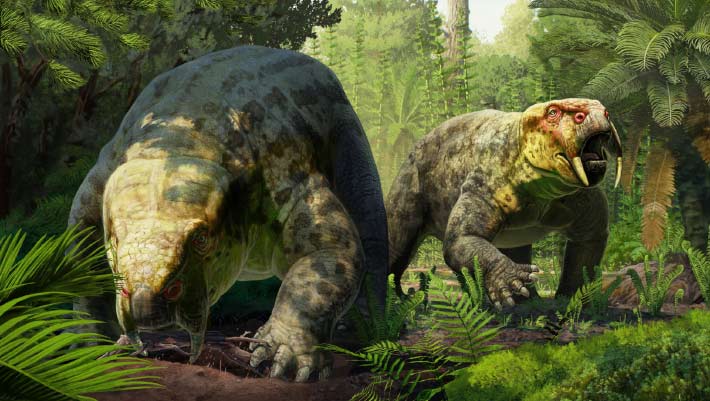
New Dicynodont Species from Tanzania Suggests Younger Age for Rocks Tied to Earliest Dinosaurs
Une nouvelle espèce de dicynodonte de Tanzanie suggère un âge plus jeune pour les roches liées aux premiers dinosaures
Tanzanie fossile spécimen Dinosauria nouvelle espèce
Les paléontologues ont identifié une nouvelle espèce de mammifère ancien et éloigné à partir de deux spécimens fossiles trouvés à des décennies d'intervalle dans les lits Manda de Tanzanie. L'article Une nouvelle espèce de dicynodonte de Tanzanie suggère un âge plus jeune pour les roches liées aux premiers dinosaures apparaît en premier sur Sci.News : Breaking Science News.
15/09/2026 sci-news ⚙ Traduction automatique
Un remarquable fossile de reptile marin du Trias préserve les organes internes
Chine Trias fossile spécimen anatomie squelette
Les scientifiques ont décrit un fossile exceptionnel du reptile marin du Trias au long cou, Austronaga minuta. Le spécimen vient de Chine et a environ 245 millions d’années. Remarquablement, une grande partie du système digestif de l’animal a été préservée. Le fossile presque complet offre aux scientifiques une vue sans précédent du squelette et de l’anatomie interne d’un archosauromorphe.
26/08/2026 everythingdinosaur ⚙ Traduction automatique
Un fossile remarquable révèle le régime alimentaire d'un ichtyosaure du Jurassique supérieur
Allemagne Jurassique Jurassique supérieur fossile spécimen Aegirosaurus Ichthyosauria Jabalisaurus squelette
Les scientifiques étudiant l’ichtyosaure Jabalisaurus tethyensis, récemment décrit, ont acquis un aperçu remarquable de son régime alimentaire. Un fossile magnifiquement conservé du sud de l'Allemagne contient des preuves des derniers repas de l'animal. De plus, le spécimen préserve des détails importants du squelette et des contours du corps. Le fossile, numéro de spécimen JME-SOS-08369, était auparavant attribué à Aegirosaurus. Cependant, les chercheurs
24/08/2026 everythingdinosaur ⚙ Traduction automatique
Nouvelles lignes directrices importantes pour les collections d’histoire naturelle coloniale
musée spécimen
Le Museum für Naturkunde Berlin a publié de nouvelles directives concernant les collections d'histoire naturelle coloniale. La publication examine comment les musées et autres institutions peuvent travailler de manière responsable avec des spécimens et des objets provenant d'anciens territoires coloniaux. Les collections d'histoire naturelle constituent une ressource inestimable pour les scientifiques. Cependant, les spécimens acquis pendant les périodes coloniales peuvent aussi refléter des inégalités historiques, des rapports de pouvoir
22/08/2026 everythingdinosaur ⚙ Traduction automatique
1 2 3 4 5