spécimen

Nature du spécimen

177 image(s) · 15 Actualités

Galerie d'images

Pterodactylus compressirostris, holotype NHMUK PV 39410 (Cenomanian / Turonian, Chalk Formation). A–D proposed lectotype, fragment of the mandibular symphysis A left lateral view B respective line drawing C dorsal view D respective line drawing. E–H referred specimen, portion of the rostrum E left lateral view F respective line drawing G ventral view H respective line drawing. Abbreviations: ch – choanae, d – dentary, m – maxillae, naof – nasoantorbital fenestra, pl – palatine, pm – premaxillae, prid – palatal ridge, sul– sulcus. Arrows indicate alveoli or teeth. Scale bar = 10 mm. Photos courtesy of The Natural History Museum.
Taxons Lonchodectidae

Pterodactylus compressirostris, holotype NHMUK PV 39410 (Cenomanian / Turonian, Chalk Formation). A–D proposed lectotype, fragment of the mandibular symphysis A left lateral view B respective line drawing C dorsal view D respective line drawing. E–H referred specimen, portion of the rostrum E left lateral view F respective line drawing G ventral view H respective line drawing. Abbreviations: ch – choanae, d – dentary, m – maxillae, naof – nasoantorbital fenestra, pl – palatine, pm – premaxillae, prid – palatal ridge, sul– sulcus. Arrows indicate alveoli or teeth. Scale bar = 10 mm. Photos courtesy of The Natural History Museum.

écaille dessin musée Cénomanien +8
Right dentary of Zalmoxes shqiperorum holotype NHMUK R4900in dorsal and lateral views, from the Sinpetru Formation of Sânpetru (Romania; outline based on the specimen UBB NVZ1-1).
Taxons Ferenceratops

Right dentary of Zalmoxes shqiperorum holotype NHMUK R4900in dorsal and lateral views, from the Sinpetru Formation of Sânpetru (Romania; outline based on the specimen UBB NVZ1-1).

Roumanie holotype spécimen Ferenceratops +2
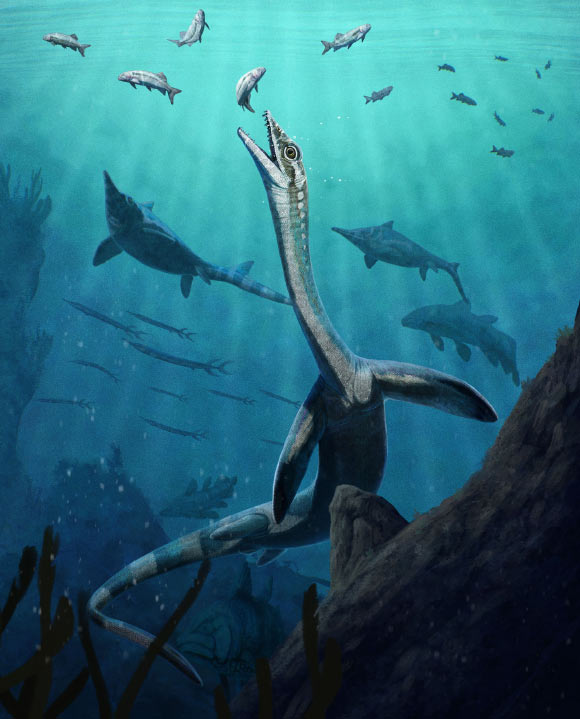
Polycotylus latipinnis specimen (LACM 129639) containing a fetus on display at the Natural History Museum of Los Angeles County.
Taxons Polycotylus

Polycotylus latipinnis specimen (LACM 129639) containing a fetus on display at the Natural History Museum of Los Angeles County.

musée spécimen Polycotylus
Fossil specimen, CM 11422, of Nyctosaurus gracilis
Taxons Nyctosaurus

Fossil specimen, CM 11422, of Nyctosaurus gracilis

fossile spécimen Nyctosauridae Nyctosaurus
Fossil specimen, CM 11422, of Nyctosaurus gracilis
Taxons Nyctosauridae

Fossil specimen, CM 11422, of Nyctosaurus gracilis

fossile spécimen Nyctosauridae Nyctosaurus
Fossil specimen, CM 11422, of Nyctosaurus gracilis
Taxons Nyctosauridae

Fossil specimen, CM 11422, of Nyctosaurus gracilis

fossile spécimen Nyctosauridae Nyctosaurus
Archaeopteryx lithographica, specimen displayed at the Museum für Naturkunde in Berlin. (This image shows the original fossil - not a cast.)
Taxons Archaeopteryx

Archaeopteryx lithographica, specimen displayed at the Museum für Naturkunde in Berlin. (This image shows the original fossil - not a cast.)

musée moulage fossile spécimen +1
Holotype specimen of Hylaeosaurus armatus Mantell, 1833 (NMH R3775) from the Grinstead Clay Formation (late Valanginian) of Tilgate Forest, Sussex, southern England.
Taxons Hylaeosaurus

Holotype specimen of Hylaeosaurus armatus Mantell, 1833 (NMH R3775) from the Grinstead Clay Formation (late Valanginian) of Tilgate Forest, Sussex, southern England.

Valanginien holotype spécimen Hylaeosaurus +2
Holotype specimen of Hylaeosaurus armatus Mantell, 1833 (NMH R3775) from the Grinstead Clay Formation (late Valanginian) of Tilgate Forest, Sussex, southern England.
Taxons Hylosaurus

Holotype specimen of Hylaeosaurus armatus Mantell, 1833 (NMH R3775) from the Grinstead Clay Formation (late Valanginian) of Tilgate Forest, Sussex, southern England.

Valanginien holotype spécimen Hylaeosaurus +2
The nodosaurid dinosaur, Glyptodontopelta is mostly known from isolated osteoderms ("armor plates"). The specimen SMP VP-1580 (State Museum of Pennysylvania) is however, the most complete known specimen, comprising parts of the skull, hundreds of osteoderms and fragments. This specimen was discovered in 2003 by Warwick Fowler, in the Naashoibito Member of the Ojo Alamo Formation (Maatrichtian, Late Cretaceous) of the San Juan Basin, New Mexico, during an expedition led by Dr. Robert Sullivan.
Taxons Glyptodontopelta

The nodosaurid dinosaur, Glyptodontopelta is mostly known from isolated osteoderms ("armor plates"). The specimen SMP VP-1580 (State Museum of Pennysylvania) is however, the most complete known specimen, comprising parts of the skull, hundreds of osteoderms and fragments. This specimen was discovered in 2003 by Warwick Fowler, in the Naashoibito Member of the Ojo Alamo Formation (Maatrichtian, Late Cretaceous) of the San Juan Basin, New Mexico, during an expedition led by Dr. Robert Sullivan.

armure musée Mexique Denver +9
Ornithocheirus simus. A–D holotype CAMSM B54428 (Albian, Cambridge Greensand), anterior part of the rostrum A left lateral view B respective line drawing C ventral view D respective line drawing E–H referred specimen CAMSM B54552 (Albian, Cambridge Greensand), anterior part of the rostrum E anterior view F respective line drawing G left lateral view H respective line drawing. Abbreviations: m – maxillae, pm – premaxillae. Arrows and numbers indicate alveoli or teeth and their respective position. Scale bar = 10 mm.
Taxons Ornithocheirus

Ornithocheirus simus. A–D holotype CAMSM B54428 (Albian, Cambridge Greensand), anterior part of the rostrum A left lateral view B respective line drawing C ventral view D respective line drawing E–H referred specimen CAMSM B54552 (Albian, Cambridge Greensand), anterior part of the rostrum E anterior view F respective line drawing G left lateral view H respective line drawing. Abbreviations: m – maxillae, pm – premaxillae. Arrows and numbers indicate alveoli or teeth and their respective position. Scale bar = 10 mm.

écaille dessin Albien holotype +2
Photograph of Museo civico di scienze naturali di Bergamo (MCSNB) 2888, the holotype specimen of Eudimorphodon ranzii ZAMBELLI 1973, a basal pterosaur from the Norian (middle Upper Triassic) of the Italian Alps.[1]


↑ see fig. 8A in Silvio Renesto (2006): A reappraisal of the diversity and biogeographic significance of the Norian (Late Triassic) reptiles from the Calcare di Zorzino. In: Jerry D. Harris, Spencer G. Lucas, Justin A. Spielmann, Martin G. Lockley, Andrew R.C. Milner, James I. Kirkland (eds.): The Triassic-Jurassic Terrestrial Transition. New Mexico Museum of Natural History and Science Bulletin 37:445–456 (online)
Taxons Eudimorphodon

Photograph of Museo civico di scienze naturali di Bergamo (MCSNB) 2888, the holotype specimen of Eudimorphodon ranzii ZAMBELLI 1973, a basal pterosaur from the Norian (middle Upper Triassic) of the Italian Alps.[1] ↑ see fig. 8A in Silvio Renesto (2006): A reappraisal of the diversity and biogeographic significance of the Norian (Late Triassic) reptiles from the Calcare di Zorzino. In: Jerry D. Harris, Spencer G. Lucas, Justin A. Spielmann, Martin G. Lockley, Andrew R.C. Milner, James I. Kirkland (eds.): The Triassic-Jurassic Terrestrial Transition. New Mexico Museum of Natural History and Science Bulletin 37:445–456 (online)

musée Mexique Jurassique Trias supérieur +6
Holotype specimen of Pterodactylus antiquus, BSP AS I 739.
Original photograph by Steven U. Vidovic, David M. Martill in http://www.plosone.org/article/info%3Adoi%2F10.1371%2Fjournal.pone.0110646

Modified by Matthew Martyniuk: Cropped, color adjusted. Top central portion of non-fossil-bearing slab digitally altered to remove portion of ruler.
Taxons Pterodactylus

Holotype specimen of Pterodactylus antiquus, BSP AS I 739. Original photograph by Steven U. Vidovic, David M. Martill in http://www.plosone.org/article/info%3Adoi%2F10.1371%2Fjournal.pone.0110646 Modified by Matthew Martyniuk: Cropped, color adjusted. Top central portion of non-fossil-bearing slab digitally altered to remove portion of ruler.

fossile holotype spécimen Ptenodracon +1
Holotype specimen of Pterodactylus antiquus, BSP AS I 739.
Original photograph by Steven U. Vidovic, David M. Martill in http://www.plosone.org/article/info%3Adoi%2F10.1371%2Fjournal.pone.0110646

Modified by Matthew Martyniuk: Cropped, color adjusted. Top central portion of non-fossil-bearing slab digitally altered to remove portion of ruler.
Taxons Ptenodracon

Holotype specimen of Pterodactylus antiquus, BSP AS I 739. Original photograph by Steven U. Vidovic, David M. Martill in http://www.plosone.org/article/info%3Adoi%2F10.1371%2Fjournal.pone.0110646 Modified by Matthew Martyniuk: Cropped, color adjusted. Top central portion of non-fossil-bearing slab digitally altered to remove portion of ruler.

fossile holotype spécimen Ptenodracon +1
Mounted skeleton of Acrocanthosaurus specimen NCSM 14345 at North Carolina Museum of Natural Sciences
Taxons Acrocanthosaurus

Mounted skeleton of Acrocanthosaurus specimen NCSM 14345 at North Carolina Museum of Natural Sciences

musée spécimen Acrocanthosaurus squelette
The skull of a Chasmosaurus mariscalensis, on display at the Texas Memorial Museum. Chasmosaurus was a Cretaceous ceratopsian of North America. This specimen was discovered in Brewster County, Texas.
Taxons Agujaceratops

The skull of a Chasmosaurus mariscalensis, on display at the Texas Memorial Museum. Chasmosaurus was a Cretaceous ceratopsian of North America. This specimen was discovered in Brewster County, Texas.

musée Crétacé spécimen Agujaceratops +3
1 2 3 4 5 6 7 8 9 10 11 12

Actualités

Museum Fossil Reveals Triassic Crocodile Cousin with Powerful Jaws
Un fossile de musée révèle un cousin crocodile du Trias doté de mâchoires puissantes
mâchoire musée Trias supérieur Trias fossile spécimen tomographie nouvelle espèce
Les tomodensitogrammes d'un spécimen vieux de plusieurs décennies du Musée d'histoire naturelle de Yale Peabody montrent une nouvelle espèce de crocodylomorphe au museau court et aux mâchoires inhabituellement fortes, offrant un instantané rare de la spécialisation écologique à l'époque du Trias supérieur. Le post Museum Fossil révèle un cousin crocodile du Trias doté de mâchoires puissantes est apparu en premier sur Sci.News: Breaking Science News.
20/04/2026 sci-news ⚙ Traduction automatique
Épisode 174 : Une histoire des dinosaures en 50 fossiles
musée fossile spécimen Dinosauria
Le professeur Paul Barrett du Natural History Museum de Londres a récemment écrit A History of Dinosaurs in 50 Fossils. Nous en avons profité pour avoir un aperçu de ce que nous savons réellement sur les dinosaures et comment il est même possible de raconter leur histoire avec seulement 50 spécimens. Dans cet épisode, Paul discute de l'histoire [&hellip
15/04/2026 palaeocast ⚙ Traduction automatique
Cette petite griffe dans un fossile vieux de 500 millions d'années vient de réécrire l'origine des araignées
griffe Cambrien fossile spécimen
Ce qui a commencé comme un nettoyage de routine des fossiles s'est transformé en une surprise scientifique majeure lorsque des chercheurs ont découvert une petite griffe dans un spécimen vieux de 500 millions d'années, là où aucune griffe ne devrait exister. Ce détail a révélé Megachelicerax cousteaui, le plus ancien parent connu des araignées, repoussant les origines de ce groupe de 20 millions d'années. Le fossile montre que les principales caractéristiques des araignées et des limules modernes étaient déjà apparues lors de l'explosion cambrienne.
03/04/2026 sciencedaily ⚙ Traduction automatique
Haolong: Beast of the Week
Haolong : Bête de la semaine
Chine Crétacé Crétacé inférieur juvénile spécimen Dinosauria Haolong
 Cette semaine, nous allons découvrir un dinosaure nouvellement décrit qui est si unique qu'il change complètement ce que nous pensions savoir sur la peau des dinosaures !  Entrez Haolong Dongi ! Haolong était un dinosaure herbivore qui vivait dans ce qui est aujourd'hui le Liaoning, en Chine, au début du Crétacé, il y a environ 112,5 millions d'années.  Le seul spécimen enregistré mesure environ 8 pieds (2,45 m) du bec à la queue, mais il était juvénile lorsqu'il est mort, l'espèce a donc probablement grandi.  Le nom du genre se traduit du chinois par "S
08/03/2026 prehistoricbeastoftheweek ⚙ Traduction automatique
Il a fallu 40 ans au T. rex pour atteindre sa taille réelle, selon une étude
os croissance prédateur spécimen Tyrannosaurus étude
Le Tyrannosaurus rex a peut-être mis beaucoup plus de temps à grandir que les scientifiques ne le pensaient autrefois. En analysant les anneaux de croissance des os fossilisés des pattes de 17 spécimens de tyrannosaures et en utilisant de nouvelles méthodes statistiques, les chercheurs ont découvert que le célèbre prédateur avait probablement mis environ 40 ans pour atteindre sa taille maximale, soit environ huit tonnes, au lieu des 25 ans précédemment estimés.
05/03/2026 sciencedaily ⚙ Traduction automatique
1 2 3