←

évolution

Thématique

17 image(s) · 72 Actualités

Galerie d'images

Rates of skeletal character evolution in the skull and postcranial skeleton of hadrosauroids. Cladograms illustrate the results from branch likelihood tests for two morphological partitions: skull (cranium and mandible) (A) and postcranial skeleton (B). In both cladograms, results from the branch likelihood tests are summarized on a strict consensus tree derived from four separately analyzed MPTs, each with 100 dating replicates (a total of 400 Hedman-dated phylogenies). Pie charts on branches illustrate the proportion of dating replicates that showed significantly high rates (red), slow rates (blue), or nonsignificant average rates (white). No pie charts are plotted on branches that showed nonsignificant rates in 100% of dating replicates. Branches that showed high rates (red) in more than 50% of dating replicates are doubled in length. See the Supplementary Material for Hedman-based results plotted separately for each MPT (Supplementary Fig. S2) and for results using the MBL dating method (Supplementary Fig. S3). Silhouettes were created by Scott Hartman and were downloaded from http://phylopic.org (Creative Commons license CC BY 3.0).

Rates of skeletal character evolution in the skull and postcranial skeleton of hadrosauroids. Cladograms illustrate the results from branch likelihood tests for two morphological partitions: skull (cranium and mandible) (A) and postcranial skeleton (B). In both cladograms, results from the branch likelihood tests are summarized on a strict consensus tree derived from four separately analyzed MPTs, each with 100 dating replicates (a total of 400 Hedman-dated phylogenies). Pie charts on branches illustrate the proportion of dating replicates that showed significantly high rates (red), slow rates (blue), or nonsignificant average rates (white). No pie charts are plotted on branches that showed nonsignificant rates in 100% of dating replicates. Branches that showed high rates (red) in more than 50% of dating replicates are doubled in length. See the Supplementary Material for Hedman-based results plotted separately for each MPT (Supplementary Fig. S2) and for results using the MBL dating method (Supplementary Fig. S3). Silhouettes were created by Scott Hartman and were downloaded from http://phylopic.org (Creative Commons license CC BY 3.0).

Protohadros datation évolution squelette +1
Phylogenetic affinities of Saltriovenator and evolution of the hand in Theropoda.

Reduced strict consensus of the shortest trees found by the phylogenetic analysis after pruning of Lewisuchus and Teleocrater. Numbers at nodes indicate decay index. Inferred manual phalangeal formula for selected nodes indicated below clade names. Hands of representative members of the avian stem (bold names) in extensor view (Herrerasaurus in flexor view), medial side at left, missing elements in white based on ancestral states inferred at least inclusive node containing the taxon. Red star indicates loss of metacarpal V, blue stars indicate multiple independent losses of metacarpal IV among tetanurans. Drawings by A. Cau.

Phylogenetic affinities of Saltriovenator and evolution of the hand in Theropoda. Reduced strict consensus of the shortest trees found by the phylogenetic analysis after pruning of Lewisuchus and Teleocrater. Numbers at nodes indicate decay index. Inferred manual phalangeal formula for selected nodes indicated below clade names. Hands of representative members of the avian stem (bold names) in extensor view (Herrerasaurus in flexor view), medial side at left, missing elements in white based on ancestral states inferred at least inclusive node containing the taxon. Red star indicates loss of metacarpal V, blue stars indicate multiple independent losses of metacarpal IV among tetanurans. Drawings by A. Cau.

dessin Herrerasaurus Lewisuchus Saltriovenator +2
Tylosaurus reconstruction. From Osborn, H. F. (1917). The origin and evolution of life, on the theory of action, reaction and interaction of energy.

Tylosaurus reconstruction. From Osborn, H. F. (1917). The origin and evolution of life, on the theory of action, reaction and interaction of energy.

Tylosaurus évolution
1 2

Actualités

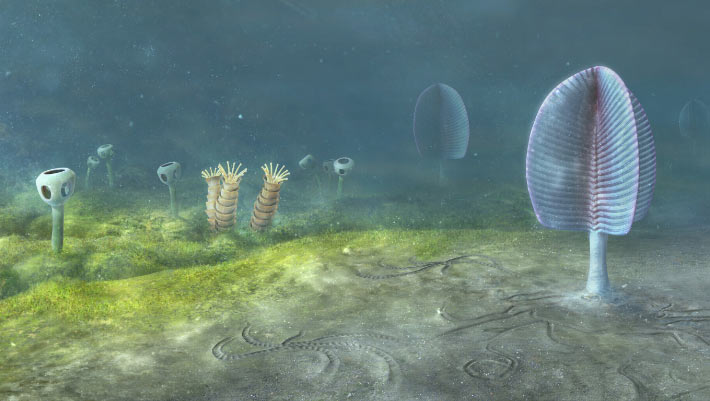
First Animals May Have Appeared 200 Million Years Earlier than Their Oldest Fossils Suggest
Les premiers animaux pourraient être apparus 200 millions d’années plus tôt que ne le suggèrent leurs plus anciens fossiles
Édiacarien fossile évolution
Les plus anciens fossiles d'animaux incontestés, provenant du biote de l'Édiacarien, datent d'environ 574 millions d'années, mais les traces chimiques laissées par les éponges, connues sous le nom de biomarqueurs lipidiques, suggèrent que les animaux existaient il y a avant 635 millions d'années. L’article Les premiers animaux pourraient être apparus 200 millions d’années plus tôt que ne le suggèrent leurs plus anciens fossiles est apparu en premier sur Sci.News : Breaking Science News.
02/10/2026 sci-news ⚙ Traduction automatique
Les chauves-souris auraient évolué pour la première fois en Europe il y a 65 millions d'années
vol fossile communication évolution mammifères étude
Une vaste étude génomique et fossile suggère que les chauves-souris ont évolué pour la première fois en Europe il y a environ 65 à 60 millions d’années avant de se propager à travers le monde. Les résultats indiquent également que le vol et l’écholocation sont apparus au début de l’évolution des chauves-souris, ce qui pourrait expliquer comment les chauves-souris sont devenues l’un des groupes de mammifères les plus prospères sur Terre.
30/09/2026 sciencedaily-paleo ⚙ Traduction automatique
Garudimimus: Beast of the Week
Garudimimus : la bête de la semaine
Mongolie Crétacé Dinosauria Garudimimus oiseau évolution
Cette semaine, nous examinons un dinosaure à plumes qui nous aide à comprendre l'évolution de la famille des dinosaures « imitateurs d'oiseaux ».  Entrez Garudimimus brevipes ! Garudimimus était un dinosaure théropode qui vivait dans ce qui est aujourd'hui la Mongolie pendant la période du Crétacé, il y a entre 96 et 89 millions d'années.  Du bec à la queue, il mesurait environ 3,5 mètres de long et il aurait probablement été omnivore de son vivant.  Le nom du genre se traduit par « Garuda Mimic », en référence à Garuda, le
27/09/2026 prehistoricbeastoftheweek ⚙ Traduction automatique
Des détails étonnants sur les fossiles inspirent les modèles d'évolution des dinosaures
fossile Dinosauria évolution
Everything Dinosaur a créé une nouvelle publicité pour le numéro 159 du magazine "Prehistoric Times". L'image en couleur sur toute la page présente le T. rex Everything Dinosaur Evolution, mais regardez attentivement la base d'affichage et il y a beaucoup plus à découvrir. La publicité couleur pleine page prévue pour le numéro 159 du magazine "Prehistoric Times". Crédit photo : Tout
27/09/2026 everythingdinosaur ⚙ Traduction automatique
Une étude remarquable révèle les origines de l'évolution des chauves-souris
vol fossile évolution étude
Une vaste étude internationale a apporté un nouvel éclairage sur l’évolution des chauves-souris. Les recherches suggèrent que les chauves-souris sont originaires d’Europe il y a environ 65 millions d’années. De plus, le vol propulsé et l’écholocation semblent avoir évolué très tôt dans leur histoire. L'étude représente la plus grande enquête à ce jour combinant les génomes des chauves-souris avec les preuves provenant des fossiles.
23/09/2026 everythingdinosaur ⚙ Traduction automatique
1 2 3 4 5 6 7 8 9 10 11 12 13 14 15