←

évolution

Thématique

17 image(s) · 72 Actualités

Galerie d'images

Rates of skeletal character evolution in the skull and postcranial skeleton of hadrosauroids. Cladograms illustrate the results from branch likelihood tests for two morphological partitions: skull (cranium and mandible) (A) and postcranial skeleton (B). In both cladograms, results from the branch likelihood tests are summarized on a strict consensus tree derived from four separately analyzed MPTs, each with 100 dating replicates (a total of 400 Hedman-dated phylogenies). Pie charts on branches illustrate the proportion of dating replicates that showed significantly high rates (red), slow rates (blue), or nonsignificant average rates (white). No pie charts are plotted on branches that showed nonsignificant rates in 100% of dating replicates. Branches that showed high rates (red) in more than 50% of dating replicates are doubled in length. See the Supplementary Material for Hedman-based results plotted separately for each MPT (Supplementary Fig. S2) and for results using the MBL dating method (Supplementary Fig. S3). Silhouettes were created by Scott Hartman and were downloaded from http://phylopic.org (Creative Commons license CC BY 3.0).

Rates of skeletal character evolution in the skull and postcranial skeleton of hadrosauroids. Cladograms illustrate the results from branch likelihood tests for two morphological partitions: skull (cranium and mandible) (A) and postcranial skeleton (B). In both cladograms, results from the branch likelihood tests are summarized on a strict consensus tree derived from four separately analyzed MPTs, each with 100 dating replicates (a total of 400 Hedman-dated phylogenies). Pie charts on branches illustrate the proportion of dating replicates that showed significantly high rates (red), slow rates (blue), or nonsignificant average rates (white). No pie charts are plotted on branches that showed nonsignificant rates in 100% of dating replicates. Branches that showed high rates (red) in more than 50% of dating replicates are doubled in length. See the Supplementary Material for Hedman-based results plotted separately for each MPT (Supplementary Fig. S2) and for results using the MBL dating method (Supplementary Fig. S3). Silhouettes were created by Scott Hartman and were downloaded from http://phylopic.org (Creative Commons license CC BY 3.0).

Protohadros datation évolution squelette +1
Phylogenetic affinities of Saltriovenator and evolution of the hand in Theropoda.

Reduced strict consensus of the shortest trees found by the phylogenetic analysis after pruning of Lewisuchus and Teleocrater. Numbers at nodes indicate decay index. Inferred manual phalangeal formula for selected nodes indicated below clade names. Hands of representative members of the avian stem (bold names) in extensor view (Herrerasaurus in flexor view), medial side at left, missing elements in white based on ancestral states inferred at least inclusive node containing the taxon. Red star indicates loss of metacarpal V, blue stars indicate multiple independent losses of metacarpal IV among tetanurans. Drawings by A. Cau.

Phylogenetic affinities of Saltriovenator and evolution of the hand in Theropoda. Reduced strict consensus of the shortest trees found by the phylogenetic analysis after pruning of Lewisuchus and Teleocrater. Numbers at nodes indicate decay index. Inferred manual phalangeal formula for selected nodes indicated below clade names. Hands of representative members of the avian stem (bold names) in extensor view (Herrerasaurus in flexor view), medial side at left, missing elements in white based on ancestral states inferred at least inclusive node containing the taxon. Red star indicates loss of metacarpal V, blue stars indicate multiple independent losses of metacarpal IV among tetanurans. Drawings by A. Cau.

dessin Herrerasaurus Lewisuchus Saltriovenator +2
Tylosaurus reconstruction. From Osborn, H. F. (1917). The origin and evolution of life, on the theory of action, reaction and interaction of energy.

Tylosaurus reconstruction. From Osborn, H. F. (1917). The origin and evolution of life, on the theory of action, reaction and interaction of energy.

Tylosaurus évolution
1 2

Actualités

Les fossiles remarquables d'Eoceras shaanxiense réécrivent l'évolution des céphalopodes
Chine Cambrien Étage 3 du Cambrien fossile évolution formation
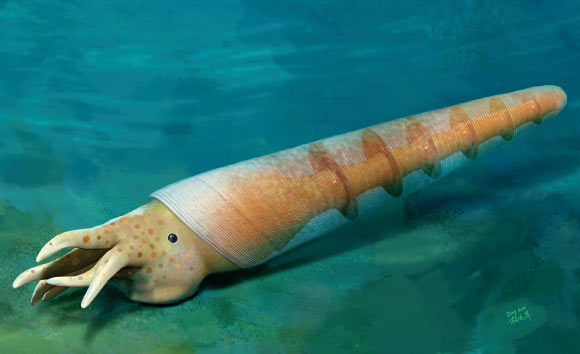
Les chercheurs ont identifié de minuscules fossiles de la formation Shuijingtuo (stade cambrien 3) du sud de la Chine qui pourraient transformer notre compréhension de l'évolution des céphalopodes. L'espèce nouvellement décrite, Eoceras shaanxiense, fournit la plus ancienne preuve connue d'un siphoncle primordial, une caractéristique anatomique cruciale qui a permis aux céphalopodes de réguler la flottabilité et de devenir finalement certains des océans.
03/08/2026 everythingdinosaur ⚙ Traduction automatique
520-Million-Year-Old Fossil from China Fills Gap in Evolutionary History of Cephalopods
Un fossile chinois vieux de 520 millions d’années comble une lacune dans l’histoire évolutive des céphalopodes
Chine Cambrien fossile évolution
Les paléontologues ont identifié le plus ancien céphalopode connu équipé d'un siphoncle - une extension tubulaire du manteau trouvée chez les céphalopodes à coquille - remontant les archives fossiles de cette caractéristique clé de l'évolution au Cambrien inférieur, il y a environ 520 millions d'années. L'article Un fossile chinois vieux de 520 millions d'années comble une lacune dans l'histoire évolutive des céphalopodes est apparu en premier sur Sci.News : Breaking Science News.
30/07/2026 sci-news ⚙ Traduction automatique
La première cloaque synapside révélée par un fossile vieux de 294 millions d'années
Allemagne fossile empreintes découverte évolution mammifères
Une trace fossile remarquable provenant d’Allemagne a fourni la plus ancienne preuve connue d’un cloaque dans la lignée des mammifères. Cette découverte aide les paléontologues à mieux comprendre l’évolution des premiers vertébrés terrestres et comble une lacune importante dans les archives fossiles. Le fossile provient de la célèbre localité fossilifère de Bromacker en Thuringe (Allemagne). Parmi les empreintes et
20/07/2026 everythingdinosaur ⚙ Traduction automatique
Des scientifiques viennent de découvrir une branche perdue de marsupiaux d’Australie
Australie fossile découverte évolution mammifères
Des fossiles du Queensland suggèrent qu'un ordre de marsupiaux nouvellement reconnu pourrait avoir survécu en Australie pendant environ 35 millions d'années, réécrivant une partie de l'histoire de l'évolution des mammifères uniques du continent. Cette découverte remet en question l'idée selon laquelle les marsupiaux d'Australie seraient tous issus d'une seule lignée ancestrale.
19/07/2026 sciencedaily ⚙ Traduction automatique
L’audition sous-marine des phoques expliquée par de nouvelles recherches
musée évolution mammifères étude
Une équipe de scientifiques internationaux a découvert le mécanisme remarquable derrière l’audition sous-marine des phoques. Une nouvelle étude, menée par des chercheurs du Musée d'histoire naturelle de Londres, révèle que les phoques existants entendent aussi bien dans l'air que sous l'eau. Les résultats aident à expliquer un mystère évolutif de longue date et pourraient soutenir les futurs efforts de conservation. La recherche, publiée
16/07/2026 everythingdinosaur ⚙ Traduction automatique
1 2 3 4 5 6 7 8 9 10 11 12 13 14 15