Germany

Country

30 image(s) · 6 News

Image gallery

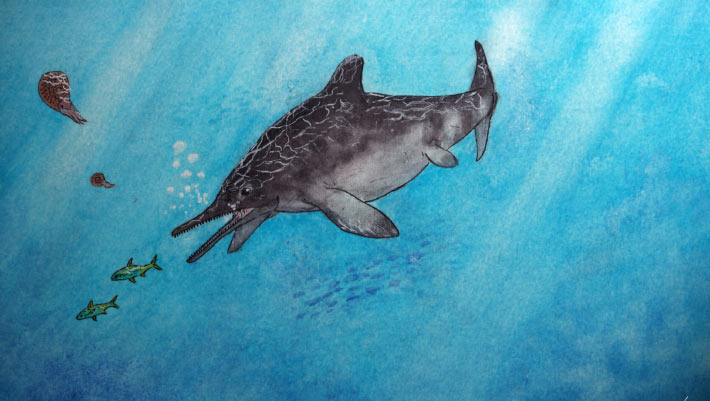
Life restoration of the small German Jurassic ichthyosaur Hauffiopteryx typicus.
References
Maxwell, E. E.; Cortés, D. (2020). "A revision of the Early Jurassic ichthyosaur Hauffiopteryx (Reptilia: Ichthyosauria), and description of a new species from Southwestern Germany". Palaeontologia Electronica 23: 1–43. Archived from the original on 2022-07-06. Retrieved on 2022-03-15.
Note: This image is currently uncolored
Taxa Hauffiopteryx

Life restoration of the small German Jurassic ichthyosaur Hauffiopteryx typicus. References Maxwell, E. E.; Cortés, D. (2020). "A revision of the Early Jurassic ichthyosaur Hauffiopteryx (Reptilia: Ichthyosauria), and description of a new species from Southwestern Germany". Palaeontologia Electronica 23: 1–43. Archived from the original on 2022-07-06. Retrieved on 2022-03-15. Note: This image is currently uncolored

description Germany Early Jurassic Jurassic +3
Early Jurassic (Lias γ, Pliensbachian) ferruginous limestone (the bed below the hammer) and marl (the bed ‘behind’ the hammer) in the cap rocks of the oolithic iron ore deposit at the village of Rottorf am Klei, Lower Saxony, Germany, largely obscured by weathered material of the same rocks.

Early Jurassic (Lias γ, Pliensbachian) ferruginous limestone (the bed below the hammer) and marl (the bed ‘behind’ the hammer) in the cap rocks of the oolithic iron ore deposit at the village of Rottorf am Klei, Lower Saxony, Germany, largely obscured by weathered material of the same rocks.

Germany Early Jurassic Jurassic Pliensbachian
Arminisaurus schuberti (NAMU ES/jl 36052), a plesiosaurian from the Pliensbachian of Bielefeld (Germany). Right scapula in medial view.

Arminisaurus schuberti (NAMU ES/jl 36052), a plesiosaurian from the Pliensbachian of Bielefeld (Germany). Right scapula in medial view.

Germany Pliensbachian Arminisaurus Plesiosauria
Arminisaurus schuberti (NAMU ES/jl 36052), a plesiosaurian from the Pliensbachian of Bielefeld (Germany). Rear part of right lower jaw ramus in side view.

Arminisaurus schuberti (NAMU ES/jl 36052), a plesiosaurian from the Pliensbachian of Bielefeld (Germany). Rear part of right lower jaw ramus in side view.

Germany Pliensbachian Arminisaurus Plesiosauria
The Holotype batomorph tooth of Antiquaobatis grimmenensis from the Late Pliensbachian (spinatum) of Grimmen (Mecklenburg-Western Pomerania, Germany).
Intervals Pliensbachian

The Holotype batomorph tooth of Antiquaobatis grimmenensis from the Late Pliensbachian (spinatum) of Grimmen (Mecklenburg-Western Pomerania, Germany).

tooth Germany Pliensbachian holotype
“Sternberger Kuchen” (“Sternberg cake”), a large late Pleistocene glaciofluvial pebble of a highly fossiliferous, shallow marine sandstone of the North German Paleogene (Sülstorf beds, formerly known as “Sternberg rock”, Chattian, Oligocene, about 25 million years old). The fossil content is mainly made up of mollusks (pelecypods, gastropods, scaphopods). Provenance: Sternberg, Mecklenburg-Vorpommern, Northeast Germany.

“Sternberger Kuchen” (“Sternberg cake”), a large late Pleistocene glaciofluvial pebble of a highly fossiliferous, shallow marine sandstone of the North German Paleogene (Sülstorf beds, formerly known as “Sternberg rock”, Chattian, Oligocene, about 25 million years old). The fossil content is mainly made up of mollusks (pelecypods, gastropods, scaphopods). Provenance: Sternberg, Mecklenburg-Vorpommern, Northeast Germany.

Germany Chattian Late Pleistocene Oligocene +3
Fossil of Cainotherium, an extinct mammal https://hdl.handle.net/21.12123/66925 in ferruginous rock of Oligocene (Chattian) age from Ingolstadt in Bavaria, Germany - Took the photo at Museon museum, Den Haag
Intervals Chattian

Fossil of Cainotherium, an extinct mammal https://hdl.handle.net/21.12123/66925 in ferruginous rock of Oligocene (Chattian) age from Ingolstadt in Bavaria, Germany - Took the photo at Museon museum, Den Haag

museum Germany Chattian Oligocene +1
Quarry called “Ratssteinbruch” at Plauenscher Grund (gorge-like valley of the river Weißeritz nearby/in the city of Dresden, Saxony, Germany), Upper Carboniferous Monzonite (historically identified as Syenite) of the Meißen Massif (Paleozoic basement) unconformably overlain by Upper Cenomanian beds of the Dölzschen Formation, yellowish basal conglomerate and overlying bluish silty clay-marlstone (“plenus-Pläner”) of the Saxo-Bohemian Cretaceous Basin (Mesozoic platform).[1]

Quarry called “Ratssteinbruch” at Plauenscher Grund (gorge-like valley of the river Weißeritz nearby/in the city of Dresden, Saxony, Germany), Upper Carboniferous Monzonite (historically identified as Syenite) of the Meißen Massif (Paleozoic basement) unconformably overlain by Upper Cenomanian beds of the Dölzschen Formation, yellowish basal conglomerate and overlying bluish silty clay-marlstone (“plenus-Pläner”) of the Saxo-Bohemian Cretaceous Basin (Mesozoic platform).[1]

Germany Carboniferous Cenomanian Cretaceous +3
Life restoration of the German Jurassic ichthyosaur Suevoleviathan disinteger. The dorsal and caudal fins are loosely based on those of Stenopterygius.
References
Maisch, M.W. (2020). "The best-preserved skeleton of Suevoleviathan integer (Bronn, 1844)(Reptilia: Ichthyosauria) from the lower Jurassic of south-western Germany, with a discussion of the genus". Neues Jahrbuch für Geologie und Paläontologie, Abhandlungen 297 (2): 153–172.
Maisch, M.W. (1998). "A new ichthyosaur genus from the Posidonia Shale (Lower Toarcian, Jurassic) of Holzmaden, SW-Germany with comments on the phylogeny of post-Triassic ichthyosaurs". Neues Jahrbuch für Geologie und Paläontologie-Abhandlungen 209 (1): 47–78.
Taxa Suevoleviathan

Life restoration of the German Jurassic ichthyosaur Suevoleviathan disinteger. The dorsal and caudal fins are loosely based on those of Stenopterygius. References Maisch, M.W. (2020). "The best-preserved skeleton of Suevoleviathan integer (Bronn, 1844)(Reptilia: Ichthyosauria) from the lower Jurassic of south-western Germany, with a discussion of the genus". Neues Jahrbuch für Geologie und Paläontologie, Abhandlungen 297 (2): 153–172. Maisch, M.W. (1998). "A new ichthyosaur genus from the Posidonia Shale (Lower Toarcian, Jurassic) of Holzmaden, SW-Germany with comments on the phylogeny of post-Triassic ichthyosaurs". Neues Jahrbuch für Geologie und Paläontologie-Abhandlungen 209 (1): 47–78.

Germany Posidonia Shale Jurassic Toarcian +6
Remake of the original picture of the Drzewica Formation. Terrestrial environment of the Pliensbachian-Toarcian boundary of Fennoscandinavia  Inland environment of the  Bornholm Coast, nearby the German realm of the Ciechocinek Formation. Includes
Ciechocinek Formation (Lower Toarcian, Bones) and Drzwica Formation (Latest Pliensbachian, Footprints) Fauna
Sorthat Formation environment, fluvial influenced mainland with Cheirolepidaceae and Bennetitales as dominant flora
Dinosaurs are based on material found on various locations of Northern Germany, and Footprints of the underliying Drzewica Formation at the Holy Cross Mountains, connected with Bornholm at the time.
Dinosaur Species appeared: 

Megalosauripus isp. Large Footprints (+65 cm) found on the Drzewica Formation. There is a dorsal vertebrae on the German Margin of the Ciechocinek Formation assigend to Megalosauria (Huene, 1966).
Gravisauria spp. representing the Grimmen Sauropod reported on 2014, as a taxon related with Tazoudasaurus. Barapasaurus-like footprints are know from the Drzewica Formation.
Coelophysoidea spp. based on coeval Anchisauripus tracks from the Holy Cross Mountains.
Basal Ornithischan, related to Eocursor, based on a crouching trace (Gerard Dariusz Gierlinski, Martin G. Lockley, Grzegorz Niedźwiedzki:2009).
Massospondylidae spp. based on Otozum-like tracks.

Remake of the original picture of the Drzewica Formation. Terrestrial environment of the Pliensbachian-Toarcian boundary of Fennoscandinavia Inland environment of the Bornholm Coast, nearby the German realm of the Ciechocinek Formation. Includes Ciechocinek Formation (Lower Toarcian, Bones) and Drzwica Formation (Latest Pliensbachian, Footprints) Fauna Sorthat Formation environment, fluvial influenced mainland with Cheirolepidaceae and Bennetitales as dominant flora Dinosaurs are based on material found on various locations of Northern Germany, and Footprints of the underliying Drzewica Formation at the Holy Cross Mountains, connected with Bornholm at the time. Dinosaur Species appeared: Megalosauripus isp. Large Footprints (+65 cm) found on the Drzewica Formation. There is a dorsal vertebrae on the German Margin of the Ciechocinek Formation assigend to Megalosauria (Huene, 1966). Gravisauria spp. representing the Grimmen Sauropod reported on 2014, as a taxon related with Tazoudasaurus. Barapasaurus-like footprints are know from the Drzewica Formation. Coelophysoidea spp. based on coeval Anchisauripus tracks from the Holy Cross Mountains. Basal Ornithischan, related to Eocursor, based on a crouching trace (Gerard Dariusz Gierlinski, Martin G. Lockley, Grzegorz Niedźwiedzki:2009). Massospondylidae spp. based on Otozum-like tracks.

bone Germany Pliensbachian Toarcian +7
Ctenochasma elegans (syn. Pterodactylus elegans) fossil from Solnhofen, Germany

American Museum of Natural History, New York, FR-5147
Received in exchange from the Paläontologisches Museum München, 1909
Taxa Ctenochasmatidae

Ctenochasma elegans (syn. Pterodactylus elegans) fossil from Solnhofen, Germany American Museum of Natural History, New York, FR-5147 Received in exchange from the Paläontologisches Museum München, 1909

museum Germany fossil Ctenochasma +5
Ctenochasma elegans (syn. Pterodactylus elegans) fossil from Solnhofen, Germany

American Museum of Natural History, New York, FR-5147
Received in exchange from the Paläontologisches Museum München, 1909
Taxa Gnathosaurinae

Ctenochasma elegans (syn. Pterodactylus elegans) fossil from Solnhofen, Germany American Museum of Natural History, New York, FR-5147 Received in exchange from the Paläontologisches Museum München, 1909

museum Germany fossil Ctenochasma +5
Ctenochasma elegans (syn. Pterodactylus elegans) fossil from Solnhofen, Germany

American Museum of Natural History, New York, FR-5147
Received in exchange from the Paläontologisches Museum München, 1909
Taxa Moganopterinae

Ctenochasma elegans (syn. Pterodactylus elegans) fossil from Solnhofen, Germany American Museum of Natural History, New York, FR-5147 Received in exchange from the Paläontologisches Museum München, 1909

museum Germany fossil Ctenochasma +5
Ctenochasma elegans (syn. Pterodactylus elegans) fossil from Solnhofen, Germany

American Museum of Natural History, New York, FR-5147
Received in exchange from the Paläontologisches Museum München, 1909
Taxa Ctenochasmatinae

Ctenochasma elegans (syn. Pterodactylus elegans) fossil from Solnhofen, Germany American Museum of Natural History, New York, FR-5147 Received in exchange from the Paläontologisches Museum München, 1909

museum Germany fossil Ctenochasma +5
Fossil specimen of Ornithomimus sp. (TMP 1995.110.1), Royal Tyrrell Museum. This specimen was recovered from the middle Dinosaur Park Formation of Alberta, Canada.
Taxa Ornithomimidae

Fossil specimen of Ornithomimus sp. (TMP 1995.110.1), Royal Tyrrell Museum. This specimen was recovered from the middle Dinosaur Park Formation of Alberta, Canada.

museum Canada Germany Dinosaur Park +6
Nichollssaura at the Royal Tyrrell Museum.
Taxa Nichollssaura

Nichollssaura at the Royal Tyrrell Museum.

museum Germany Nichollssaura
1 2

News

Earliest Synapsid Cloaca Revealed by 294-Million-Year-Old Fossil
Germany fossil tracks discovery evolution mammals
A remarkable trace fossil from Germany has provided the oldest known evidence of a cloaca in the mammalian lineage. The discovery helps palaeontologists better understand the evolution of early terrestrial vertebrates and fills an important gap in the fossil record. The fossil comes from the famous Bromacker fossil locality in Thuringia (Germany). Among footprints and
20/07/2026 everythingdinosaur
Fossils from German Quarry Reveal New Subspecies of European Leopard
Germany Quaternary fossil mammals new species
Named Panthera pardus burgtonnae, the newly-identified leopard subspecies roamed Europe during the Eemian interglacial period and was far more heavily built than modern leopards. The post Fossils from German Quarry Reveal New Subspecies of European Leopard appeared first on Sci.News: Breaking Science News.
30/06/2026 sci-news
New Schleich Woolly Mammoth Model Coming into Stock
limb Germany juvenile Dinosauria
The new Schleich Woolly Mammoth model is coming into stock at Everything Dinosaur. Team members are preparing for the arrival of this latest Schleich figure.  The Germany-based model manufacturer has made models of Ice Animals in the past.  It had previously manufactured a Woolly Mammoth adult and juvenile.  The new Mammuthus primigenius figure will be
26/06/2026 everythingdinosaur
New Jurassic Pterosaur Unearthed in Germany
Germany Jurassic fossil Monofenestrata Pterosauria new species skeleton
Paleontologists have described a new genus and species of early monofenestratan pterosaur based on a nearly complete and well-preserved fossil skeleton discovered in Bavaria, Germany. The post New Jurassic Pterosaur Unearthed in Germany appeared first on Sci.News: Breaking Science News.
19/05/2026 sci-news
Torvosaurus: Beast of the Week
bone predator Germany Portugal United States Jurassic Late Jurassic Dinosauria Torvosaurus
Today we are going to look at a huge Jurassic predatory dinosaur, Torvosaurus tanneri!  Torvosaurus lived about 150 million years ago during the Late Jurassic period. Its bones have been unearthed in Colorado, USA, Portugal, and possibly Germany (Europe and North America were not as vastly separated back then, remember, so a lot of the dinosaurs on each of them from that time shared recent ancestors).  From nose to tail it measured up to 36 feet (about 11m) and would have been among the largest,
08/02/2026 prehistoricbeastoftheweek
1 2