France

Country

47 image(s) · 5 News

Image gallery

The making of this document was supported by Wikimédia France. (Submit your project!)
Taxa Bambiraptor

The making of this document was supported by Wikimédia France. (Submit your project!)

France Bambiraptor
Obelignathus septimanicus holotype, MDE D30 from the 'Grès à Reptiles' Formation of Montouliers, southern France. Photographs and photogrammetric models of the right dentary in dorsal (A), anterior (B), medial (C), and lateral (D) views.
Taxa Obelignathus

Obelignathus septimanicus holotype, MDE D30 from the 'Grès à Reptiles' Formation of Montouliers, southern France. Photographs and photogrammetric models of the right dentary in dorsal (A), anterior (B), medial (C), and lateral (D) views.

France holotype Obelignathus formation
Photographed at the Cité de l'Automobile, France.
Taxa Velocipes

Photographed at the Cité de l'Automobile, France.

France Velocipes
Solitary tooth of a sauropod from Angeac-Charente in France. Based on its morphology, it is not from an unnamed titanosaur like other material from this site, but from an unnamed titanosauriform similar to Ligabuesaurus or Veneosaurus.
Taxa Ligabuesaurus

Solitary tooth of a sauropod from Angeac-Charente in France. Based on its morphology, it is not from an unnamed titanosaur like other material from this site, but from an unnamed titanosauriform similar to Ligabuesaurus or Veneosaurus.

tooth France Ligabuesaurus Titanosauria +1
this sponge of the Santonien chalk is on a flint nivel "Brasspoint" . it's probably Ventriculites - it was found in a subterranean quarry in the "Forêt de La Londe" Normandie - France (cliché Jean-Claude Staigre - CNEK 2017

this sponge of the Santonien chalk is on a flint nivel "Brasspoint" . it's probably Ventriculites - it was found in a subterranean quarry in the "Forêt de La Londe" Normandie - France (cliché Jean-Claude Staigre - CNEK 2017

France Santonian
Lower Santonian from Les Âges, commune of Saint-Crépin-de-Richemont, Dordogne, France. The limestone is very rich in bryozoans.

Lower Santonian from Les Âges, commune of Saint-Crépin-de-Richemont, Dordogne, France. The limestone is very rich in bryozoans.

France Santonian
The Pectinida fossil Neithea in Lower Santonian bioclastic limestone. Found near Les Âges in the commune of Saint-Crépin-de-Richemont, Dordogne, France.
Intervals Santonian

The Pectinida fossil Neithea in Lower Santonian bioclastic limestone. Found near Les Âges in the commune of Saint-Crépin-de-Richemont, Dordogne, France.

France Santonian fossil
Crommium angustatum Grateloup, 1827 fossil snail shell (apical view) from the Oligocene of France. (42 mm across at its widest)
Of all the molluscs, the gastropods (snails) have made the most ecological adaptations.  They can be found in almost all fundamental environments: marine, freshwater, terrestrial.  Most gastropods live in the ocean, and have a single, asymmetrically coiled, external shell of calcium carbonate (CaCO3 - usually aragonite).  The hard calcareous shell is the most easily fossilized part of the gastropod.  The soft parts of a snail (the “slug” portion) include a well developed head having eyes, tentacles, and a mouth, and a well developed, strong, muscular foot used principally for locomotion.  The shell is carried upright on the snail’s back, or is partially dragged behind.  When threatened by a predator, many snails can retract their soft parts into the shell’s interior for protection.
Many fossil snails in the Paleozoic rock record are often not well preserved, or are preserved as internal molds.  The original aragonite of many gastropod shells is not stable on geologic time scales, and often recrystallizes or dissolves completely away.  Fossil snail shells in Mesozoic and Cenozoic rocks are usually better preserved.
Classification: Animalia, Mollusca, Gastropoda, Naticoidea, Ampullinidae
Age: Rupelian Stage (Stampian Stage), Lower Oligocene

Locality: Gaas, Landes Department, Aquitaine, southwestern France

Crommium angustatum Grateloup, 1827 fossil snail shell (apical view) from the Oligocene of France. (42 mm across at its widest) Of all the molluscs, the gastropods (snails) have made the most ecological adaptations. They can be found in almost all fundamental environments: marine, freshwater, terrestrial. Most gastropods live in the ocean, and have a single, asymmetrically coiled, external shell of calcium carbonate (CaCO3 - usually aragonite). The hard calcareous shell is the most easily fossilized part of the gastropod. The soft parts of a snail (the “slug” portion) include a well developed head having eyes, tentacles, and a mouth, and a well developed, strong, muscular foot used principally for locomotion. The shell is carried upright on the snail’s back, or is partially dragged behind. When threatened by a predator, many snails can retract their soft parts into the shell’s interior for protection. Many fossil snails in the Paleozoic rock record are often not well preserved, or are preserved as internal molds. The original aragonite of many gastropod shells is not stable on geologic time scales, and often recrystallizes or dissolves completely away. Fossil snail shells in Mesozoic and Cenozoic rocks are usually better preserved. Classification: Animalia, Mollusca, Gastropoda, Naticoidea, Ampullinidae Age: Rupelian Stage (Stampian Stage), Lower Oligocene Locality: Gaas, Landes Department, Aquitaine, southwestern France

scale locomotion predator France +6
Crommium angustatum Grateloup, 1827 fossil snail shell (apical view) from the Oligocene of France. (42 mm across at its widest)
Of all the molluscs, the gastropods (snails) have made the most ecological adaptations.  They can be found in almost all fundamental environments: marine, freshwater, terrestrial.  Most gastropods live in the ocean, and have a single, asymmetrically coiled, external shell of calcium carbonate (CaCO3 - usually aragonite).  The hard calcareous shell is the most easily fossilized part of the gastropod.  The soft parts of a snail (the “slug” portion) include a well developed head having eyes, tentacles, and a mouth, and a well developed, strong, muscular foot used principally for locomotion.  The shell is carried upright on the snail’s back, or is partially dragged behind.  When threatened by a predator, many snails can retract their soft parts into the shell’s interior for protection.
Many fossil snails in the Paleozoic rock record are often not well preserved, or are preserved as internal molds.  The original aragonite of many gastropod shells is not stable on geologic time scales, and often recrystallizes or dissolves completely away.  Fossil snail shells in Mesozoic and Cenozoic rocks are usually better preserved.
Classification: Animalia, Mollusca, Gastropoda, Naticoidea, Ampullinidae
Age: Rupelian Stage (Stampian Stage), Lower Oligocene

Locality: Gaas, Landes Department, Aquitaine, southwestern France

Crommium angustatum Grateloup, 1827 fossil snail shell (apical view) from the Oligocene of France. (42 mm across at its widest) Of all the molluscs, the gastropods (snails) have made the most ecological adaptations. They can be found in almost all fundamental environments: marine, freshwater, terrestrial. Most gastropods live in the ocean, and have a single, asymmetrically coiled, external shell of calcium carbonate (CaCO3 - usually aragonite). The hard calcareous shell is the most easily fossilized part of the gastropod. The soft parts of a snail (the “slug” portion) include a well developed head having eyes, tentacles, and a mouth, and a well developed, strong, muscular foot used principally for locomotion. The shell is carried upright on the snail’s back, or is partially dragged behind. When threatened by a predator, many snails can retract their soft parts into the shell’s interior for protection. Many fossil snails in the Paleozoic rock record are often not well preserved, or are preserved as internal molds. The original aragonite of many gastropod shells is not stable on geologic time scales, and often recrystallizes or dissolves completely away. Fossil snail shells in Mesozoic and Cenozoic rocks are usually better preserved. Classification: Animalia, Mollusca, Gastropoda, Naticoidea, Ampullinidae Age: Rupelian Stage (Stampian Stage), Lower Oligocene Locality: Gaas, Landes Department, Aquitaine, southwestern France

scale locomotion predator France +6
Crommium angustatum Grateloup, 1827 fossil snail shell (abapertural view) from the Oligocene of France. (57 mm tall)
Of all the molluscs, the gastropods (snails) have made the most ecological adaptations.  They can be found in almost all fundamental environments: marine, freshwater, terrestrial.  Most gastropods live in the ocean, and have a single, asymmetrically coiled, external shell of calcium carbonate (CaCO3 - usually aragonite).  The hard calcareous shell is the most easily fossilized part of the gastropod.  The soft parts of a snail (the “slug” portion) include a well developed head having eyes, tentacles, and a mouth, and a well developed, strong, muscular foot used principally for locomotion.  The shell is carried upright on the snail’s back, or is partially dragged behind.  When threatened by a predator, many snails can retract their soft parts into the shell’s interior for protection.
Many fossil snails in the Paleozoic rock record are often not well preserved, or are preserved as internal molds.  The original aragonite of many gastropod shells is not stable on geologic time scales, and often recrystallizes or dissolves completely away.  Fossil snail shells in Mesozoic and Cenozoic rocks are usually better preserved.
Classification: Animalia, Mollusca, Gastropoda, Naticoidea, Ampullinidae
Age: Rupelian Stage (Stampian Stage), Lower Oligocene

Locality: Gaas, Landes Department, Aquitaine, southwestern France

Crommium angustatum Grateloup, 1827 fossil snail shell (abapertural view) from the Oligocene of France. (57 mm tall) Of all the molluscs, the gastropods (snails) have made the most ecological adaptations. They can be found in almost all fundamental environments: marine, freshwater, terrestrial. Most gastropods live in the ocean, and have a single, asymmetrically coiled, external shell of calcium carbonate (CaCO3 - usually aragonite). The hard calcareous shell is the most easily fossilized part of the gastropod. The soft parts of a snail (the “slug” portion) include a well developed head having eyes, tentacles, and a mouth, and a well developed, strong, muscular foot used principally for locomotion. The shell is carried upright on the snail’s back, or is partially dragged behind. When threatened by a predator, many snails can retract their soft parts into the shell’s interior for protection. Many fossil snails in the Paleozoic rock record are often not well preserved, or are preserved as internal molds. The original aragonite of many gastropod shells is not stable on geologic time scales, and often recrystallizes or dissolves completely away. Fossil snail shells in Mesozoic and Cenozoic rocks are usually better preserved. Classification: Animalia, Mollusca, Gastropoda, Naticoidea, Ampullinidae Age: Rupelian Stage (Stampian Stage), Lower Oligocene Locality: Gaas, Landes Department, Aquitaine, southwestern France

scale locomotion predator France +6
Pleuroceras spinatum (Bruguière 1789)- Amaltheidae; Pyritic specimen. biozone index to the end of Pliensbachian.
Stage : Pliensbachian from 189,6 ± 1,5 Ma to -183,0 ± 1,5 Ma (million years ago) (Domerian)
Locality: Lanuéjols, Gard, France
Size : 4.5x3.8x1.45 cm 30.6g

Pleuroceras spinatum (Bruguière 1789)- Amaltheidae; Pyritic specimen. biozone index to the end of Pliensbachian. Stage : Pliensbachian from 189,6 ± 1,5 Ma to -183,0 ± 1,5 Ma (million years ago) (Domerian) Locality: Lanuéjols, Gard, France Size : 4.5x3.8x1.45 cm 30.6g

France Pliensbachian specimen
Fossil shell of Aulacostephanus yo from France, on display at Gallery of Paleontology and Comparative Anatomy, Paris.
Intervals Kimmeridgian

Fossil shell of Aulacostephanus yo from France, on display at Gallery of Paleontology and Comparative Anatomy, Paris.

France fossil anatomy
Crioceratites fabreae fossils on display at the French National Museum of Natural History in Paris, France.

Crioceratites fabreae fossils on display at the French National Museum of Natural History in Paris, France.

museum France fossil
Crioceratites duvali fossil on display at the French National Museum of Natural History in Paris, France.

Crioceratites duvali fossil on display at the French National Museum of Natural History in Paris, France.

museum France fossil
Abri sous falaise à Voulgézac (Charente, France)

Abri sous falaise à Voulgézac (Charente, France)

France
Rock shelter (abri) in Coniacian limestone in the Boulou valley (left-hand side) near La Tabaterie, commune of La Gonterie-Boulouneix, Dordogne, France. In the abri there is a natural spring and next to it a deep well - dangerous!

Rock shelter (abri) in Coniacian limestone in the Boulou valley (left-hand side) near La Tabaterie, commune of La Gonterie-Boulouneix, Dordogne, France. In the abri there is a natural spring and next to it a deep well - dangerous!

France Coniacian
1 2 3

News

Hidden charcoal reveals the true age of ancient cave paintings
France dating
A new analysis has precisely dated paintings in France’s Font-de-Gaume cave for the first time. Scientists discovered charcoal inside black pigments once thought to contain only minerals, allowing them to use radiocarbon dating. The results show that a bison was painted about 13,000 years ago, while sections of a mask-like figure were added during several widely separated periods.
28/07/2026 sciencedaily
Jurassic Pliosaur Liopleurodon Was Big, but Not as Big as Once Feared
France Jurassic Liopleurodon Pliosaurus
Liopleurodon ferox is a short-necked marine reptile that patrolled the seas of what is now England and France some 163 million years ago. The post Jurassic Pliosaur Liopleurodon Was Big, but Not as Big as Once Feared appeared first on Sci.News: Breaking Science News.
22/07/2026 sci-news
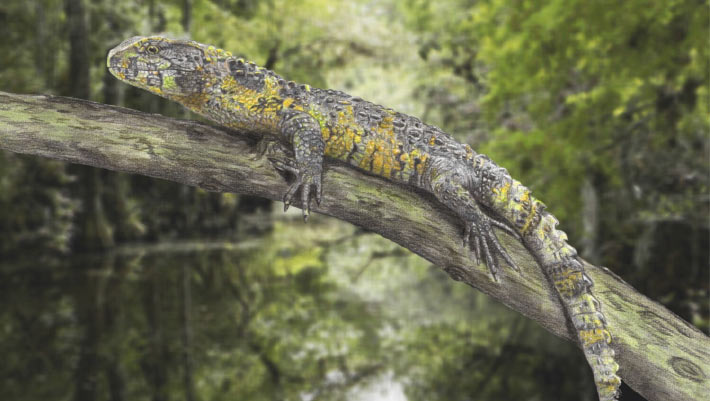
83-Million-Year-Old Crocodile Lizard Fossil Unearthed in France
jaw France fossil discovery new species partial
Paleontologists have identified a new genus and species of pan-shinisaur lizard from a partial upper jaw discovered in southern France, pushing the presence of its lineage in Europe back by at least 30 million years. The post 83-Million-Year-Old Crocodile Lizard Fossil Unearthed in France appeared first on Sci.News: Breaking Science News.
22/05/2026 sci-news
Ancient bones reveal chilling victory rituals after Europe’s earliest wars
bone tooth France
New evidence from Neolithic mass graves in northeastern France suggests that some of Europe’s earliest violent encounters were not random acts of brutality, but carefully staged displays of power. By analyzing chemical clues locked in ancient bones and teeth, researchers found that many victims were outsiders who suffered extreme, ritualized violence after conflict. Severed arms appear to have been taken from local enemies killed in battle, while captives from farther away were executed in a gri
08/02/2026 sciencedaily
Mirasaura: Beast of the Week
reconstitution France Late Triassic Triassic
 This week we will be checking out a newly published and super unique little creature, Mirasaura grouvogeli!Watercolor life reconstruction of Mirasaura grouvogeli by Christopher DiPiazza.Mirasaura was a reptile that lived in what is now France, during the late Triassic period, 247 million years ago.  Adults of this species may have grown to about 8-10 inches (20-25cm), The genus name translates to "Marvelous Reptile".  The species name, grouvogeli, honors Louis Grouvogel, who originally discover
27/07/2025 prehistoricbeastoftheweek