Dinosauria

Taxon

285 image(s) · 193 Actualités

Voir la fiche

Galerie d'images

ROM Dinosaurs 019
Taxons Geosternbergia

ROM Dinosaurs 019

Canada Dinosauria Geosternbergia Pteranodontidae
A Berthasaura leopoldinae 3d Reconstruction by  Alex Pritchard Dinosauria - Dinosaur Fossil Replicas
Taxons Berthasaura

A Berthasaura leopoldinae 3d Reconstruction by Alex Pritchard Dinosauria - Dinosaur Fossil Replicas

fossile Berthasaura Dinosauria
Reconstructed skull of Duriavenator hesperis showing known material (white) of the holotype and only known specimen. Unknown bones based on related Eustreptospondylus oxoniensis. Scale bar is 10cm, image is 10px/cm. Cranial anatomy based on Benson (2008) "A redescription of "Megalosaurus" hesperis (Dinosauria, Theropoda) from the Inferior Oolite (Bajocian, Middle Jurassic) of Dorset, United Kingdom"
Taxons Duriavenator

Reconstructed skull of Duriavenator hesperis showing known material (white) of the holotype and only known specimen. Unknown bones based on related Eustreptospondylus oxoniensis. Scale bar is 10cm, image is 10px/cm. Cranial anatomy based on Benson (2008) "A redescription of "Megalosaurus" hesperis (Dinosauria, Theropoda) from the Inferior Oolite (Bajocian, Middle Jurassic) of Dorset, United Kingdom"

os écaille Royaume-Uni Bajocien +11
Reconstructed skull of Wiehenvenator albati based on holotype specimen (white). Scale bar is 10cm, image if 10px/cm. Unknown material based on related Torvosaurus tanneri. Cranial anatomy based on Rauhut et al (2016) "A new megalosaurid theropod dinosaur from the late Middle Jurassic (Callovian) of north-western Germany: implications for theropod evolution and faunal turnover in the Jurassic"
Taxons Wiehenvenator

Reconstructed skull of Wiehenvenator albati based on holotype specimen (white). Scale bar is 10cm, image if 10px/cm. Unknown material based on related Torvosaurus tanneri. Cranial anatomy based on Rauhut et al (2016) "A new megalosaurid theropod dinosaur from the late Middle Jurassic (Callovian) of north-western Germany: implications for theropod evolution and faunal turnover in the Jurassic"

écaille Allemagne Callovien Jurassique +10
Reconstruceted skull of Dubreuillosaurus illustrating known (white) and unknown (grey) material. Scale bar is 10cm. Based of figures and description of Allain (2002) "Discovery of megalosaur (Dinosauria, Theropoda) in the middle Bathonian of Normandy (France) and its implications for the phylogeny of basal Tetanurae"
Taxons Dubreuillosaurus

Reconstruceted skull of Dubreuillosaurus illustrating known (white) and unknown (grey) material. Scale bar is 10cm. Based of figures and description of Allain (2002) "Discovery of megalosaur (Dinosauria, Theropoda) in the middle Bathonian of Normandy (France) and its implications for the phylogeny of basal Tetanurae"

écaille description France Bathonien +8
Skeletal mount of the spinosaurine species Ichthyovenator laosensis at the Giga Dinosaur Exhibition in the National Museum of Nature and Science, Tokyo.
Taxons Ichthyovenator

Skeletal mount of the spinosaurine species Ichthyovenator laosensis at the Giga Dinosaur Exhibition in the National Museum of Nature and Science, Tokyo.

musée Dinosauria Ichthyovenator
Fossil of Streptospondylus, a dinosaur from the Middle Jurassic period of France. Took the photo at the Gallery of Paleontology and Comparative Anatomy in the French National Museum of Natural History, Paris.
Taxons Streptospondylus

Fossil of Streptospondylus, a dinosaur from the Middle Jurassic period of France. Took the photo at the Gallery of Paleontology and Comparative Anatomy in the French National Museum of Natural History, Paris.

musée France Jurassique Jurassique moyen +4
Portraits of the theropod dinosaur Alpkarakush
Taxons Alpkarakush

Portraits of the theropod dinosaur Alpkarakush

Alpkarakush Dinosauria
Illustration of the pelvis from the theropod dinosaur Siamotyrannus isanensis. Siamotyrannus lived in Thailand, according to scientists about 90 MYA. It has been estimated to a length of 7 meter, and a weight of about 2 tonnes. Scientists has been uncertain if Siamotyrannus is a member of the family Tyrannosauridae or to Sinraptoridae.
Taxons Siamotyrannus

Illustration of the pelvis from the theropod dinosaur Siamotyrannus isanensis. Siamotyrannus lived in Thailand, according to scientists about 90 MYA. It has been estimated to a length of 7 meter, and a weight of about 2 tonnes. Scientists has been uncertain if Siamotyrannus is a member of the family Tyrannosauridae or to Sinraptoridae.

bassin Thaïlande Dinosauria Siamotyrannus +2
Dinosaur Vectaerovenator Reconstruction
Taxons Vectaerovenator

Dinosaur Vectaerovenator Reconstruction

Dinosauria Vectaerovenator
Illustration of Sinusonasus (Dinosauria, Theropoda, Coelurosauria, Deinonychosauria, Troodontidae). This restoration is an edited and updated version of a drawing I originally uploaded on Wikimedia at December 11th 2009 (which i turn is based on a fossil seen at http://site.sinodino.com/Museum/images/Sinusonasus.JPG.).
Taxons Sinusonasus

Illustration of Sinusonasus (Dinosauria, Theropoda, Coelurosauria, Deinonychosauria, Troodontidae). This restoration is an edited and updated version of a drawing I originally uploaded on Wikimedia at December 11th 2009 (which i turn is based on a fossil seen at http://site.sinodino.com/Museum/images/Sinusonasus.JPG.).

dessin musée fossile Coelurosauria +5
A diagram showing the bones and feathering preserved in IVPP V 12638, the holotype of Yixianosaurus longimanus, a feathered dinosaur.
Taxons Yixianosaurus

A diagram showing the bones and feathering preserved in IVPP V 12638, the holotype of Yixianosaurus longimanus, a feathered dinosaur.

os holotype Dinosauria Yixianosaurus
Forearm and hand of Machairasaurus leptorhynchos Longrich et al. 2010 (Dinosauria: Theropoda: Oviraptoridae: Ingeniinae) from the Late Cretaceous Djadokhta Formation beds of Bayan Mandahu, Inner Mongolia, China. Digital photography and editing by Nick Longrich
Taxons Machairasaurus

Forearm and hand of Machairasaurus leptorhynchos Longrich et al. 2010 (Dinosauria: Theropoda: Oviraptoridae: Ingeniinae) from the Late Cretaceous Djadokhta Formation beds of Bayan Mandahu, Inner Mongolia, China. Digital photography and editing by Nick Longrich

Chine Mongolie Djadokhta Crétacé +8
Duonychus tsogtbaatari in Dinosaur Expo 2019 at Nationail Science Museum in Tokyo
Taxons Duonychus

Duonychus tsogtbaatari in Dinosaur Expo 2019 at Nationail Science Museum in Tokyo

musée Dinosauria Duonychus
Skeletal reconsturion of alvarezsaurian dinosaur Shishugounykus inexpectus. Scale bar, 200 mm.
Taxons Shishugounykus

Skeletal reconsturion of alvarezsaurian dinosaur Shishugounykus inexpectus. Scale bar, 200 mm.

écaille Alvarezsauria Dinosauria Shishugounykus
Holotype specimen of Notatesseraeraptor frickensis, a theropod dinosaur, in Sauriermuseum Frick .
Taxons Notatesseraeraptor

Holotype specimen of Notatesseraeraptor frickensis, a theropod dinosaur, in Sauriermuseum Frick .

holotype spécimen Dinosauria Notatesseraeraptor
1 2 3 4 5 6 7 8 9 10 11 12 13 14 15 16 17 18

Actualités

Nanotyrannus: Beast of the Week
Nanotyrannus : Bête de la semaine
États-Unis Crétacé Dinosauria Nanotyrannus
 Cette semaine, nous allons découvrir un dinosaure dont l'identité a fait l'objet de nombreux débats pendant des décennies.  Découvrez Nanotyrannus ! Nanotyrannus était un dinosaure carnivore qui vivait dans ce qui est aujourd'hui le Montana aux États-Unis au cours de la dernière période du Crétacé, il y a entre 67 et 66 millions d'années.  Du museau à la queue, il mesurait entre 17 et 20 pieds (6,2 mètres) de long à l’état adulte. Le nom du genre se traduit par « petit tyran nain » car on pensait à l'origine qu'il s'agissait d'un proche parent.
19/11/2025 prehistoricbeastoftheweek ⚙ Traduction automatique
Zuul: Beast of the Week
Zuul : la bête de la semaine
film États-Unis Crétacé Crétacé supérieur Ankylosauria Dinosauria Zuul
 Cette semaine, nous allons découvrir un étonnant dinosaure blindé au nom délicieusement effrayant.  Découvrez le crurivastateur Zuul !  Zuul était un dinosaure ankylosaure qui vivait dans ce qui est aujourd'hui le Montana, aux États-Unis, à la fin du Crétacé, il y a environ 75 millions d'années.  Il mesurait environ 6 mètres du bec à la queue et aurait mangé des plantes de son vivant.  Le nom du genre fait directement référence au monstre du film Ghostbusters de 1984, qui, selon les paléontologues, ressemblait au dinosaure.
31/10/2025 prehistoricbeastoftheweek ⚙ Traduction automatique
Avant le T. rex, il y avait le « prince dragon »
migration prédateur Dinosauria Khankhuuluu Tyrannosaurus découverte nouvelle espèce
Les scientifiques ont dévoilé Khankhuuluu, une nouvelle espèce de dinosaure mongol qui est antérieure et ressemble beaucoup aux premiers tyrannosaures. Avec son long museau, ses petites cornes et sa silhouette élancée, il représente une forme de transition entre les prédateurs rapides de taille moyenne et les chasseurs géants comme le T. rex. La découverte suggère également que les grands tyrannosaures ont évolué pour la première fois en Amérique du Nord à la suite d'une ancienne migration en provenance d'Asie.
24/10/2025 sciencedaily-human-evo ⚙ Traduction automatique
Zavacephale: Beast of the Week
Zavacephale : Bête de la semaine
Mongolie Crétacé Crétacé inférieur spécimen Dinosauria Pachycephalosauria Zavacephale
 Cette semaine, nous examinerons un petit dinosaure nouvellement décrit qui élargit considérablement nos connaissances sur l'un des types de dinosaures les plus inhabituels, les pachycéphalosaures.  Bienvenue Zavacephale rinpoché !Zavacephale vivait dans ce qui est aujourd'hui la Mongolie au début du Crétacé, il y a entre 119 et 110 millions d'années.  Du museau à la queue, le spécimen trouvé ne mesurait qu'environ 1 mètre de long, mais il aurait probablement pu grandir.  Le nom du genre, Zavacephale, tran
21/09/2025 prehistoricbeastoftheweek ⚙ Traduction automatique
Pentaceratops: Beast of the Week
Pentaceratops : la bête de la semaine
Mexique États-Unis Crétacé Crétacé supérieur Ceratopsia Dinosauria Pentaceratops
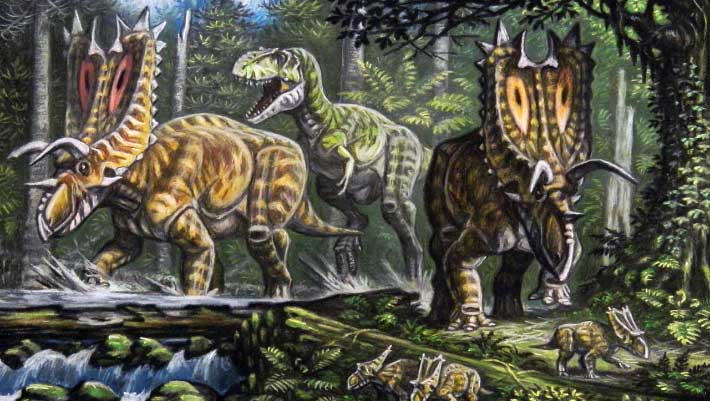
Cette semaine, nous allons découvrir encore un autre superbe dinosaure cératopsien.  Entrez Pentaceratops sternbergii ! Pentaceratops était un dinosaure herbivore qui mesurait environ vingt pieds de long du bec à la queue. En tant que cératopsien (cornes, becs et volants), il faisait partie du groupe des chasmosaurines et était étroitement apparenté au Chasmosaurus et au Coahuilaceratops pour n'en nommer que quelques-uns.  Il vivait dans ce qui est aujourd’hui le Nouveau-Mexique, aux États-Unis, à la fin du Crétacé, il y a entre 76 et 73 millions d’années.  Le nom du genre,
14/09/2025 prehistoricbeastoftheweek ⚙ Traduction automatique
1 2 3 4 5 6 7 8 9 10 11 12 13 14 15 16 17 18 19 20 21 22 23 24 25 26 27 28 29 30 31 32 33 34 35 36 37 38 39