←

Dinosauria

Taxon

300 image(s) · 316 Actualités

Voir la fiche

Galerie d'images

Saltasaurus (which means "lizard from Salta") was a sauropod dinosaur of the Late Cretaceous Period. Relatively small among sauropods, though still massive by human standards, it was characterized by a diplodocid-like head
Taxons Saltasaurus

Saltasaurus (which means "lizard from Salta") was a sauropod dinosaur of the Late Cretaceous Period. Relatively small among sauropods, though still massive by human standards, it was characterized by a diplodocid-like head

Crétacé Crétacé supérieur Balochisauridae Dinosauria +7
Saltasaurus (which means "lizard from Salta") was a sauropod dinosaur of the Late Cretaceous Period. Relatively small among sauropods, though still massive by human standards, it was characterized by a diplodocid-like head
Taxons Lithostrotia

Saltasaurus (which means "lizard from Salta") was a sauropod dinosaur of the Late Cretaceous Period. Relatively small among sauropods, though still massive by human standards, it was characterized by a diplodocid-like head

Crétacé Crétacé supérieur Balochisauridae Dinosauria +7
Saltasaurus (which means "lizard from Salta") was a sauropod dinosaur of the Late Cretaceous Period. Relatively small among sauropods, though still massive by human standards, it was characterized by a diplodocid-like head
Taxons Titanosauridae

Saltasaurus (which means "lizard from Salta") was a sauropod dinosaur of the Late Cretaceous Period. Relatively small among sauropods, though still massive by human standards, it was characterized by a diplodocid-like head

Crétacé Crétacé supérieur Balochisauridae Dinosauria +7
Saltasaurus (which means "lizard from Salta") was a sauropod dinosaur of the Late Cretaceous Period. Relatively small among sauropods, though still massive by human standards, it was characterized by a diplodocid-like head
Taxons Saltasauridae

Saltasaurus (which means "lizard from Salta") was a sauropod dinosaur of the Late Cretaceous Period. Relatively small among sauropods, though still massive by human standards, it was characterized by a diplodocid-like head

Crétacé Crétacé supérieur Balochisauridae Dinosauria +7
Saltasaurus (which means "lizard from Salta") was a sauropod dinosaur of the Late Cretaceous Period. Relatively small among sauropods, though still massive by human standards, it was characterized by a diplodocid-like head
Taxons Saltasaurinae

Saltasaurus (which means "lizard from Salta") was a sauropod dinosaur of the Late Cretaceous Period. Relatively small among sauropods, though still massive by human standards, it was characterized by a diplodocid-like head

Crétacé Crétacé supérieur Balochisauridae Dinosauria +7
Saltasaurus (which means "lizard from Salta") was a sauropod dinosaur of the Late Cretaceous Period. Relatively small among sauropods, though still massive by human standards, it was characterized by a diplodocid-like head
Taxons Balochisauridae

Saltasaurus (which means "lizard from Salta") was a sauropod dinosaur of the Late Cretaceous Period. Relatively small among sauropods, though still massive by human standards, it was characterized by a diplodocid-like head

Crétacé Crétacé supérieur Balochisauridae Dinosauria +7
Saltasaurus (which means "lizard from Salta") was a sauropod dinosaur of the Late Cretaceous Period. Relatively small among sauropods, though still massive by human standards, it was characterized by a diplodocid-like head
Taxons Saltasaurini

Saltasaurus (which means "lizard from Salta") was a sauropod dinosaur of the Late Cretaceous Period. Relatively small among sauropods, though still massive by human standards, it was characterized by a diplodocid-like head

Crétacé Crétacé supérieur Balochisauridae Dinosauria +7
Map of the localities in the Bauru Basin where the sauropod dinosaurs were collected.

Map of the localities in the Bauru Basin where the sauropod dinosaurs were collected.

Dinosauria Ibirania
(A) A phylogenetic principal-component analysis (PCA) represents the projection of the Dinosauria supertree (STAR Methods) into a PCA of climatic variables. PC1 axis shows strong positive correlation with maximum temperature ([temp max), low positive correlation with precipitation seasonality ( precip season), strong negative correlation with minimum temperature (Ytemp min), and strong negative correlation with minimum precipitation (Yprecip min). PC2 axis shows strong positive correlation with minimum temperature ([temp min) and negative correlation with precipitation seasonality (Yprecip season). Shadows around points highlight the relative density in the principal compo- nent space of non-dinosaurian Dinosauromorpha (gray), Ornithischia (blue), Sauropodomorpha (green), and Theropoda (red).
(B) Lower left plot shows 95% confidence interval convex hulls for each dinosauromorph subclade. Blue thermometer (top left corner) symbolizes the direction of the vector in the PC space region for cold temper- atures; yellow thermometer (top right corner) indicates the direction of the vector in PC space for warm tem- peratures; brown shrub (top right corner) depicts dry conditions, while the same with a gray, rainy cloud (mid, lower side of the graph) illustrates seasonal conditions.
Silhouettes represent the following taxa (clockwise from the higher left corner): Minmi, Edmontosaurus, Pachyrhinosaurus, Tyrannosaurus, Asilisaurus, Graci- liceratops, Harpymimus, Altirhinus, Gobititan, Suz- housaurus, Marasuchus, Pampadromaeus, Herrer- asaurus, Vulcanodon, Diplodocus, Giraffatitan,

Coelophysis, Dromomeron, Gondwanatitan, Tapuiasaurus, Anchisaurus, Siamotyrannus, Diodorus, Suchomimus, Phuwiangosaurus, Ouranosaurus, Irritator, Tangvayosaurus, Nanshiungosaurus, Aeolosaurus, Rebbachisaurus, Chuxiongosaurus, Tethyshadros, Koreanosaurus. Genyodectes, Mapusaurus, Vegavis, Goyocephale, and Rhoetosaurus.

(A) A phylogenetic principal-component analysis (PCA) represents the projection of the Dinosauria supertree (STAR Methods) into a PCA of climatic variables. PC1 axis shows strong positive correlation with maximum temperature ([temp max), low positive correlation with precipitation seasonality ( precip season), strong negative correlation with minimum temperature (Ytemp min), and strong negative correlation with minimum precipitation (Yprecip min). PC2 axis shows strong positive correlation with minimum temperature ([temp min) and negative correlation with precipitation seasonality (Yprecip season). Shadows around points highlight the relative density in the principal compo- nent space of non-dinosaurian Dinosauromorpha (gray), Ornithischia (blue), Sauropodomorpha (green), and Theropoda (red). (B) Lower left plot shows 95% confidence interval convex hulls for each dinosauromorph subclade. Blue thermometer (top left corner) symbolizes the direction of the vector in the PC space region for cold temper- atures; yellow thermometer (top right corner) indicates the direction of the vector in PC space for warm tem- peratures; brown shrub (top right corner) depicts dry conditions, while the same with a gray, rainy cloud (mid, lower side of the graph) illustrates seasonal conditions. Silhouettes represent the following taxa (clockwise from the higher left corner): Minmi, Edmontosaurus, Pachyrhinosaurus, Tyrannosaurus, Asilisaurus, Graci- liceratops, Harpymimus, Altirhinus, Gobititan, Suz- housaurus, Marasuchus, Pampadromaeus, Herrer- asaurus, Vulcanodon, Diplodocus, Giraffatitan, Coelophysis, Dromomeron, Gondwanatitan, Tapuiasaurus, Anchisaurus, Siamotyrannus, Diodorus, Suchomimus, Phuwiangosaurus, Ouranosaurus, Irritator, Tangvayosaurus, Nanshiungosaurus, Aeolosaurus, Rebbachisaurus, Chuxiongosaurus, Tethyshadros, Koreanosaurus. Genyodectes, Mapusaurus, Vegavis, Goyocephale, and Rhoetosaurus.

Dinosauria Ornithischia Pampadromaeus Sauropodomorpha +1
Simplified cladogram of Iguanodontia, drawn by me, based on Norman 2004 ("Basal Iguanodontia" in The Dinosauria 2nd Edition).

Simplified cladogram of Iguanodontia, drawn by me, based on Norman 2004 ("Basal Iguanodontia" in The Dinosauria 2nd Edition).

Dinosauria Iguanodontia Mochlodon
Herbivorous dinosaur found in the Al-khoudh area.  This dinosaur is similar to the Zalmoxes and Rhabdodon dinosaurs.  The skeleton in the Bait Al Baranda Museum was assembled from bones borrowed from several museums.

Herbivorous dinosaur found in the Al-khoudh area. This dinosaur is similar to the Zalmoxes and Rhabdodon dinosaurs. The skeleton in the Bait Al Baranda Museum was assembled from bones borrowed from several museums.

os musée Dinosauria Mochlodon +3
Locality map for Australian eurypodan thyreophoran fossils.

1, Stegosaurian? footprint (QM F5701), Walloon Coal Measures, Balgowan Colliery, Balgowan (Bajocian–Bathonian); 2, Minmi paravertebra holotype (QM F10329) (Molnar, 1980), Minmi Member, Bungil Formation (Valanginian–Barremian); 3, Thyreophoran trackways, Broome Sandstone, Dampier Peninsula, Western Australia (Valanginian–Barremian); 4, Ankylosauria indet. (see Barrett et al., 2010) ‘Flat Rocks’ Wonthaggi Formation (upper Hauterivian–Albian); 5, NMV P216739, ‘Lake Copco–Dinosaur Cove’ Eumeralla Formation (middle upper Aptian to lower middle Albian) (Barrett et al., 2010); 6, QM F33286; 7, AM F119849 and AM F35259; 8, Kunbarrasaurus ieversi gen. et sp. nov. (formerly Minmi sp.) (QM F18101); 9, QM F33565 and QM F33566; 10, QM F44324-28. Legend: Dark Green, Toolebuc Formation (late middle–early late Albian); Green, Allaru Formation (upper Albian–(?)lower Cenomanian); Light green, Mackunda Formation (upper Albian–lower Cenomanian); Lightest green, Winton Formation (late Albian–early Turonian).
Formations Toolebuc

Locality map for Australian eurypodan thyreophoran fossils. 1, Stegosaurian? footprint (QM F5701), Walloon Coal Measures, Balgowan Colliery, Balgowan (Bajocian–Bathonian); 2, Minmi paravertebra holotype (QM F10329) (Molnar, 1980), Minmi Member, Bungil Formation (Valanginian–Barremian); 3, Thyreophoran trackways, Broome Sandstone, Dampier Peninsula, Western Australia (Valanginian–Barremian); 4, Ankylosauria indet. (see Barrett et al., 2010) ‘Flat Rocks’ Wonthaggi Formation (upper Hauterivian–Albian); 5, NMV P216739, ‘Lake Copco–Dinosaur Cove’ Eumeralla Formation (middle upper Aptian to lower middle Albian) (Barrett et al., 2010); 6, QM F33286; 7, AM F119849 and AM F35259; 8, Kunbarrasaurus ieversi gen. et sp. nov. (formerly Minmi sp.) (QM F18101); 9, QM F33565 and QM F33566; 10, QM F44324-28. Legend: Dark Green, Toolebuc Formation (late middle–early late Albian); Green, Allaru Formation (upper Albian–(?)lower Cenomanian); Light green, Mackunda Formation (upper Albian–lower Cenomanian); Lightest green, Winton Formation (late Albian–early Turonian).

Australie Broome Sandstone Eumeralla Toolebuc +18
Original figure caption: .mw-parser-output .smallcaps{font-variant:small-caps}The Middletown Slab covered with the Footprints of Carnivorous Dinosaurs. The tracks are in high relief. Additional notes: Most if not all of these tridactylous (i.e. three-toed) footprints/tracks (but not the actual trackmaker!) are referred to as Grallator or as Grallator-type trace fossils. “High relief” means that these are actually casts of footprints forming a positive relief on the lower surface of the sandstone slab (so-called positive hyporelief). The material that originally formed the mud over which the dinosaurs walked was too friable to be recovered from the quarry in one piece. The slab consists of so called ‘brownstone’ which is the trading name of the sandstone quarried at Middletown, Connecticut. This sandstone belongs to the Lower Jurassic Portland Formation of the Hartford Basin (“Connecticut Valley”) and thus to the upper part of the Newark Supergroup. The trackmakers probably were relatively small ‘primitive’ theropod dinosaurs (coelophysoids) such as Podokesaurus the remains of which were recovered from Lower Jurassic deposits of the Hartford Basin.
Formations Portland

Original figure caption: .mw-parser-output .smallcaps{font-variant:small-caps}The Middletown Slab covered with the Footprints of Carnivorous Dinosaurs. The tracks are in high relief. Additional notes: Most if not all of these tridactylous (i.e. three-toed) footprints/tracks (but not the actual trackmaker!) are referred to as Grallator or as Grallator-type trace fossils. “High relief” means that these are actually casts of footprints forming a positive relief on the lower surface of the sandstone slab (so-called positive hyporelief). The material that originally formed the mud over which the dinosaurs walked was too friable to be recovered from the quarry in one piece. The slab consists of so called ‘brownstone’ which is the trading name of the sandstone quarried at Middletown, Connecticut. This sandstone belongs to the Lower Jurassic Portland Formation of the Hartford Basin (“Connecticut Valley”) and thus to the upper part of the Newark Supergroup. The trackmakers probably were relatively small ‘primitive’ theropod dinosaurs (coelophysoids) such as Podokesaurus the remains of which were recovered from Lower Jurassic deposits of the Hartford Basin.

Portland Jurassique moulage fossile +4
Title: Dinosaur hunting in western Canada
Identifier: dinosaurhuntingi00russ (find matches)
Year: 1966 (1960s)
Authors: Russell, Loris Shano, 1904-; Royal Ontario Museum
Subjects: Dinosaurs; Paleontology
Publisher: (Toronto : Printed at the University of Toronto Press)
Contributing Library: ROM - University of Toronto
Digitizing Sponsor: University of Toronto

View Book Page: Book Viewer
About This Book: Catalog Entry
View All Images: All Images From Book
Click here to view book online to see this illustration in context in a browseable online version of this book.

Text Appearing Before Image: 
This season of 1921 George Sternberg became the first dinosaur col- lector on the Red Deer River to have his work recorded in motion pictures. This happened by a curious error. The Dominion Motion Picture Bureau, predecessor of the National Film Board of Canada, had decided to make a short motion picture based on the work being done by the Geological Survey of Canada in the collecting and displaying of Canadian dinosaurs. The camera party sent to Alberta was naturally supposed to visit the Geological Survey party under Charles M. Sternberg, but local directions sent them to the camp of George Sternberg. So this excellent little film records field work by the University of Alberta party and preparation being done at the National Museum of Canada in Ottawa. That winter George Sternberg continued the preparation of the speci- mens obtained during the two preceding field seasons, but in the spring he resigned to accept a position with the Field Museum of Natural History of Chicago, under Elmer S. Riggs. The summer of 1922 was the last time that the eldest of the Sternberg sons worked on the Red Deer River, his collec- tion going to Chicago. However, he returned to Edmonton for several months in 1935, to complete the preparation of the collection that he brought together in 1920 and 1921. When George Sternberg left the Geological Survey of Canada in 1918, the only one of the four Sternbergs remaining at Ottawa was Charles Mortram Sternberg, the second son of C. H. Sternberg. Actually, Charles had his first independent expedition to the Red Deer badlands in 1917, C. M. Sternberg ami G. E. Lindblad working on the skull of a horned dinosaur (Centrasaurus sp.), Oldman formation, Red Deer River, 1917. N.M.C., No. 39994.
Text Appearing After Image: 
22

Note About Images

Please note that these images are extracted from scanned page images that may have been digitally enhanced for readability - coloration and appearance of these illustrations may not perfectly resemble the original work.

Title: Dinosaur hunting in western Canada Identifier: dinosaurhuntingi00russ (find matches) Year: 1966 (1960s) Authors: Russell, Loris Shano, 1904-; Royal Ontario Museum Subjects: Dinosaurs; Paleontology Publisher: (Toronto : Printed at the University of Toronto Press) Contributing Library: ROM - University of Toronto Digitizing Sponsor: University of Toronto View Book Page: Book Viewer About This Book: Catalog Entry View All Images: All Images From Book Click here to view book online to see this illustration in context in a browseable online version of this book. Text Appearing Before Image: This season of 1921 George Sternberg became the first dinosaur col- lector on the Red Deer River to have his work recorded in motion pictures. This happened by a curious error. The Dominion Motion Picture Bureau, predecessor of the National Film Board of Canada, had decided to make a short motion picture based on the work being done by the Geological Survey of Canada in the collecting and displaying of Canadian dinosaurs. The camera party sent to Alberta was naturally supposed to visit the Geological Survey party under Charles M. Sternberg, but local directions sent them to the camp of George Sternberg. So this excellent little film records field work by the University of Alberta party and preparation being done at the National Museum of Canada in Ottawa. That winter George Sternberg continued the preparation of the speci- mens obtained during the two preceding field seasons, but in the spring he resigned to accept a position with the Field Museum of Natural History of Chicago, under Elmer S. Riggs. The summer of 1922 was the last time that the eldest of the Sternberg sons worked on the Red Deer River, his collec- tion going to Chicago. However, he returned to Edmonton for several months in 1935, to complete the preparation of the collection that he brought together in 1920 and 1921. When George Sternberg left the Geological Survey of Canada in 1918, the only one of the four Sternbergs remaining at Ottawa was Charles Mortram Sternberg, the second son of C. H. Sternberg. Actually, Charles had his first independent expedition to the Red Deer badlands in 1917, C. M. Sternberg ami G. E. Lindblad working on the skull of a horned dinosaur (Centrasaurus sp.), Oldman formation, Red Deer River, 1917. N.M.C., No. 39994. Text Appearing After Image: 22 Note About Images Please note that these images are extracted from scanned page images that may have been digitally enhanced for readability - coloration and appearance of these illustrations may not perfectly resemble the original work.

chasse film musée Canada +1
Locality map: Grand Staircase-Escalante National Monument, southern Utah.
Map showing locality (indicated by star) of Nasutoceratops titusi holotype UMNH VP 16800, recovered from the Kaiparowits Formation of Grand Staircase-Escalante National Monument (GSENM). GSENM is bounded by the red rectangle and silhouetted in dark gray on the inset of Utah and surrounding states (modified from [1]).

The original map has been modified to show Nasutoceratops instead of Machairoceratops as in the original source. New location based on map in Ceratopsid Dinosaurs from the Grand Staircase of Southern Utah, page 489.

Locality map: Grand Staircase-Escalante National Monument, southern Utah. Map showing locality (indicated by star) of Nasutoceratops titusi holotype UMNH VP 16800, recovered from the Kaiparowits Formation of Grand Staircase-Escalante National Monument (GSENM). GSENM is bounded by the red rectangle and silhouetted in dark gray on the inset of Utah and surrounding states (modified from [1]). The original map has been modified to show Nasutoceratops instead of Machairoceratops as in the original source. New location based on map in Ceratopsid Dinosaurs from the Grand Staircase of Southern Utah, page 489.

Kaiparowits holotype Ceratopsidae Dinosauria +3
Locality map: Grand Staircase-Escalante National Monument, southern Utah.
Map showing locality (indicated by star) of Kosmoceratops richardsoni holotype UMNH VP 17000 and assigned subadult UMNH VP 16878, recovered from the Kaiparowits Formation of Grand Staircase-Escalante National Monument (GSENM). GSENM is bounded by the red rectangle and silhouetted in dark gray on the inset of Utah and surrounding states (modified from [1]).

The original map has been modified to show Kosmoceratops instead of Machairoceratops as in the original source. New location based on map in Ceratopsid Dinosaurs from the Grand Staircase of Southern Utah, page 489.

Locality map: Grand Staircase-Escalante National Monument, southern Utah. Map showing locality (indicated by star) of Kosmoceratops richardsoni holotype UMNH VP 17000 and assigned subadult UMNH VP 16878, recovered from the Kaiparowits Formation of Grand Staircase-Escalante National Monument (GSENM). GSENM is bounded by the red rectangle and silhouetted in dark gray on the inset of Utah and surrounding states (modified from [1]). The original map has been modified to show Kosmoceratops instead of Machairoceratops as in the original source. New location based on map in Ceratopsid Dinosaurs from the Grand Staircase of Southern Utah, page 489.

Kaiparowits holotype Ceratopsidae Dinosauria +3
1 2 3 4 5 6 7 8 9 10 11 12 13 14 15 16 17 18 19

Actualités

Cette étrange créature vivait il y a 309 millions d'années, bien avant les dinosaures
musée Dinosauria évolution
Il y a plus de 300 millions d'années, bien avant que les dinosaures ne parcourent la Terre, la région de Chicago était un paysage humide et marécageux regorgeant de créatures bizarres. Aujourd'hui, des scientifiques du Field Museum ont identifié une espèce jusqu'alors méconnue d'un ancien ancêtre des amphibiens, révélant de nouveaux indices sur l'évolution des grenouilles et des salamandres.
18/11/2026 sciencedaily ⚙ Traduction automatique
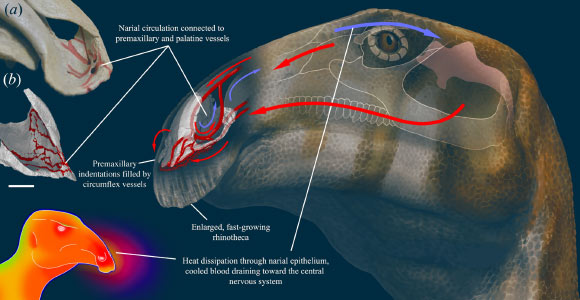
Duck-Billed Dinosaur’s Beak was as Complex as Bird’s
Le bec du dinosaure à bec de canard était aussi complexe que celui d'un oiseau
dent Italie Canardia Dinosauria Tethyshadros oiseau
Tethyshadros insularis, un dinosaure insulaire à bec de canard qui vivait il y a 81 millions d'années dans ce qui est aujourd'hui l'Italie, n'avait pas de peigne composé de pointes en forme de dents au bout de son museau, selon une nouvelle analyse. L'article Le bec du dinosaure à bec de canard était aussi complexe que celui de l'oiseau est apparu en premier sur Sci.News : Breaking Science News.
18/11/2026 sci-news ⚙ Traduction automatique
Dinosaures : des traces de sang fossilisées agitent la communauté paléontologique
fossile Dinosauria découverte
Une équipe internationale affirme avoir identifié, pour la première fois de manière formelle, des traces de globules rouges minéralisés dans un fossile de dinosaure vieux de 115 millions d’années. Si cette découverte se confirme, la science des animaux disparus depuis des temps immémoriaux pourrait bien connaître une petite révolution.
18/11/2026 sciencesetavenir
Everything Dinosaur Worldwide Delivery – Un service auquel vous pouvez faire confiance
Royaume-Uni Dinosauria
Everything Dinosaur a actualisé sa page Web populaire « Faites-nous confiance pour livrer », en introduisant six nouvelles images qui mettent en évidence l'engagement de l'entreprise envers le service client, la connaissance spécialisée des dinosaures et l'expédition internationale fiable. La livraison mondiale d'Everything Dinosaur constitue une partie importante de l'entreprise depuis sa création en 2005.  Par exemple, la société basée au Royaume-Uni envoie des dinosaures
17/11/2026 everythingdinosaur ⚙ Traduction automatique
Infernogallus: Beast of the Week
Infernogallus : la bête de la semaine
États-Unis Crétacé Crétacé supérieur Dinosauria Infernogallus oiseau
 Cette semaine, nous allons découvrir un nouveau dinosaure ressemblant à un oiseau.  Entrez Infernogallus jamesi !Infernogallus était un dinosaure théropode qui vivait dans ce qui est aujourd'hui l'ouest des États-Unis (Montana, Dakota du Nord et Dakota du Sud) à la fin du Crétacé, il y a entre 68 et 66 millions d'années.  Il était petit, mesurant seulement environ 1,25 m du bec à la queue, et semble avoir été un herbivore ou peut-être un omnivore, de son vivant.  Le nom du genre, Infernogallus, se traduit par « Infer
15/11/2026 prehistoricbeastoftheweek ⚙ Traduction automatique
1 2 3 4 5 6 7 8 9 10 11 12 13 14 15 16 17 18 19 20 21 22 23 24 25 26 27 28 29 30 31 32 33 34 35 36 37 38 39 40 41 42 43 44 45 46 47 48 49 50 51 52 53 54 55 56 57 58 59 60 61 62 63 64