extinction

Thématique

4 image(s) · 11 Actualités

Galerie d'images

Figure 1. Evolution of macroecological traits in Dinosauria. Large scale event in dinosaur evolution (a); the origin of dinosaurs (star), hyperthermals (volcano), the earliest fossil Avialae (bird), the earliest fossil angiosperm (flower), the Cretaceous/Palaeogene mass extinction (asteroid). Phylogeny of dinosaurs (b) redrawn from Sereno and adapted to the current consensus and upon which an ancestral state reconstruction of temperature niche (mean annual temperature) after Chiarenza et al. is plotted; Mesozoic palaeogeographies (c) for Triassic (T), Jurassic (J) and Cretaceous (K). Silhouette colours symbolize body mass for each of the taxa represented; information on dietary habits are plotted after Barrett and Zanno & Makovicky; numbers represent clades discussed through this study: 1, Ornithischia; 2, Thyreophora; 3, Ornithopoda; 4, Hadrosauroidea; 5, Marginocephalia; 6, Ceratopsia; 7, Saurischia; 8, Sauropodomorpha; 9, Sauropoda; 10, Theropoda; 11, Ceratosauria; 12, Tetanurae; 13, Coelurosauria; 14, Maniraptoriformes; 15, Maniraptora; 16, Deinonychosauria; 17, Avialae; 18, Ornithothoraces. Palaeogeographies modified from original plots via R package ‘mapast’ using plate models by Scotese.

Figure 1. Evolution of macroecological traits in Dinosauria. Large scale event in dinosaur evolution (a); the origin of dinosaurs (star), hyperthermals (volcano), the earliest fossil Avialae (bird), the earliest fossil angiosperm (flower), the Cretaceous/Palaeogene mass extinction (asteroid). Phylogeny of dinosaurs (b) redrawn from Sereno and adapted to the current consensus and upon which an ancestral state reconstruction of temperature niche (mean annual temperature) after Chiarenza et al. is plotted; Mesozoic palaeogeographies (c) for Triassic (T), Jurassic (J) and Cretaceous (K). Silhouette colours symbolize body mass for each of the taxa represented; information on dietary habits are plotted after Barrett and Zanno & Makovicky; numbers represent clades discussed through this study: 1, Ornithischia; 2, Thyreophora; 3, Ornithopoda; 4, Hadrosauroidea; 5, Marginocephalia; 6, Ceratopsia; 7, Saurischia; 8, Sauropodomorpha; 9, Sauropoda; 10, Theropoda; 11, Ceratosauria; 12, Tetanurae; 13, Coelurosauria; 14, Maniraptoriformes; 15, Maniraptora; 16, Deinonychosauria; 17, Avialae; 18, Ornithothoraces. Palaeogeographies modified from original plots via R package ‘mapast’ using plate models by Scotese.

écaille Crétacé Jurassique Mésozoïque +23
Holotype of Alcione elainus.
Fig. 6 of:
Longrich, N. R., Martill, D. M., & Andres, B. (2018). Late Maastrichtian pterosaurs from North Africa and mass extinction of Pterosauria at the Cretaceous-Paleogene boundary. PLoS biology, 16(3), e2001663.
---
Original figure legend:
A. elainus FSAC-OB 2, holotype partial skeleton and FSAC-OB 217, metacarpal IV.

(A) Holotype right humerus in anterior view, (B) holotype right ulna and radius in anterior view, respectively, (C) holotype sternum in left lateral view, (D) referred metacarpal IV, (E) holotype, distal end of left metacarpal IV and left scapulocoracoid, and (F) holotype right femur in posterior view. Abbreviations: co, coracoid; cr, cristospine; dc, distal condyle; dpc, deltopectoral crest; ect, ectepicondyle; fh, femoral head; gl, glenoid; gt, greater trochanter; hh, humeral head; hum, humerus; mcIV, metacarpal IV, pc, proximal cotyle; pf, pneumatic foramen; rad, radius; scpr, supracondylar process; ste, sternum; uln, ulna.

Holotype of Alcione elainus. Fig. 6 of: Longrich, N. R., Martill, D. M., & Andres, B. (2018). Late Maastrichtian pterosaurs from North Africa and mass extinction of Pterosauria at the Cretaceous-Paleogene boundary. PLoS biology, 16(3), e2001663. --- Original figure legend: A. elainus FSAC-OB 2, holotype partial skeleton and FSAC-OB 217, metacarpal IV. (A) Holotype right humerus in anterior view, (B) holotype right ulna and radius in anterior view, respectively, (C) holotype sternum in left lateral view, (D) referred metacarpal IV, (E) holotype, distal end of left metacarpal IV and left scapulocoracoid, and (F) holotype right femur in posterior view. Abbreviations: co, coracoid; cr, cristospine; dc, distal condyle; dpc, deltopectoral crest; ect, ectepicondyle; fh, femoral head; gl, glenoid; gt, greater trochanter; hh, humeral head; hum, humerus; mcIV, metacarpal IV, pc, proximal cotyle; pf, pneumatic foramen; rad, radius; scpr, supracondylar process; ste, sternum; uln, ulna.

crête humérus Crétacé Maastrichtien +7
Holotype of Alcione elainus.
Fig. 6 of:
Longrich, N. R., Martill, D. M., & Andres, B. (2018). Late Maastrichtian pterosaurs from North Africa and mass extinction of Pterosauria at the Cretaceous-Paleogene boundary. PLoS biology, 16(3), e2001663.
---
Original figure legend:
A. elainus FSAC-OB 2, holotype partial skeleton and FSAC-OB 217, metacarpal IV.

(A) Holotype right humerus in anterior view, (B) holotype right ulna and radius in anterior view, respectively, (C) holotype sternum in left lateral view, (D) referred metacarpal IV, (E) holotype, distal end of left metacarpal IV and left scapulocoracoid, and (F) holotype right femur in posterior view. Abbreviations: co, coracoid; cr, cristospine; dc, distal condyle; dpc, deltopectoral crest; ect, ectepicondyle; fh, femoral head; gl, glenoid; gt, greater trochanter; hh, humeral head; hum, humerus; mcIV, metacarpal IV, pc, proximal cotyle; pf, pneumatic foramen; rad, radius; scpr, supracondylar process; ste, sternum; uln, ulna.
Taxons Alcione

Holotype of Alcione elainus. Fig. 6 of: Longrich, N. R., Martill, D. M., & Andres, B. (2018). Late Maastrichtian pterosaurs from North Africa and mass extinction of Pterosauria at the Cretaceous-Paleogene boundary. PLoS biology, 16(3), e2001663. --- Original figure legend: A. elainus FSAC-OB 2, holotype partial skeleton and FSAC-OB 217, metacarpal IV. (A) Holotype right humerus in anterior view, (B) holotype right ulna and radius in anterior view, respectively, (C) holotype sternum in left lateral view, (D) referred metacarpal IV, (E) holotype, distal end of left metacarpal IV and left scapulocoracoid, and (F) holotype right femur in posterior view. Abbreviations: co, coracoid; cr, cristospine; dc, distal condyle; dpc, deltopectoral crest; ect, ectepicondyle; fh, femoral head; gl, glenoid; gt, greater trochanter; hh, humeral head; hum, humerus; mcIV, metacarpal IV, pc, proximal cotyle; pf, pneumatic foramen; rad, radius; scpr, supracondylar process; ste, sternum; uln, ulna.

crête humérus Crétacé Maastrichtien +7
Life restoration of the Triassic ichthyosaur Qianichthyosaurus xingyiensis.
References
Motani, Ryosuke; Jiang, Da-yong; Tintori, Andrea; Ji, Cheng; Huang, Jian-dong (2017). "Pre- versus post-mass extinction divergence of Mesozoic marine reptiles dictated by time-scale dependence of evolutionary rates". Proceedings of the Royal Society B 284 (1854): 20170241. DOI:10.1098/rspb.2017.0241.

Life restoration of the Triassic ichthyosaur Qianichthyosaurus xingyiensis. References Motani, Ryosuke; Jiang, Da-yong; Tintori, Andrea; Ji, Cheng; Huang, Jian-dong (2017). "Pre- versus post-mass extinction divergence of Mesozoic marine reptiles dictated by time-scale dependence of evolutionary rates". Proceedings of the Royal Society B 284 (1854): 20170241. DOI:10.1098/rspb.2017.0241.

écaille Mésozoïque Trias Ichthyosauria +3

Actualités

Un fossile écrasé révèle un dinosaure qui n’aurait pas dû exister
Trias fossile Dinosauria découverte extinction nouvelle espèce crâne
Un crâne de dinosaure gravement mutilé, oublié dans un tiroir, s'est avéré être une découverte rare et importante. Reconstruit par un étudiant de Virginia Tech, il a révélé une nouvelle espèce de dinosaure carnivore primitif présentant des caractéristiques inhabituelles jamais vues auparavant. Le fossile suggère que certains groupes de dinosaures ont été anéantis lors de l’extinction de la fin du Trias, et pas seulement leurs rivaux. Il s’agit peut-être de l’un des derniers survivants d’une ancienne lignée de dinosaures.
15/04/2026 sciencedaily ⚙ Traduction automatique
Les ancêtres des mammifères ont pondu, et ce fossile vieux de 250 millions d'années le prouve enfin
fossile découverte extinction mammifères
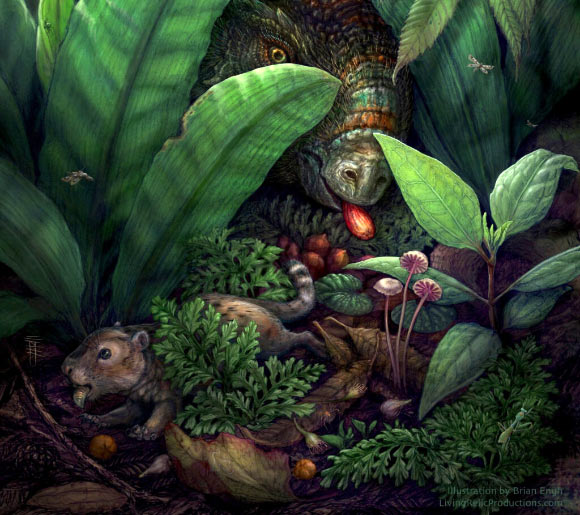
À la suite de l’extinction la plus catastrophique de la Terre, un survivant improbable s’est levé pour dominer un monde brisé : Lystrosaurus. Aujourd’hui, une étonnante découverte de fossile – un œuf ancien contenant un embryon recroquevillé – a enfin répondu à un mystère vieux de plusieurs décennies quant à savoir si les ancêtres des mammifères ont pondu des œufs. Grâce à une technologie d’imagerie avancée, les scientifiques ont confirmé que ces créatures résilientes se reproduisaient de cette façon, produisant probablement de gros œufs à coquille molle remplis de nutriments.
14/04/2026 sciencedaily ⚙ Traduction automatique
Des fossiles perdus révèlent des monstres marins qui ont pris le relais après la plus grande extinction de la Terre
prédateur Australie Madagascar fossile extinction
Une cache perdue de fossiles vieux de 250 millions d’années en Australie a réécrit une partie de l’histoire de la vie après la pire extinction massive de la Terre. Au lieu d’une seule espèce d’amphibien marin, les chercheurs ont découvert des preuves d’une communauté étonnamment diversifiée de premiers prédateurs océaniques. L'une de ces créatures avait des parents s'étendant de l'Arctique à Madagascar, ce qui montre que certains des premiers tétrapodes marins se sont répandus à travers le monde à une vitesse remarquable.
25/02/2026 sciencedaily ⚙ Traduction automatique
Une ancienne sécheresse aurait pu anéantir les vrais hobbits il y a 61 000 ans
extinction formation
Une sécheresse massive qui a duré des siècles pourrait avoir entraîné l’extinction des « hobbits » de Flores. Les enregistrements climatiques conservés dans les formations souterraines montrent que les précipitations ont chuté au moment même où la petite espèce humaine disparaissait. Dans le même temps, le nombre d’éléphants pygmées dont ils dépendaient a fortement diminué à mesure que les rivières s’asséchaient. Avec la disparition de la nourriture et de l'eau, les hobbits ont peut-être été repoussés et entrés dans leur dernier chapitre.
19/02/2026 sciencedaily-human-evo ⚙ Traduction automatique
La pire extinction de la Terre a été suivie par un retour incroyablement rapide des océans
prédateur fossile découverte extinction
Un spectaculaire trésor de fossiles sur l’île arctique du Spitzberg montre que la vie marine a fait un retour étonnant après la plus grande extinction de la Terre. Des dizaines de milliers de fossiles révèlent des reptiles entièrement aquatiques et des chaînes alimentaires complexes qui prospèrent à peine trois millions d'années plus tard. Certains prédateurs mesuraient plus de cinq mètres de long, remettant en question l’idée d’une récupération lente et progressive. La découverte réécrit les débuts de l’histoire des écosystèmes océaniques.
30/12/2025 sciencedaily ⚙ Traduction automatique
1 2 3