←

crest

Anatomical part

41 image(s) · 5 News

Image gallery

Mimodactylus libanensis gen. et sp. nov. (a) Photo and drawing of the complete specimen. (b) Close up of scapula and coracoid. (c) Detail of the wrist, showing the relation of the pteroid and the carpus. (d) Detail of the humerus. Scale-bars, a: 50 mm; b-d: 10 mm. Abbreviations. car: carpus; cdv: caudal vertebrae; cor: coracoid; cra: cranium; cs: cristospine; cv: cervical vertebrae; d: dentary; dcar: distal carpals; dpc: deltopectoral crest; dri: dorsal ribs; dv: dorsal vertebrae; fe: femur; hu: humerus; man: mandible; mcI-III: first to third metacarpals; mcIV: wing metacarpal; mtar: metatarsals; pcar: proximal carpals; ph1d4: first wing phalanx; ph2d4: second wing phalanx; ph3d4: third wing phalanx; ph4d4: fourth wing phalanx; ppu: prepubis; ptd: pteroid; ra: radius; sca: scapula; sri: sacral ribs; stp: sternal plate; sym: mandibular symphysis; tar: tarsus; te: teeth; ti: tibia; ul: ulna; the abbreviations ‘l’ and ‘r’ represents respectively left and right.
Taxa Mimodactylidae

Mimodactylus libanensis gen. et sp. nov. (a) Photo and drawing of the complete specimen. (b) Close up of scapula and coracoid. (c) Detail of the wrist, showing the relation of the pteroid and the carpus. (d) Detail of the humerus. Scale-bars, a: 50 mm; b-d: 10 mm. Abbreviations. car: carpus; cdv: caudal vertebrae; cor: coracoid; cra: cranium; cs: cristospine; cv: cervical vertebrae; d: dentary; dcar: distal carpals; dpc: deltopectoral crest; dri: dorsal ribs; dv: dorsal vertebrae; fe: femur; hu: humerus; man: mandible; mcI-III: first to third metacarpals; mcIV: wing metacarpal; mtar: metatarsals; pcar: proximal carpals; ph1d4: first wing phalanx; ph2d4: second wing phalanx; ph3d4: third wing phalanx; ph4d4: fourth wing phalanx; ppu: prepubis; ptd: pteroid; ra: radius; sca: scapula; sri: sacral ribs; stp: sternal plate; sym: mandibular symphysis; tar: tarsus; te: teeth; ti: tibia; ul: ulna; the abbreviations ‘l’ and ‘r’ represents respectively left and right.

crest humerus scale drawing +3
Mimodactylus libanensis gen. et sp. nov. (a) Photo and drawing of the complete specimen. (b) Close up of scapula and coracoid. (c) Detail of the wrist, showing the relation of the pteroid and the carpus. (d) Detail of the humerus. Scale-bars, a: 50 mm; b-d: 10 mm. Abbreviations. car: carpus; cdv: caudal vertebrae; cor: coracoid; cra: cranium; cs: cristospine; cv: cervical vertebrae; d: dentary; dcar: distal carpals; dpc: deltopectoral crest; dri: dorsal ribs; dv: dorsal vertebrae; fe: femur; hu: humerus; man: mandible; mcI-III: first to third metacarpals; mcIV: wing metacarpal; mtar: metatarsals; pcar: proximal carpals; ph1d4: first wing phalanx; ph2d4: second wing phalanx; ph3d4: third wing phalanx; ph4d4: fourth wing phalanx; ppu: prepubis; ptd: pteroid; ra: radius; sca: scapula; sri: sacral ribs; stp: sternal plate; sym: mandibular symphysis; tar: tarsus; te: teeth; ti: tibia; ul: ulna; the abbreviations ‘l’ and ‘r’ represents respectively left and right.
Taxa Mimodactylus

Mimodactylus libanensis gen. et sp. nov. (a) Photo and drawing of the complete specimen. (b) Close up of scapula and coracoid. (c) Detail of the wrist, showing the relation of the pteroid and the carpus. (d) Detail of the humerus. Scale-bars, a: 50 mm; b-d: 10 mm. Abbreviations. car: carpus; cdv: caudal vertebrae; cor: coracoid; cra: cranium; cs: cristospine; cv: cervical vertebrae; d: dentary; dcar: distal carpals; dpc: deltopectoral crest; dri: dorsal ribs; dv: dorsal vertebrae; fe: femur; hu: humerus; man: mandible; mcI-III: first to third metacarpals; mcIV: wing metacarpal; mtar: metatarsals; pcar: proximal carpals; ph1d4: first wing phalanx; ph2d4: second wing phalanx; ph3d4: third wing phalanx; ph4d4: fourth wing phalanx; ppu: prepubis; ptd: pteroid; ra: radius; sca: scapula; sri: sacral ribs; stp: sternal plate; sym: mandibular symphysis; tar: tarsus; te: teeth; ti: tibia; ul: ulna; the abbreviations ‘l’ and ‘r’ represents respectively left and right.

crest humerus scale drawing +3
Cimoliopterus cuvieri. Holotype NHMUK PV 39409 (Cenomanian / Turonian, Chalk Formation), anterior part of the rostrum A right lateral view B respective line drawing C ventral view D respective line drawing. Abbreviations: m – maxillae, pm – premaxillae, pmcr – premaxillary crest, prid – palatal ridge. Arrows and numbers indicate alveoli or teeth and their respective position. Scale bar = 10 mm. Photos courtesy of The Natural History Museum.
Taxa Cimoliopterus

Cimoliopterus cuvieri. Holotype NHMUK PV 39409 (Cenomanian / Turonian, Chalk Formation), anterior part of the rostrum A right lateral view B respective line drawing C ventral view D respective line drawing. Abbreviations: m – maxillae, pm – premaxillae, pmcr – premaxillary crest, prid – palatal ridge. Arrows and numbers indicate alveoli or teeth and their respective position. Scale bar = 10 mm. Photos courtesy of The Natural History Museum.

crest scale drawing museum +5
T. regalis FSAC-OB 1, holotype left humerus.

In (A), ventral view, (B) dorsal view, (C) anterior view, (D) distal view, and (E) proximal view. Abbreviations: dpc, deltopectoral crest; ect, ectepicondyle; ent, entepicondyle; lc, lateral condyle; mc, medial condyle; pf, pneumatic fossa/foramen; scpr, supracondylar process; uc, ulnar crest; ut, ulnar tubercle.
Taxa Tethydraco

T. regalis FSAC-OB 1, holotype left humerus. In (A), ventral view, (B) dorsal view, (C) anterior view, (D) distal view, and (E) proximal view. Abbreviations: dpc, deltopectoral crest; ect, ectepicondyle; ent, entepicondyle; lc, lateral condyle; mc, medial condyle; pf, pneumatic fossa/foramen; scpr, supracondylar process; uc, ulnar crest; ut, ulnar tubercle.

crest humerus holotype Tethydraco
Lonchodraco giganteus comb. n. Lectotype NHMUK PV 39412 (Cenomanian / Turonian, Chalk Formation). A–F articulated anterior parts of the rostrum and mandible A right lateral view B respective line drawing C left lateral view D respective line drawing E anterior view F respective line drawing G associated scapulocoracoid in posterior view. Abbreviations: ch – choanae, cor – coracoid, d – dentary, dcr – dentary crest, m – maxillae, pl – palatine, pm – premaxillae, pmcr – premaxillaery crest, prid – palatal ridge, sca – scapula. Arrows indicate alveoli or teeth. Scale bar = 10 mm. Photos courtesy of The Natural History Museum.
Taxa Lonchodraco

Lonchodraco giganteus comb. n. Lectotype NHMUK PV 39412 (Cenomanian / Turonian, Chalk Formation). A–F articulated anterior parts of the rostrum and mandible A right lateral view B respective line drawing C left lateral view D respective line drawing E anterior view F respective line drawing G associated scapulocoracoid in posterior view. Abbreviations: ch – choanae, cor – coracoid, d – dentary, dcr – dentary crest, m – maxillae, pl – palatine, pm – premaxillae, pmcr – premaxillaery crest, prid – palatal ridge, sca – scapula. Arrows indicate alveoli or teeth. Scale bar = 10 mm. Photos courtesy of The Natural History Museum.

crest scale drawing museum +4
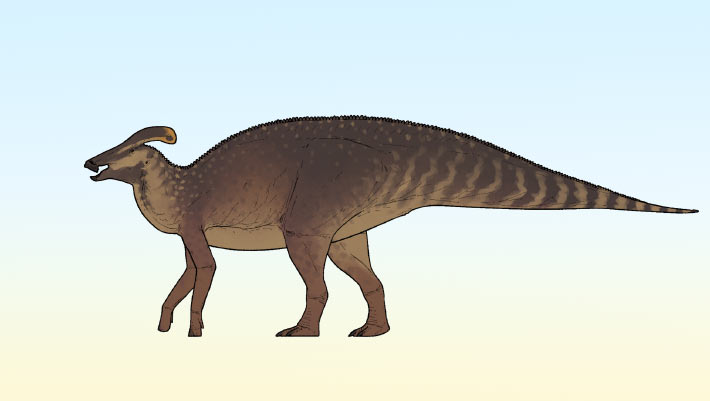
Plesiolophus is a lambeosaurine hadrosaur known from the same locality, but an earlier time period than Parasaurolophus. Though it is nearly impossible to know conclusively, Plesiolophus cannot be ruled out as a direct ancestor. Like Parasaurolophus, Plesiolophus would have had a distinct crest protruding backward from its skull.

Plesiolophus is a lambeosaurine hadrosaur known from the same locality, but an earlier time period than Parasaurolophus. Though it is nearly impossible to know conclusively, Plesiolophus cannot be ruled out as a direct ancestor. Like Parasaurolophus, Plesiolophus would have had a distinct crest protruding backward from its skull.

crest Hadrosauria Parasaurolophus Plesiolophus +1
Holotype of Jian changmaensis (GSGM-D050), an articulated partial left pectoral girdle (scapulocoracoid) and forelimb (humerus, radius, and ulna). A, silhouette of generalized microraptorine dromaeosaurid theropod (courtesy Scott Hartman) showing skeletal elements preserved; B, photograph of specimen as preserved, exposed primarily in dorsomedial (scapulocoracoid), caudodorsal (humerus), and dorsal (radius and ulna) views; C, interpretive line drawing of B; D, detail photograph of scapulocoracoid and proximal end of humerus in caudodorsal view, showing supracoracoid fenestra and other structures; E, interpretive line drawing of D. Abbreviations: ac, acromion; bc, bicipital crest; C, coracoid; cr, caudal ridge; dep, dorsal epicondyle; dpc, deltopectoral crest; dr, dorsal ridge; ed, epicondylar depression; fs?, fossa for M. supinator?; H, humerus; hh, humeral head; lp, lateral process; ‘mb’, ‘medial bar’; op, olecranon process; R, radius; S, scapula; scb, scapular blade; scf, supracoracoid fenestra; sta, sternal articulation; U, ulna.
Taxa Jian

Holotype of Jian changmaensis (GSGM-D050), an articulated partial left pectoral girdle (scapulocoracoid) and forelimb (humerus, radius, and ulna). A, silhouette of generalized microraptorine dromaeosaurid theropod (courtesy Scott Hartman) showing skeletal elements preserved; B, photograph of specimen as preserved, exposed primarily in dorsomedial (scapulocoracoid), caudodorsal (humerus), and dorsal (radius and ulna) views; C, interpretive line drawing of B; D, detail photograph of scapulocoracoid and proximal end of humerus in caudodorsal view, showing supracoracoid fenestra and other structures; E, interpretive line drawing of D. Abbreviations: ac, acromion; bc, bicipital crest; C, coracoid; cr, caudal ridge; dep, dorsal epicondyle; dpc, deltopectoral crest; dr, dorsal ridge; ed, epicondylar depression; fs?, fossa for M. supinator?; H, humerus; hh, humeral head; lp, lateral process; ‘mb’, ‘medial bar’; op, olecranon process; R, radius; S, scapula; scb, scapular blade; scf, supracoracoid fenestra; sta, sternal articulation; U, ulna.

crest humerus drawing holotype +4
Holotype of Alcione elainus.
Fig. 6 of:
Longrich, N. R., Martill, D. M., & Andres, B. (2018). Late Maastrichtian pterosaurs from North Africa and mass extinction of Pterosauria at the Cretaceous-Paleogene boundary. PLoS biology, 16(3), e2001663.
---
Original figure legend:
A. elainus FSAC-OB 2, holotype partial skeleton and FSAC-OB 217, metacarpal IV.

(A) Holotype right humerus in anterior view, (B) holotype right ulna and radius in anterior view, respectively, (C) holotype sternum in left lateral view, (D) referred metacarpal IV, (E) holotype, distal end of left metacarpal IV and left scapulocoracoid, and (F) holotype right femur in posterior view. Abbreviations: co, coracoid; cr, cristospine; dc, distal condyle; dpc, deltopectoral crest; ect, ectepicondyle; fh, femoral head; gl, glenoid; gt, greater trochanter; hh, humeral head; hum, humerus; mcIV, metacarpal IV, pc, proximal cotyle; pf, pneumatic foramen; rad, radius; scpr, supracondylar process; ste, sternum; uln, ulna.
Taxa Alcione

Holotype of Alcione elainus. Fig. 6 of: Longrich, N. R., Martill, D. M., & Andres, B. (2018). Late Maastrichtian pterosaurs from North Africa and mass extinction of Pterosauria at the Cretaceous-Paleogene boundary. PLoS biology, 16(3), e2001663. --- Original figure legend: A. elainus FSAC-OB 2, holotype partial skeleton and FSAC-OB 217, metacarpal IV. (A) Holotype right humerus in anterior view, (B) holotype right ulna and radius in anterior view, respectively, (C) holotype sternum in left lateral view, (D) referred metacarpal IV, (E) holotype, distal end of left metacarpal IV and left scapulocoracoid, and (F) holotype right femur in posterior view. Abbreviations: co, coracoid; cr, cristospine; dc, distal condyle; dpc, deltopectoral crest; ect, ectepicondyle; fh, femoral head; gl, glenoid; gt, greater trochanter; hh, humeral head; hum, humerus; mcIV, metacarpal IV, pc, proximal cotyle; pf, pneumatic foramen; rad, radius; scpr, supracondylar process; ste, sternum; uln, ulna.

crest humerus Cretaceous Maastrichtian +7
Figure 4
The reconstruction of the skull and lower jaw of the holotype of Darwinopterus camposi sp. nov. (IVPP V 17957). Scale bar: 50 mm. Abbreviations: d, dentary; f, frontal; j, jugal; ltf, lower temporal fenestra; m, maxilla; man.sys, mandibular symphysis; naof, nasoantorbital fenestra; o, orbit; p, parietal; pm, premaxilla; pmcr, premaxillary crest; po, postorbital; prn, nasal process; q, quadrate; sq, squamosal; utf, upper temporal fenestra.
Taxa Monofenestrata

Figure 4 The reconstruction of the skull and lower jaw of the holotype of Darwinopterus camposi sp. nov. (IVPP V 17957). Scale bar: 50 mm. Abbreviations: d, dentary; f, frontal; j, jugal; ltf, lower temporal fenestra; m, maxilla; man.sys, mandibular symphysis; naof, nasoantorbital fenestra; o, orbit; p, parietal; pm, premaxilla; pmcr, premaxillary crest; po, postorbital; prn, nasal process; q, quadrate; sq, squamosal; utf, upper temporal fenestra.

crest scale holotype Darwinoptera +3
Figure 4
The reconstruction of the skull and lower jaw of the holotype of Darwinopterus camposi sp. nov. (IVPP V 17957). Scale bar: 50 mm. Abbreviations: d, dentary; f, frontal; j, jugal; ltf, lower temporal fenestra; m, maxilla; man.sys, mandibular symphysis; naof, nasoantorbital fenestra; o, orbit; p, parietal; pm, premaxilla; pmcr, premaxillary crest; po, postorbital; prn, nasal process; q, quadrate; sq, squamosal; utf, upper temporal fenestra.
Taxa Darwinoptera

Figure 4 The reconstruction of the skull and lower jaw of the holotype of Darwinopterus camposi sp. nov. (IVPP V 17957). Scale bar: 50 mm. Abbreviations: d, dentary; f, frontal; j, jugal; ltf, lower temporal fenestra; m, maxilla; man.sys, mandibular symphysis; naof, nasoantorbital fenestra; o, orbit; p, parietal; pm, premaxilla; pmcr, premaxillary crest; po, postorbital; prn, nasal process; q, quadrate; sq, squamosal; utf, upper temporal fenestra.

crest scale holotype Darwinoptera +3
Anzu is a fairly large caenagnathid oviraptorosaurian dinosaur that grew to nearly 4 m in length, and weighed 200-300 kg. It was a bipedal dinosaur and was covered in feathers, with a large sloping crest atop its head. Typical of oviraptorosaurs, Anzu had a short toothless beak, an adaptation that suggests it was most likely herbivorous or possibly omnivorous.

Anzu is a fairly large caenagnathid oviraptorosaurian dinosaur that grew to nearly 4 m in length, and weighed 200-300 kg. It was a bipedal dinosaur and was covered in feathers, with a large sloping crest atop its head. Typical of oviraptorosaurs, Anzu had a short toothless beak, an adaptation that suggests it was most likely herbivorous or possibly omnivorous.

crest feather Anzu Caenagnathidae +2
1 2 3

News

New Crested Dinosaur Species Identified in Canada
crest Canada Campanian Cretaceous Dinosauria Hadrosauridae dating new species
A new genus and species of lambeosaurine hadrosaurid dinosaur has been identified in southern Alberta, Canada, dating back 77 million years to the Campanian age of the Cretaceous period. The post New Crested Dinosaur Species Identified in Canada appeared first on Sci.News: Breaking Science News.
14/07/2026 sci-news
A giant blade-crested spinosaurus, the “hell heron,” discovered in the Sahara
crest predator Niger fossil Dinosauria Spinosauria
Deep in the heart of the Sahara, scientists have uncovered Spinosaurus mirabilis — a spectacular new predator crowned with a massive, scimitar-shaped crest that may once have blazed with color under the desert sun. Discovered in remote inland river deposits in Niger, the fossil rewrites what we thought we knew about spinosaur dinosaurs, suggesting they weren’t fully aquatic hunters but powerful waders stalking fish in forested waterways hundreds of miles from the sea.
23/02/2026 sciencedaily
Corythosaurus: Beast of the Week
crest Canada Canardia Corythosaurus Dinosauria Hadrosauria Hadrosauridae Hypacrosaurus Lambeosauria Parasaurolophus Velafrons
This week we will take a look at a well known duckbill dinosaur.  Enter Corythosaurus!  Corythosaurus was a plant eater that belonged to the lambiosaurine group within the family, Hadrosauridae. (duckbills)  Lambiosaurine hadrosaurs typically had hollow crests on their heads and narrower beaks compared to other kinds hadrosaurs.  It was closely related to other lambiosaurine hadrosaurs such as Parasaurolophus, Hypacrosaurus, Lambeosaurus, and Velafrons.  It lived in what is now Alberta, Canada,
15/02/2026 prehistoricbeastoftheweek
Parasaurolophus: Beast of the Week
crest Cretaceous Late Cretaceous specimen Canardia Dinosauria Parasaurolophus
This week we will be taking a look at a very popular duck-billed dinosaur.  Say hello to Parasaurolophus!  Parasaurolophus was a plant eater that lived in what is now North America during the Late Cretaceous, about 77 to 73 million years ago.  Parasaurolophus measured about 30 feet (9.1 meters) long from beak to tail, but certain incomplete specimens show evidence of having been a bit larger.  Parasaurolophus is most well-known for its long, curved crest that grew from the back of its head, givi
21/12/2025 prehistoricbeastoftheweek
Dinosaur mummy found with hooves and a hidden crest
crest scale movie Dinosauria Edmontosaurus
Scientists have reconstructed the most complete and lifelike profile of Edmontosaurus annectens thanks to an extraordinary preservation process called clay templating, in which a thin clay film captured the dinosaur’s skin, scales, spikes, and even hooves in three dimensions. By combining newly excavated “mummies,” advanced imaging, and artistic reconstruction, researchers revealed a tall crest, a single row of tail spikes, delicate pebble-like scales, and—most remarkably—the earliest known hoov
30/11/2025 sciencedaily