fossile

Nature du spécimen

267 image(s) · 171 Actualités

Galerie d'images

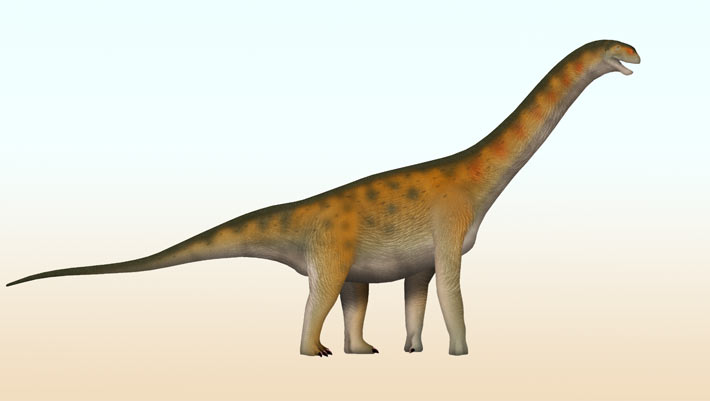
A restoration of Rinconsaurus compared to a human ,

•  Based proportionally on fossil elements and skeletal reconstruction featured in the Rinconsaurus description,[1] with missing parts based on other titanosaur reconstructions. The remains of Rinconsaurus represent two adults and a juvenile all of which are incomplete; some of the proportions shown here, such as the neck, limb lengths, and skull shape are not certain.
•  Osteroderms are not yet known in Rinconsaurus.  The osteoderms shown here are based loosely on Mendozasaurus.[2] Osteoderms are known from at least 10 titanosaur genera spread across the family tree but it's not clear if all titanosaurs had them.[3] Titanosaur osteoderms are rare and their layout and position on the body are not certain. [4]
•  The colours and patterns, as with the majority of reconstructions of prehistoric creatures, are speculative.
•  Human silhouette approximately 180 cm tall.

NOTE: I often update my images. If you want to have any of my images on a website, please (if possible) don’t host/save it to the website server. I’d prefer it if the image's Wikimedia URL is used. This means that if I update an image, it will be updated on the site as well.  Thanks.   


References


↑ Coria, Jorge; B.J.G. Riga (2003). "Rinconsaurus caudamirus gen. et sp nov., a new titanosaurid (Dinosauria, Sauropoda) from the Late Cretaceous of Patagonia, Argentina". Revista Geologica de Chile 30 (2): 333–353. ISSN 0716-0208. Retrieved on 2007-05-21.

↑   González Riga B (2003) A new titanosaur (Dinosauria, Sauropoda) from the Upper Cretaceous of Mendoza, Argentina. Ameghiniana 40 (2) 

↑  Carrano, M.T. and D’Emic, M.D.  2015 'Osteoderms of the titanosaur sauropod dinosaur Alamosaurus sanjuanensis Gilmore, 1922'. Journal of Vertebrate Paleontology.

↑    Vidal D, Ortega F, Sanz JL (2014) Titanosaur Osteoderms from the Upper Cretaceous of Lo Hueco (Spain) and Their Implications on the Armor of Laurasian Titanosaurs. PLoS ONE 9(8): e102488. doi:10.1371/journal.pone.0102488
Taxons Rinconsauria

A restoration of Rinconsaurus compared to a human , • Based proportionally on fossil elements and skeletal reconstruction featured in the Rinconsaurus description,[1] with missing parts based on other titanosaur reconstructions. The remains of Rinconsaurus represent two adults and a juvenile all of which are incomplete; some of the proportions shown here, such as the neck, limb lengths, and skull shape are not certain. • Osteroderms are not yet known in Rinconsaurus. The osteoderms shown here are based loosely on Mendozasaurus.[2] Osteoderms are known from at least 10 titanosaur genera spread across the family tree but it's not clear if all titanosaurs had them.[3] Titanosaur osteoderms are rare and their layout and position on the body are not certain. [4] • The colours and patterns, as with the majority of reconstructions of prehistoric creatures, are speculative. • Human silhouette approximately 180 cm tall. NOTE: I often update my images. If you want to have any of my images on a website, please (if possible) don’t host/save it to the website server. I’d prefer it if the image's Wikimedia URL is used. This means that if I update an image, it will be updated on the site as well. Thanks. References ↑ Coria, Jorge; B.J.G. Riga (2003). "Rinconsaurus caudamirus gen. et sp nov., a new titanosaurid (Dinosauria, Sauropoda) from the Late Cretaceous of Patagonia, Argentina". Revista Geologica de Chile 30 (2): 333–353. ISSN 0716-0208. Retrieved on 2007-05-21. ↑ González Riga B (2003) A new titanosaur (Dinosauria, Sauropoda) from the Upper Cretaceous of Mendoza, Argentina. Ameghiniana 40 (2) ↑ Carrano, M.T. and D’Emic, M.D. 2015 'Osteoderms of the titanosaur sauropod dinosaur Alamosaurus sanjuanensis Gilmore, 1922'. Journal of Vertebrate Paleontology. ↑ Vidal D, Ortega F, Sanz JL (2014) Titanosaur Osteoderms from the Upper Cretaceous of Lo Hueco (Spain) and Their Implications on the Armor of Laurasian Titanosaurs. PLoS ONE 9(8): e102488. doi:10.1371/journal.pone.0102488

armure membre description Argentine +14
Ctenochasma elegans (syn. Pterodactylus elegans) fossil from Solnhofen, Germany

American Museum of Natural History, New York, FR-5147
Received in exchange from the Paläontologisches Museum München, 1909
Taxons Ctenochasmatidae

Ctenochasma elegans (syn. Pterodactylus elegans) fossil from Solnhofen, Germany American Museum of Natural History, New York, FR-5147 Received in exchange from the Paläontologisches Museum München, 1909

musée Allemagne fossile Ctenochasma +2
fossil placodont
Taxons Cyamodontidae

fossil placodont

fossile Cyamodontidae Placodontia
Mounted replica of a composite skeleton of Edmontosaurus annectens on display at the University of Oxford Museum, Oxford, England. The original skeleton is compiled from disarticulated fossil bones from a bonebed of the Hell Creek Formation, exposed in the Ruth Mason Quarry in Harding County, South Dakota. It is 8.5 m (28 ft.) long and the skull is almost 1 m (39 in.) in length.[1][2]


↑ Dinosaurs in the Museum. Oxford University Museum of Natural History (brochure, PDF), p. 7

↑ BHI Fossil Replica Catalog 2012. Black Hills Institute of Geological Research, Inc., Hill City, SD, 2012 (PDF), p. 22
Taxons Saurolophinae

Mounted replica of a composite skeleton of Edmontosaurus annectens on display at the University of Oxford Museum, Oxford, England. The original skeleton is compiled from disarticulated fossil bones from a bonebed of the Hell Creek Formation, exposed in the Ruth Mason Quarry in Harding County, South Dakota. It is 8.5 m (28 ft.) long and the skull is almost 1 m (39 in.) in length.[1][2] ↑ Dinosaurs in the Museum. Oxford University Museum of Natural History (brochure, PDF), p. 7 ↑ BHI Fossil Replica Catalog 2012. Black Hills Institute of Geological Research, Inc., Hill City, SD, 2012 (PDF), p. 22

os musée Hell Creek fossile +6
fossil of henodus
Taxons Cyamodontoidea

fossil of henodus

fossile Cyamodontoidea Henodontidae Henodus
fossil of henodus
Taxons Henodontidae

fossil of henodus

fossile Cyamodontoidea Henodontidae Henodus
Fossil of Halisaurus, an extinct reptile- Took the picture at Muse (Trento)
Taxons Halisaurinae

Fossil of Halisaurus, an extinct reptile- Took the picture at Muse (Trento)

fossile Halisaurinae Halisaurus
Fossils of Magnapualia
Taxons Magnapaulia

Fossils of Magnapualia

fossile Magnapaulia
Neotype fossil of Ardeadactylus longicollum, specimen number SMNS 56603 (Number 58 in Wellnhofer 1970).
Taxons Ardeadactylus

Neotype fossil of Ardeadactylus longicollum, specimen number SMNS 56603 (Number 58 in Wellnhofer 1970).

fossile spécimen Ardeadactylus Wellnhoferia
A cast of BYU 9025, the holotype fossil of the sauropod dinosaur Supersaurus, a giant scapulocoracoid measuring 2.4m long.
• The source photo was taken at the Dinosaur Journey Musuem.
• Notes regarding the file; This image was edited and extracted from the original seen here. [1] The Photoshop CC lens correction profile and a 'perspective warp' correction were applied.
Taxons Supersaurus

A cast of BYU 9025, the holotype fossil of the sauropod dinosaur Supersaurus, a giant scapulocoracoid measuring 2.4m long. • The source photo was taken at the Dinosaur Journey Musuem. • Notes regarding the file; This image was edited and extracted from the original seen here. [1] The Photoshop CC lens correction profile and a 'perspective warp' correction were applied.

moulage fossile holotype Dinosauria +1
Saurexallopus, a four toed dinosaur or bird trace fossil (jr syn Exallopus
Taxons Saurexallopus

Saurexallopus, a four toed dinosaur or bird trace fossil (jr syn Exallopus

fossile Dinosauria Exallopus Saurexallopus +1
Fossil samples – e.g. ‘primitive’ bony fish (1, 2), a skull of a temnospondyl ‘amphibian’ (probably a metoposauroid) in dorsal view (3), a skull of an archosaur of the crocodile lineage (probably a phytosaur) in palatal view (4), holotype of the “gliding reptile” Icarosaurus siefkeri [1] (5) and Atreipus-Grallator-type dinosaur tracks (bottom right) – from the Newark Supergroup, i.e. a series of mainly Late Triassic to Early Jurassic sedimentary rocks of eastern North America


↑ Edwin H. Colbert: A gliding reptile from the Triassic of New Jersey. American Museum Novitates, 2230. American Museum of Natural History, New York 1966, digitallibrary.amnh.org, cf. fig. 3 therein.
Taxons Atreipus

Fossil samples – e.g. ‘primitive’ bony fish (1, 2), a skull of a temnospondyl ‘amphibian’ (probably a metoposauroid) in dorsal view (3), a skull of an archosaur of the crocodile lineage (probably a phytosaur) in palatal view (4), holotype of the “gliding reptile” Icarosaurus siefkeri [1] (5) and Atreipus-Grallator-type dinosaur tracks (bottom right) – from the Newark Supergroup, i.e. a series of mainly Late Triassic to Early Jurassic sedimentary rocks of eastern North America ↑ Edwin H. Colbert: A gliding reptile from the Triassic of New Jersey. American Museum Novitates, 2230. American Museum of Natural History, New York 1966, digitallibrary.amnh.org, cf. fig. 3 therein.

musée Jurassique inférieur Jurassique Trias supérieur +9
Archaeopteryx lithographica, specimen displayed at the Museum für Naturkunde in Berlin. (This image shows the original fossil - not a cast.)
Taxons Archaeopteryx

Archaeopteryx lithographica, specimen displayed at the Museum für Naturkunde in Berlin. (This image shows the original fossil - not a cast.)

musée moulage fossile spécimen +1
fossil of temnodontosaurus
Taxons Temnodontosaurus

fossil of temnodontosaurus

fossile Temnodontosaurus
Fossil of Hainosaurus, an extinct reptile  --  Took the photo at Natural History Museum of Bruxelles
Taxons Hainosaurus

Fossil of Hainosaurus, an extinct reptile -- Took the photo at Natural History Museum of Bruxelles

musée fossile Hainosaurus
Vertebrae of Gualicho shinyae from the fossil collection of the Museo patagónico de ciencias naturales Juan Carlos Salgado, General Roca, Río Negro. Scale as size reference.

Vertebrae of Gualicho shinyae from the fossil collection of the Museo patagónico de ciencias naturales Juan Carlos Salgado, General Roca, Río Negro. Scale as size reference.

écaille fossile Gualicho
1 2 3 4 5 6 7 8 9 10 11 12 13 14 15 16 17

Actualités

Fish Fossils from Early Paleocene Fill 10-Million-Year Gap after Dinosaur Extinction
Des fossiles de poissons du début du Paléocène comblent un écart de 10 millions d'années après l'extinction des dinosaures
Égypte Paléocène fossile Dinosauria extinction
Les paléontologues ont décrit un assemblage de fossiles de poissons marins provenant du site de Qreiya 3, vieux de 62,2 millions d'années, dans le désert oriental d'Égypte, ouvrant ainsi une fenêtre sur cette transition. L'article Les fossiles de poissons du début du Paléocène comblent un écart de 10 millions d'années après l'extinction des dinosaures est apparu en premier sur Sci.News : Breaking Science News.
05/06/2026 sci-news ⚙ Traduction automatique
Un vrai cauchemar volant : des chercheurs ont découvert un « dragon » préhistorique avec 4 ailes qui terrorisait les premiers oiseaux !
plume chasse Chine Crétacé fossile Dinosauria oiseau étude
Les raptors, dinosaures à plumes du Crétacé, ne pouvaient pas voler malgré leur lien étroit avec les oiseaux. Une nouvelle étude menée sur un site fossilifère en Chine révèle toutefois que certains d’entre eux auraient été capables de planer et de chasser les premiers oiseaux.
05/06/2026 futura-terre
Goethe ne savait pas que cette fourmi vieille de 40 millions d'années était cachée dans sa collection
nid fossile insecte
Les scientifiques examinant l’ambre de la collection personnelle de Goethe ont découvert trois insectes fossiles cachés, dont une fourmi éteinte préservée avec des détails extraordinaires. L’imagerie 3D avancée a permis aux chercheurs de voir non seulement les caractéristiques extérieures de la fourmi, mais également les structures à l’intérieur de son corps. Les résultats offrent de nouveaux indices sur la biologie de l’espèce et suggèrent qu’elle a probablement construit de grands nids dans les arbres.
04/06/2026 sciencedaily-paleo ⚙ Traduction automatique
À la recherche d'une espèce insaisissable d'allosaure
os Tanzanie Tendaguru fossile Allosauria formation
Allosaurus has become a bit of a taxonomic waste basket.  Ce terme concerne le matériel fossile provenant de théropodes attribué au genre.  Cependant, certaines preuves justifiant l'attribution du matériel sont provisoires.  Par exemple, des os de théropodes du sud-est de la Tanzanie (Formation Tendaguru) avaient été attribués à une espèce d'allosaure nommée Allosaurus tendagurensis.  En 1925,
04/06/2026 everythingdinosaur ⚙ Traduction automatique
Une découverte en Chine bouscule l’histoire d’étranges animaux vieux de 520 millions d’années
Chine Cambrien fossile datation découverte
Discrets mais omniprésents dans les océans actuels, les bryozoaires cachent une histoire bien plus ancienne qu’on ne le pensait. Des fossiles exceptionnels découverts en Chine montrent qu’il y a 520 millions d’années, ces animaux coloniaux étaient déjà des structures complexes, pleinement...
03/06/2026 futura-terre
1 2 3 4 5 6 7 8 9 10 11 12 13 14 15 16 17 18 19 20 21 22 23 24 25 26 27 28 29 30 31 32 33 34 35