fossile

Nature du spécimen

267 image(s) · 171 Actualités

Galerie d'images

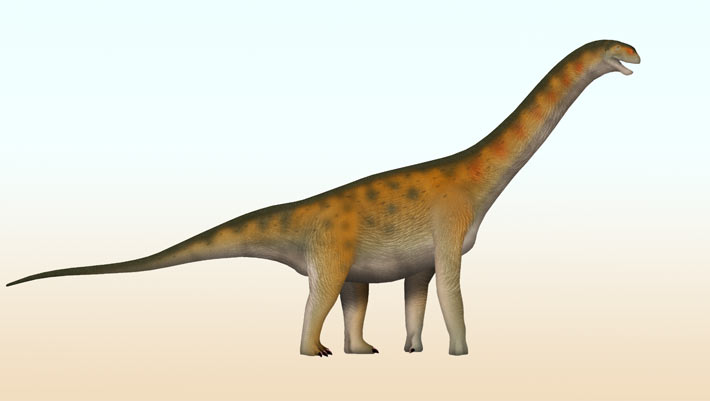
Sidersaura is a rebbachisaurid sauropod dinosaur from the Late Cretaceous of Argentina. Rebbachisaurids are the last known dipldocoids, and lived alongside the titanosaurs until fairly late in the Cretaceous before disappearing from the fossil record, presumably going extinct. They have long tails and relatively short necks, by sauropod standards. Sidersaura one of the most recent rebbachisaurids yet found, living in the Cenomanian–Turonian ages of the Late Cretaceous. It was large for a rebbachisaurid, growing to about 20 m in length.

Sidersaura is a rebbachisaurid sauropod dinosaur from the Late Cretaceous of Argentina. Rebbachisaurids are the last known dipldocoids, and lived alongside the titanosaurs until fairly late in the Cretaceous before disappearing from the fossil record, presumably going extinct. They have long tails and relatively short necks, by sauropod standards. Sidersaura one of the most recent rebbachisaurids yet found, living in the Cenomanian–Turonian ages of the Late Cretaceous. It was large for a rebbachisaurid, growing to about 20 m in length.

Argentine Cénomanien Crétacé Crétacé supérieur +6
Fossil of Coloborhynchus, an extinct pterosaur- Took the photo at Naturalis museum, Leiden

Fossil of Coloborhynchus, an extinct pterosaur- Took the photo at Naturalis museum, Leiden

musée fossile Coloborhynchus Maaradactylus +1
Life restoration of the mosasaurine mosasaurid Eremiasaurus, with unknown portions and soft tissues based primarily on Prognathodon and supplemented with Mosasaurus where needed.
References
Leblanc, A.R.H.; Caldwell, M.W.; Bardet, N. (2012). "A new mosasaurine from the Maastrichtian (Upper Cretaceous) phosphates of Morocco and its implications for mosasaurine systematics". Journal of Vertebrate Paleontology 32 (1): 82–104.
Lindgren, J.; Kaddumi, H.; Polcyn, M. (2013). "Soft tissue preservation in a fossil marine lizard with a bilobed tail fin". Nature Communications 4: 2423. DOI:10.1038/ncomms3423.
Konishi, T.; Brinkman, D.; Massare, J.A.; Caldwell, M.W. (2011). "New exceptional specimens of Prognathodon overtoni (Squamata, Mosasauridae) from the upper Campanian of Alberta, Canada, and the systematics and ecology of the genus". Journal of Vertebrate Paleontology 31 (5): 1026–1046.
Russell, D.A. (1967). "Systematics and morphology of American mosasaurs". Bulletin of the Peabody Museum of Natural History 23: 1–241.

Life restoration of the mosasaurine mosasaurid Eremiasaurus, with unknown portions and soft tissues based primarily on Prognathodon and supplemented with Mosasaurus where needed. References Leblanc, A.R.H.; Caldwell, M.W.; Bardet, N. (2012). "A new mosasaurine from the Maastrichtian (Upper Cretaceous) phosphates of Morocco and its implications for mosasaurine systematics". Journal of Vertebrate Paleontology 32 (1): 82–104. Lindgren, J.; Kaddumi, H.; Polcyn, M. (2013). "Soft tissue preservation in a fossil marine lizard with a bilobed tail fin". Nature Communications 4: 2423. DOI:10.1038/ncomms3423. Konishi, T.; Brinkman, D.; Massare, J.A.; Caldwell, M.W. (2011). "New exceptional specimens of Prognathodon overtoni (Squamata, Mosasauridae) from the upper Campanian of Alberta, Canada, and the systematics and ecology of the genus". Journal of Vertebrate Paleontology 31 (5): 1026–1046. Russell, D.A. (1967). "Systematics and morphology of American mosasaurs". Bulletin of the Peabody Museum of Natural History 23: 1–241.

tissus écologie musée Canada +11
Fossil samples – e.g. ‘primitive’ bony fish (1, 2), a skull of a temnospondyl ‘amphibian’ (probably a metoposauroid) in dorsal view (3), a skull of an archosaur of the crocodile lineage (probably a phytosaur) in palatal view (4), holotype of the “gliding reptile” Icarosaurus siefkeri [1] (5) and Atreipus-Grallator-type dinosaur tracks (bottom right) – from the Newark Supergroup, i.e. a series of mainly Late Triassic to Early Jurassic sedimentary rocks of eastern North America


↑ Edwin H. Colbert: A gliding reptile from the Triassic of New Jersey. American Museum Novitates, 2230. American Museum of Natural History, New York 1966, digitallibrary.amnh.org, cf. fig. 3 therein.

Fossil samples – e.g. ‘primitive’ bony fish (1, 2), a skull of a temnospondyl ‘amphibian’ (probably a metoposauroid) in dorsal view (3), a skull of an archosaur of the crocodile lineage (probably a phytosaur) in palatal view (4), holotype of the “gliding reptile” Icarosaurus siefkeri [1] (5) and Atreipus-Grallator-type dinosaur tracks (bottom right) – from the Newark Supergroup, i.e. a series of mainly Late Triassic to Early Jurassic sedimentary rocks of eastern North America ↑ Edwin H. Colbert: A gliding reptile from the Triassic of New Jersey. American Museum Novitates, 2230. American Museum of Natural History, New York 1966, digitallibrary.amnh.org, cf. fig. 3 therein.

musée Jurassique inférieur Jurassique Trias supérieur +8
Title: A descriptive catalogue of the marine reptiles of the Oxford clay. Based on the Leeds Collection in the British Museum (Natural History), London ..
Identifier: descriptivecatal02brit (find matches)
Year: 1910 (1910s)
Authors: British Museum (Natural History). Dept. of Geology; Andrews, Charles William, 1866-1924
Subjects: Reptiles, Fossil
Publisher: London, Printed by order of the Trustees
Contributing Library: Smithsonian Libraries
Digitizing Sponsor: Biodiversity Heritage Library

View Book Page: Book Viewer
About This Book: Catalog Entry
View All Images: All Images From Book
Click here to view book online to see this illustration in context in a browseable online version of this book.

Text Appearing Before Image: 
CATAL.MARINE KEPT. OXFORD CLAY. PART II. PLATE I. pmcc.
Text Appearing After Image: 
>p77ia:. G.M.Woodward del. etlibh. West, Newman imp. PLIOSAURUS FEROX.

Note About Images

Please note that these images are extracted from scanned page images that may have been digitally enhanced for readability - coloration and appearance of these illustrations may not perfectly resemble the original work.

Title: A descriptive catalogue of the marine reptiles of the Oxford clay. Based on the Leeds Collection in the British Museum (Natural History), London .. Identifier: descriptivecatal02brit (find matches) Year: 1910 (1910s) Authors: British Museum (Natural History). Dept. of Geology; Andrews, Charles William, 1866-1924 Subjects: Reptiles, Fossil Publisher: London, Printed by order of the Trustees Contributing Library: Smithsonian Libraries Digitizing Sponsor: Biodiversity Heritage Library View Book Page: Book Viewer About This Book: Catalog Entry View All Images: All Images From Book Click here to view book online to see this illustration in context in a browseable online version of this book. Text Appearing Before Image: CATAL.MARINE KEPT. OXFORD CLAY. PART II. PLATE I. pmcc. Text Appearing After Image: >p77ia:. G.M.Woodward del. etlibh. West, Newman imp. PLIOSAURUS FEROX. Note About Images Please note that these images are extracted from scanned page images that may have been digitally enhanced for readability - coloration and appearance of these illustrations may not perfectly resemble the original work.

musée Oxford Clay fossile Liopleurodon +2
Rhomaleosaurus cramptoni fossil, Natural History Museum, London
Taxons Rhomaleosaurus

Rhomaleosaurus cramptoni fossil, Natural History Museum, London

musée fossile Rhomaleosaurus
Figure 1. Evolution of macroecological traits in Dinosauria. Large scale event in dinosaur evolution (a); the origin of dinosaurs (star), hyperthermals (volcano), the earliest fossil Avialae (bird), the earliest fossil angiosperm (flower), the Cretaceous/Palaeogene mass extinction (asteroid). Phylogeny of dinosaurs (b) redrawn from Sereno and adapted to the current consensus and upon which an ancestral state reconstruction of temperature niche (mean annual temperature) after Chiarenza et al. is plotted; Mesozoic palaeogeographies (c) for Triassic (T), Jurassic (J) and Cretaceous (K). Silhouette colours symbolize body mass for each of the taxa represented; information on dietary habits are plotted after Barrett and Zanno & Makovicky; numbers represent clades discussed through this study: 1, Ornithischia; 2, Thyreophora; 3, Ornithopoda; 4, Hadrosauroidea; 5, Marginocephalia; 6, Ceratopsia; 7, Saurischia; 8, Sauropodomorpha; 9, Sauropoda; 10, Theropoda; 11, Ceratosauria; 12, Tetanurae; 13, Coelurosauria; 14, Maniraptoriformes; 15, Maniraptora; 16, Deinonychosauria; 17, Avialae; 18, Ornithothoraces. Palaeogeographies modified from original plots via R package ‘mapast’ using plate models by Scotese.

Figure 1. Evolution of macroecological traits in Dinosauria. Large scale event in dinosaur evolution (a); the origin of dinosaurs (star), hyperthermals (volcano), the earliest fossil Avialae (bird), the earliest fossil angiosperm (flower), the Cretaceous/Palaeogene mass extinction (asteroid). Phylogeny of dinosaurs (b) redrawn from Sereno and adapted to the current consensus and upon which an ancestral state reconstruction of temperature niche (mean annual temperature) after Chiarenza et al. is plotted; Mesozoic palaeogeographies (c) for Triassic (T), Jurassic (J) and Cretaceous (K). Silhouette colours symbolize body mass for each of the taxa represented; information on dietary habits are plotted after Barrett and Zanno & Makovicky; numbers represent clades discussed through this study: 1, Ornithischia; 2, Thyreophora; 3, Ornithopoda; 4, Hadrosauroidea; 5, Marginocephalia; 6, Ceratopsia; 7, Saurischia; 8, Sauropodomorpha; 9, Sauropoda; 10, Theropoda; 11, Ceratosauria; 12, Tetanurae; 13, Coelurosauria; 14, Maniraptoriformes; 15, Maniraptora; 16, Deinonychosauria; 17, Avialae; 18, Ornithothoraces. Palaeogeographies modified from original plots via R package ‘mapast’ using plate models by Scotese.

écaille Crétacé Jurassique Mésozoïque +23
Simplified cladogram of Dinosauria with the distribution of feathers according to the fossil record. Despite its more ancient origin, it
was only in maniraptoriformes that modern-type feathers (pennaceous feathers) have arisen (Based in Xu & Guo, 2009; Clarke,

2013; Godefroit et al., 2013; Han et al., 2014; Koshchowitz et al., 2014).

Simplified cladogram of Dinosauria with the distribution of feathers according to the fossil record. Despite its more ancient origin, it was only in maniraptoriformes that modern-type feathers (pennaceous feathers) have arisen (Based in Xu & Guo, 2009; Clarke, 2013; Godefroit et al., 2013; Han et al., 2014; Koshchowitz et al., 2014).

plume fossile Dinosauria Maniraptoriformes +1
Photographer: User:Ballista

Edited in Adobe PhotoShop: User:Firsfron
Photographed object is in fact a cast of a real fossil. It's part of a hands-on exhibit of the NHM in London.

Photographer: User:Ballista Edited in Adobe PhotoShop: User:Firsfron Photographed object is in fact a cast of a real fossil. It's part of a hands-on exhibit of the NHM in London.

moulage fossile Neotheropoda
The Chicago specimen of Archaeopteryx (PA 830), a well-preserved fossil highlighting the transitional features between non-avian dinosaurs and birds, housed at the Field Museum of Natural History.

The Chicago specimen of Archaeopteryx (PA 830), a well-preserved fossil highlighting the transitional features between non-avian dinosaurs and birds, housed at the Field Museum of Natural History.

musée fossile spécimen Archaeopteryx +2
Fossil of Anhanguera, an extinct reptile-- Took the photo at Natural History Museum, London

Fossil of Anhanguera, an extinct reptile-- Took the photo at Natural History Museum, London

musée fossile Anhanguera
Fossil of Balaur, an extinct theropod- Took the photo at Fossil Show, Munich
Taxons Balaur

Fossil of Balaur, an extinct theropod- Took the photo at Fossil Show, Munich

fossile Balaur
The Canadian Fossil Discovery Centre in Morden boasts the largest collection of marine invertebrate fossils in Canada. Visitors to the museum not only get to see this collection, but can join a dig in search for more fossils at a 109-acre escarpment property.

Photo credit: Robyn Hanson
Taxons Tylosaurus

The Canadian Fossil Discovery Centre in Morden boasts the largest collection of marine invertebrate fossils in Canada. Visitors to the museum not only get to see this collection, but can join a dig in search for more fossils at a 109-acre escarpment property. Photo credit: Robyn Hanson

musée Canada fossile Tylosaurus +1
Fossil of Pinacosaurus, an ankylosaurian  dinosaur
Took the photo at Musee d'Histoire Naturelle, Brussels
Taxons Eopinacosaurus

Fossil of Pinacosaurus, an ankylosaurian dinosaur Took the photo at Musee d'Histoire Naturelle, Brussels

fossile Ankylosauria Dinosauria Eopinacosaurus +1
Duria Antiquior, célèbre aquarelle du géologue Henry de la Beche représentant la vie dans l'ancien Dorset d'après des fossiles trouvés par Mary Anning.

Duria Antiquior, célèbre aquarelle du géologue Henry de la Beche représentant la vie dans l'ancien Dorset d'après des fossiles trouvés par Mary Anning.

old school fossile Ichthyosaurus Plesiosaurus +1
Geographic and geologic map showing the location and involved strata of the studied fossil sites in the Xinhe Formation. (A, B) location of the fossiliferous localities in the Gansu Province. (C) Geological map of the involved strata of the studied fossil site (from State Bureau of Surveying and Mapping, GS (2016)2884). White star=Jinchuanloong niedu. Black star=plesiosaur fossils. (D) Stratigraphic chart of the Jurassic at the localities.

Geographic and geologic map showing the location and involved strata of the studied fossil sites in the Xinhe Formation. (A, B) location of the fossiliferous localities in the Gansu Province. (C) Geological map of the involved strata of the studied fossil site (from State Bureau of Surveying and Mapping, GS (2016)2884). White star=Jinchuanloong niedu. Black star=plesiosaur fossils. (D) Stratigraphic chart of the Jurassic at the localities.

Jurassique fossile Jinchuanloong Plesiosauria +1
1 2 3 4 5 6 7 8 9 10 11 12 13 14 15 16 17

Actualités

Fish Fossils from Early Paleocene Fill 10-Million-Year Gap after Dinosaur Extinction
Des fossiles de poissons du début du Paléocène comblent un écart de 10 millions d'années après l'extinction des dinosaures
Égypte Paléocène fossile Dinosauria extinction
Les paléontologues ont décrit un assemblage de fossiles de poissons marins provenant du site de Qreiya 3, vieux de 62,2 millions d'années, dans le désert oriental d'Égypte, ouvrant ainsi une fenêtre sur cette transition. L'article Les fossiles de poissons du début du Paléocène comblent un écart de 10 millions d'années après l'extinction des dinosaures est apparu en premier sur Sci.News : Breaking Science News.
05/06/2026 sci-news ⚙ Traduction automatique
Un vrai cauchemar volant : des chercheurs ont découvert un « dragon » préhistorique avec 4 ailes qui terrorisait les premiers oiseaux !
plume chasse Chine Crétacé fossile Dinosauria oiseau étude
Les raptors, dinosaures à plumes du Crétacé, ne pouvaient pas voler malgré leur lien étroit avec les oiseaux. Une nouvelle étude menée sur un site fossilifère en Chine révèle toutefois que certains d’entre eux auraient été capables de planer et de chasser les premiers oiseaux.
05/06/2026 futura-terre
Goethe ne savait pas que cette fourmi vieille de 40 millions d'années était cachée dans sa collection
nid fossile insecte
Les scientifiques examinant l’ambre de la collection personnelle de Goethe ont découvert trois insectes fossiles cachés, dont une fourmi éteinte préservée avec des détails extraordinaires. L’imagerie 3D avancée a permis aux chercheurs de voir non seulement les caractéristiques extérieures de la fourmi, mais également les structures à l’intérieur de son corps. Les résultats offrent de nouveaux indices sur la biologie de l’espèce et suggèrent qu’elle a probablement construit de grands nids dans les arbres.
04/06/2026 sciencedaily-paleo ⚙ Traduction automatique
À la recherche d'une espèce insaisissable d'allosaure
os Tanzanie Tendaguru fossile Allosauria formation
Allosaurus has become a bit of a taxonomic waste basket.  Ce terme concerne le matériel fossile provenant de théropodes attribué au genre.  Cependant, certaines preuves justifiant l'attribution du matériel sont provisoires.  Par exemple, des os de théropodes du sud-est de la Tanzanie (Formation Tendaguru) avaient été attribués à une espèce d'allosaure nommée Allosaurus tendagurensis.  En 1925,
04/06/2026 everythingdinosaur ⚙ Traduction automatique
Une découverte en Chine bouscule l’histoire d’étranges animaux vieux de 520 millions d’années
Chine Cambrien fossile datation découverte
Discrets mais omniprésents dans les océans actuels, les bryozoaires cachent une histoire bien plus ancienne qu’on ne le pensait. Des fossiles exceptionnels découverts en Chine montrent qu’il y a 520 millions d’années, ces animaux coloniaux étaient déjà des structures complexes, pleinement...
03/06/2026 futura-terre
1 2 3 4 5 6 7 8 9 10 11 12 13 14 15 16 17 18 19 20 21 22 23 24 25 26 27 28 29 30 31 32 33 34 35