←

fossile

Nature du spécimen

226 image(s) · 215 Actualités

Galerie d'images

Elangatoolithidae fossil dinosaur eggs, from China. Exhibit in the Academy of Natural Sciences, 1900 Benjamin Franklin Parkway, Philadelphia, Pennsylvania, USA. Photography was permitted in this area of the museum without restrictions.
Taxons Elongatoolithidae

Elangatoolithidae fossil dinosaur eggs, from China. Exhibit in the Academy of Natural Sciences, 1900 Benjamin Franklin Parkway, Philadelphia, Pennsylvania, USA. Photography was permitted in this area of the museum without restrictions.

musée Chine États-Unis fossile +2
Fossil specimen of Ornithomimus sp. (TMP 1995.110.1), Royal Tyrrell Museum. This specimen was recovered from the middle Dinosaur Park Formation of Alberta, Canada.
Taxons Ornithomimidae

Fossil specimen of Ornithomimus sp. (TMP 1995.110.1), Royal Tyrrell Museum. This specimen was recovered from the middle Dinosaur Park Formation of Alberta, Canada.

musée Canada Allemagne Dinosaur Park +6
Uses https://commons.wikimedia.org/wiki/File:Dromaeosaurus_in_Canadian_Museum_of_Nature.jpg
File:Alaskan_troodont_Perot_Museum.jpg
File:Unenlagia_fossils.jpg
File:Talos_sampsoni.png
https://en.wikipedia.org/wiki/File:Velociraptor_Wyoming_Dinosaur_Center.jpg
https://en.wikipedia.org/wiki/Saurornitholestes
File:Buitreraptor-Deinonychus.jpg

File:Dakotaraptor_lateral_Wiki.jpg
Taxons Deinonychosauria

Uses https://commons.wikimedia.org/wiki/File:Dromaeosaurus_in_Canadian_Museum_of_Nature.jpg File:Alaskan_troodont_Perot_Museum.jpg File:Unenlagia_fossils.jpg File:Talos_sampsoni.png https://en.wikipedia.org/wiki/File:Velociraptor_Wyoming_Dinosaur_Center.jpg https://en.wikipedia.org/wiki/Saurornitholestes File:Buitreraptor-Deinonychus.jpg File:Dakotaraptor_lateral_Wiki.jpg

musée fossile Buitreraptor Dakotaraptor +8
Palaeogeography of the Earth in Aptian, with location of Acrocanthosaurus fossils as green dots
Intervalles Aptian

Palaeogeography of the Earth in Aptian, with location of Acrocanthosaurus fossils as green dots

Aptien fossile Acrocanthosaurus
Map of Cretaceous-aged dinosaur fossil localities of Mongolia.
Gobihadros mongoliensis was collected from Bayshin Tsav in Area C. Open squares indicate Late Cretaceous sites, solid squares represent Early Cretaceous localities. Abbreviations: A, Localities of Western Gobi Desert in Mongolia, mainly group of localities of Nemegtian age (early Maastrichtian), Late Cretaceous; B, Localities of Central Gobi Desert in Mongolia, mainly Djadokhtian age (Campanian), Late Cretaceous; C & D- Localities of Eastern Gobi Desert in Mongolia, mainly Baynshirenian age (Cenomanian-Santonian), Late Cretaceous. Figure has been modified from Tsogtbaatar et al. 2014, Figure 1 [24].
Formations Baynshire

Map of Cretaceous-aged dinosaur fossil localities of Mongolia. Gobihadros mongoliensis was collected from Bayshin Tsav in Area C. Open squares indicate Late Cretaceous sites, solid squares represent Early Cretaceous localities. Abbreviations: A, Localities of Western Gobi Desert in Mongolia, mainly group of localities of Nemegtian age (early Maastrichtian), Late Cretaceous; B, Localities of Central Gobi Desert in Mongolia, mainly Djadokhtian age (Campanian), Late Cretaceous; C & D- Localities of Eastern Gobi Desert in Mongolia, mainly Baynshirenian age (Cenomanian-Santonian), Late Cretaceous. Figure has been modified from Tsogtbaatar et al. 2014, Figure 1 [24].

Mongolie Campanien Cénomanien Crétacé +8
Figure 2: Fossil vertebrate locality of Eric the Red West.
Shore platform looking west, showing undulating erosive boundary (solid white line) between the top of the Anchor Sandstone (AS) and the base of the ETRW Sandstone (ES). White dashed lines indicate selected bedding surfaces. White scale in mid-ground (indicated by arrow) equals 1 m.
Formations Eumeralla

Figure 2: Fossil vertebrate locality of Eric the Red West. Shore platform looking west, showing undulating erosive boundary (solid white line) between the top of the Anchor Sandstone (AS) and the base of the ETRW Sandstone (ES). White dashed lines indicate selected bedding surfaces. White scale in mid-ground (indicated by arrow) equals 1 m.

écaille fossile
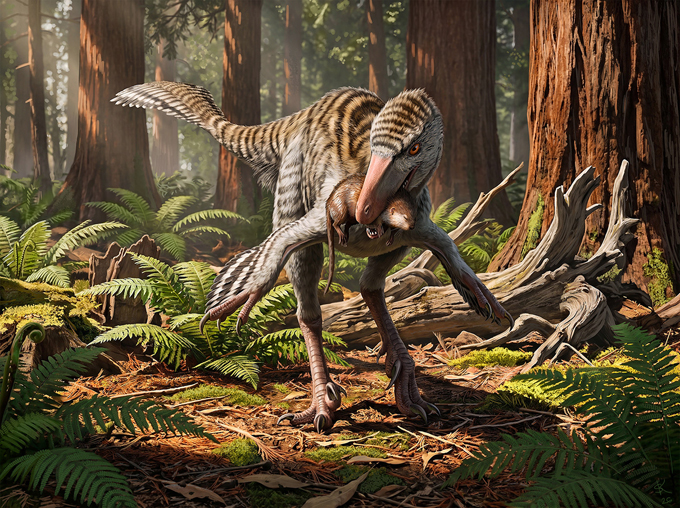
Représentation du dinosaure Dinevenator robustus, récemment découvert. Ce troodontidé a été identifié en 2026 à partir d'un fossile collecté dans le comté de San Juan.
Taxons Dinevenator

Représentation du dinosaure Dinevenator robustus, récemment découvert. Ce troodontidé a été identifié en 2026 à partir d'un fossile collecté dans le comté de San Juan.

fossile Dinevenator Troodontidae
A broken concretion with fossils inside; Late Cretaceous Pierre shale, near Ekalaka, Montana.
Formations Pierre Shale

A broken concretion with fossils inside; Late Cretaceous Pierre shale, near Ekalaka, Montana.

Pierre Shale Crétacé Crétacé supérieur fossile
The distictive banding of the Morrison Formation, a group of rock layers that occur throughout Dinosaur National Monument.  The formation originated as muds and sands laid down by ancient rivers, and some of its outcrops have been found to contain 150-million-year-old dinosaur fossils like those found at the monument's Dinosaur Quarry.
Formations Morrison

The distictive banding of the Morrison Formation, a group of rock layers that occur throughout Dinosaur National Monument. The formation originated as muds and sands laid down by ancient rivers, and some of its outcrops have been found to contain 150-million-year-old dinosaur fossils like those found at the monument's Dinosaur Quarry.

Morrison fossile Dinosauria formation
Bituminous claystone, Lower Jurassic, Hesselberg, Middle Franconia.
Sedimentary rock of very thin laminated layers (particles less than 0,0002 mm).

Rock formation is known for its rich fossil findings, ex. Ichthyosaur.
Formations Posidonia Shale

Bituminous claystone, Lower Jurassic, Hesselberg, Middle Franconia. Sedimentary rock of very thin laminated layers (particles less than 0,0002 mm). Rock formation is known for its rich fossil findings, ex. Ichthyosaur.

Jurassique fossile Ichthyosauria formation
Khaan fossil holotype IGM 100/1127.
Taxons Khaan

Khaan fossil holotype IGM 100/1127.

États-Unis fossile holotype Khaan
The Natural Science Museum at El Chocón, in the northwestern Argentine Patagonia (the Comahue region). Fossil of dinosaur
Taxons Skorpiovenator

The Natural Science Museum at El Chocón, in the northwestern Argentine Patagonia (the Comahue region). Fossil of dinosaur

musée Argentine fossile Dinosauria +1
Nyasasaurus is a basal dinosauromorph that may be the earliest known dinosaur. It was a small bipedal animal at about 2-3 m in length. Nyasasaurus is difficult to classify due to inconclusive fossil evidence, but if it is a true dinosaur, it pushes the dinosaur lineage back about 12 million years to the Middle Triassic.
Taxons Nyasasaurus

Nyasasaurus is a basal dinosauromorph that may be the earliest known dinosaur. It was a small bipedal animal at about 2-3 m in length. Nyasasaurus is difficult to classify due to inconclusive fossil evidence, but if it is a true dinosaur, it pushes the dinosaur lineage back about 12 million years to the Middle Triassic.

Trias moyen Trias fossile Dinosauria +1
Fossil at the Museo Argentino de Ciencias Naturales in Caballito, Buenos Aires, Argentina.
Taxons Pterodaustro

Fossil at the Museo Argentino de Ciencias Naturales in Caballito, Buenos Aires, Argentina.

Argentine fossile Pterodaustro
Sidersaura is a rebbachisaurid sauropod dinosaur from the Late Cretaceous of Argentina. Rebbachisaurids are the last known dipldocoids, and lived alongside the titanosaurs until fairly late in the Cretaceous before disappearing from the fossil record, presumably going extinct. They have long tails and relatively short necks, by sauropod standards. Sidersaura one of the most recent rebbachisaurids yet found, living in the Cenomanian–Turonian ages of the Late Cretaceous. It was large for a rebbachisaurid, growing to about 20 m in length.
Taxons Sidersaura

Sidersaura is a rebbachisaurid sauropod dinosaur from the Late Cretaceous of Argentina. Rebbachisaurids are the last known dipldocoids, and lived alongside the titanosaurs until fairly late in the Cretaceous before disappearing from the fossil record, presumably going extinct. They have long tails and relatively short necks, by sauropod standards. Sidersaura one of the most recent rebbachisaurids yet found, living in the Cenomanian–Turonian ages of the Late Cretaceous. It was large for a rebbachisaurid, growing to about 20 m in length.

Argentine Cénomanien Crétacé Crétacé supérieur +6
Fossil of Mei long (holotype), on temporary display at the Shanghai Natural History Museum as part of the exhibition "China's Dinosaur World". Shot on July 22, 2025.
Taxons Mei

Fossil of Mei long (holotype), on temporary display at the Shanghai Natural History Museum as part of the exhibition "China's Dinosaur World". Shot on July 22, 2025.

musée Chine fossile holotype +1
1 2 3 4 5 6 7 8 9 10 11 12 13 14 15

Actualités

Un spinosaure géant à crête, le « héron de l'enfer », découvert dans le Sahara
crête prédateur Niger fossile Dinosauria Spinosauria
Au cœur du Sahara, des scientifiques ont découvert Spinosaurus mirabilis, un nouveau prédateur spectaculaire couronné d'une crête massive en forme de cimeterre qui aurait pu autrefois briller de couleurs sous le soleil du désert. Découvert dans des gisements de rivières intérieures isolées au Niger, le fossile réécrit ce que nous pensions savoir sur les dinosaures spinosaures, suggérant qu'ils n'étaient pas des chasseurs entièrement aquatiques mais de puissants échassiers traquant les poissons dans les cours d'eau boisés à des centaines de kilomètres de la mer.
23/02/2026 sciencedaily ⚙ Traduction automatique
Le tricératops avait un nez géant qui aurait pu refroidir sa tête massive
fossile Triceratops tomographie crâne
La tête massive du tricératops faisait peut-être plus que simplement montrer ces fameuses cornes. À l’aide de tomodensitogrammes et de reconstructions 3D de crânes fossiles, les chercheurs ont découvert un système nasal étonnamment complexe caché à l’intérieur de son énorme museau. Au lieu d’être simplement un nez surdimensionné pour sentir, il abritait probablement des réseaux complexes de nerfs et de vaisseaux sanguins, et même des structures spéciales qui aidaient à réguler la chaleur et l’humidité.
22/02/2026 sciencedaily ⚙ Traduction automatique
Cet animal ancien fut l'un des premiers à manger des plantes sur terre
dent fossile crâne
Il y a des centaines de millions d’années, les premiers animaux à ramper sur terre étaient de purs mangeurs de viande, alors même que les plantes avaient déjà envahi le paysage. Aujourd’hui, les scientifiques ont découvert un fossile vieux de 307 millions d’années qui réécrit cette histoire : l’un des premiers vertébrés terrestres connus à avoir commencé à manger des plantes. L'animal, nommé Tyrannoroter heberti, était une créature trapue de la taille d'un ballon de football avec un crâne rempli de dents spécialisées conçues pour écraser et broyer la végétation.
11/02/2026 sciencedaily ⚙ Traduction automatique
Ces fossiles vieux de 773 000 ans pourraient révéler notre ancêtre humain commun
fossile évolution Homo sapiens
Les fossiles d'une grotte marocaine ont été datés avec une précision remarquable il y a environ 773 000 ans, grâce à une signature magnétique verrouillée dans les sédiments environnants. Les restes d’hominidés présentent un mélange de caractéristiques anciennes et plus modernes, les plaçant à proximité d’un point de branchement crucial dans l’évolution humaine. Ces individus représentent probablement une population africaine proche du dernier ancêtre commun de l'Homo sapiens, des Néandertaliens et des Dénisoviens.
07/02/2026 sciencedaily ⚙ Traduction automatique
Les bébés dinosaures étaient l'épine dorsale de la chaîne alimentaire jurassique
chasse prédateur proie Jurassique fossile Dinosauria
Bien qu’ils soient devenus les plus gros animaux ayant jamais marché sur terre, les sauropodes ont commencé leur vie petits, exposés et seuls. Les preuves fossiles suggèrent que leurs bébés étaient fréquemment mangés par de multiples prédateurs, ce qui en faisait un élément clé de la chaîne alimentaire jurassique. Cet approvisionnement constant en proies faciles peut expliquer pourquoi les premiers prédateurs ont prospéré sans avoir besoin d’adaptations extrêmes en matière de chasse. Les résultats offrent un rare aperçu du fonctionnement réel des écosystèmes de dinosaures.
02/02/2026 sciencedaily ⚙ Traduction automatique
1 2 3 4 5 6 7 8 9 10 11 12 13 14 15 16 17 18 19 20 21 22 23 24 25 26 27 28 29 30 31 32 33 34 35 36 37 38 39 40 41 42 43