←

fossile

Nature du spécimen

226 image(s) · 215 Actualités

Galerie d'images

Elangatoolithidae fossil dinosaur eggs, from China. Exhibit in the Academy of Natural Sciences, 1900 Benjamin Franklin Parkway, Philadelphia, Pennsylvania, USA. Photography was permitted in this area of the museum without restrictions.
Taxons Elongatoolithidae

Elangatoolithidae fossil dinosaur eggs, from China. Exhibit in the Academy of Natural Sciences, 1900 Benjamin Franklin Parkway, Philadelphia, Pennsylvania, USA. Photography was permitted in this area of the museum without restrictions.

musée Chine États-Unis fossile +2
Fossil specimen of Ornithomimus sp. (TMP 1995.110.1), Royal Tyrrell Museum. This specimen was recovered from the middle Dinosaur Park Formation of Alberta, Canada.
Taxons Ornithomimidae

Fossil specimen of Ornithomimus sp. (TMP 1995.110.1), Royal Tyrrell Museum. This specimen was recovered from the middle Dinosaur Park Formation of Alberta, Canada.

musée Canada Allemagne Dinosaur Park +6
Uses https://commons.wikimedia.org/wiki/File:Dromaeosaurus_in_Canadian_Museum_of_Nature.jpg
File:Alaskan_troodont_Perot_Museum.jpg
File:Unenlagia_fossils.jpg
File:Talos_sampsoni.png
https://en.wikipedia.org/wiki/File:Velociraptor_Wyoming_Dinosaur_Center.jpg
https://en.wikipedia.org/wiki/Saurornitholestes
File:Buitreraptor-Deinonychus.jpg

File:Dakotaraptor_lateral_Wiki.jpg
Taxons Deinonychosauria

Uses https://commons.wikimedia.org/wiki/File:Dromaeosaurus_in_Canadian_Museum_of_Nature.jpg File:Alaskan_troodont_Perot_Museum.jpg File:Unenlagia_fossils.jpg File:Talos_sampsoni.png https://en.wikipedia.org/wiki/File:Velociraptor_Wyoming_Dinosaur_Center.jpg https://en.wikipedia.org/wiki/Saurornitholestes File:Buitreraptor-Deinonychus.jpg File:Dakotaraptor_lateral_Wiki.jpg

musée fossile Buitreraptor Dakotaraptor +8
Palaeogeography of the Earth in Aptian, with location of Acrocanthosaurus fossils as green dots
Intervalles Aptian

Palaeogeography of the Earth in Aptian, with location of Acrocanthosaurus fossils as green dots

Aptien fossile Acrocanthosaurus
Map of Cretaceous-aged dinosaur fossil localities of Mongolia.
Gobihadros mongoliensis was collected from Bayshin Tsav in Area C. Open squares indicate Late Cretaceous sites, solid squares represent Early Cretaceous localities. Abbreviations: A, Localities of Western Gobi Desert in Mongolia, mainly group of localities of Nemegtian age (early Maastrichtian), Late Cretaceous; B, Localities of Central Gobi Desert in Mongolia, mainly Djadokhtian age (Campanian), Late Cretaceous; C & D- Localities of Eastern Gobi Desert in Mongolia, mainly Baynshirenian age (Cenomanian-Santonian), Late Cretaceous. Figure has been modified from Tsogtbaatar et al. 2014, Figure 1 [24].
Formations Baynshire

Map of Cretaceous-aged dinosaur fossil localities of Mongolia. Gobihadros mongoliensis was collected from Bayshin Tsav in Area C. Open squares indicate Late Cretaceous sites, solid squares represent Early Cretaceous localities. Abbreviations: A, Localities of Western Gobi Desert in Mongolia, mainly group of localities of Nemegtian age (early Maastrichtian), Late Cretaceous; B, Localities of Central Gobi Desert in Mongolia, mainly Djadokhtian age (Campanian), Late Cretaceous; C & D- Localities of Eastern Gobi Desert in Mongolia, mainly Baynshirenian age (Cenomanian-Santonian), Late Cretaceous. Figure has been modified from Tsogtbaatar et al. 2014, Figure 1 [24].

Mongolie Campanien Cénomanien Crétacé +8
Figure 2: Fossil vertebrate locality of Eric the Red West.
Shore platform looking west, showing undulating erosive boundary (solid white line) between the top of the Anchor Sandstone (AS) and the base of the ETRW Sandstone (ES). White dashed lines indicate selected bedding surfaces. White scale in mid-ground (indicated by arrow) equals 1 m.
Formations Eumeralla

Figure 2: Fossil vertebrate locality of Eric the Red West. Shore platform looking west, showing undulating erosive boundary (solid white line) between the top of the Anchor Sandstone (AS) and the base of the ETRW Sandstone (ES). White dashed lines indicate selected bedding surfaces. White scale in mid-ground (indicated by arrow) equals 1 m.

écaille fossile
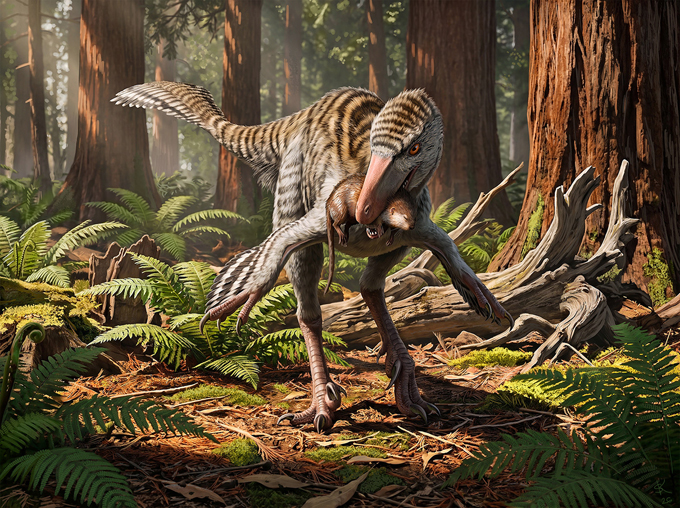
Représentation du dinosaure Dinevenator robustus, récemment découvert. Ce troodontidé a été identifié en 2026 à partir d'un fossile collecté dans le comté de San Juan.
Taxons Dinevenator

Représentation du dinosaure Dinevenator robustus, récemment découvert. Ce troodontidé a été identifié en 2026 à partir d'un fossile collecté dans le comté de San Juan.

fossile Dinevenator Troodontidae
A broken concretion with fossils inside; Late Cretaceous Pierre shale, near Ekalaka, Montana.
Formations Pierre Shale

A broken concretion with fossils inside; Late Cretaceous Pierre shale, near Ekalaka, Montana.

Pierre Shale Crétacé Crétacé supérieur fossile
The distictive banding of the Morrison Formation, a group of rock layers that occur throughout Dinosaur National Monument.  The formation originated as muds and sands laid down by ancient rivers, and some of its outcrops have been found to contain 150-million-year-old dinosaur fossils like those found at the monument's Dinosaur Quarry.
Formations Morrison

The distictive banding of the Morrison Formation, a group of rock layers that occur throughout Dinosaur National Monument. The formation originated as muds and sands laid down by ancient rivers, and some of its outcrops have been found to contain 150-million-year-old dinosaur fossils like those found at the monument's Dinosaur Quarry.

Morrison fossile Dinosauria formation
Bituminous claystone, Lower Jurassic, Hesselberg, Middle Franconia.
Sedimentary rock of very thin laminated layers (particles less than 0,0002 mm).

Rock formation is known for its rich fossil findings, ex. Ichthyosaur.
Formations Posidonia Shale

Bituminous claystone, Lower Jurassic, Hesselberg, Middle Franconia. Sedimentary rock of very thin laminated layers (particles less than 0,0002 mm). Rock formation is known for its rich fossil findings, ex. Ichthyosaur.

Jurassique fossile Ichthyosauria formation
Khaan fossil holotype IGM 100/1127.
Taxons Khaan

Khaan fossil holotype IGM 100/1127.

États-Unis fossile holotype Khaan
The Natural Science Museum at El Chocón, in the northwestern Argentine Patagonia (the Comahue region). Fossil of dinosaur
Taxons Skorpiovenator

The Natural Science Museum at El Chocón, in the northwestern Argentine Patagonia (the Comahue region). Fossil of dinosaur

musée Argentine fossile Dinosauria +1
Nyasasaurus is a basal dinosauromorph that may be the earliest known dinosaur. It was a small bipedal animal at about 2-3 m in length. Nyasasaurus is difficult to classify due to inconclusive fossil evidence, but if it is a true dinosaur, it pushes the dinosaur lineage back about 12 million years to the Middle Triassic.
Taxons Nyasasaurus

Nyasasaurus is a basal dinosauromorph that may be the earliest known dinosaur. It was a small bipedal animal at about 2-3 m in length. Nyasasaurus is difficult to classify due to inconclusive fossil evidence, but if it is a true dinosaur, it pushes the dinosaur lineage back about 12 million years to the Middle Triassic.

Trias moyen Trias fossile Dinosauria +1
Fossil at the Museo Argentino de Ciencias Naturales in Caballito, Buenos Aires, Argentina.
Taxons Pterodaustro

Fossil at the Museo Argentino de Ciencias Naturales in Caballito, Buenos Aires, Argentina.

Argentine fossile Pterodaustro
Sidersaura is a rebbachisaurid sauropod dinosaur from the Late Cretaceous of Argentina. Rebbachisaurids are the last known dipldocoids, and lived alongside the titanosaurs until fairly late in the Cretaceous before disappearing from the fossil record, presumably going extinct. They have long tails and relatively short necks, by sauropod standards. Sidersaura one of the most recent rebbachisaurids yet found, living in the Cenomanian–Turonian ages of the Late Cretaceous. It was large for a rebbachisaurid, growing to about 20 m in length.
Taxons Sidersaura

Sidersaura is a rebbachisaurid sauropod dinosaur from the Late Cretaceous of Argentina. Rebbachisaurids are the last known dipldocoids, and lived alongside the titanosaurs until fairly late in the Cretaceous before disappearing from the fossil record, presumably going extinct. They have long tails and relatively short necks, by sauropod standards. Sidersaura one of the most recent rebbachisaurids yet found, living in the Cenomanian–Turonian ages of the Late Cretaceous. It was large for a rebbachisaurid, growing to about 20 m in length.

Argentine Cénomanien Crétacé Crétacé supérieur +6
Fossil of Mei long (holotype), on temporary display at the Shanghai Natural History Museum as part of the exhibition "China's Dinosaur World". Shot on July 22, 2025.
Taxons Mei

Fossil of Mei long (holotype), on temporary display at the Shanghai Natural History Museum as part of the exhibition "China's Dinosaur World". Shot on July 22, 2025.

musée Chine fossile holotype +1
1 2 3 4 5 6 7 8 9 10 11 12 13 14 15

Actualités

Des dents vieilles de 2 millions d'années révèlent les secrets de l'aube de l'humanité
mâchoire dent protéine fossile génétique
Pendant des décennies, Paranthropus Robustus a intrigué les scientifiques en tant que cousin puissant et à grande mâchoire des premiers humains. Aujourd’hui, grâce à d’anciennes analyses de protéines, les chercheurs ont découvert de nouveaux secrets cachés dans l’émail dentaire vieux de 2 millions d’années. Ces protéines ont révélé à la fois le sexe et des différences génétiques subtiles entre les fossiles, suggérant que Paranthropus n'était peut-être pas une seule espèce mais un mélange évolutif plus complexe.
01/11/2025 sciencedaily-human-evo ⚙ Traduction automatique
Qui étaient les humains mystérieux derrière les outils indonésiens vieux d’un million d’années ?
migration Indonésie fossile découverte évolution
Une découverte révolutionnaire sur l'île indonésienne de Sulawesi révèle que les premiers hominidés ont traversé des mers dangereuses il y a plus d'un million d'années, laissant derrière eux des outils en pierre qui remodèlent notre compréhension des migrations anciennes. Ces découvertes, plus anciennes que les preuves précédentes dans la région, mettent en évidence Sulawesi comme une pièce essentielle du puzzle de l’évolution humaine. Pourtant, l’absence de fossiles maintient l’identité de ces fabricants d’outils entourée de mystère, suscitant de nouvelles questions quant à savoir s’ils étaient des Homo avant.
10/09/2025 sciencedaily-human-evo ⚙ Traduction automatique
De nouveaux fossiles révèlent une branche cachée de l’évolution humaine
dent Éthiopie fossile spécimen découverte évolution
Les fossiles découverts en Éthiopie remodèlent notre vision de l’évolution humaine. Au lieu d’une marche directe depuis des ancêtres ressemblant à des singes jusqu’aux humains modernes, les chercheurs voient désormais un arbre enchevêtré et ramifié avec plusieurs espèces coexistant. Des dents récemment découvertes révèlent une espèce d'australopithèque jusqu'alors inconnue qui vivait aux côtés de certains des premiers spécimens d'Homo il y a près de 2,8 millions d'années. Cela suggère que la nature a testé plusieurs versions de « l’être humain » avant que notre lignée ne perdure.
28/08/2025 sciencedaily-human-evo ⚙ Traduction automatique
Langebaanweg Partie 3 – Une archive animale
musée fossile
Bien que nous ayons discuté de l'importance du Langebaanweg en termes de sa position géologique et de son histoire, ce qui le rend vraiment célèbre est l'incroyable taille et la diversité de son assemblage de fossiles. Au cours des 60 dernières années, les collections du musée Iziko du Cap ont été remplies d'un [&hellip
22/08/2025 palaeocast ⚙ Traduction automatique
La découverte d’un fossile ancien en Ethiopie réécrit les origines humaines
membre Éthiopie fossile découverte origine humaine
Dans les déserts d’Éthiopie, des scientifiques ont découvert des fossiles montrant que les premiers membres de notre genre Homo vivaient côte à côte avec une espèce d’australopithèque nouvellement identifiée il y a près de trois millions d’années. Ces découvertes remettent en question la vieille idée d’une échelle évolutive droite, révélant à la place un réseau enchevêtré d’anciens parents.
22/08/2025 sciencedaily-human-evo ⚙ Traduction automatique
1 2 3 4 5 6 7 8 9 10 11 12 13 14 15 16 17 18 19 20 21 22 23 24 25 26 27 28 29 30 31 32 33 34 35 36 37 38 39 40 41 42 43