←

fossile

Nature du spécimen

226 image(s) · 216 Actualités

Galerie d'images

Elangatoolithidae fossil dinosaur eggs, from China. Exhibit in the Academy of Natural Sciences, 1900 Benjamin Franklin Parkway, Philadelphia, Pennsylvania, USA. Photography was permitted in this area of the museum without restrictions.
Taxons Elongatoolithidae

Elangatoolithidae fossil dinosaur eggs, from China. Exhibit in the Academy of Natural Sciences, 1900 Benjamin Franklin Parkway, Philadelphia, Pennsylvania, USA. Photography was permitted in this area of the museum without restrictions.

musée Chine États-Unis fossile +2
Fossil specimen of Ornithomimus sp. (TMP 1995.110.1), Royal Tyrrell Museum. This specimen was recovered from the middle Dinosaur Park Formation of Alberta, Canada.
Taxons Ornithomimidae

Fossil specimen of Ornithomimus sp. (TMP 1995.110.1), Royal Tyrrell Museum. This specimen was recovered from the middle Dinosaur Park Formation of Alberta, Canada.

musée Canada Allemagne Dinosaur Park +6
Uses https://commons.wikimedia.org/wiki/File:Dromaeosaurus_in_Canadian_Museum_of_Nature.jpg
File:Alaskan_troodont_Perot_Museum.jpg
File:Unenlagia_fossils.jpg
File:Talos_sampsoni.png
https://en.wikipedia.org/wiki/File:Velociraptor_Wyoming_Dinosaur_Center.jpg
https://en.wikipedia.org/wiki/Saurornitholestes
File:Buitreraptor-Deinonychus.jpg

File:Dakotaraptor_lateral_Wiki.jpg
Taxons Deinonychosauria

Uses https://commons.wikimedia.org/wiki/File:Dromaeosaurus_in_Canadian_Museum_of_Nature.jpg File:Alaskan_troodont_Perot_Museum.jpg File:Unenlagia_fossils.jpg File:Talos_sampsoni.png https://en.wikipedia.org/wiki/File:Velociraptor_Wyoming_Dinosaur_Center.jpg https://en.wikipedia.org/wiki/Saurornitholestes File:Buitreraptor-Deinonychus.jpg File:Dakotaraptor_lateral_Wiki.jpg

musée fossile Buitreraptor Dakotaraptor +8
Palaeogeography of the Earth in Aptian, with location of Acrocanthosaurus fossils as green dots
Intervalles Aptian

Palaeogeography of the Earth in Aptian, with location of Acrocanthosaurus fossils as green dots

Aptien fossile Acrocanthosaurus
Map of Cretaceous-aged dinosaur fossil localities of Mongolia.
Gobihadros mongoliensis was collected from Bayshin Tsav in Area C. Open squares indicate Late Cretaceous sites, solid squares represent Early Cretaceous localities. Abbreviations: A, Localities of Western Gobi Desert in Mongolia, mainly group of localities of Nemegtian age (early Maastrichtian), Late Cretaceous; B, Localities of Central Gobi Desert in Mongolia, mainly Djadokhtian age (Campanian), Late Cretaceous; C & D- Localities of Eastern Gobi Desert in Mongolia, mainly Baynshirenian age (Cenomanian-Santonian), Late Cretaceous. Figure has been modified from Tsogtbaatar et al. 2014, Figure 1 [24].
Formations Baynshire

Map of Cretaceous-aged dinosaur fossil localities of Mongolia. Gobihadros mongoliensis was collected from Bayshin Tsav in Area C. Open squares indicate Late Cretaceous sites, solid squares represent Early Cretaceous localities. Abbreviations: A, Localities of Western Gobi Desert in Mongolia, mainly group of localities of Nemegtian age (early Maastrichtian), Late Cretaceous; B, Localities of Central Gobi Desert in Mongolia, mainly Djadokhtian age (Campanian), Late Cretaceous; C & D- Localities of Eastern Gobi Desert in Mongolia, mainly Baynshirenian age (Cenomanian-Santonian), Late Cretaceous. Figure has been modified from Tsogtbaatar et al. 2014, Figure 1 [24].

Mongolie Campanien Cénomanien Crétacé +8
Figure 2: Fossil vertebrate locality of Eric the Red West.
Shore platform looking west, showing undulating erosive boundary (solid white line) between the top of the Anchor Sandstone (AS) and the base of the ETRW Sandstone (ES). White dashed lines indicate selected bedding surfaces. White scale in mid-ground (indicated by arrow) equals 1 m.
Formations Eumeralla

Figure 2: Fossil vertebrate locality of Eric the Red West. Shore platform looking west, showing undulating erosive boundary (solid white line) between the top of the Anchor Sandstone (AS) and the base of the ETRW Sandstone (ES). White dashed lines indicate selected bedding surfaces. White scale in mid-ground (indicated by arrow) equals 1 m.

écaille fossile
Représentation du dinosaure Dinevenator robustus, récemment découvert. Ce troodontidé a été identifié en 2026 à partir d'un fossile collecté dans le comté de San Juan.
Taxons Dinevenator

Représentation du dinosaure Dinevenator robustus, récemment découvert. Ce troodontidé a été identifié en 2026 à partir d'un fossile collecté dans le comté de San Juan.

fossile Dinevenator Troodontidae
A broken concretion with fossils inside; Late Cretaceous Pierre shale, near Ekalaka, Montana.
Formations Pierre Shale

A broken concretion with fossils inside; Late Cretaceous Pierre shale, near Ekalaka, Montana.

Pierre Shale Crétacé Crétacé supérieur fossile
The distictive banding of the Morrison Formation, a group of rock layers that occur throughout Dinosaur National Monument.  The formation originated as muds and sands laid down by ancient rivers, and some of its outcrops have been found to contain 150-million-year-old dinosaur fossils like those found at the monument's Dinosaur Quarry.
Formations Morrison

The distictive banding of the Morrison Formation, a group of rock layers that occur throughout Dinosaur National Monument. The formation originated as muds and sands laid down by ancient rivers, and some of its outcrops have been found to contain 150-million-year-old dinosaur fossils like those found at the monument's Dinosaur Quarry.

Morrison fossile Dinosauria formation
Bituminous claystone, Lower Jurassic, Hesselberg, Middle Franconia.
Sedimentary rock of very thin laminated layers (particles less than 0,0002 mm).

Rock formation is known for its rich fossil findings, ex. Ichthyosaur.
Formations Posidonia Shale

Bituminous claystone, Lower Jurassic, Hesselberg, Middle Franconia. Sedimentary rock of very thin laminated layers (particles less than 0,0002 mm). Rock formation is known for its rich fossil findings, ex. Ichthyosaur.

Jurassique fossile Ichthyosauria formation
Khaan fossil holotype IGM 100/1127.
Taxons Khaan

Khaan fossil holotype IGM 100/1127.

États-Unis fossile holotype Khaan
The Natural Science Museum at El Chocón, in the northwestern Argentine Patagonia (the Comahue region). Fossil of dinosaur
Taxons Skorpiovenator

The Natural Science Museum at El Chocón, in the northwestern Argentine Patagonia (the Comahue region). Fossil of dinosaur

musée Argentine fossile Dinosauria +1
Nyasasaurus is a basal dinosauromorph that may be the earliest known dinosaur. It was a small bipedal animal at about 2-3 m in length. Nyasasaurus is difficult to classify due to inconclusive fossil evidence, but if it is a true dinosaur, it pushes the dinosaur lineage back about 12 million years to the Middle Triassic.
Taxons Nyasasaurus

Nyasasaurus is a basal dinosauromorph that may be the earliest known dinosaur. It was a small bipedal animal at about 2-3 m in length. Nyasasaurus is difficult to classify due to inconclusive fossil evidence, but if it is a true dinosaur, it pushes the dinosaur lineage back about 12 million years to the Middle Triassic.

Trias moyen Trias fossile Dinosauria +1
Fossil at the Museo Argentino de Ciencias Naturales in Caballito, Buenos Aires, Argentina.
Taxons Pterodaustro

Fossil at the Museo Argentino de Ciencias Naturales in Caballito, Buenos Aires, Argentina.

Argentine fossile Pterodaustro
Sidersaura is a rebbachisaurid sauropod dinosaur from the Late Cretaceous of Argentina. Rebbachisaurids are the last known dipldocoids, and lived alongside the titanosaurs until fairly late in the Cretaceous before disappearing from the fossil record, presumably going extinct. They have long tails and relatively short necks, by sauropod standards. Sidersaura one of the most recent rebbachisaurids yet found, living in the Cenomanian–Turonian ages of the Late Cretaceous. It was large for a rebbachisaurid, growing to about 20 m in length.
Taxons Sidersaura

Sidersaura is a rebbachisaurid sauropod dinosaur from the Late Cretaceous of Argentina. Rebbachisaurids are the last known dipldocoids, and lived alongside the titanosaurs until fairly late in the Cretaceous before disappearing from the fossil record, presumably going extinct. They have long tails and relatively short necks, by sauropod standards. Sidersaura one of the most recent rebbachisaurids yet found, living in the Cenomanian–Turonian ages of the Late Cretaceous. It was large for a rebbachisaurid, growing to about 20 m in length.

Argentine Cénomanien Crétacé Crétacé supérieur +6
Fossil of Mei long (holotype), on temporary display at the Shanghai Natural History Museum as part of the exhibition "China's Dinosaur World". Shot on July 22, 2025.
Taxons Mei

Fossil of Mei long (holotype), on temporary display at the Shanghai Natural History Museum as part of the exhibition "China's Dinosaur World". Shot on July 22, 2025.

musée Chine fossile holotype +1
1 2 3 4 5 6 7 8 9 10 11 12 13 14 15

Actualités

Cet ancien parent du crocodile a grandi sur quatre pattes puis a marché sur deux
fossile Dinosauria
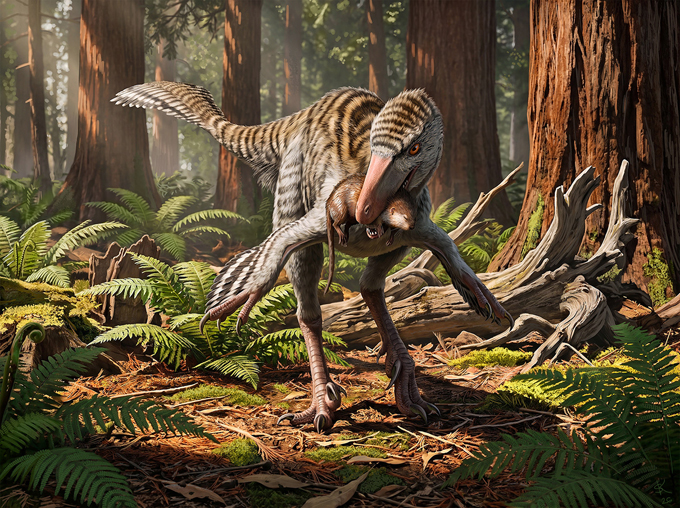
Un étrange parent d'un crocodile de l'époque des dinosaures réécrit ce que les scientifiques pensaient savoir sur les anciens reptiles. Cette créature de la taille d'un caniche, appelée Sonselasuchus cedrus, semble avoir commencé sa vie en marchant à quatre pattes avant de passer à une position sur deux pattes à mesure qu'elle grandissait - une transformation inhabituelle rarement observée dans les archives fossiles.
23/04/2026 sciencedaily ⚙ Traduction automatique
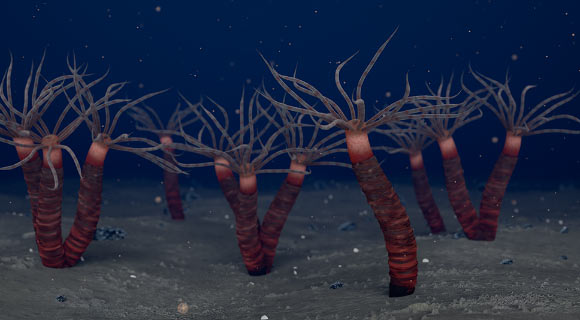
450-Million-Year-Old Fossils Reveal Strange, Tube-Dwelling Jellyfish Relative
Des fossiles vieux de 450 millions d’années révèlent un étrange parent de méduses tubicoles
Canada fossile spécimen nouvelle espèce
Les paléontologues ont identifié un nouveau genre et une nouvelle espèce de polype médusozoaire tubicole au corps mou à partir de spécimens bien conservés trouvés à environ 50 km au nord-est de la ville de Québec au Canada. L'article Des fossiles vieux de 450 millions d'années révèlent un étrange parent de méduses tubicoles apparaît en premier sur Sci.News : Breaking Science News.
21/04/2026 sci-news ⚙ Traduction automatique
Ces minuscules fossiles de dinosaures ont trompé les scientifiques pendant 20 ans
armure os croissance fossile Ankylosauria Dinosauria découverte
De minuscules fossiles de dinosaures qui ont intrigué les scientifiques pendant plus de 20 ans ont enfin révélé leur véritable identité. Plutôt que d’appartenir à une espèce miniature, ce sont en réalité des bébés ankylosaures, certains âgés de moins d’un an, y compris un possible nouveau-né. En étudiant les schémas de croissance osseuse, les chercheurs ont confirmé que ces jeunes dinosaures n’étaient pas encore devenus des adultes de grande taille. La découverte apporte un nouvel éclairage sur la façon dont les ankylosaures se sont développés, montrant qu'ils ont commencé à développer une armure étonnamment tôt.
21/04/2026 sciencedaily ⚙ Traduction automatique
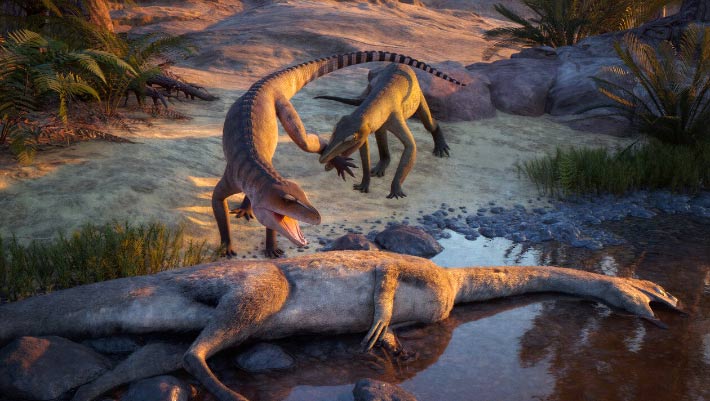
Museum Fossil Reveals Triassic Crocodile Cousin with Powerful Jaws
Un fossile de musée révèle un cousin crocodile du Trias doté de mâchoires puissantes
mâchoire musée Trias supérieur Trias fossile spécimen tomographie nouvelle espèce
Les tomodensitogrammes d'un spécimen vieux de plusieurs décennies du Musée d'histoire naturelle de Yale Peabody montrent une nouvelle espèce de crocodylomorphe au museau court et aux mâchoires inhabituellement fortes, offrant un instantané rare de la spécialisation écologique à l'époque du Trias supérieur. Le post Museum Fossil révèle un cousin crocodile du Trias doté de mâchoires puissantes est apparu en premier sur Sci.News: Breaking Science News.
20/04/2026 sci-news ⚙ Traduction automatique
Les scientifiques pensaient qu'il s'agissait d'un jeune T. rex. Ils avaient tort
os croissance prédateur fossile juvénile Dinosauria Nanotyrannus
Un mystère de longue date sur les dinosaures pourrait enfin être résolu : Nanotyrannus, autrefois considéré comme un simple T. rex adolescent, semble avoir été une espèce distincte après tout. Les scientifiques ont analysé un minuscule os de la gorge du fossile original et ont découvert des schémas de croissance montrant que l'animal était déjà mature et non un géant juvénile en devenir. Ce petit prédateur, environ la moitié de la taille d'un T. rex adulte, errait probablement aux côtés de son célèbre cousin, ajoutant une nouvelle couche de complexité à l'écosystème préhistorique.
16/04/2026 sciencedaily ⚙ Traduction automatique
1 2 3 4 5 6 7 8 9 10 11 12 13 14 15 16 17 18 19 20 21 22 23 24 25 26 27 28 29 30 31 32 33 34 35 36 37 38 39 40 41 42 43 44