←

fossile

Nature du spécimen

226 image(s) · 215 Actualités

Galerie d'images

Fossil of Coloborhynchus, an extinct pterosaur- Took the photo at Naturalis museum, Leiden
Taxons Maaradactylus

Fossil of Coloborhynchus, an extinct pterosaur- Took the photo at Naturalis museum, Leiden

musée fossile Coloborhynchus Maaradactylus +1
Sinornithosaurus millenii fossil displayed in Hong Kong Science Museum
Taxons Sinornithosaurus

Sinornithosaurus millenii fossil displayed in Hong Kong Science Museum

musée fossile Sinornithosaurus
Jinfengopteryx elegans fossil displayed in Hong Kong Science Museum
Taxons Jinfengopteryginae

Jinfengopteryx elegans fossil displayed in Hong Kong Science Museum

musée fossile Jinfengopteryginae Jinfengopteryx
Jinfengopteryx elegans fossil displayed in Hong Kong Science Museum
Taxons Jinfengopteryx

Jinfengopteryx elegans fossil displayed in Hong Kong Science Museum

musée fossile Jinfengopteryginae Jinfengopteryx
Fossil skeleton of Guaibasaurus, a basal Saurischian dinosaur genus
Taxons Guaibasauridae

Fossil skeleton of Guaibasaurus, a basal Saurischian dinosaur genus

fossile Dinosauria Guaibasauridae Guaibasaurus +2
Fossil of Romeosaurus, an extinct reptile - Took the picture at Museo Paleontologico di Sant'Anna d'Alfaedo
Taxons Yaguarasaurinae

Fossil of Romeosaurus, an extinct reptile - Took the picture at Museo Paleontologico di Sant'Anna d'Alfaedo

fossile Romeosaurus Yaguarasaurinae
Fossil of Romeosaurus, an extinct reptile - Took the picture at Museo Paleontologico di Sant'Anna d'Alfaedo
Taxons Romeosaurus

Fossil of Romeosaurus, an extinct reptile - Took the picture at Museo Paleontologico di Sant'Anna d'Alfaedo

fossile Romeosaurus Yaguarasaurinae
Fossil of Quetzalcoatlus, an extinct pterosaur- Took the photo at Senckenberg Museum of Frankfurt
Taxons Quetzalcoatlus

Fossil of Quetzalcoatlus, an extinct pterosaur- Took the photo at Senckenberg Museum of Frankfurt

musée fossile Pterosauria Quetzalcoatlus
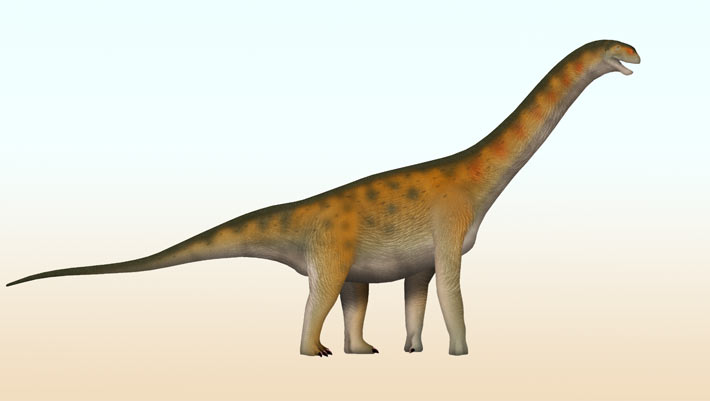
A restoration of Rinconsaurus compared to a human ,

•  Based proportionally on fossil elements and skeletal reconstruction featured in the Rinconsaurus description,[1] with missing parts based on other titanosaur reconstructions. The remains of Rinconsaurus represent two adults and a juvenile all of which are incomplete; some of the proportions shown here, such as the neck, limb lengths, and skull shape are not certain.
•  Osteroderms are not yet known in Rinconsaurus.  The osteoderms shown here are based loosely on Mendozasaurus.[2] Osteoderms are known from at least 10 titanosaur genera spread across the family tree but it's not clear if all titanosaurs had them.[3] Titanosaur osteoderms are rare and their layout and position on the body are not certain. [4]
•  The colours and patterns, as with the majority of reconstructions of prehistoric creatures, are speculative.
•  Human silhouette approximately 180 cm tall.

NOTE: I often update my images. If you want to have any of my images on a website, please (if possible) don’t host/save it to the website server. I’d prefer it if the image's Wikimedia URL is used. This means that if I update an image, it will be updated on the site as well.  Thanks.   


References


↑ Coria, Jorge; B.J.G. Riga (2003). "Rinconsaurus caudamirus gen. et sp nov., a new titanosaurid (Dinosauria, Sauropoda) from the Late Cretaceous of Patagonia, Argentina". Revista Geologica de Chile 30 (2): 333–353. ISSN 0716-0208. Retrieved on 2007-05-21.

↑   González Riga B (2003) A new titanosaur (Dinosauria, Sauropoda) from the Upper Cretaceous of Mendoza, Argentina. Ameghiniana 40 (2) 

↑  Carrano, M.T. and D’Emic, M.D.  2015 'Osteoderms of the titanosaur sauropod dinosaur Alamosaurus sanjuanensis Gilmore, 1922'. Journal of Vertebrate Paleontology.

↑    Vidal D, Ortega F, Sanz JL (2014) Titanosaur Osteoderms from the Upper Cretaceous of Lo Hueco (Spain) and Their Implications on the Armor of Laurasian Titanosaurs. PLoS ONE 9(8): e102488. doi:10.1371/journal.pone.0102488
Taxons Rinconsauria

A restoration of Rinconsaurus compared to a human , • Based proportionally on fossil elements and skeletal reconstruction featured in the Rinconsaurus description,[1] with missing parts based on other titanosaur reconstructions. The remains of Rinconsaurus represent two adults and a juvenile all of which are incomplete; some of the proportions shown here, such as the neck, limb lengths, and skull shape are not certain. • Osteroderms are not yet known in Rinconsaurus. The osteoderms shown here are based loosely on Mendozasaurus.[2] Osteoderms are known from at least 10 titanosaur genera spread across the family tree but it's not clear if all titanosaurs had them.[3] Titanosaur osteoderms are rare and their layout and position on the body are not certain. [4] • The colours and patterns, as with the majority of reconstructions of prehistoric creatures, are speculative. • Human silhouette approximately 180 cm tall. NOTE: I often update my images. If you want to have any of my images on a website, please (if possible) don’t host/save it to the website server. I’d prefer it if the image's Wikimedia URL is used. This means that if I update an image, it will be updated on the site as well. Thanks. References ↑ Coria, Jorge; B.J.G. Riga (2003). "Rinconsaurus caudamirus gen. et sp nov., a new titanosaurid (Dinosauria, Sauropoda) from the Late Cretaceous of Patagonia, Argentina". Revista Geologica de Chile 30 (2): 333–353. ISSN 0716-0208. Retrieved on 2007-05-21. ↑ González Riga B (2003) A new titanosaur (Dinosauria, Sauropoda) from the Upper Cretaceous of Mendoza, Argentina. Ameghiniana 40 (2) ↑ Carrano, M.T. and D’Emic, M.D. 2015 'Osteoderms of the titanosaur sauropod dinosaur Alamosaurus sanjuanensis Gilmore, 1922'. Journal of Vertebrate Paleontology. ↑ Vidal D, Ortega F, Sanz JL (2014) Titanosaur Osteoderms from the Upper Cretaceous of Lo Hueco (Spain) and Their Implications on the Armor of Laurasian Titanosaurs. PLoS ONE 9(8): e102488. doi:10.1371/journal.pone.0102488

armure membre description Argentine +14
A restoration of Rinconsaurus compared to a human ,

•  Based proportionally on fossil elements and skeletal reconstruction featured in the Rinconsaurus description,[1] with missing parts based on other titanosaur reconstructions. The remains of Rinconsaurus represent two adults and a juvenile all of which are incomplete; some of the proportions shown here, such as the neck, limb lengths, and skull shape are not certain.
•  Osteroderms are not yet known in Rinconsaurus.  The osteoderms shown here are based loosely on Mendozasaurus.[2] Osteoderms are known from at least 10 titanosaur genera spread across the family tree but it's not clear if all titanosaurs had them.[3] Titanosaur osteoderms are rare and their layout and position on the body are not certain. [4]
•  The colours and patterns, as with the majority of reconstructions of prehistoric creatures, are speculative.
•  Human silhouette approximately 180 cm tall.

NOTE: I often update my images. If you want to have any of my images on a website, please (if possible) don’t host/save it to the website server. I’d prefer it if the image's Wikimedia URL is used. This means that if I update an image, it will be updated on the site as well.  Thanks.   


References


↑ Coria, Jorge; B.J.G. Riga (2003). "Rinconsaurus caudamirus gen. et sp nov., a new titanosaurid (Dinosauria, Sauropoda) from the Late Cretaceous of Patagonia, Argentina". Revista Geologica de Chile 30 (2): 333–353. ISSN 0716-0208. Retrieved on 2007-05-21.

↑   González Riga B (2003) A new titanosaur (Dinosauria, Sauropoda) from the Upper Cretaceous of Mendoza, Argentina. Ameghiniana 40 (2) 

↑  Carrano, M.T. and D’Emic, M.D.  2015 'Osteoderms of the titanosaur sauropod dinosaur Alamosaurus sanjuanensis Gilmore, 1922'. Journal of Vertebrate Paleontology.

↑    Vidal D, Ortega F, Sanz JL (2014) Titanosaur Osteoderms from the Upper Cretaceous of Lo Hueco (Spain) and Their Implications on the Armor of Laurasian Titanosaurs. PLoS ONE 9(8): e102488. doi:10.1371/journal.pone.0102488
Taxons Rinconsaurus

A restoration of Rinconsaurus compared to a human , • Based proportionally on fossil elements and skeletal reconstruction featured in the Rinconsaurus description,[1] with missing parts based on other titanosaur reconstructions. The remains of Rinconsaurus represent two adults and a juvenile all of which are incomplete; some of the proportions shown here, such as the neck, limb lengths, and skull shape are not certain. • Osteroderms are not yet known in Rinconsaurus. The osteoderms shown here are based loosely on Mendozasaurus.[2] Osteoderms are known from at least 10 titanosaur genera spread across the family tree but it's not clear if all titanosaurs had them.[3] Titanosaur osteoderms are rare and their layout and position on the body are not certain. [4] • The colours and patterns, as with the majority of reconstructions of prehistoric creatures, are speculative. • Human silhouette approximately 180 cm tall. NOTE: I often update my images. If you want to have any of my images on a website, please (if possible) don’t host/save it to the website server. I’d prefer it if the image's Wikimedia URL is used. This means that if I update an image, it will be updated on the site as well. Thanks. References ↑ Coria, Jorge; B.J.G. Riga (2003). "Rinconsaurus caudamirus gen. et sp nov., a new titanosaurid (Dinosauria, Sauropoda) from the Late Cretaceous of Patagonia, Argentina". Revista Geologica de Chile 30 (2): 333–353. ISSN 0716-0208. Retrieved on 2007-05-21. ↑ González Riga B (2003) A new titanosaur (Dinosauria, Sauropoda) from the Upper Cretaceous of Mendoza, Argentina. Ameghiniana 40 (2) ↑ Carrano, M.T. and D’Emic, M.D. 2015 'Osteoderms of the titanosaur sauropod dinosaur Alamosaurus sanjuanensis Gilmore, 1922'. Journal of Vertebrate Paleontology. ↑ Vidal D, Ortega F, Sanz JL (2014) Titanosaur Osteoderms from the Upper Cretaceous of Lo Hueco (Spain) and Their Implications on the Armor of Laurasian Titanosaurs. PLoS ONE 9(8): e102488. doi:10.1371/journal.pone.0102488

armure membre description Argentine +14
fossil placodont
Taxons Cyamodontidae

fossil placodont

fossile Cyamodontidae Cyamodus Placodontia
fossil placodont
Taxons Cyamodus

fossil placodont

fossile Cyamodontidae Cyamodus Placodontia
fossil of henodus
Taxons Cyamodontoidea

fossil of henodus

fossile Cyamodontoidea Henodontidae Henodus
fossil of henodus
Taxons Henodontidae

fossil of henodus

fossile Cyamodontoidea Henodontidae Henodus
Fossils of Magnapualia
Taxons Magnapaulia

Fossils of Magnapualia

fossile Magnapaulia
Neotype fossil of Ardeadactylus longicollum, specimen number SMNS 56603 (Number 58 in Wellnhofer 1970).
Taxons Ardeadactylus

Neotype fossil of Ardeadactylus longicollum, specimen number SMNS 56603 (Number 58 in Wellnhofer 1970).

fossile spécimen Ardeadactylus Wellnhoferia
1 2 3 4 5 6 7 8 9 10 11 12 13 14 15

Actualités

Fossil Find in China Reveals Dinosaur Family Never Before Seen in East Asia
Une découverte de fossiles en Chine révèle une famille de dinosaures jamais vue auparavant en Asie de l'Est
Chine fossile Dinosauria découverte nouvelle espèce
Des paléontologues travaillant dans le sud de la Chine ont identifié une nouvelle espèce de dinosaure sauropode qui semble appartenir à un groupe jamais documenté auparavant en Asie de l'Est. L'article Une découverte de fossiles en Chine révèle une famille de dinosaures jamais vue auparavant en Asie de l'Est est apparu en premier sur Sci.News : Breaking Science News.
04/08/2026 sci-news ⚙ Traduction automatique
244-Million-Year-Old Fossil Preserves Earliest Reptilian Digestive System
Un fossile vieux de 244 millions d’années préserve le premier système digestif reptilien
Chine Trias fossile spécimen
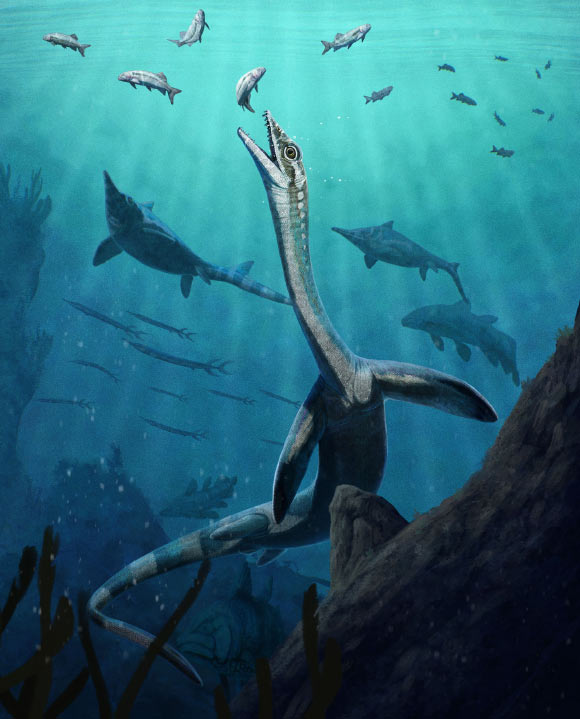
Un spécimen superbement conservé d'Austronaga minuta, un petit reptile marin au long cou du Trias chinois, contient un estomac, un foie et des intestins fossilisés, offrant aux paléontologues leur plus ancien aperçu détaillé de la façon dont les premiers reptiles digéraient la nourriture. L'article Un fossile vieux de 244 millions d'années préserve le premier système digestif reptilien est apparu en premier sur Sci.News : Breaking Science News.
04/08/2026 sci-news ⚙ Traduction automatique
Une créature vieille de 518 millions d'années révèle les origines des crocs d'araignée
membre tissus fossile
Une minuscule créature marine vieille de 518 millions d’années a révélé les premières preuves connues des structures qui sont finalement devenues des crocs d’araignées. Cachés à l’intérieur du fossile se trouvaient des membres en forme de pinces et des tissus mous préservés qui aident à expliquer comment les ancêtres des araignées et des scorpions sont devenus de redoutables chasseurs.
04/08/2026 sciencedaily-paleo ⚙ Traduction automatique
Les fossiles remarquables d'Eoceras shaanxiense réécrivent l'évolution des céphalopodes
Chine Cambrien Étage 3 du Cambrien fossile évolution formation
Les chercheurs ont identifié de minuscules fossiles de la formation Shuijingtuo (stade cambrien 3) du sud de la Chine qui pourraient transformer notre compréhension de l'évolution des céphalopodes. L'espèce nouvellement décrite, Eoceras shaanxiense, fournit la plus ancienne preuve connue d'un siphoncle primordial, une caractéristique anatomique cruciale qui a permis aux céphalopodes de réguler la flottabilité et de devenir finalement certains des océans.
03/08/2026 everythingdinosaur ⚙ Traduction automatique
Célébration de Peter Trusler Palaeoart – Redonner vie aux océans anciens
os fossile Ichthyosauria découverte
L’un des points forts du reportage sur les nouvelles découvertes scientifiques est de voir les œuvres d’art remarquables qui accompagnent de nombreux articles de recherche. Bien que les fossiles en fournissent la preuve, il faut souvent l'habileté d'un paléoartiste talentueux pour transformer les os et les impressions en scènes vivantes des temps profonds. Par exemple, nous avons récemment parlé d’un remarquable fossile d’ichtyosaure.
02/08/2026 everythingdinosaur ⚙ Traduction automatique
1 2 3 4 5 6 7 8 9 10 11 12 13 14 15 16 17 18 19 20 21 22 23 24 25 26 27 28 29 30 31 32 33 34 35 36 37 38 39 40 41 42 43