fossile

Nature du spécimen

267 image(s) · 171 Actualités

Galerie d'images

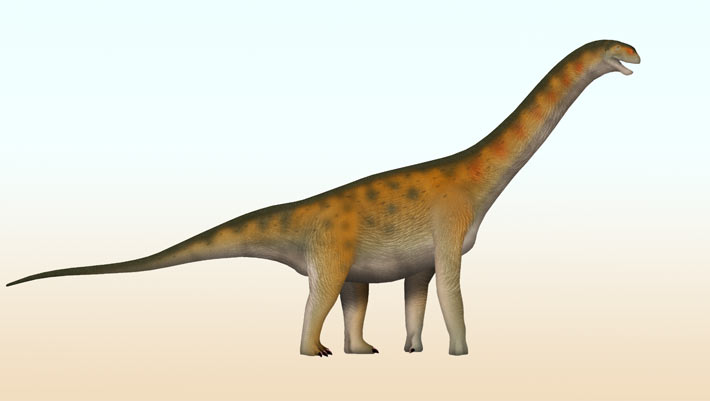
Jinchuanloong is a relatively basal sauropod that measured an estimated 10 m in length. Sauropod skulls typically don't preserve well in the fossil record, but Jinchuanloong is known mainly from the skull, and parts of the neck and tail. Like all sauropods, Jinchuanloong was a quadrupedal herbivore that used its long neck to reach the vegetation that it fed on.

Jinchuanloong is a relatively basal sauropod that measured an estimated 10 m in length. Sauropod skulls typically don't preserve well in the fossil record, but Jinchuanloong is known mainly from the skull, and parts of the neck and tail. Like all sauropods, Jinchuanloong was a quadrupedal herbivore that used its long neck to reach the vegetation that it fed on.

fossile Jinchuanloong crâne
Fossil of Quetzalcoatlus, an extinct pterosaur- Took the photo at Senckenberg Museum of Frankfurt

Fossil of Quetzalcoatlus, an extinct pterosaur- Took the photo at Senckenberg Museum of Frankfurt

musée fossile Pterosauria Quetzalcoatlus
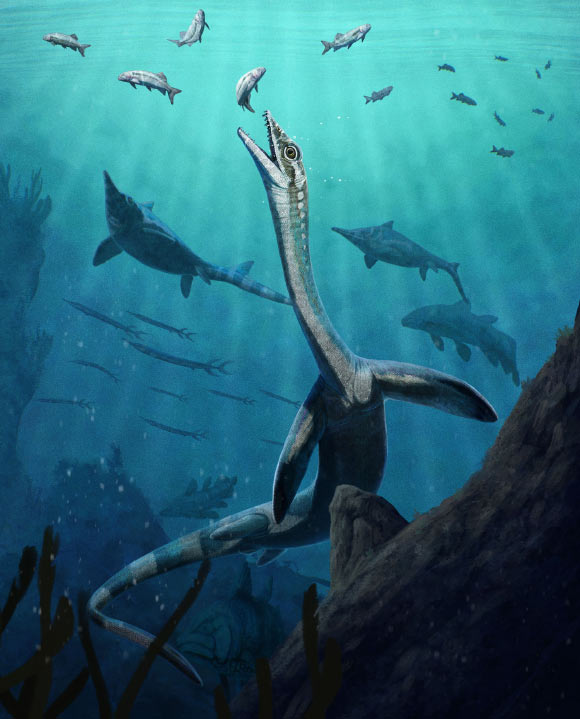
Artists’ reconstruction of the living Sarabosaurus dahli swimming with ammonites and fish in southern Utah, 94 million years ago. Artwork by Andrey Atuchin. On June 23, 2023, the following link will go live for more information, www.blm.gov/press-release/94-million-year-old-fossil-prov...

Artists’ reconstruction of the living Sarabosaurus dahli swimming with ammonites and fish in southern Utah, 94 million years ago. Artwork by Andrey Atuchin. On June 23, 2023, the following link will go live for more information, www.blm.gov/press-release/94-million-year-old-fossil-prov...

fossile Sarabosaurus Selmasaurini
Various fossils pertaining to the holotype of the Triassic ichthyosaur Toretocnemus (originally Leptocheirus, also Merriamia) zitteli. This image is derived from plate 23 in Merriam (1903), done by an uncredited artist. The arrangement of the individual figures has been modified from the original (most notably, figures 3 and 4 were swapped to minimize confusion).
Original description:
Leptocheirus zitteli n. gen. and sp.
Figures reproduced natural size from the type specimen.

Fig. 1.— Right side of skull.
Fig. 2. — Cross-section of posterior portion of the lower jaw, taken above the point marked A on the lateral view of the skull.
Fig. 3. — Cross-section of the upper and lower jaws, taken at the break immediately behind the point marked Sp on the lateral view of the skull.
Fig. 4. — Lateral view of an anterior caudal centrum.
Legend (modified from original):

Ar - articular
A - angular
D - dentary
J - jugal
L - lacrimal
Mx - maxilla
Po - postorbital
Sa - surangular
Se - sclerotic ring
Sp - spenial
T - cross-section of tooth
X - doubtful element

Various fossils pertaining to the holotype of the Triassic ichthyosaur Toretocnemus (originally Leptocheirus, also Merriamia) zitteli. This image is derived from plate 23 in Merriam (1903), done by an uncredited artist. The arrangement of the individual figures has been modified from the original (most notably, figures 3 and 4 were swapped to minimize confusion). Original description: Leptocheirus zitteli n. gen. and sp. Figures reproduced natural size from the type specimen. Fig. 1.— Right side of skull. Fig. 2. — Cross-section of posterior portion of the lower jaw, taken above the point marked A on the lateral view of the skull. Fig. 3. — Cross-section of the upper and lower jaws, taken at the break immediately behind the point marked Sp on the lateral view of the skull. Fig. 4. — Lateral view of an anterior caudal centrum. Legend (modified from original): Ar - articular A - angular D - dentary J - jugal L - lacrimal Mx - maxilla Po - postorbital Sa - surangular Se - sclerotic ring Sp - spenial T - cross-section of tooth X - doubtful element

description Trias fossile holotype +7
Various fossils pertaining to the holotype of the Triassic ichthyosaur Toretocnemus californicus. This image is derived from plate 24 in Merriam (1903), done by an uncredited artist. The arrangement of the individual figures has been modified from the original.
Original description:
Toretocnemus californicus n. gen. and sp.
Figures reproduced natural size from the type specimen.

Fig. 1. — Inferior side of right posterior limb. t, tibia.
Fig. 2. — Right anterior limb. r, radius.
Fig. 3.— Pelvic arch.
Fig. 4. — Middle dorsal vertebrae and a rib from the same region.

Various fossils pertaining to the holotype of the Triassic ichthyosaur Toretocnemus californicus. This image is derived from plate 24 in Merriam (1903), done by an uncredited artist. The arrangement of the individual figures has been modified from the original. Original description: Toretocnemus californicus n. gen. and sp. Figures reproduced natural size from the type specimen. Fig. 1. — Inferior side of right posterior limb. t, tibia. Fig. 2. — Right anterior limb. r, radius. Fig. 3.— Pelvic arch. Fig. 4. — Middle dorsal vertebrae and a rib from the same region.

membre description Trias fossile +6
Photograph of a fossil cast of a Tanycolagreus topwilsoni skeleton taken at the North American Museum of Ancient Life.

Photograph of a fossil cast of a Tanycolagreus topwilsoni skeleton taken at the North American Museum of Ancient Life.

musée moulage fossile Coeluridae +2
Tanycolagreus fossil holotype TPII 2000-09-29, North American Museum of Ancient Life.

Tanycolagreus fossil holotype TPII 2000-09-29, North American Museum of Ancient Life.

musée États-Unis fossile holotype +2
Diagram of the skull of Taniwhasaurus antarcticus, the areas in black being the known fossil material.
Reference source:

Álvarez–Herrera, Agnolin & Novas (2020) "A rostral neurovascular system in the mosasaur Taniwhasaurus antarcticus"

Diagram of the skull of Taniwhasaurus antarcticus, the areas in black being the known fossil material. Reference source: Álvarez–Herrera, Agnolin & Novas (2020) "A rostral neurovascular system in the mosasaur Taniwhasaurus antarcticus"

fossile Plioplatecarpinae Taniwhasaurus crâne
Fossil skeleton of Guaibasaurus, a basal Saurischian dinosaur genus

Fossil skeleton of Guaibasaurus, a basal Saurischian dinosaur genus

fossile Dinosauria Guaibasauridae Guaibasaurus +2
Ctenochasma elegans (syn. Pterodactylus elegans) fossil from Solnhofen, Germany

American Museum of Natural History, New York, FR-5147
Received in exchange from the Paläontologisches Museum München, 1909
Taxons Gnathosaurinae

Ctenochasma elegans (syn. Pterodactylus elegans) fossil from Solnhofen, Germany American Museum of Natural History, New York, FR-5147 Received in exchange from the Paläontologisches Museum München, 1909

musée Allemagne fossile Ctenochasma +5
Ctenochasma elegans (syn. Pterodactylus elegans) fossil from Solnhofen, Germany

American Museum of Natural History, New York, FR-5147
Received in exchange from the Paläontologisches Museum München, 1909
Taxons Moganopterinae

Ctenochasma elegans (syn. Pterodactylus elegans) fossil from Solnhofen, Germany American Museum of Natural History, New York, FR-5147 Received in exchange from the Paläontologisches Museum München, 1909

musée Allemagne fossile Ctenochasma +5
Ctenochasma elegans (syn. Pterodactylus elegans) fossil from Solnhofen, Germany

American Museum of Natural History, New York, FR-5147
Received in exchange from the Paläontologisches Museum München, 1909
Taxons Ctenochasmatinae

Ctenochasma elegans (syn. Pterodactylus elegans) fossil from Solnhofen, Germany American Museum of Natural History, New York, FR-5147 Received in exchange from the Paläontologisches Museum München, 1909

musée Allemagne fossile Ctenochasma +5
fossil of henodus

fossil of henodus

fossile Cyamodontoidea Henodontidae Henodus
Fossil of Halisaurus, an extinct reptile- Took the picture at Muse (Trento)
Taxons Halisaurini

Fossil of Halisaurus, an extinct reptile- Took the picture at Muse (Trento)

fossile Halisaurinae Halisaurini Halisauromorpha +2
Fossil of Halisaurus, an extinct reptile- Took the picture at Muse (Trento)
Taxons Pluridensini

Fossil of Halisaurus, an extinct reptile- Took the picture at Muse (Trento)

fossile Halisaurinae Halisaurini Halisauromorpha +2
Fossil of Halisaurus, an extinct reptile- Took the picture at Muse (Trento)
Taxons Halisauromorpha

Fossil of Halisaurus, an extinct reptile- Took the picture at Muse (Trento)

fossile Halisaurinae Halisaurini Halisauromorpha +2
1 2 3 4 5 6 7 8 9 10 11 12 13 14 15 16 17

Actualités

Fish Fossils from Early Paleocene Fill 10-Million-Year Gap after Dinosaur Extinction
Des fossiles de poissons du début du Paléocène comblent un écart de 10 millions d'années après l'extinction des dinosaures
Égypte Paléocène fossile Dinosauria extinction
Les paléontologues ont décrit un assemblage de fossiles de poissons marins provenant du site de Qreiya 3, vieux de 62,2 millions d'années, dans le désert oriental d'Égypte, ouvrant ainsi une fenêtre sur cette transition. L'article Les fossiles de poissons du début du Paléocène comblent un écart de 10 millions d'années après l'extinction des dinosaures est apparu en premier sur Sci.News : Breaking Science News.
05/06/2026 sci-news ⚙ Traduction automatique
Un vrai cauchemar volant : des chercheurs ont découvert un « dragon » préhistorique avec 4 ailes qui terrorisait les premiers oiseaux !
plume chasse Chine Crétacé fossile Dinosauria oiseau étude
Les raptors, dinosaures à plumes du Crétacé, ne pouvaient pas voler malgré leur lien étroit avec les oiseaux. Une nouvelle étude menée sur un site fossilifère en Chine révèle toutefois que certains d’entre eux auraient été capables de planer et de chasser les premiers oiseaux.
05/06/2026 futura-terre
Goethe ne savait pas que cette fourmi vieille de 40 millions d'années était cachée dans sa collection
nid fossile insecte
Les scientifiques examinant l’ambre de la collection personnelle de Goethe ont découvert trois insectes fossiles cachés, dont une fourmi éteinte préservée avec des détails extraordinaires. L’imagerie 3D avancée a permis aux chercheurs de voir non seulement les caractéristiques extérieures de la fourmi, mais également les structures à l’intérieur de son corps. Les résultats offrent de nouveaux indices sur la biologie de l’espèce et suggèrent qu’elle a probablement construit de grands nids dans les arbres.
04/06/2026 sciencedaily-paleo ⚙ Traduction automatique
À la recherche d'une espèce insaisissable d'allosaure
os Tanzanie Tendaguru fossile Allosauria formation
Allosaurus has become a bit of a taxonomic waste basket.  Ce terme concerne le matériel fossile provenant de théropodes attribué au genre.  Cependant, certaines preuves justifiant l'attribution du matériel sont provisoires.  Par exemple, des os de théropodes du sud-est de la Tanzanie (Formation Tendaguru) avaient été attribués à une espèce d'allosaure nommée Allosaurus tendagurensis.  En 1925,
04/06/2026 everythingdinosaur ⚙ Traduction automatique
Une découverte en Chine bouscule l’histoire d’étranges animaux vieux de 520 millions d’années
Chine Cambrien fossile datation découverte
Discrets mais omniprésents dans les océans actuels, les bryozoaires cachent une histoire bien plus ancienne qu’on ne le pensait. Des fossiles exceptionnels découverts en Chine montrent qu’il y a 520 millions d’années, ces animaux coloniaux étaient déjà des structures complexes, pleinement...
03/06/2026 futura-terre
1 2 3 4 5 6 7 8 9 10 11 12 13 14 15 16 17 18 19 20 21 22 23 24 25 26 27 28 29 30 31 32 33 34 35