fossile

Nature du spécimen

150 image(s) · 54 Actualités

Galerie d'images

Fossil of Suevoleviathan, an extinct reptile- Took the picture at Museum of Paleontology at Tuebingen

musée fossile Suevoleviathan

The Naturmuseum Senckenberg in Frankfurt is the second largest museum of natural history in Germany. It is particularly popular with children, who enjoy the extensive collection of dinosaur skeletons: Senckenberg boasts the largest exhibition of large dinosaurs in Europe. One particular treasure is a dinosaur fossil with unique, preserved scaled skin. The museum contains the world's largest and most diverse collection of stuffed birds with about 2000 specimens.

musée Allemagne fossile Peloneustes

Fossil in the Oxford University natural history museum

musée fossile Peloneustes

Identifier: catalogueoffossi02bri (find matches) Title: Catalogue of the fossil Reptilia and Amphibia in the British Museum (Natural history) ... By Richard Lydekker .. Year: 1888 (1880s) Authors: British Museum (Natural History). Dept. of Geology Lydekker, Richard, 1849-1915 Subjects: Reptiles, Fossil Amphibians, Fossil Publisher: London, Printed by order of the Trustees Contributing Library: Smithsonian Libraries Digitizing Sponsor: Biodiversity Heritage Library View Book Page: Book Viewer About This Book: Catalog Entry View All Images: All Images From Book Click here to view book online to see this illustration in context in a browseable online version of this book. Text Appearing Before Image: rface smooth; their terminal faces onlyslightly cupped, transversely ellipsoidal, and somewhat angulatod.Dorsals with longer centra, having nearly flat terminal faces, andforward overhang of upper part. Pectoral girdle of the general typeof Pliosaurus, with a small triangular omostornum between theventral plates of the scapula) (fig. 48), which have a strong ridge 1 Quart. Journ. Geol. Soc. vol. xlv. p. 49 (1889). 152 SATJKOPTERYGTA. dividing the ventral from the dorsal portion, and are thus more ofthe type of Thaumatosaurus. Pelvis (figs. 53, 54) like that ofPliosaurus, the pubis and ischium uniting to form an obturatorforamen. Relative lengths of humerus and femur unknown.Humerus articulating distally with only the radius and ulna, whichare relatively short, and separated only by a small interval (fig. 52) ;ulna and fibula subreniform, the former being considerably thelarger of the two. This genus may have been directly derived from the Longiros-trine group of Plesiosaurus. Fig. 49. Text Appearing After Image: Peloneustes philarchus.—Dorsal aspect of the coracoids; from the Oxford Clay of Bedford. Reduced, gl, glenoid cavity. (This and the preceding figure from the Quart. Joum. Geol. Soc.) Peloneustes sequalis (Phillips1). Syn. Pliosaurus cequalis, Phillips2.Pliosaurus sterrodirus, Seeley3. Imperfectly known. Cervical vertebrae with the neural canal•sunk into the centrum, and the pectorals with distinctly concaveterminal faces. Larger than typical examples of the next species. This species was founded upon a femur (fig. 50) from the Kime-ridge Clay of Oxfordshire, which so closely resembles the corre-sponding bone of P.jihilarchus as to indicate its generic identity; the 1 Geology of Oxford, p. 365 (1871).—Plesiosaurus. 2 Loc. cit. 3 Index to Ayes &c. in Cambridge Museum, p. 98 (1869).—No description. PLESI0SATJKIDJE, 153 length of this specimen is 0,572 (23 inches). The undermentionedvertebrae agree in relative size with this femur, and in genericcharacters with those of the ty Note About Images Please note that these images are extracted from scanned page images that may have been digitally enhanced for readability - coloration and appearance of these illustrations may not perfectly resemble the original work.

musée fossile Peloneustes Pliosaurus +1

Identifier: catalogueoffossi02bri (find matches) Title: Catalogue of the fossil Reptilia and Amphibia in the British Museum (Natural history) ... By Richard Lydekker .. Year: 1888 (1880s) Authors: British Museum (Natural History). Dept. of Geology Lydekker, Richard, 1849-1915 Subjects: Reptiles, Fossil Amphibians, Fossil Publisher: London, Printed by order of the Trustees Contributing Library: Smithsonian Libraries Digitizing Sponsor: Biodiversity Heritage Library View Book Page: Book Viewer About This Book: Catalog Entry View All Images: All Images From Book Click here to view book online to see this illustration in context in a browseable online version of this book. Text Appearing Before Image: pterygian; from theKimeridge Clay of Ely. \. a, proximal, b, distal epiphysis ; c, shaft. 46792. Two still smaller specimens; from the Kimeridge Clay ofDevizes, Wiltshire. Cunnington Collection. R. 400. Two phalangeals; from the Oxford Clay of Weymouth,Dorsetshire. Presented by C. Westendarp, Esq., 1884. 150 SAUEOPTERIGIA. R. 1381. One longitudinal half of the humerus or femur of a me- (Ficj.) dium-sized form, with the inner surface cut and polished; from the Kimeridge Clay of Ely. This specimen is figured in the woodcut on the preceding page, and shows the two epiphyses almost meeting in the middle of the shaft. No history. R. 1381 a. The proximal half of a larger humerus or femur, longitu-dinally bisected; from the Kimeridge Clay of Ely. Thecontour of the proximal epiphysis is well displayed. No history. 46912. The proximal portion of a still larger humerus or femur,longitudinally bisected; from Shotover. The whole ofthe proximal epiphysis is displayed, of which the terminal Kg. 47. Text Appearing After Image: Sauropterygian mandibles.—A. Peloneustesphilarchus; from the Oxford Clay.\. B. Thaitmatosaurus indicus; from the Upper Jurassic of India. ).0. Pksiosaimcs dolichodirus; from the Lower Lias. f. (From the Kec.Geol. Surv. Ind.) PLESI0SAURID2E. 151 extremity appears to have been separated by a small va-cuity from that of the distal epiphysis. No history. 42097. One lateral half of a humerus or femur, with the inner sur- face cut; from the Neocomian bone-bed of Potton, Bed-fordshire. The extremity of one epiphysis is entire anddetached from the shaft, while a section is shown of thatat the opposite end. Purchased, 1870. 42098. A small imperfect femur, with the proximal epiphysis de- tached and lying loose in the cup of the shaft; fromPotton. Purchased, 1870. Genus PELONEUSTES, Lydekker \ Skull and teeth of the general type of Pliosaurus, but the mandible(fig. 47, A) with a longer symphysis, which includes more than adozen teeth. Neck short, with the anterior vertebras relativelyshort. Ve Note About Images Please note that these images are extracted from scanned page images that may have been digitally enhanced for readability - coloration and appearance of these illustrations may not perfectly resemble the original work.

musée Oxford Clay fossile Peloneustes +1

Title: A descriptive catalogue of the marine reptiles of the Oxford clay. Based on the Leeds Collection in the British Museum (Natural History), London .. Identifier: descriptivecatal02brit (find matches) Year: 1910 (1910s) Authors: British Museum (Natural History). Dept. of Geology; Andrews, Charles William, 1866-1924 Subjects: Reptiles, Fossil Publisher: London, Printed by order of the Trustees Contributing Library: Smithsonian Libraries Digitizing Sponsor: Biodiversity Heritage Library View Book Page: Book Viewer About This Book: Catalog Entry View All Images: All Images From Book Click here to view book online to see this illustration in context in a browseable online version of this book. Text Appearing Before Image: 78 MAEINE EEPTILES OF THE OXEOED CLAT. Test-fig. 30. Text Appearing After Image: aa. Coracoids of Peloneustes evansi: A, from front; B, from above. (E. 3897, 1 nat. size.) glenoid facet; p.e.a., postero-esternal angle; sc.f., facet for scapula; sym., symphysial surface. Note About Images Please note that these images are extracted from scanned page images that may have been digitally enhanced for readability - coloration and appearance of these illustrations may not perfectly resemble the original work.

musée Oxford Clay fossile Peloneustes +1
Taxons Peloneustes

Title: A descriptive catalogue of the marine reptiles of the Oxford clay. Based on the Leeds Collection in the British Museum (Natural History), London .. Identifier: descriptivecatal02brit (find matches) Year: 1910 (1910s) Authors: British Museum (Natural History). Dept. of Geology; Andrews, Charles William, 1866-1924 Subjects: Reptiles, Fossil Publisher: London, Printed by order of the Trustees Contributing Library: Smithsonian Libraries Digitizing Sponsor: Biodiversity Heritage Library View Book Page: Book Viewer About This Book: Catalog Entry View All Images: All Images From Book Click here to view book online to see this illustration in context in a browseable online version of this book. Text Appearing Before Image: CATAL,MARINE REPT. OXFORD CLAY. PART II. PLATE IV. col. — v.orb. Text Appearing After Image: pas par. G.M.Woodward Aei.et litli. West.Newznsr. imp. PEEONEUSTES philarghus. Note About Images Please note that these images are extracted from scanned page images that may have been digitally enhanced for readability - coloration and appearance of these illustrations may not perfectly resemble the original work.

musée Oxford Clay fossile Peloneustes +1

Title: A descriptive catalogue of the marine reptiles of the Oxford clay. Based on the Leeds Collection in the British Museum (Natural History), London .. Identifier: descriptivecatal02brit (find matches) Year: 1910 (1910s) Authors: British Museum (Natural History). Dept. of Geology; Andrews, Charles William, 1866-1924 Subjects: Reptiles, Fossil Publisher: London, Printed by order of the Trustees Contributing Library: Smithsonian Libraries Digitizing Sponsor: Biodiversity Heritage Library View Book Page: Book Viewer About This Book: Catalog Entry View All Images: All Images From Book Click here to view book online to see this illustration in context in a browseable online version of this book. Text Appearing Before Image: CATAL.MARINE REPT. OXFORD CLAY. PART II. FLATE II. Text Appearing After Image: G.M.Woodwa/p& del.etlitfL PLIOSAURUS PEROX. West, Newman imp. Note About Images Please note that these images are extracted from scanned page images that may have been digitally enhanced for readability - coloration and appearance of these illustrations may not perfectly resemble the original work.

musée Oxford Clay fossile Liopleurodon +2
Taxons Liopleurodon

Title: A descriptive catalogue of the marine reptiles of the Oxford clay. Based on the Leeds Collection in the British Museum (Natural History), London .. Identifier: descriptivecatal02brit (find matches) Year: 1910 (1910s) Authors: British Museum (Natural History). Dept. of Geology; Andrews, Charles William, 1866-1924 Subjects: Reptiles, Fossil Publisher: London, Printed by order of the Trustees Contributing Library: Smithsonian Libraries Digitizing Sponsor: Biodiversity Heritage Library View Book Page: Book Viewer About This Book: Catalog Entry View All Images: All Images From Book Click here to view book online to see this illustration in context in a browseable online version of this book. Text Appearing Before Image: CATAL.MARINE KEPT. OXFORD CLAY. PART II. PLATE I. pmcc. Text Appearing After Image: >p77ia:. G.M.Woodward del. etlibh. West, Newman imp. PLIOSAURUS FEROX. Note About Images Please note that these images are extracted from scanned page images that may have been digitally enhanced for readability - coloration and appearance of these illustrations may not perfectly resemble the original work.

musée Oxford Clay fossile Liopleurodon +2

Fossil - Took The picture at Royal Belgian Institute of Natural Sciences, Brussels

fossile Hainosaurus

Fossil - Took The picture at Royal Belgian Institute of Natural Sciences, Brussels

fossile Hainosaurus

Fossil - Took The picture at Royal Belgian Institute of Natural Sciences, Brussels

fossile Hainosaurus

Fossil of Hainosaurus, an extinct reptile -- Took the photo at Natural History Museum of Bruxelles

musée fossile Hainosaurus

Fossil of Anhanguera, an extinct reptile-- Took the photo at Natural History Museum, London

musée fossile Anhanguera

Crâne de mosasaure d'espèce Platecarpus tympaniticus (squamates, mosasaures). Provenance : Smoky Hill Chalk, Kansas (aux Etats-Unis). Date : Crétacé supérieur, période du Campanien, 88 millions d'années avant notre ère. Collections du Muséum national d'histoire naturelle de Paris (France). Exposé à l'occasion de l'exposition "Un T-Rex à Paris" au Muséum national d'histoire naturelle de Paris (France) du 6 juin au 2 septembre 2018. Légende du fossile dans cette exposition : "Les mosasaures ne sont pas des dinosaures mais des reptiles marins, très répandus à la fin du Crétacé. Certains genres comme Globidens et Halisaurus sont connus aussi bien aux Etats-Unis qu'au Maroc. Ces animaux étaient d'excellents nageurs, capables de traverser l'Atlantique."

France Maroc Campanien Crétacé +6
Taxons Eremiasaurus

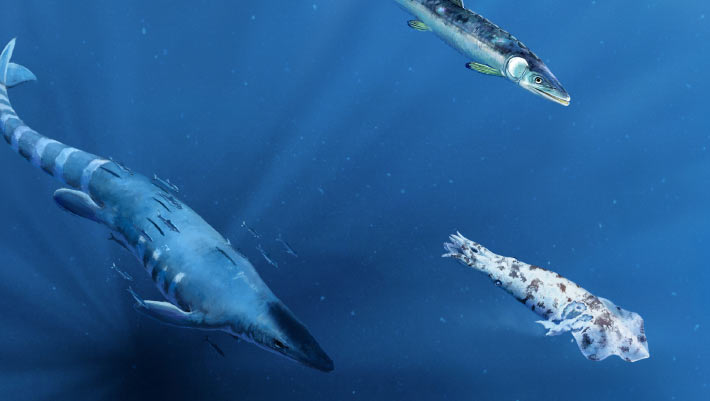
Life restoration of the mosasaurine mosasaurid Eremiasaurus, with unknown portions and soft tissues based primarily on Prognathodon and supplemented with Mosasaurus where needed. References Leblanc, A.R.H.; Caldwell, M.W.; Bardet, N. (2012). "A new mosasaurine from the Maastrichtian (Upper Cretaceous) phosphates of Morocco and its implications for mosasaurine systematics". Journal of Vertebrate Paleontology 32 (1): 82–104. Lindgren, J.; Kaddumi, H.; Polcyn, M. (2013). "Soft tissue preservation in a fossil marine lizard with a bilobed tail fin". Nature Communications 4: 2423. DOI:10.1038/ncomms3423. Konishi, T.; Brinkman, D.; Massare, J.A.; Caldwell, M.W. (2011). "New exceptional specimens of Prognathodon overtoni (Squamata, Mosasauridae) from the upper Campanian of Alberta, Canada, and the systematics and ecology of the genus". Journal of Vertebrate Paleontology 31 (5): 1026–1046. Russell, D.A. (1967). "Systematics and morphology of American mosasaurs". Bulletin of the Peabody Museum of Natural History 23: 1–241.

tissus écologie musée restauration +10
1 2 3 4 5 6 7 8 9 10

Actualités

Des scientifiques ont découvert un rhinocéros dans l'Arctique et cela change tout
fossile datation nouvelle espèce
Des scientifiques ont découvert une nouvelle espèce de rhinocéros dans l'Extrême-Arctique canadien, révélant que les rhinocéros vivaient autrefois bien plus au nord que prévu. Le fossile, datant de 23 millions d'années, est exceptionnellement complet et a contribué à remodeler les idées sur la façon dont ces animaux ont migré entre les continents. Les preuves suggèrent que les rhinocéros ont traversé l'Europe vers l'Amérique du Nord plus récemment que les scientifiques ne le pensaient autrefois.
24/03/2026 sciencedaily ⚙ Traduction automatique
Ce dinosaure de 2 livres réécrit ce que les scientifiques savent de l'évolution
fossile Alnashetri oiseau évolution squelette
Un squelette de dinosaure presque complet découvert en Patagonie aide les scientifiques à percer le mystère des alvarezsaures, un groupe étrange de dinosaures ressemblant à des oiseaux. Le fossile d'Alnashetri cerropoliciensis révèle que ces animaux sont devenus minuscules avant de développer leurs caractéristiques spécialisées ultérieures, telles que des bras tronqués et des adaptations mangeuses de fourmis. Pesant moins de deux livres, le dinosaure est l’un des plus petits connus d’Amérique du Sud.
10/03/2026 sciencedaily ⚙ Traduction automatique
Un fossile de « Sword Dragon » vieux de 190 millions d’années réécrit l’histoire des ichtyosaures
Royaume-Uni Jurassique fossile évolution squelette
Un ichtyosaure nouvellement identifié de la côte jurassique du Royaume-Uni est en train de réécrire une partie du manuel préhistorique. Surnommé le « dragon-épée du Dorset », ce reptile marin de trois mètres de long a vécu pendant une période d’évolution mal comprise, au cours de laquelle les principaux groupes d’ichtyosaures disparaissaient et de nouveaux apparaissaient. Son squelette magnifiquement préservé – doté d’un museau en forme de lame et d’un éventuel dernier repas – permet de déterminer le moment où cette transition dramatique s’est produite.
24/02/2026 sciencedaily ⚙ Traduction automatique
Un spinosaure géant à crête, le « héron de l'enfer », découvert dans le Sahara
crête prédateur Niger fossile Spinosaurus
Au cœur du Sahara, des scientifiques ont découvert Spinosaurus mirabilis, un nouveau prédateur spectaculaire couronné d'une crête massive en forme de cimeterre qui aurait pu autrefois briller de couleurs sous le soleil du désert. Découvert dans des gisements de rivières intérieures isolées au Niger, le fossile réécrit ce que nous pensions savoir sur les dinosaures spinosaures, suggérant qu'ils n'étaient pas des chasseurs entièrement aquatiques mais de puissants échassiers traquant les poissons dans les cours d'eau boisés à des centaines de kilomètres de la mer.
23/02/2026 sciencedaily ⚙ Traduction automatique
Le tricératops avait un nez géant qui aurait pu refroidir sa tête massive
fossile Triceratops
La tête massive du tricératops faisait peut-être plus que simplement montrer ces fameuses cornes. À l’aide de tomodensitogrammes et de reconstructions 3D de crânes fossiles, les chercheurs ont découvert un système nasal étonnamment complexe caché à l’intérieur de son énorme museau. Au lieu d’être simplement un nez surdimensionné pour sentir, il abritait probablement des réseaux complexes de nerfs et de vaisseaux sanguins, et même des structures spéciales qui aidaient à réguler la chaleur et l’humidité.
22/02/2026 sciencedaily ⚙ Traduction automatique
1 2 3 4 5 6 7 8 9 10 11