fossile

Nature du spécimen

150 image(s) · 54 Actualités

Galerie d'images

Taxons Huaxiagnathus

Huaxiagnathus orientalis fossil displayed in Hong Kong Science Museum

musée fossile Huaxiagnathus
Taxons Procompsognathus

Holotype fossil specimen SMNS 12591 of Procompsognathus

fossile holotype spécimen Procompsognathinae +1
Taxons Procompsognathinae

Holotype fossil specimen SMNS 12591 of Procompsognathus

fossile holotype spécimen Procompsognathinae +1
Taxons Tyrannomimus

An overview of the known fossil material of Tyrannomimus fukuiensis. Fossil specimens shown in are not in the same scale. The bar is scaled for the paratype (FPDM-V-10295). The holotype (FPDM-V-11333) and paratype in are colored in red and blue, respectively. The right femur in is mirrored from the left one (FPDM-V-11338).

écaille fossile holotype Tyrannomimus
Taxons Xuanhuaceratops

Artistic reconstruction of the head of an early ceratopsian Xuanhuaceratops niei based on the currently known fossil material and the cranial remains of other chaoyangsaurids.

reconstitution fossile Ceratopsia Xuanhuaceratops +1
Taxons Xuanhuasaurus

Artistic reconstruction of the head of an early ceratopsian Xuanhuaceratops niei based on the currently known fossil material and the cranial remains of other chaoyangsaurids.

reconstitution fossile Ceratopsia Xuanhuaceratops +1
Taxons Koreaceratops

Fossil of Koreaceratops found at Hwaseong-si Gyeonggi-do, Korea.

fossile Koreaceratops
Taxons Helioceratops

Helioceratops brachygnathus restoration based on fossil images.

restauration fossile Helioceratops
Taxons Craspedodon

fossil Craspedodon

fossile Craspedodon
Taxons Lurdusaurus

Fossil of Lurdusaurus, an ornithopod dinosaur Took the photo at Musee d'Histoire Naturelle, Brussels

fossile Lurdusaurus
Taxons Morrosaurus

Life restoration of Morrosaurus antarcticus based on fossil images. Integument based on small, bipedal ornithischians like Kulindadromeus.

restauration fossile Kulindadromeus Morrosaurus
Taxons Jinzhousaurus

Jinzhousaurus yangi fossil displayed in Hong Kong Science Museum

musée fossile Jinzhousaurus
Taxons Theiophytalia

Theiophytalia kerri Brill & Carpenter, 2006 - ornithopod dinosaur skull from the Cretaceous of Colorado, USA. (YPM 1887, public display, Garden of the Gods visitor center, Colorado Springs, Colorado, USA) This skull is the holotype and only known specimen of an entire genus of ornithopod dinosaurs, Theiophytalia. Ornithopods were herbivorous dinosaurs. From exhibit signage: A Brand New Dinosaur Species Theiophytalia kerri What we know about the dinosaur fossil - so far: It is the only Theiophytalia kerri fossil known to exist in the world. It is a brand new genus and species of dinosaur. Theiophytalia kerri means "belonging to the Garden of the Gods". "Theios" is a Greek word that means "belonging to the gods" and "phytalia" means "garden". "kerri" honors James Hutchinson Kerr (pronounced "Care"), who discovered the dinosaur fossil. Theiophytalia was a medium-sized dinosaur, measuring about 30 feet from head to tail. It was found in 1878 in the Garden of the Gods in the lower Lytle Member of the Purgatoire Rock Formation of the Dakota Group. The dinosaur fossil skull is from the Aptian-Albian Age of the Cretaceous Ear, 125 - 100 million years old. Look closely at the fossil skull. Where are the teeth located? You can see the teeth in the back of the jaw. There are no teeth in the front of the dinosaur's beak-like mouth. This is evidence that the Theiophytalia was a plant eater. It could nip and tear plants, then grind them between its tightly-packed back teeth, similar to plant-eaters of today. Timeline: Dinosaur Fossil Discovered, then Forgotten 1878 - James Kerr, geology professor at Colorado College, finds a fossil skull "in one of the ridges east of the red rocks of the Garden of the Gods." 1886 - O.C. Marsh, famous 1800s dinosaur collector from Yale University, obtains the fossil skull from James Kerr, identifies it as a Camptosaurus dinosaur, and sends the fossil to the Yale Peabody Museum in New Haven, Connecticut. 1886 - 1995 - While the dinosaur fossil skull safely rests in the Yale Museum for many decades, knowledge of its existence is forgotten in Colorado Springs. Rediscovery - 117 years later 1994 - Colorado Springs City park staff research new exhibits for the Garden of the Gods Visitor and Nature Center, set to open in 1995. They meet with Doctor Kirk Johnson, curator of paleontology at the Denver Museum of Nature & Science. 1995 - Kirk Johnson refers the park staff to his museum colleague Doctor Ken Carpenter, expert dinosaur scientist. Doctor Carpenter remembers seeing in his files "something about a dinosaur fossil found in Garden of the Gods" and mails the following article to park staff. Camptosaurus amplus No. 1887, Yale Museum, consisting of portions of the skull and lower jaw. It was collected from deposits in the Garden of the Gods, Colorado Springs, Colorado. With this specimen was found the following note in Professor O.C. Marsh's handwriting, "Part of this animal and various Sauropoda bones were taken out by Professor Kerr in 1878." A Case of Mistaken Identity Reveals a Brand New Dinosaur! 1996 - Kirk Johnson (a Yale alumnus) secures permission to hand-carry the Camptosaurus fossil from the Yale Peabody Museum to Denver so that Ken Carpenter can make a cast (a precise replica) of the fossil. Doctor Carpenter notices irregularities in the Camptosaurus fossil and decides to re-examine the fossil when his schedule permits. 1997 - The Camptosaurus fossil replica is given to the City of Colorado Springs and is exhibited at the Garden of the Gods Visitor and Nature Center. 2006 - Doctor Carpenter and his associate Kathleen Brill reassess the fossil skull and note that it differs from other Camptosaurus skulls in several significant ways, such as the narrower mouth and snout, and the position of the nasal openings, and the bony structures over the eyes. Also, microscopic identification of the rock matrix clinging to the fossil, and research of archival maps, reveal that the fossil skull was actually found in the lower Dakota Rock Formation, not the Morrison Formation as originally reported in the 1800s. The skull is from a dinosaur that lived in the Cretaceous Ear and can't be a Jurassic Era Camptosaurus. Doctor Carpenter's exacting research reveals that the dinosaur skull is a brand new genus and species of dinosaur! He names it Theiophytalia kerri. 2008 - The Theiophytalia kerri is proudly re-exhibited at the Garden of the Gods Visitor and Nature Center. Classification: Animalia, Chordata, Vertebrata, Dinosauria, Ornithischia, Ornithopoda Stratigraphy: lower Lytle Member, Purgatoire Formation, Dakota Group, Aptian to Albian Stages, upper Lower Cretaceous Locality: Garden of the Gods, Colorado Springs, Colorado, USA See info. at: en.wikipedia.org/wiki/Theiophytalia and en.wikipedia.org/wiki/Ornithopoda

États-Unis Crétacé fossile holotype +3
Taxons Liaoningosaurus

Fossil specimen of Liaoningosaurus paradoxus on display at the Beijing Museum of Natural History.

musée fossile spécimen Liaoningosaurus
Taxons Gargoyleosaurus

Fossil skeleton of Gargoyleosaurus parkpinorum taken in 2007 at the Denver Museum of Nature and Science.

musée Denver fossile Gargoyleosaurus +1
Taxons Isanosaurus

fossil of Isanosaurus attavipachi, an extinct sauropod

fossile Isanosaurus
1 2 3 4 5 6 7 8 9 10

Actualités

Des scientifiques ont découvert un rhinocéros dans l'Arctique et cela change tout
fossile datation nouvelle espèce
Des scientifiques ont découvert une nouvelle espèce de rhinocéros dans l'Extrême-Arctique canadien, révélant que les rhinocéros vivaient autrefois bien plus au nord que prévu. Le fossile, datant de 23 millions d'années, est exceptionnellement complet et a contribué à remodeler les idées sur la façon dont ces animaux ont migré entre les continents. Les preuves suggèrent que les rhinocéros ont traversé l'Europe vers l'Amérique du Nord plus récemment que les scientifiques ne le pensaient autrefois.
24/03/2026 sciencedaily ⚙ Traduction automatique
Ce dinosaure de 2 livres réécrit ce que les scientifiques savent de l'évolution
fossile Alnashetri oiseau évolution squelette
Un squelette de dinosaure presque complet découvert en Patagonie aide les scientifiques à percer le mystère des alvarezsaures, un groupe étrange de dinosaures ressemblant à des oiseaux. Le fossile d'Alnashetri cerropoliciensis révèle que ces animaux sont devenus minuscules avant de développer leurs caractéristiques spécialisées ultérieures, telles que des bras tronqués et des adaptations mangeuses de fourmis. Pesant moins de deux livres, le dinosaure est l’un des plus petits connus d’Amérique du Sud.
10/03/2026 sciencedaily ⚙ Traduction automatique
Un fossile de « Sword Dragon » vieux de 190 millions d’années réécrit l’histoire des ichtyosaures
Royaume-Uni Jurassique fossile évolution squelette
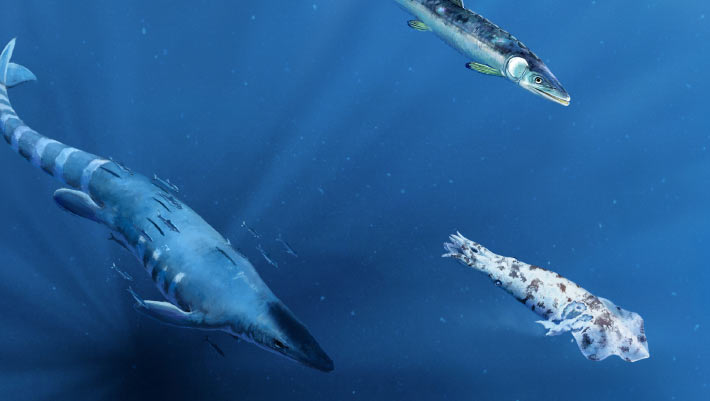
Un ichtyosaure nouvellement identifié de la côte jurassique du Royaume-Uni est en train de réécrire une partie du manuel préhistorique. Surnommé le « dragon-épée du Dorset », ce reptile marin de trois mètres de long a vécu pendant une période d’évolution mal comprise, au cours de laquelle les principaux groupes d’ichtyosaures disparaissaient et de nouveaux apparaissaient. Son squelette magnifiquement préservé – doté d’un museau en forme de lame et d’un éventuel dernier repas – permet de déterminer le moment où cette transition dramatique s’est produite.
24/02/2026 sciencedaily ⚙ Traduction automatique
Un spinosaure géant à crête, le « héron de l'enfer », découvert dans le Sahara
crête prédateur Niger fossile Spinosaurus
Au cœur du Sahara, des scientifiques ont découvert Spinosaurus mirabilis, un nouveau prédateur spectaculaire couronné d'une crête massive en forme de cimeterre qui aurait pu autrefois briller de couleurs sous le soleil du désert. Découvert dans des gisements de rivières intérieures isolées au Niger, le fossile réécrit ce que nous pensions savoir sur les dinosaures spinosaures, suggérant qu'ils n'étaient pas des chasseurs entièrement aquatiques mais de puissants échassiers traquant les poissons dans les cours d'eau boisés à des centaines de kilomètres de la mer.
23/02/2026 sciencedaily ⚙ Traduction automatique
Le tricératops avait un nez géant qui aurait pu refroidir sa tête massive
fossile Triceratops
La tête massive du tricératops faisait peut-être plus que simplement montrer ces fameuses cornes. À l’aide de tomodensitogrammes et de reconstructions 3D de crânes fossiles, les chercheurs ont découvert un système nasal étonnamment complexe caché à l’intérieur de son énorme museau. Au lieu d’être simplement un nez surdimensionné pour sentir, il abritait probablement des réseaux complexes de nerfs et de vaisseaux sanguins, et même des structures spéciales qui aidaient à réguler la chaleur et l’humidité.
22/02/2026 sciencedaily ⚙ Traduction automatique
1 2 3 4 5 6 7 8 9 10 11