←

fossile

Nature du spécimen

248 image(s) · 265 Actualités

Galerie d'images

Illustration of a fossil of Chubutisaurus
Taxons Chubutisaurus

Illustration of a fossil of Chubutisaurus

fossile Chubutisaurus
Illustration of a fossil of Plateosauravus
Taxons Plateosauravus

Illustration of a fossil of Plateosauravus

fossile Plateosauravus
Fossil of Balaur, an extinct theropod- Took the photo at Fossil Show, Munich
Taxons Balaur

Fossil of Balaur, an extinct theropod- Took the photo at Fossil Show, Munich

fossile Balaur
The Canadian Fossil Discovery Centre in Morden boasts the largest collection of marine invertebrate fossils in Canada. Visitors to the museum not only get to see this collection, but can join a dig in search for more fossils at a 109-acre escarpment property.

Photo credit: Robyn Hanson

The Canadian Fossil Discovery Centre in Morden boasts the largest collection of marine invertebrate fossils in Canada. Visitors to the museum not only get to see this collection, but can join a dig in search for more fossils at a 109-acre escarpment property. Photo credit: Robyn Hanson

musée Canada fossile Tylosaurus +1
Caririchnium leonardii - dinosaur track from the Cretaceous of Colorado, USA. (replica; public display, Red Rocks Amphitheater visitor center, west of Denver, Colorado, USA)
Dinosaur Ridge, Colorado has numerous dinosaur fossils, including bones and tracks.  The most common track type at the site is Caririchnium leonardii, which was made by an iguanodontid dinosaur.  The large, wide, three-toed print was produced by a hindfoot.
Stratigraphy: Dakota Sandstone, upper Lower Cretaceous

Provenance: eastern side of Dinosaur Ridge, Dakota Hogback, west of Denver, north-central Colorado, USA
Taxons Caririchnium

Caririchnium leonardii - dinosaur track from the Cretaceous of Colorado, USA. (replica; public display, Red Rocks Amphitheater visitor center, west of Denver, Colorado, USA) Dinosaur Ridge, Colorado has numerous dinosaur fossils, including bones and tracks. The most common track type at the site is Caririchnium leonardii, which was made by an iguanodontid dinosaur. The large, wide, three-toed print was produced by a hindfoot. Stratigraphy: Dakota Sandstone, upper Lower Cretaceous Provenance: eastern side of Dinosaur Ridge, Dakota Hogback, west of Denver, north-central Colorado, USA

os États-Unis Denver Crétacé +6
Fossil of Mosasaurus, an extinct mosasaur, reconstruction of the Mosasaurus of Bemelen. Took the photo at Natural History Museum of Maastricht
Taxons Mosasaurus

Fossil of Mosasaurus, an extinct mosasaur, reconstruction of the Mosasaurus of Bemelen. Took the photo at Natural History Museum of Maastricht

musée fossile Moanasaurus Mosasaurus
Elangatoolithidae fossil dinosaur eggs, from China. Exhibit in the Academy of Natural Sciences, 1900 Benjamin Franklin Parkway, Philadelphia, Pennsylvania, USA. Photography was permitted in this area of the museum without restrictions.
Taxons Elongatoolithidae

Elangatoolithidae fossil dinosaur eggs, from China. Exhibit in the Academy of Natural Sciences, 1900 Benjamin Franklin Parkway, Philadelphia, Pennsylvania, USA. Photography was permitted in this area of the museum without restrictions.

musée Chine États-Unis fossile +2
Fossil specimen of Ornithomimus sp. (TMP 1995.110.1), Royal Tyrrell Museum. This specimen was recovered from the middle Dinosaur Park Formation of Alberta, Canada.
Taxons Ornithomimidae

Fossil specimen of Ornithomimus sp. (TMP 1995.110.1), Royal Tyrrell Museum. This specimen was recovered from the middle Dinosaur Park Formation of Alberta, Canada.

musée Canada Allemagne Dinosaur Park +6
Uses https://commons.wikimedia.org/wiki/File:Dromaeosaurus_in_Canadian_Museum_of_Nature.jpg
File:Alaskan_troodont_Perot_Museum.jpg
File:Unenlagia_fossils.jpg
File:Talos_sampsoni.png
https://en.wikipedia.org/wiki/File:Velociraptor_Wyoming_Dinosaur_Center.jpg
https://en.wikipedia.org/wiki/Saurornitholestes
File:Buitreraptor-Deinonychus.jpg

File:Dakotaraptor_lateral_Wiki.jpg
Taxons Deinonychosauria

Uses https://commons.wikimedia.org/wiki/File:Dromaeosaurus_in_Canadian_Museum_of_Nature.jpg File:Alaskan_troodont_Perot_Museum.jpg File:Unenlagia_fossils.jpg File:Talos_sampsoni.png https://en.wikipedia.org/wiki/File:Velociraptor_Wyoming_Dinosaur_Center.jpg https://en.wikipedia.org/wiki/Saurornitholestes File:Buitreraptor-Deinonychus.jpg File:Dakotaraptor_lateral_Wiki.jpg

musée fossile Buitreraptor Dakotaraptor +8
Palaeogeography of the Earth in Aptian, with location of Acrocanthosaurus fossils as green dots
Intervalles Aptian

Palaeogeography of the Earth in Aptian, with location of Acrocanthosaurus fossils as green dots

Aptien fossile Acrocanthosaurus
Map of Cretaceous-aged dinosaur fossil localities of Mongolia.
Gobihadros mongoliensis was collected from Bayshin Tsav in Area C. Open squares indicate Late Cretaceous sites, solid squares represent Early Cretaceous localities. Abbreviations: A, Localities of Western Gobi Desert in Mongolia, mainly group of localities of Nemegtian age (early Maastrichtian), Late Cretaceous; B, Localities of Central Gobi Desert in Mongolia, mainly Djadokhtian age (Campanian), Late Cretaceous; C & D- Localities of Eastern Gobi Desert in Mongolia, mainly Baynshirenian age (Cenomanian-Santonian), Late Cretaceous. Figure has been modified from Tsogtbaatar et al. 2014, Figure 1 [24].

Map of Cretaceous-aged dinosaur fossil localities of Mongolia. Gobihadros mongoliensis was collected from Bayshin Tsav in Area C. Open squares indicate Late Cretaceous sites, solid squares represent Early Cretaceous localities. Abbreviations: A, Localities of Western Gobi Desert in Mongolia, mainly group of localities of Nemegtian age (early Maastrichtian), Late Cretaceous; B, Localities of Central Gobi Desert in Mongolia, mainly Djadokhtian age (Campanian), Late Cretaceous; C & D- Localities of Eastern Gobi Desert in Mongolia, mainly Baynshirenian age (Cenomanian-Santonian), Late Cretaceous. Figure has been modified from Tsogtbaatar et al. 2014, Figure 1 [24].

Mongolie Campanien Cénomanien Crétacé +8
Figure 2: Fossil vertebrate locality of Eric the Red West.
Shore platform looking west, showing undulating erosive boundary (solid white line) between the top of the Anchor Sandstone (AS) and the base of the ETRW Sandstone (ES). White dashed lines indicate selected bedding surfaces. White scale in mid-ground (indicated by arrow) equals 1 m.

Figure 2: Fossil vertebrate locality of Eric the Red West. Shore platform looking west, showing undulating erosive boundary (solid white line) between the top of the Anchor Sandstone (AS) and the base of the ETRW Sandstone (ES). White dashed lines indicate selected bedding surfaces. White scale in mid-ground (indicated by arrow) equals 1 m.

écaille fossile
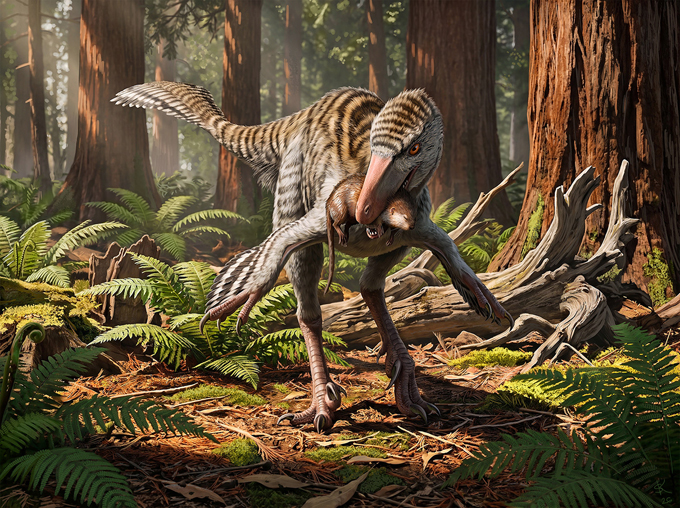
Représentation du dinosaure Dinevenator robustus, récemment découvert. Ce troodontidé a été identifié en 2026 à partir d'un fossile collecté dans le comté de San Juan.

Représentation du dinosaure Dinevenator robustus, récemment découvert. Ce troodontidé a été identifié en 2026 à partir d'un fossile collecté dans le comté de San Juan.

fossile Dinevenator Troodontidae
A broken concretion with fossils inside; Late Cretaceous Pierre shale, near Ekalaka, Montana.

A broken concretion with fossils inside; Late Cretaceous Pierre shale, near Ekalaka, Montana.

Pierre Shale Crétacé Crétacé supérieur fossile
The distictive banding of the Morrison Formation, a group of rock layers that occur throughout Dinosaur National Monument.  The formation originated as muds and sands laid down by ancient rivers, and some of its outcrops have been found to contain 150-million-year-old dinosaur fossils like those found at the monument's Dinosaur Quarry.

The distictive banding of the Morrison Formation, a group of rock layers that occur throughout Dinosaur National Monument. The formation originated as muds and sands laid down by ancient rivers, and some of its outcrops have been found to contain 150-million-year-old dinosaur fossils like those found at the monument's Dinosaur Quarry.

Morrison fossile Dinosauria formation
Bituminous claystone, Lower Jurassic, Hesselberg, Middle Franconia.
Sedimentary rock of very thin laminated layers (particles less than 0,0002 mm).

Rock formation is known for its rich fossil findings, ex. Ichthyosaur.

Bituminous claystone, Lower Jurassic, Hesselberg, Middle Franconia. Sedimentary rock of very thin laminated layers (particles less than 0,0002 mm). Rock formation is known for its rich fossil findings, ex. Ichthyosaur.

Jurassique fossile Ichthyosauria formation
1 2 3 4 5 6 7 8 9 10 11 12 13 14 15 16

Actualités

Des abeilles anciennes trouvées nichant à l’intérieur d’os fossiles lors d’une découverte d’une grotte rare
os mâchoire nid proie fossile découverte
Il y a des milliers d'années, dans une grotte d'Hispaniola, une chaîne d'événements inhabituelle a laissé derrière elle un trésor scientifique rare : des abeilles nichant dans des os fossilisés. Après que des chouettes effraies géantes aient amené à plusieurs reprises des proies comme des hutias dans la grotte, leurs restes se sont accumulés dans des chambres riches en limon, créant un étrange environnement souterrain. Plus tard, les abeilles fouisseuses ont profité des sédiments mous et ont même réutilisé de minuscules cavités dans des mâchoires et des os fossilisés comme nids prêts à l'emploi, les recouvrant d'un revêtement lisse et imperméable.
03/04/2026 sciencedaily ⚙ Traduction automatique
D’étranges roches en « peau d’éléphant » révèlent une vie ancienne dans l’océan sombre
Maroc fossile découverte formation
Une étrange formation rocheuse ridée au Maroc a amené les scientifiques à repenser l'endroit où pourraient vivre d'anciens microbes. Au lieu d’eaux peu profondes et ensoleillées, ces microbes pourraient avoir prospéré dans les profondeurs de l’océan, alimentés par les produits chimiques libérés par les glissements de terrain sous-marins. La découverte suggère que les environnements sombres et riches en nutriments ont abrité des écosystèmes prospères beaucoup plus tôt que prévu. Cela soulève également la possibilité que de nombreux fossiles similaires aient été négligés ou mal interprétés.
03/04/2026 sciencedaily-paleo ⚙ Traduction automatique
Les scientifiques disent que nous avons cherché au mauvais endroit les origines humaines
Égypte fossile évolution origine humaine
Un singe fossile découvert dans le nord de l’Égypte est en train de remodeler l’histoire de l’évolution humaine. L'espèce Masripithecus vivait il y a environ 17 à 18 millions d'années et pourrait être très proche de l'ancêtre de tous les singes modernes. Cette constatation remet en question l’attention portée depuis longtemps à l’Afrique de l’Est. Au lieu de cela, il désigne l’Afrique du Nord et les régions voisines comme berceau possible des singes.
28/03/2026 sciencedaily-paleo ⚙ Traduction automatique
Des scientifiques ont découvert un rhinocéros dans l'Arctique et cela change tout
fossile datation nouvelle espèce
Des scientifiques ont découvert une nouvelle espèce de rhinocéros dans l'Extrême-Arctique canadien, révélant que les rhinocéros vivaient autrefois bien plus au nord que prévu. Le fossile, datant de 23 millions d'années, est exceptionnellement complet et a contribué à remodeler les idées sur la façon dont ces animaux ont migré entre les continents. Les preuves suggèrent que les rhinocéros ont traversé l'Europe vers l'Amérique du Nord plus récemment que les scientifiques ne le pensaient autrefois.
24/03/2026 sciencedaily ⚙ Traduction automatique
Ce crocodile courait comme un lévrier à travers la Grande-Bretagne préhistorique il y a 200 millions d'années.
Royaume-Uni Trias fossile nouvelle espèce
Un reptile du Trias récemment découvert au Royaume-Uni ressemblait plus à un lévrier de course qu'à un crocodile, construit pour la vitesse sur terre. Doté de longues pattes et d'un corps léger, il chassait les petits animaux dans un environnement sec et montagneux il y a des millions d'années. Les scientifiques l’ont identifié comme une nouvelle espèce après avoir repéré des différences clés dans ses fossiles. C’est aussi un hommage à un professeur inspirant qui a contribué à éveiller la curiosité d’un futur scientifique.
21/03/2026 sciencedaily ⚙ Traduction automatique
1 2 3 4 5 6 7 8 9 10 11 12 13 14 15 16 17 18 19 20 21 22 23 24 25 26 27 28 29 30 31 32 33 34 35 36 37 38 39 40 41 42 43 44 45 46 47 48 49 50 51 52 53