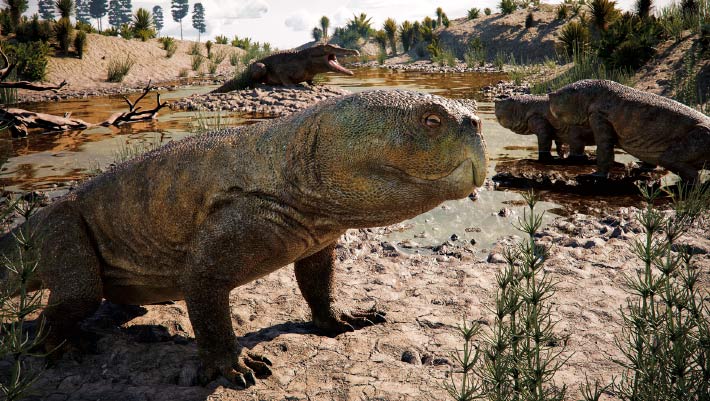
fossile

Nature du spécimen

267 image(s) · 171 Actualités

Galerie d'images

A restoration of Rinconsaurus compared to a human ,

•  Based proportionally on fossil elements and skeletal reconstruction featured in the Rinconsaurus description,[1] with missing parts based on other titanosaur reconstructions. The remains of Rinconsaurus represent two adults and a juvenile all of which are incomplete; some of the proportions shown here, such as the neck, limb lengths, and skull shape are not certain.
•  Osteroderms are not yet known in Rinconsaurus.  The osteoderms shown here are based loosely on Mendozasaurus.[2] Osteoderms are known from at least 10 titanosaur genera spread across the family tree but it's not clear if all titanosaurs had them.[3] Titanosaur osteoderms are rare and their layout and position on the body are not certain. [4]
•  The colours and patterns, as with the majority of reconstructions of prehistoric creatures, are speculative.
•  Human silhouette approximately 180 cm tall.

NOTE: I often update my images. If you want to have any of my images on a website, please (if possible) don’t host/save it to the website server. I’d prefer it if the image's Wikimedia URL is used. This means that if I update an image, it will be updated on the site as well.  Thanks.   


References


↑ Coria, Jorge; B.J.G. Riga (2003). "Rinconsaurus caudamirus gen. et sp nov., a new titanosaurid (Dinosauria, Sauropoda) from the Late Cretaceous of Patagonia, Argentina". Revista Geologica de Chile 30 (2): 333–353. ISSN 0716-0208. Retrieved on 2007-05-21.

↑   González Riga B (2003) A new titanosaur (Dinosauria, Sauropoda) from the Upper Cretaceous of Mendoza, Argentina. Ameghiniana 40 (2) 

↑  Carrano, M.T. and D’Emic, M.D.  2015 'Osteoderms of the titanosaur sauropod dinosaur Alamosaurus sanjuanensis Gilmore, 1922'. Journal of Vertebrate Paleontology.

↑    Vidal D, Ortega F, Sanz JL (2014) Titanosaur Osteoderms from the Upper Cretaceous of Lo Hueco (Spain) and Their Implications on the Armor of Laurasian Titanosaurs. PLoS ONE 9(8): e102488. doi:10.1371/journal.pone.0102488
Taxons Rinconsauria

A restoration of Rinconsaurus compared to a human , • Based proportionally on fossil elements and skeletal reconstruction featured in the Rinconsaurus description,[1] with missing parts based on other titanosaur reconstructions. The remains of Rinconsaurus represent two adults and a juvenile all of which are incomplete; some of the proportions shown here, such as the neck, limb lengths, and skull shape are not certain. • Osteroderms are not yet known in Rinconsaurus. The osteoderms shown here are based loosely on Mendozasaurus.[2] Osteoderms are known from at least 10 titanosaur genera spread across the family tree but it's not clear if all titanosaurs had them.[3] Titanosaur osteoderms are rare and their layout and position on the body are not certain. [4] • The colours and patterns, as with the majority of reconstructions of prehistoric creatures, are speculative. • Human silhouette approximately 180 cm tall. NOTE: I often update my images. If you want to have any of my images on a website, please (if possible) don’t host/save it to the website server. I’d prefer it if the image's Wikimedia URL is used. This means that if I update an image, it will be updated on the site as well. Thanks. References ↑ Coria, Jorge; B.J.G. Riga (2003). "Rinconsaurus caudamirus gen. et sp nov., a new titanosaurid (Dinosauria, Sauropoda) from the Late Cretaceous of Patagonia, Argentina". Revista Geologica de Chile 30 (2): 333–353. ISSN 0716-0208. Retrieved on 2007-05-21. ↑ González Riga B (2003) A new titanosaur (Dinosauria, Sauropoda) from the Upper Cretaceous of Mendoza, Argentina. Ameghiniana 40 (2) ↑ Carrano, M.T. and D’Emic, M.D. 2015 'Osteoderms of the titanosaur sauropod dinosaur Alamosaurus sanjuanensis Gilmore, 1922'. Journal of Vertebrate Paleontology. ↑ Vidal D, Ortega F, Sanz JL (2014) Titanosaur Osteoderms from the Upper Cretaceous of Lo Hueco (Spain) and Their Implications on the Armor of Laurasian Titanosaurs. PLoS ONE 9(8): e102488. doi:10.1371/journal.pone.0102488

armure membre description Argentine +14
Ctenochasma elegans (syn. Pterodactylus elegans) fossil from Solnhofen, Germany

American Museum of Natural History, New York, FR-5147
Received in exchange from the Paläontologisches Museum München, 1909
Taxons Ctenochasmatidae

Ctenochasma elegans (syn. Pterodactylus elegans) fossil from Solnhofen, Germany American Museum of Natural History, New York, FR-5147 Received in exchange from the Paläontologisches Museum München, 1909

musée Allemagne fossile Ctenochasma +2
fossil placodont
Taxons Cyamodontidae

fossil placodont

fossile Cyamodontidae Placodontia
Mounted replica of a composite skeleton of Edmontosaurus annectens on display at the University of Oxford Museum, Oxford, England. The original skeleton is compiled from disarticulated fossil bones from a bonebed of the Hell Creek Formation, exposed in the Ruth Mason Quarry in Harding County, South Dakota. It is 8.5 m (28 ft.) long and the skull is almost 1 m (39 in.) in length.[1][2]


↑ Dinosaurs in the Museum. Oxford University Museum of Natural History (brochure, PDF), p. 7

↑ BHI Fossil Replica Catalog 2012. Black Hills Institute of Geological Research, Inc., Hill City, SD, 2012 (PDF), p. 22
Taxons Saurolophinae

Mounted replica of a composite skeleton of Edmontosaurus annectens on display at the University of Oxford Museum, Oxford, England. The original skeleton is compiled from disarticulated fossil bones from a bonebed of the Hell Creek Formation, exposed in the Ruth Mason Quarry in Harding County, South Dakota. It is 8.5 m (28 ft.) long and the skull is almost 1 m (39 in.) in length.[1][2] ↑ Dinosaurs in the Museum. Oxford University Museum of Natural History (brochure, PDF), p. 7 ↑ BHI Fossil Replica Catalog 2012. Black Hills Institute of Geological Research, Inc., Hill City, SD, 2012 (PDF), p. 22

os musée Hell Creek fossile +6
fossil of henodus
Taxons Cyamodontoidea

fossil of henodus

fossile Cyamodontoidea Henodontidae Henodus
fossil of henodus
Taxons Henodontidae

fossil of henodus

fossile Cyamodontoidea Henodontidae Henodus
Fossil of Halisaurus, an extinct reptile- Took the picture at Muse (Trento)
Taxons Halisaurinae

Fossil of Halisaurus, an extinct reptile- Took the picture at Muse (Trento)

fossile Halisaurinae Halisaurus
Fossils of Magnapualia
Taxons Magnapaulia

Fossils of Magnapualia

fossile Magnapaulia
Neotype fossil of Ardeadactylus longicollum, specimen number SMNS 56603 (Number 58 in Wellnhofer 1970).
Taxons Ardeadactylus

Neotype fossil of Ardeadactylus longicollum, specimen number SMNS 56603 (Number 58 in Wellnhofer 1970).

fossile spécimen Ardeadactylus Wellnhoferia
A cast of BYU 9025, the holotype fossil of the sauropod dinosaur Supersaurus, a giant scapulocoracoid measuring 2.4m long.
• The source photo was taken at the Dinosaur Journey Musuem.
• Notes regarding the file; This image was edited and extracted from the original seen here. [1] The Photoshop CC lens correction profile and a 'perspective warp' correction were applied.
Taxons Supersaurus

A cast of BYU 9025, the holotype fossil of the sauropod dinosaur Supersaurus, a giant scapulocoracoid measuring 2.4m long. • The source photo was taken at the Dinosaur Journey Musuem. • Notes regarding the file; This image was edited and extracted from the original seen here. [1] The Photoshop CC lens correction profile and a 'perspective warp' correction were applied.

moulage fossile holotype Dinosauria +1
Saurexallopus, a four toed dinosaur or bird trace fossil (jr syn Exallopus
Taxons Saurexallopus

Saurexallopus, a four toed dinosaur or bird trace fossil (jr syn Exallopus

fossile Dinosauria Exallopus Saurexallopus +1
Fossil samples – e.g. ‘primitive’ bony fish (1, 2), a skull of a temnospondyl ‘amphibian’ (probably a metoposauroid) in dorsal view (3), a skull of an archosaur of the crocodile lineage (probably a phytosaur) in palatal view (4), holotype of the “gliding reptile” Icarosaurus siefkeri [1] (5) and Atreipus-Grallator-type dinosaur tracks (bottom right) – from the Newark Supergroup, i.e. a series of mainly Late Triassic to Early Jurassic sedimentary rocks of eastern North America


↑ Edwin H. Colbert: A gliding reptile from the Triassic of New Jersey. American Museum Novitates, 2230. American Museum of Natural History, New York 1966, digitallibrary.amnh.org, cf. fig. 3 therein.
Taxons Atreipus

Fossil samples – e.g. ‘primitive’ bony fish (1, 2), a skull of a temnospondyl ‘amphibian’ (probably a metoposauroid) in dorsal view (3), a skull of an archosaur of the crocodile lineage (probably a phytosaur) in palatal view (4), holotype of the “gliding reptile” Icarosaurus siefkeri [1] (5) and Atreipus-Grallator-type dinosaur tracks (bottom right) – from the Newark Supergroup, i.e. a series of mainly Late Triassic to Early Jurassic sedimentary rocks of eastern North America ↑ Edwin H. Colbert: A gliding reptile from the Triassic of New Jersey. American Museum Novitates, 2230. American Museum of Natural History, New York 1966, digitallibrary.amnh.org, cf. fig. 3 therein.

musée Jurassique inférieur Jurassique Trias supérieur +9
Archaeopteryx lithographica, specimen displayed at the Museum für Naturkunde in Berlin. (This image shows the original fossil - not a cast.)
Taxons Archaeopteryx

Archaeopteryx lithographica, specimen displayed at the Museum für Naturkunde in Berlin. (This image shows the original fossil - not a cast.)

musée moulage fossile spécimen +1
fossil of temnodontosaurus
Taxons Temnodontosaurus

fossil of temnodontosaurus

fossile Temnodontosaurus
Fossil of Hainosaurus, an extinct reptile  --  Took the photo at Natural History Museum of Bruxelles
Taxons Hainosaurus

Fossil of Hainosaurus, an extinct reptile -- Took the photo at Natural History Museum of Bruxelles

musée fossile Hainosaurus
Vertebrae of Gualicho shinyae from the fossil collection of the Museo patagónico de ciencias naturales Juan Carlos Salgado, General Roca, Río Negro. Scale as size reference.

Vertebrae of Gualicho shinyae from the fossil collection of the Museo patagónico de ciencias naturales Juan Carlos Salgado, General Roca, Río Negro. Scale as size reference.

écaille fossile Gualicho
1 2 3 4 5 6 7 8 9 10 11 12 13 14 15 16 17

Actualités

De nouveaux fossiles au Qatar révèlent une petite vache marine cachée depuis 21 millions d'années
os Qatar fossile
Des fossiles du Qatar ont révélé une petite espèce de vache marine nouvellement identifiée qui vivait dans le golfe Persique il y a plus de 20 millions d'années. Le site contient la collection la plus dense connue d’os fossiles de vaches marines, démontrant que ces animaux prospéraient autrefois dans de riches prairies d’herbiers marins. Leur rôle écologique reflète celui des dugongs modernes, qui remodèlent encore les fonds marins du Golfe en broutant. Les résultats pourraient aider les chercheurs à comprendre comment les écosystèmes d’herbiers marins réagissent aux changements environnementaux à long terme.
12/12/2025 sciencedaily ⚙ Traduction automatique
Des analyses du cerveau fossile montrent que les ptérosaures ont évolué en un éclair
vol fossile Pterosauria oiseau découverte évolution
Les anciens ptérosaures ont peut-être pris leur envol bien plus tôt et de manière plus explosive que les oiseaux, développant le vol dès leur origine malgré leur cerveau relativement petit. Grâce à l'imagerie CT avancée, les scientifiques ont reconstruit les cavités cérébrales de fossiles de ptérosaures et de leurs proches parents, découvrant des indices surprenants, tels que des lobes optiques élargis, qui suggèrent un saut rapide vers le vol motorisé. Leurs découvertes contrastent fortement avec l'évolution lente et par étapes observée chez les oiseaux, dont le cerveau s'est développé au fil du temps.
09/12/2025 sciencedaily ⚙ Traduction automatique
Cet os rare résout enfin le mystère du Nanotyrannus
os croissance musée fossile spécimen Nanotyrannus Tyrannosaurus découverte
Les scientifiques ont confirmé que Nanotyrannus était une espèce mature et non un jeune T. rex. Un examen microscopique de son os hyoïde a fourni la preuve clé, correspondant aux signaux de croissance observés dans les spécimens connus de T. rex. Cette découverte suggère un écosystème de tyrannosaures plus riche et plus compétitif qu’on ne le pensait auparavant. Il montre également comment les fossiles de musée et les analyses de pointe peuvent réécrire l’histoire préhistorique.
09/12/2025 sciencedaily ⚙ Traduction automatique
Un ancien crocodile égyptien au long museau réécrit l’évolution
chasse prédateur Égypte fossile spécimen découverte évolution
Un parent de crocodile nouvellement identifié en Égypte repousse les origines des dyrosauridés chasseurs marins de plusieurs millions d'années. Le fossile, Wadisuchus kassabi, présente un mélange de traits primitifs et avancés qui marquent une transition évolutive clé. Des spécimens rares d’âges différents révèlent comment ces anciens prédateurs se sont développés. Cette découverte renforce l’Afrique en tant que centre de l’évolution précoce des dyrosauridés.
01/12/2025 sciencedaily ⚙ Traduction automatique
Un mini-prédateur vieux de 242 millions d'années change l'évolution du lézard
membre dent prédateur fossile évolution nouvelle espèce crâne
Un minuscule fossile du Devon vieux de 242 millions d’années bouleverse les hypothèses des scientifiques sur les premiers membres de la lignée des lézards. Au lieu des charnières du crâne et des dents du palais typiques des lézards et des serpents modernes, cette ancienne créature présente un mélange surprenant de traits primitifs et inhabituels, ainsi que des dents étonnamment grandes en forme de lame. Les scans synchrotron haute résolution ont révélé des détails invisibles à l'œil nu, aidant ainsi les chercheurs à nommer la nouvelle espèce Agriodontosaurus helsbypetrae
30/11/2025 sciencedaily ⚙ Traduction automatique
1 2 3 4 5 6 7 8 9 10 11 12 13 14 15 16 17 18 19 20 21 22 23 24 25 26 27 28 29 30 31 32 33 34 35