←

Jurassique

Intervalle géologique

117 image(s) · 38 Actualités

Voir la fiche

Galerie d'images

A lampshell of the genus Acanthothiris, Class Rhynchonellata, Order Rhynchonellida, Family Acanthothirididae, 20mm along the axis, view of the pedunculate valve, from Woodeaton, Oxfordshire, UK, middle Middle Jurassic (Bathonian)

A lampshell of the genus Acanthothiris, Class Rhynchonellata, Order Rhynchonellida, Family Acanthothirididae, 20mm along the axis, view of the pedunculate valve, from Woodeaton, Oxfordshire, UK, middle Middle Jurassic (Bathonian)

Royaume-Uni Bathonien Jurassique Jurassique moyen
A lampshell of the genus Acanthothiris, Class Rhynchonellata, Order Rhynchonellida, Family Acanthothirididae, 20mm along the axis, view of the opening, from Woodeaton, Oxfordshire, UK, middle Middle Jurassic (Bathonian)

A lampshell of the genus Acanthothiris, Class Rhynchonellata, Order Rhynchonellida, Family Acanthothirididae, 20mm along the axis, view of the opening, from Woodeaton, Oxfordshire, UK, middle Middle Jurassic (Bathonian)

Royaume-Uni Bathonien Jurassique Jurassique moyen
A lampshell of the genus Acanthothiris, Class Rhynchonellata, Order Rhynchonellida, Family Acanthothirididae, 20mm along the axis, lateral view, from Woodeaton, Oxfordshire, UK, middle Middle Jurassic (Bathonian)

A lampshell of the genus Acanthothiris, Class Rhynchonellata, Order Rhynchonellida, Family Acanthothirididae, 20mm along the axis, lateral view, from Woodeaton, Oxfordshire, UK, middle Middle Jurassic (Bathonian)

Royaume-Uni Bathonien Jurassique Jurassique moyen
A lampshell of the genus Acanthothiris, Class Rhynchonellata, Order Rhynchonellida, Family Acanthothirididae, 20mm along the axis, view of the hinge, from Woodeaton, Oxfordshire, UK, middle Middle Jurassic (Bathonian)

A lampshell of the genus Acanthothiris, Class Rhynchonellata, Order Rhynchonellida, Family Acanthothirididae, 20mm along the axis, view of the hinge, from Woodeaton, Oxfordshire, UK, middle Middle Jurassic (Bathonian)

Royaume-Uni Bathonien Jurassique Jurassique moyen
A lampshell of the genus Acanthothiris, Class Rhynchonellata, Order Rhynchonellida, Family Acanthothirididae, 20mm along the axis, view of the brachial valve, from Woodeaton, Oxfordshire, UK, middle Middle Jurassic (Bathonian)
Intervalles Bathonian

A lampshell of the genus Acanthothiris, Class Rhynchonellata, Order Rhynchonellida, Family Acanthothirididae, 20mm along the axis, view of the brachial valve, from Woodeaton, Oxfordshire, UK, middle Middle Jurassic (Bathonian)

Royaume-Uni Bathonien Jurassique Jurassique moyen
An atypical (without intertidal and supratidal environment) carbonate platform settles down along the margin. Shallow water oolithes and oncoids are deposited in a narrow zone between a basin with Cancellophycus to the north and a marine/swampy plain with abundants mollusc fauna. However the Mytilus formation, rich in bathonian and callovian foraminifera (Septfontaine, 1984 etc.), develop thick limestone beds tenth of meter above, wrongly attributed to the upper Jurassic. See discussion in Septfontaine (1984).

An atypical (without intertidal and supratidal environment) carbonate platform settles down along the margin. Shallow water oolithes and oncoids are deposited in a narrow zone between a basin with Cancellophycus to the north and a marine/swampy plain with abundants mollusc fauna. However the Mytilus formation, rich in bathonian and callovian foraminifera (Septfontaine, 1984 etc.), develop thick limestone beds tenth of meter above, wrongly attributed to the upper Jurassic. See discussion in Septfontaine (1984).

Bathonien Callovien Jurassique formation
A map showing the distribution of paraves in Late Jurassic with the respective paleogeographic setting.

A map showing the distribution of paraves in Late Jurassic with the respective paleogeographic setting.

Jurassique Jurassique supérieur Paraves
Figure 1. Evolution of macroecological traits in Dinosauria. Large scale event in dinosaur evolution (a); the origin of dinosaurs (star), hyperthermals (volcano), the earliest fossil Avialae (bird), the earliest fossil angiosperm (flower), the Cretaceous/Palaeogene mass extinction (asteroid). Phylogeny of dinosaurs (b) redrawn from Sereno and adapted to the current consensus and upon which an ancestral state reconstruction of temperature niche (mean annual temperature) after Chiarenza et al. is plotted; Mesozoic palaeogeographies (c) for Triassic (T), Jurassic (J) and Cretaceous (K). Silhouette colours symbolize body mass for each of the taxa represented; information on dietary habits are plotted after Barrett and Zanno & Makovicky; numbers represent clades discussed through this study: 1, Ornithischia; 2, Thyreophora; 3, Ornithopoda; 4, Hadrosauroidea; 5, Marginocephalia; 6, Ceratopsia; 7, Saurischia; 8, Sauropodomorpha; 9, Sauropoda; 10, Theropoda; 11, Ceratosauria; 12, Tetanurae; 13, Coelurosauria; 14, Maniraptoriformes; 15, Maniraptora; 16, Deinonychosauria; 17, Avialae; 18, Ornithothoraces. Palaeogeographies modified from original plots via R package ‘mapast’ using plate models by Scotese.

Figure 1. Evolution of macroecological traits in Dinosauria. Large scale event in dinosaur evolution (a); the origin of dinosaurs (star), hyperthermals (volcano), the earliest fossil Avialae (bird), the earliest fossil angiosperm (flower), the Cretaceous/Palaeogene mass extinction (asteroid). Phylogeny of dinosaurs (b) redrawn from Sereno and adapted to the current consensus and upon which an ancestral state reconstruction of temperature niche (mean annual temperature) after Chiarenza et al. is plotted; Mesozoic palaeogeographies (c) for Triassic (T), Jurassic (J) and Cretaceous (K). Silhouette colours symbolize body mass for each of the taxa represented; information on dietary habits are plotted after Barrett and Zanno & Makovicky; numbers represent clades discussed through this study: 1, Ornithischia; 2, Thyreophora; 3, Ornithopoda; 4, Hadrosauroidea; 5, Marginocephalia; 6, Ceratopsia; 7, Saurischia; 8, Sauropodomorpha; 9, Sauropoda; 10, Theropoda; 11, Ceratosauria; 12, Tetanurae; 13, Coelurosauria; 14, Maniraptoriformes; 15, Maniraptora; 16, Deinonychosauria; 17, Avialae; 18, Ornithothoraces. Palaeogeographies modified from original plots via R package ‘mapast’ using plate models by Scotese.

écaille Crétacé Jurassique Mésozoïque +23
Diagram illustrating the "Temporal paradox" in paleontology. First given it's nickname by Alan Feduccia, the paradox is made up by the fact that almost all feathered dinosaurs are dated to have lived millions of years after Archaeopteryx, the oldest bird (late Jurassic, believed to have existed about 150 million years ago). Only a few of the feathered dinosaurs/birdlike dinosaurs are given an older date than Archaeopteryx.

Diagram illustrating the "Temporal paradox" in paleontology. First given it's nickname by Alan Feduccia, the paradox is made up by the fact that almost all feathered dinosaurs are dated to have lived millions of years after Archaeopteryx, the oldest bird (late Jurassic, believed to have existed about 150 million years ago). Only a few of the feathered dinosaurs/birdlike dinosaurs are given an older date than Archaeopteryx.

Jurassique Jurassique supérieur Archaeopteryx Coelurosauria +2
Restoration of Early Jurassic environment preserved at the SGDS, with the theropod Dilophosaurus wetherilli in bird-like resting pose, demonstrating the manufacture of SGDS.18.T1 resting trace.

Restoration of Early Jurassic environment preserved at the SGDS, with the theropod Dilophosaurus wetherilli in bird-like resting pose, demonstrating the manufacture of SGDS.18.T1 resting trace.

Jurassique inférieur Jurassique Dilophosaurus Neotheropoda +1
Geographic and geologic map showing the location and involved strata of the studied fossil sites in the Xinhe Formation. (A, B) location of the fossiliferous localities in the Gansu Province. (C) Geological map of the involved strata of the studied fossil site (from State Bureau of Surveying and Mapping, GS (2016)2884). White star=Jinchuanloong niedu. Black star=plesiosaur fossils. (D) Stratigraphic chart of the Jurassic at the localities.

Geographic and geologic map showing the location and involved strata of the studied fossil sites in the Xinhe Formation. (A, B) location of the fossiliferous localities in the Gansu Province. (C) Geological map of the involved strata of the studied fossil site (from State Bureau of Surveying and Mapping, GS (2016)2884). White star=Jinchuanloong niedu. Black star=plesiosaur fossils. (D) Stratigraphic chart of the Jurassic at the localities.

Jurassique fossile Jinchuanloong Plesiosauria +1
Life restoration of Tanycolagreus topwilsoni.
Based on Figure 2.16 of "New small theropod from the Upper Jurassic Morrison Formation of Wyoming" by Kenneth Carpenter, Clifford Miles, and Karen Cloward (The Carnivorous Dinosaurs pp. 23-48, Indiana University Press).

Life restoration of Tanycolagreus topwilsoni. Based on Figure 2.16 of "New small theropod from the Upper Jurassic Morrison Formation of Wyoming" by Kenneth Carpenter, Clifford Miles, and Karen Cloward (The Carnivorous Dinosaurs pp. 23-48, Indiana University Press).

Morrison Jurassique Coeluridae Dinosauria +2
Pencil drawing of Coelurus, a coelurosaurian dinosaur that lived from the Late Jurassic period (North America).

Pencil drawing of Coelurus, a coelurosaurian dinosaur that lived from the Late Jurassic period (North America).

dessin Jurassique Jurassique supérieur Coeluria +3
Coelurus fragilis, a coelurosaur from the Late Jurassic of North America, pencil drawing, digital coloring

Coelurus fragilis, a coelurosaur from the Late Jurassic of North America, pencil drawing, digital coloring

dessin Jurassique Jurassique supérieur Coeluria +3
Original figure caption: .mw-parser-output .smallcaps{font-variant:small-caps}The Middletown Slab covered with the Footprints of Carnivorous Dinosaurs. The tracks are in high relief. Additional notes: Most if not all of these tridactylous (i.e. three-toed) footprints/tracks (but not the actual trackmaker!) are referred to as Grallator or as Grallator-type trace fossils. “High relief” means that these are actually casts of footprints forming a positive relief on the lower surface of the sandstone slab (so-called positive hyporelief). The material that originally formed the mud over which the dinosaurs walked was too friable to be recovered from the quarry in one piece. The slab consists of so called ‘brownstone’ which is the trading name of the sandstone quarried at Middletown, Connecticut. This sandstone belongs to the Lower Jurassic Portland Formation of the Hartford Basin (“Connecticut Valley”) and thus to the upper part of the Newark Supergroup. The trackmakers probably were relatively small ‘primitive’ theropod dinosaurs (coelophysoids) such as Podokesaurus the remains of which were recovered from Lower Jurassic deposits of the Hartford Basin.
Formations Portland

Original figure caption: .mw-parser-output .smallcaps{font-variant:small-caps}The Middletown Slab covered with the Footprints of Carnivorous Dinosaurs. The tracks are in high relief. Additional notes: Most if not all of these tridactylous (i.e. three-toed) footprints/tracks (but not the actual trackmaker!) are referred to as Grallator or as Grallator-type trace fossils. “High relief” means that these are actually casts of footprints forming a positive relief on the lower surface of the sandstone slab (so-called positive hyporelief). The material that originally formed the mud over which the dinosaurs walked was too friable to be recovered from the quarry in one piece. The slab consists of so called ‘brownstone’ which is the trading name of the sandstone quarried at Middletown, Connecticut. This sandstone belongs to the Lower Jurassic Portland Formation of the Hartford Basin (“Connecticut Valley”) and thus to the upper part of the Newark Supergroup. The trackmakers probably were relatively small ‘primitive’ theropod dinosaurs (coelophysoids) such as Podokesaurus the remains of which were recovered from Lower Jurassic deposits of the Hartford Basin.

Portland Jurassique moulage fossile +4
Eubrontes dinosaur track from the Jurassic of Connecticut, USA.
Trace fossils are any indirect evidence of ancient life.  They refer to features in rocks that do not represent parts of the body of a once-living organism.  Traces include footprints, tracks, trails, burrows, borings, and bitemarks.  Body fossils provide information about the morphology of ancient organisms, while trace fossils provide information about the behavior of ancient life forms.  Interpreting trace fossils and determination of the identity of a trace maker can be straightforward (for example, a dinosaur footprint represents walking behavior) or not.  Sediments that have trace fossils are said to be bioturbated.  Burrowed textures in sedimentary rocks are referred to as bioturbation.  Trace fossils have scientific names assigned to them, in the same style & manner as living organisms or body fossils.
This track was made by a theropod, a group of small to large, carnivorous, bipedal dinosaurs.  The specimen comes from a Triassic to Jurassic terrestrial sedimentary succession that filled up a half graben, many of which occur along America's eastern seaboard.  Such half-graben basins formed during the Triassic as the Pangaea supercontinent tried to rift apart, but failed.  Pangaea successfully broke apart during the Jurassic.
Stratigraphy: East Berlin Formation, Newark Supergroup, Lower Jurassic
Locality: unrecorded / undisclosed site at or near the town of Rocky Hill, central Connecticut, USA


Info. at:
mrdata.usgs.gov/geology/state/sgmc-unit.php?unit=CTJeb%3B0
and

en.wikipedia.org/wiki/Eubrontes

Eubrontes dinosaur track from the Jurassic of Connecticut, USA. Trace fossils are any indirect evidence of ancient life. They refer to features in rocks that do not represent parts of the body of a once-living organism. Traces include footprints, tracks, trails, burrows, borings, and bitemarks. Body fossils provide information about the morphology of ancient organisms, while trace fossils provide information about the behavior of ancient life forms. Interpreting trace fossils and determination of the identity of a trace maker can be straightforward (for example, a dinosaur footprint represents walking behavior) or not. Sediments that have trace fossils are said to be bioturbated. Burrowed textures in sedimentary rocks are referred to as bioturbation. Trace fossils have scientific names assigned to them, in the same style & manner as living organisms or body fossils. This track was made by a theropod, a group of small to large, carnivorous, bipedal dinosaurs. The specimen comes from a Triassic to Jurassic terrestrial sedimentary succession that filled up a half graben, many of which occur along America's eastern seaboard. Such half-graben basins formed during the Triassic as the Pangaea supercontinent tried to rift apart, but failed. Pangaea successfully broke apart during the Jurassic. Stratigraphy: East Berlin Formation, Newark Supergroup, Lower Jurassic Locality: unrecorded / undisclosed site at or near the town of Rocky Hill, central Connecticut, USA Info. at: mrdata.usgs.gov/geology/state/sgmc-unit.php?unit=CTJeb%3B0 and en.wikipedia.org/wiki/Eubrontes

États-Unis Jurassique Trias fossile +5
1 2 3 4 5 6 7 8

Actualités

Une nouvelle recherche fascinante révèle comment les spinosauridés se sont propagés dans le monde antique
film Jurassique Dinosauria Spinosauridae
Les dinosaures spinosauridés, rendus célèbres par leur apparition dans la franchise cinématographique Jurassic Park, ont une histoire évolutive fascinante. Des recherches récemment publiées suggèrent que ce groupe inhabituel de théropodes prédateurs est originaire d’Europe avant de se propager en Afrique, en Amérique du Sud et en Asie. Les résultats fournissent de nouvelles informations sur la manière dont ces théropodes remarquables ont voyagé à travers le monde antique.
08/11/2026 everythingdinosaur ⚙ Traduction automatique
Nouveaux modèles d’animaux préhistoriques CollectA pour 2027 (partie 1)
Jurassique Jurassique supérieur Anurognathus Dinosauria Pterosauria Tyrannosaurus
Everything Dinosaur, en collaboration avec nos amis de CollectA, révèle les premiers et nouveaux modèles d'animaux préhistoriques CollectA pour 2027.  Il y aura un nouveau Tyrannosaurus rex CollectA. De plus, CollectA présentera un modèle grandeur nature du ptérosaure Anurognathus du Jurassique supérieur. La nouveauté CollectA 2027 de la figurine T. rex a une tête articulée.
06/11/2026 everythingdinosaur ⚙ Traduction automatique
Cette découverte extraordinaire avec un dinosaure nous rapproche-t-elle un peu de Jurassic Park ?
ADN Jurassique fossile Dinosauria découverte
Nous aimerions tous que les dinosaures reviennent sur Terre comme dans Jurassic Park, en retrouvant de l'ADN fossile pour les cloner. Pour le moment, on pense encore que cela devrait rester de la science-fiction. Mais une découverte récente laisse tout de même songeur et même rêveur à ce...
02/11/2026 futura-terre
Les scientifiques découvrent un étrange « calmar » jurassique comme on n'en a jamais vu
prédateur Jurassique fossile
Des scientifiques ont identifié la bélemnite la plus « corpulente » jamais découverte : un animal étrange, apparenté aux calmars et doté d’un corps en forme de tonneau, qui peuplait les mers anciennes du Wyoming il y a 160 millions d’années. Ces fossiles, d’une rareté exceptionnelle, révèlent une créature sans équivalent connu, qui était probablement un prédateur d’animaux plus petits ressemblant à des calmars, et qui constitue un survivant inattendu au sein d’une famille que l’on croyait disparue.
20/10/2026 sciencedaily ⚙ Traduction automatique
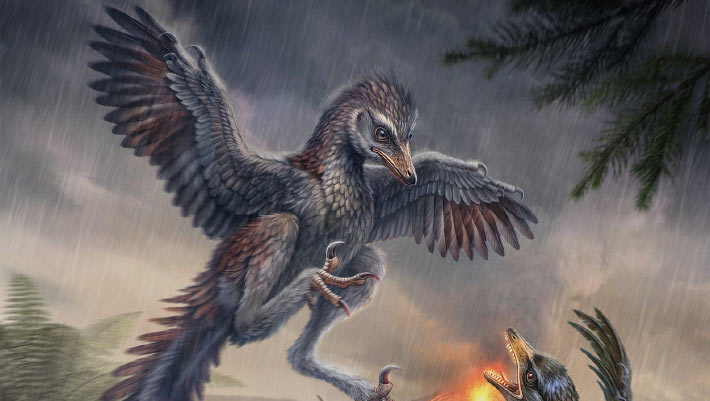
Jurassic Fossil Hints that Some Early Birds Were Flightless
Un fossile du Jurassique laisse entendre que certains des premiers oiseaux étaient incapables de voler
Chine Jurassique Jurassique supérieur fossile oiseau
Des paléontologues ont décrit un nouveau genre et une nouvelle espèce d’oiseau primitif, issus de la faune de Zhenghe (datant du Jurassique supérieur), dans le sud-est de la Chine. Ce fossile du Jurassique suggère que certains oiseaux primitifs étaient incapables de voler. Article initialement publié sur Sci.News : Actualités scientifiques.
15/10/2026 sci-news ⚙ Traduction automatique
1 2 3 4 5 6 7 8