Taxons
Theiophytalia
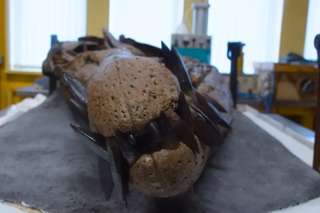
Theiophytalia kerri Brill & Carpenter, 2006 - ornithopod dinosaur skull from the Cretaceous of Colorado, USA. (YPM 1887, public display, Garden of the Gods visitor center, Colorado Springs, Colorado, USA)
This skull is the holotype and only known specimen of an entire genus of ornithopod dinosaurs, Theiophytalia. Ornithopods were herbivorous dinosaurs.
From exhibit signage:
A Brand New Dinosaur Species Theiophytalia kerri
What we know about the dinosaur fossil - so far:
It is the only Theiophytalia kerri fossil known to exist in the world.
It is a brand new genus and species of dinosaur.
Theiophytalia kerri means "belonging to the Garden of the Gods". "Theios" is a Greek word that means "belonging to the gods" and "phytalia" means "garden". "kerri" honors James Hutchinson Kerr (pronounced "Care"), who discovered the dinosaur fossil.
Theiophytalia was a medium-sized dinosaur, measuring about 30 feet from head to tail.
It was found in 1878 in the Garden of the Gods in the lower Lytle Member of the Purgatoire Rock Formation of the Dakota Group.
The dinosaur fossil skull is from the Aptian-Albian Age of the Cretaceous Ear, 125 - 100 million years old.
Look closely at the fossil skull. Where are the teeth located? You can see the teeth in the back of the jaw. There are no teeth in the front of the dinosaur's beak-like mouth. This is evidence that the Theiophytalia was a plant eater. It could nip and tear plants, then grind them between its tightly-packed back teeth, similar to plant-eaters of today.
Timeline:
Dinosaur Fossil Discovered, then Forgotten
1878 - James Kerr, geology professor at Colorado College, finds a fossil skull "in one of the ridges east of the red rocks of the Garden of the Gods."
1886 - O.C. Marsh, famous 1800s dinosaur collector from Yale University, obtains the fossil skull from James Kerr, identifies it as a Camptosaurus dinosaur, and sends the fossil to the Yale Peabody Museum in New Haven, Connecticut.
1886 - 1995 - While the dinosaur fossil skull safely rests in the Yale Museum for many decades, knowledge of its existence is forgotten in Colorado Springs.
Rediscovery - 117 years later
1994 - Colorado Springs City park staff research new exhibits for the Garden of the Gods Visitor and Nature Center, set to open in 1995. They meet with Doctor Kirk Johnson, curator of paleontology at the Denver Museum of Nature & Science.
1995 - Kirk Johnson refers the park staff to his museum colleague Doctor Ken Carpenter, expert dinosaur scientist. Doctor Carpenter remembers seeing in his files "something about a dinosaur fossil found in Garden of the Gods" and mails the following article to park staff.
Camptosaurus amplus No. 1887, Yale Museum, consisting of portions of the skull and lower jaw. It was collected from deposits in the Garden of the Gods, Colorado Springs, Colorado. With this specimen was found the following note in Professor O.C. Marsh's handwriting, "Part of this animal and various Sauropoda bones were taken out by Professor Kerr in 1878."
A Case of Mistaken Identity Reveals a Brand New Dinosaur!
1996 - Kirk Johnson (a Yale alumnus) secures permission to hand-carry the Camptosaurus fossil from the Yale Peabody Museum to Denver so that Ken Carpenter can make a cast (a precise replica) of the fossil.
Doctor Carpenter notices irregularities in the Camptosaurus fossil and decides to re-examine the fossil when his schedule permits.
1997 - The Camptosaurus fossil replica is given to the City of Colorado Springs and is exhibited at the Garden of the Gods Visitor and Nature Center.
2006 - Doctor Carpenter and his associate Kathleen Brill reassess the fossil skull and note that it differs from other Camptosaurus skulls in several significant ways, such as the narrower mouth and snout, and the position of the nasal openings, and the bony structures over the eyes.
Also, microscopic identification of the rock matrix clinging to the fossil, and research of archival maps, reveal that the fossil skull was actually found in the lower Dakota Rock Formation, not the Morrison Formation as originally reported in the 1800s. The skull is from a dinosaur that lived in the Cretaceous Ear and can't be a Jurassic Era Camptosaurus.
Doctor Carpenter's exacting research reveals that the dinosaur skull is a brand new genus and species of dinosaur! He names it Theiophytalia kerri.
2008 - The Theiophytalia kerri is proudly re-exhibited at the Garden of the Gods Visitor and Nature Center.
Classification: Animalia, Chordata, Vertebrata, Dinosauria, Ornithischia, Ornithopoda
Stratigraphy: lower Lytle Member, Purgatoire Formation, Dakota Group, Aptian to Albian Stages, upper Lower Cretaceous
Locality: Garden of the Gods, Colorado Springs, Colorado, USA
See info. at:
en.wikipedia.org/wiki/Theiophytalia
and
en.wikipedia.org/wiki/Ornithopoda


![Sarcosaurus diagram of known material: reconstruction based on basal Ceratosaurs (such as Berberosaurus and Saltriovenator). The Skull was made to look more generic and less like more derived Ceratosaurs such as Ceratosaurus. "Liassaurus", referred to "cf. Sarcosaurus woodi" and is smaller than the holotype: material in light grey is preserved, but to what extent is uncertain as it is not figured.
References:
Carrano and Sampson (2004). "A review of coelophysoids (Dinosauria: Theropoda) from the Early Jurassic of Europe, with comments on the late history of the Coelophysoidea." N. Jb. Geol. Palaont. Mh., 2004(9): 537-558. (for figures of the material)
theropoddatabase.com/Coelophysoidea.htm#Sarcosauruswoodi (for measurements of "Liassaurus")
Allain, Ronan & Tykoski, Ronald & Aquesbi, Najat & Jalil, Nour-Eddine & Monbaron, Michel & Russell, Dale & Taquet, Philippe. (2007). An abelisauroid (Dinosauria: Theropoda) from the Early Jurassic of the High Atlas Mountains, Morocco, and the radiation of Ceratosaurs. Journal of Vertebrate Paleontology. 27. 10.1671/0272-4634(2007)27[610:AADTFT]2.0.CO;2. (for measurements for Berberosaurus)](https://upload.wikimedia.org/wikipedia/commons/thumb/8/80/Sarcosaurus_known_material.png/330px-Sarcosaurus_known_material.png?utm_source=en.wikipedia.org&utm_campaign=api&utm_content=thumbnail)


![Photograph of Museo civico di scienze naturali di Bergamo (MCSNB) 2888, the holotype specimen of Eudimorphodon ranzii ZAMBELLI 1973, a basal pterosaur from the Norian (middle Upper Triassic) of the Italian Alps.[1]
↑ see fig. 8A in Silvio Renesto (2006): A reappraisal of the diversity and biogeographic significance of the Norian (Late Triassic) reptiles from the Calcare di Zorzino. In: Jerry D. Harris, Spencer G. Lucas, Justin A. Spielmann, Martin G. Lockley, Andrew R.C. Milner, James I. Kirkland (eds.): The Triassic-Jurassic Terrestrial Transition. New Mexico Museum of Natural History and Science Bulletin 37:445–456 (online)](https://upload.wikimedia.org/wikipedia/commons/thumb/9/9c/Eudimorphodon.jpg/330px-Eudimorphodon.jpg?utm_source=en.wikipedia.org&utm_campaign=api&utm_content=thumbnail)