Jurassique

Intervalle géologique

98 image(s) · 16 Actualités

Voir la fiche

Galerie d'images

Caudal vertebrae and chevrons of the British Jurassic pliosaurid plesiosaur Eardasaurus housed at the Oxford University Natural History Museum.

Caudal vertebrae and chevrons of the British Jurassic pliosaurid plesiosaur Eardasaurus housed at the Oxford University Natural History Museum.

musée Jurassique Peloneustes Plesiosauria +1
Paddle of the British Jurassic pliosaurid plesiosaur Eardasaurus housed at the Oxford University Natural History Museum.

Paddle of the British Jurassic pliosaurid plesiosaur Eardasaurus housed at the Oxford University Natural History Museum.

musée Jurassique Peloneustes Plesiosauria +1
Drawings of Dryolestida left upper−molar, modified from the original descriptions. A–C, Kimmeridgian; D–F, Tithonian–Berriasian; G–H, early Barremian; I, late Barremian. A. Left M4 or M5 of Comotherium richi Prothero, 1981, from the Upper Jurassic Morrison Formation, Como Bluff locality, Wyoming, USA. B. Right M5, reversed, of Dryolestes leiriensis Martin, 1999, from Guimarota, Portugal.C. Left M6 of Krebsotherium lusitanicum Martin, 1999, from Guimarota, Portugal. D. Right M4 or M 6 (reversed) of Portopinheirodon asymmetricus Martin, 1999, Porto Pinheiro, Lourinha, Portugal. E. Right M5 (reversed) of Laolestes andresi Martin, 1999, from Porto Pinheiro, Lourinha, Portugal. F. Right upper molar of Donodon perscriptoris Sigogneau−Russell, 1991, Anoual, Morocco.G. Left M4 orM5 of Crusafontia amoae sp. nov., holotype, Cuesta Corrales 2, El Castellar Formation, Galve, Teruel, Spain. H. Right M6 orM7 (reversed) of Crusafontia amoae sp. nov., first described as upper molar of Crusafontia cuencana by Krebs (1993), P−2 H4 Pelejón 2, Galve, Teruel, Spain. I. Left M2 or M3, of Crusafontia cuencana Henkel and Krebs, 1969, Uña, La Huérguina Formation, Cuenca, Spain, (from Krebs 1993). Scale bars 1 mm.

Drawings of Dryolestida left upper−molar, modified from the original descriptions. A–C, Kimmeridgian; D–F, Tithonian–Berriasian; G–H, early Barremian; I, late Barremian. A. Left M4 or M5 of Comotherium richi Prothero, 1981, from the Upper Jurassic Morrison Formation, Como Bluff locality, Wyoming, USA. B. Right M5, reversed, of Dryolestes leiriensis Martin, 1999, from Guimarota, Portugal.C. Left M6 of Krebsotherium lusitanicum Martin, 1999, from Guimarota, Portugal. D. Right M4 or M 6 (reversed) of Portopinheirodon asymmetricus Martin, 1999, Porto Pinheiro, Lourinha, Portugal. E. Right M5 (reversed) of Laolestes andresi Martin, 1999, from Porto Pinheiro, Lourinha, Portugal. F. Right upper molar of Donodon perscriptoris Sigogneau−Russell, 1991, Anoual, Morocco.G. Left M4 orM5 of Crusafontia amoae sp. nov., holotype, Cuesta Corrales 2, El Castellar Formation, Galve, Teruel, Spain. H. Right M6 orM7 (reversed) of Crusafontia amoae sp. nov., first described as upper molar of Crusafontia cuencana by Krebs (1993), P−2 H4 Pelejón 2, Galve, Teruel, Spain. I. Left M2 or M3, of Crusafontia cuencana Henkel and Krebs, 1969, Uña, La Huérguina Formation, Cuenca, Spain, (from Krebs 1993). Scale bars 1 mm.

description dessin Maroc Portugal +11
Attenborosaurus conybeari, a plesiosaur from the Early Jurassic of England, pencil drawing
Taxons Dactylosaurus

Attenborosaurus conybeari, a plesiosaur from the Early Jurassic of England, pencil drawing

dessin Jurassique inférieur Jurassique Attenborosaurus +5
Attenborosaurus conybeari, a plesiosaur from the Early Jurassic of England, pencil drawing
Taxons Eromangasaurus

Attenborosaurus conybeari, a plesiosaur from the Early Jurassic of England, pencil drawing

dessin Jurassique inférieur Jurassique Attenborosaurus +5
Attenborosaurus conybeari, a plesiosaur from the Early Jurassic of England, pencil drawing
Taxons Eurycleidus

Attenborosaurus conybeari, a plesiosaur from the Early Jurassic of England, pencil drawing

dessin Jurassique inférieur Jurassique Attenborosaurus +5
Pleuroceras solare, Amaltheidae; Pyritic specimen; Diameter 3.2 cm; Upper Pliensbachian, Lower Jurassic; Little Switzerland, Bavaria, Germany. own collection, therefore not geocoded.
Taxons Coralloidoolithus

Pleuroceras solare, Amaltheidae; Pyritic specimen; Diameter 3.2 cm; Upper Pliensbachian, Lower Jurassic; Little Switzerland, Bavaria, Germany. own collection, therefore not geocoded.

Allemagne Suisse Jurassique Pliensbachien +3
Pleuroceras solare, Amaltheidae; Pyritic specimen; Diameter 3.2 cm; Upper Pliensbachian, Lower Jurassic; Little Switzerland, Bavaria, Germany. own collection, therefore not geocoded.
Taxons Dispersituberoolithus

Pleuroceras solare, Amaltheidae; Pyritic specimen; Diameter 3.2 cm; Upper Pliensbachian, Lower Jurassic; Little Switzerland, Bavaria, Germany. own collection, therefore not geocoded.

Allemagne Suisse Jurassique Pliensbachien +3
Pantydraco caducus, a sauropodomorph from the Late Triassic or Early Jurassic of England, after Yates, 2003, pencil drawing, digital coloring
Taxons Pantydraco

Pantydraco caducus, a sauropodomorph from the Late Triassic or Early Jurassic of England, after Yates, 2003, pencil drawing, digital coloring

dessin Jurassique inférieur Jurassique Trias supérieur +3
Kimmerosaurus swims through a shallow jurassic reef in this reconstruction
Taxons Kimmerosaurus

Kimmerosaurus swims through a shallow jurassic reef in this reconstruction

Jurassique Kimmerosaurus
Known fossil pieces after Aviatyrannis jurassica (Dinosauria, Theropoda, Coelurosauria, Tyrannosauroidea).[1]
Sources

↑ Rauhut O.W.M. (2003), "A tyrannosaurid dinosaur from the Upper Jurassic of Portugal", Paleontology 46(5): p. 903-910.
Taxons Aviatyrannis

Known fossil pieces after Aviatyrannis jurassica (Dinosauria, Theropoda, Coelurosauria, Tyrannosauroidea).[1] Sources ↑ Rauhut O.W.M. (2003), "A tyrannosaurid dinosaur from the Upper Jurassic of Portugal", Paleontology 46(5): p. 903-910.

Portugal Jurassique fossile Aviatyrannis +5
Partial skull of Manidens condorensis from the Middle Jurassic Cañadón Asfalto Formation of Argentina. Skull reconstructions in lateral view. Dashed lines indicate estimated edges. Abbreviations: a angular antfo antorbital fossa asaf anterior surangular foramen be buccal emargination bo basioccipital bt basal tubera d dentary d1, 2, 11 dentary tooth 1, 2, 11 emfo external mandibular fossa f frontal gl glenoid gr groove j jugal jfl jugal flange jh jugal horn m maxilla m1, 11 maxillary tooth 1, 11 n nasal pd predentary pm premaxilla po postorbital pof postorbital fossa popr paroccipital process q quadrate qj quadratojugal ri ridge sa surangular sq squamosal.
Taxons Manidens

Partial skull of Manidens condorensis from the Middle Jurassic Cañadón Asfalto Formation of Argentina. Skull reconstructions in lateral view. Dashed lines indicate estimated edges. Abbreviations: a angular antfo antorbital fossa asaf anterior surangular foramen be buccal emargination bo basioccipital bt basal tubera d dentary d1, 2, 11 dentary tooth 1, 2, 11 emfo external mandibular fossa f frontal gl glenoid gr groove j jugal jfl jugal flange jh jugal horn m maxilla m1, 11 maxillary tooth 1, 11 n nasal pd predentary pm premaxilla po postorbital pof postorbital fossa popr paroccipital process q quadrate qj quadratojugal ri ridge sa surangular sq squamosal.

dent Argentine Jurassique Jurassique moyen +4
Montanoceratops cerorhynchus (Brown & Schlaikjer, 1942) - fossil ceratopsian dinosaur skeleton from the Cretaceous of Montana, USA. (MOR 542, Museum of the Rockies, Bozeman, Montana, USA)
The species name is sometimes incorrectly spelled "cerorhynchos".  The original publication spells it "cerorhynchus".  The genus name is sometimes incorrectly spelled "Montanaceratops".
Ceratopsians are the "horned dinosaurs".  They were large, quadrupedal, herbivorous dinosaurs having a beaked skull and a frill - an extension of bone behind the skull that partially covered the neck.  Ceratopsian dinosaurs are known from the Jurassic and Cretaceous.  The last members of the group died out at the Cretaceous-Tertiary boundary, 65 million years ago.
This is a partial skeleton of a juvenile Montanoceratops, a ceratopsian from the near-latest Cretaceous of western North America.  This type of ceratopsian lacked facial horns.


From exhibit signage:
Sixty-eight million years ago, when the horned dinosaurs Triceratops and Torosaurus inhabited the coastal plain near the inland ocean, primitive "horned" dinosaurs named Montanoceratops lived in uplands near the young Rocky Mountains.  These little protoceratopsians fed on plants with slicing teeth and narrow beaks similar to their giant three-horned relatives.


Classification: Animalia, Chordata, Vertebrata, Reptilia, Archosauria, Dinosauria, Ornithischia, Marginocephalia, Ceratopsia, Leptoceratopsidae
Stratigraphy: St. Mary River Formation, Maastrichtian Stage, Upper Cretaceous
Locality: Little Rocky Coulee, north of the town of Cut Bank, eastern Glacier County, northwestern Montana, USA


Info. at:

en.wikipedia.org/wiki/Montanoceratops
Taxons Montanoceratops

Montanoceratops cerorhynchus (Brown & Schlaikjer, 1942) - fossil ceratopsian dinosaur skeleton from the Cretaceous of Montana, USA. (MOR 542, Museum of the Rockies, Bozeman, Montana, USA) The species name is sometimes incorrectly spelled "cerorhynchos". The original publication spells it "cerorhynchus". The genus name is sometimes incorrectly spelled "Montanaceratops". Ceratopsians are the "horned dinosaurs". They were large, quadrupedal, herbivorous dinosaurs having a beaked skull and a frill - an extension of bone behind the skull that partially covered the neck. Ceratopsian dinosaurs are known from the Jurassic and Cretaceous. The last members of the group died out at the Cretaceous-Tertiary boundary, 65 million years ago. This is a partial skeleton of a juvenile Montanoceratops, a ceratopsian from the near-latest Cretaceous of western North America. This type of ceratopsian lacked facial horns. From exhibit signage: Sixty-eight million years ago, when the horned dinosaurs Triceratops and Torosaurus inhabited the coastal plain near the inland ocean, primitive "horned" dinosaurs named Montanoceratops lived in uplands near the young Rocky Mountains. These little protoceratopsians fed on plants with slicing teeth and narrow beaks similar to their giant three-horned relatives. Classification: Animalia, Chordata, Vertebrata, Reptilia, Archosauria, Dinosauria, Ornithischia, Marginocephalia, Ceratopsia, Leptoceratopsidae Stratigraphy: St. Mary River Formation, Maastrichtian Stage, Upper Cretaceous Locality: Little Rocky Coulee, north of the town of Cut Bank, eastern Glacier County, northwestern Montana, USA Info. at: en.wikipedia.org/wiki/Montanoceratops

os musée États-Unis Crétacé +10
Sarcosaurus diagram of known material: reconstruction based on basal Ceratosaurs (such as Berberosaurus and Saltriovenator). The Skull was made to look more generic and less like more derived Ceratosaurs such as Ceratosaurus. "Liassaurus", referred to "cf. Sarcosaurus woodi" and is smaller than the holotype: material in light grey is preserved, but to what extent is uncertain as it is not figured.
References:
Carrano and Sampson (2004). "A review of coelophysoids (Dinosauria: Theropoda) from the Early Jurassic of Europe, with comments on the late history of the Coelophysoidea." N. Jb. Geol. Palaont. Mh., 2004(9): 537-558. (for figures of the material)
theropoddatabase.com/Coelophysoidea.htm#Sarcosauruswoodi (for measurements of "Liassaurus")

Allain, Ronan & Tykoski, Ronald & Aquesbi, Najat & Jalil, Nour-Eddine & Monbaron, Michel & Russell, Dale & Taquet, Philippe. (2007). An abelisauroid (Dinosauria: Theropoda) from the Early Jurassic of the High Atlas Mountains, Morocco, and the radiation of Ceratosaurs. Journal of Vertebrate Paleontology. 27. 10.1671/0272-4634(2007)27[610:AADTFT]2.0.CO;2. (for measurements for Berberosaurus)
Taxons Sarcosaurus

Sarcosaurus diagram of known material: reconstruction based on basal Ceratosaurs (such as Berberosaurus and Saltriovenator). The Skull was made to look more generic and less like more derived Ceratosaurs such as Ceratosaurus. "Liassaurus", referred to "cf. Sarcosaurus woodi" and is smaller than the holotype: material in light grey is preserved, but to what extent is uncertain as it is not figured. References: Carrano and Sampson (2004). "A review of coelophysoids (Dinosauria: Theropoda) from the Early Jurassic of Europe, with comments on the late history of the Coelophysoidea." N. Jb. Geol. Palaont. Mh., 2004(9): 537-558. (for figures of the material) theropoddatabase.com/Coelophysoidea.htm#Sarcosauruswoodi (for measurements of "Liassaurus") Allain, Ronan & Tykoski, Ronald & Aquesbi, Najat & Jalil, Nour-Eddine & Monbaron, Michel & Russell, Dale & Taquet, Philippe. (2007). An abelisauroid (Dinosauria: Theropoda) from the Early Jurassic of the High Atlas Mountains, Morocco, and the radiation of Ceratosaurs. Journal of Vertebrate Paleontology. 27. 10.1671/0272-4634(2007)27[610:AADTFT]2.0.CO;2. (for measurements for Berberosaurus)

Maroc Jurassique inférieur Jurassique holotype +8
Lamplughsaura dharmarasensis, a basal sauropodomorph from the Lower Jurassic of India, after description by T.S. Kutty et al., 2007, pencil drawing, digital coloring
Taxons Lamplughsaura

Lamplughsaura dharmarasensis, a basal sauropodomorph from the Lower Jurassic of India, after description by T.S. Kutty et al., 2007, pencil drawing, digital coloring

description dessin Inde Jurassique +2
Germanodactylus cristatus specimen SMNK PAL 6592. Germanodactylidae; Upper Jurassic, Eichstätt, Germany; Staatliches Museum für Naturkunde Karlsruhe, Germany.
Taxons Germanodactylus

Germanodactylus cristatus specimen SMNK PAL 6592. Germanodactylidae; Upper Jurassic, Eichstätt, Germany; Staatliches Museum für Naturkunde Karlsruhe, Germany.

musée Allemagne Jurassique spécimen +2
1 2 3 4 5 6 7

Actualités

Cet étrange dinosaure géant pourrait changer ce que nous savons sur les titans du Jurassique
Argentine Jurassique fossile Bicharracosaurus Brachiosauria Brachiosauridae Dinosauria Diplodocia évolution
Un étrange nouveau dinosaure géant découvert en Argentine donne aux paléontologues un nouveau regard sur l'évolution des titans du Jurassique dans l'hémisphère sud. Bicharracosaurus dionidei s'étendait sur environ 20 mètres de long et présentait un étrange mélange de caractéristiques observées chez les parents du Diplodocus et du Brachiosaurus. Les scientifiques pensent qu’il pourrait s’agir du premier brachiosaure du Jurassique connu d’Amérique du Sud, contribuant ainsi à combler une lacune majeure dans les archives fossiles de dinosaures.
12/05/2026 sciencedaily ⚙ Traduction automatique
Early Sauropodomorph Dinosaur Unearthed in China
Un dinosaure sauropodomorphe découvert en Chine
Chine Jurassique inférieur Jurassique Dinosauria Massopoda nouvelle espèce partiel squelette
Un nouveau genre et une nouvelle espèce de sauropodomorphe massopodan qui vivaient au début du Jurassique ont été identifiés à partir d'un squelette partiel découvert dans le sud-ouest de la Chine. L'article Les premiers dinosaures sauropodomorphes découverts en Chine est apparu en premier sur Sci.News : Breaking Science News.
04/05/2026 sci-news ⚙ Traduction automatique
Le modèle d'ammonite s'avère inestimable lors d'une promenade guidée aux fossiles
Jurassique fossile
Lyme Regis est célèbre pour ses fossiles.  En effet, des milliers de touristes affluent dans cette partie de la « Côte Jurassique » à la recherche de fossiles. Il est judicieux de réserver une promenade aux fossiles avec un guide expérimenté. Notre ami Brandon Lennon a emmené les gars de la chaîne YouTube "All the Gear" pour un fossile guidé
04/05/2026 everythingdinosaur ⚙ Traduction automatique
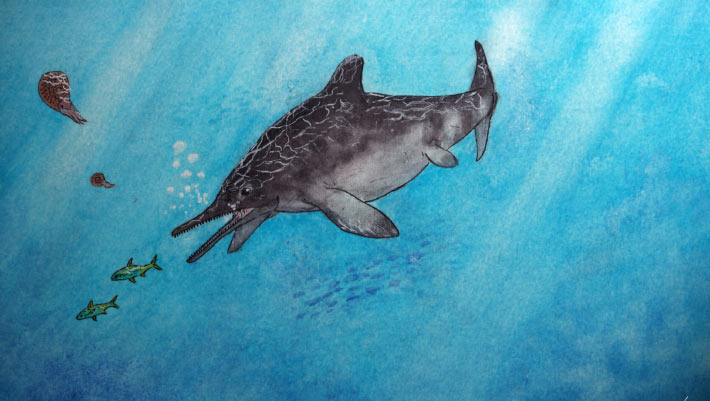
Un fossile de « Sword Dragon » vieux de 190 millions d’années réécrit l’histoire des ichtyosaures
Royaume-Uni Jurassique fossile Ichthyosauria évolution squelette
Un ichtyosaure nouvellement identifié de la côte jurassique du Royaume-Uni est en train de réécrire une partie du manuel préhistorique. Surnommé le « dragon-épée du Dorset », ce reptile marin de trois mètres de long a vécu pendant une période d’évolution mal comprise, au cours de laquelle les principaux groupes d’ichtyosaures disparaissaient et de nouveaux apparaissaient. Son squelette magnifiquement préservé – doté d’un museau en forme de lame et d’un éventuel dernier repas – permet de déterminer le moment où cette transition dramatique s’est produite.
24/02/2026 sciencedaily ⚙ Traduction automatique
Torvosaurus: Beast of the Week
Torvosaurus : Bête de la semaine
os prédateur Allemagne Portugal États-Unis Jurassique Jurassique supérieur Dinosauria Torvosaurus
Aujourd'hui, nous allons nous intéresser à un énorme dinosaure prédateur du Jurassique, Torvosaurus tanneri !  Torvosaurus vivait il y a environ 150 millions d’années à la fin du Jurassique. Ses ossements ont été découverts dans le Colorado, aux États-Unis, au Portugal et peut-être en Allemagne (l'Europe et l'Amérique du Nord n'étaient pas aussi éloignées à l'époque, rappelez-vous, donc beaucoup de dinosaures présents sur chacun d'eux partageaient des ancêtres récents).  Du nez à la queue, il mesurait jusqu'à 36 pieds (environ 11 m) et aurait été parmi les plus grands,
08/02/2026 prehistoricbeastoftheweek ⚙ Traduction automatique
1 2 3 4