Jurassique

Intervalle géologique

107 image(s) · 21 Actualités

Voir la fiche

Galerie d'images

Brontosaurus excelsus in the Yale Peabody Museum of Natural History.
Brontosaurus excelsus
Inv no. YPM 1980 (holotype specimen of the species)
Discoverer William H. Reed 1879
Locality Como Bluff, Wyoming
Age Morrison Formatian, Jurassic period, 150 million years ago
Taxons Phytodinosauria

Brontosaurus excelsus in the Yale Peabody Museum of Natural History. Brontosaurus excelsus Inv no. YPM 1980 (holotype specimen of the species) Discoverer William H. Reed 1879 Locality Como Bluff, Wyoming Age Morrison Formatian, Jurassic period, 150 million years ago

musée Morrison Jurassique holotype +3
Identifier: waterreptilesofp1914will
Title: Water reptiles of the past and present
Year: 1914 (1910s)
Authors:  Williston, Samuel Wendell, 1851-1918
Subjects:  Aquatic reptiles
Publisher:  Chicago, Ill., The University of Chicago Press
Contributing Library:  Boston Public Library
Digitizing Sponsor:  Boston Public Library

View Book Page: Book Viewer
About This Book: Catalog Entry
View All Images: All Images From Book
Click here to view book online to see this illustration in context in a browseable online version of this book.

Text Appearing Before Image:
served and very complete skeletons ofdifferent species of ichthyosaurs from the Jurassic deposits ofWiirtemberg, in which remains of these animals occur in great 112 WATER REPTILES OF THE PAST AND PRESENT profusion. His researches, and those of several authors since then,supplementing and confirming or disproving those of the manyobservers made during the preceding seventy years, have finallydetermined almost perfectly the complete structure of the moretypical ichthyosaurs, enabling us to infer not a little as to theirhabits and distribution in the old Jurassic oceans. Within thepast few years the discoveries of Professor J. C. Merriam of Cali-fornia have likewise added greatly to our knowledge of the earlierichthyosaurs. It may now truthfully be said that of no group ofextinct reptiles do we have a more complete and satisfactory knowl-edge than of the ichthyosaurs. Nevertheless we have yet very much more to learn about theorder Ichthyosauria as a whole—whence they came and how they
Text Appearing After Image:
Fig. 52.—Ichthyosaurus quadricissus.museum, from Dr. Dreverman. Photograph of specimen in Senckenberg originated; what their nearest kin were among other reptiles; andespecially, more about the connecting links between them andterrestrial reptiles. They have, as an order, so isolated a position,are so widely separated from all other reptiles in structure, that theyhave long been a puzzle to paleontologists. Like the whales andother cetaceans among mammals, we know the ichthyosaurs wellin the plenitude of their power and the fulness of their development,but have yet only an imperfect knowledge of their earlier history,and none whatever of their earliest. However, as will be seenfarther on, the recent discoveries by Merriam have shed much lighton some of the stages of their evolution. So nearly perfectly wereall the later ichthyosaurs adapted to their life in the water that itwas believed by nearly all paleontologists until about a score of years ICHTHYOSAURIA 3 ago that they had desc

Note About Images

Please note that these images are extracted from scanned page images that may have been digitally enhanced for readability - coloration and appearance of these illustrations may not perfectly resemble the original work.
Taxons Stenopterygiidae

Identifier: waterreptilesofp1914will Title: Water reptiles of the past and present Year: 1914 (1910s) Authors: Williston, Samuel Wendell, 1851-1918 Subjects: Aquatic reptiles Publisher: Chicago, Ill., The University of Chicago Press Contributing Library: Boston Public Library Digitizing Sponsor: Boston Public Library View Book Page: Book Viewer About This Book: Catalog Entry View All Images: All Images From Book Click here to view book online to see this illustration in context in a browseable online version of this book. Text Appearing Before Image: served and very complete skeletons ofdifferent species of ichthyosaurs from the Jurassic deposits ofWiirtemberg, in which remains of these animals occur in great 112 WATER REPTILES OF THE PAST AND PRESENT profusion. His researches, and those of several authors since then,supplementing and confirming or disproving those of the manyobservers made during the preceding seventy years, have finallydetermined almost perfectly the complete structure of the moretypical ichthyosaurs, enabling us to infer not a little as to theirhabits and distribution in the old Jurassic oceans. Within thepast few years the discoveries of Professor J. C. Merriam of Cali-fornia have likewise added greatly to our knowledge of the earlierichthyosaurs. It may now truthfully be said that of no group ofextinct reptiles do we have a more complete and satisfactory knowl-edge than of the ichthyosaurs. Nevertheless we have yet very much more to learn about theorder Ichthyosauria as a whole—whence they came and how they Text Appearing After Image: Fig. 52.—Ichthyosaurus quadricissus.museum, from Dr. Dreverman. Photograph of specimen in Senckenberg originated; what their nearest kin were among other reptiles; andespecially, more about the connecting links between them andterrestrial reptiles. They have, as an order, so isolated a position,are so widely separated from all other reptiles in structure, that theyhave long been a puzzle to paleontologists. Like the whales andother cetaceans among mammals, we know the ichthyosaurs wellin the plenitude of their power and the fulness of their development,but have yet only an imperfect knowledge of their earlier history,and none whatever of their earliest. However, as will be seenfarther on, the recent discoveries by Merriam have shed much lighton some of the stages of their evolution. So nearly perfectly wereall the later ichthyosaurs adapted to their life in the water that itwas believed by nearly all paleontologists until about a score of years ICHTHYOSAURIA 3 ago that they had desc Note About Images Please note that these images are extracted from scanned page images that may have been digitally enhanced for readability - coloration and appearance of these illustrations may not perfectly resemble the original work.

Jurassique Ichthyosauria Stenopterygiidae squelette
Adeopapposaurus mognai, Early Jurassic of Argentina. Digital.
Taxons Massospondylidae

Adeopapposaurus mognai, Early Jurassic of Argentina. Digital.

Argentine Jurassique inférieur Jurassique Adeopapposaurus +2
Galeamopus hayi (formerly Diplodocus) type specimen (HMNS 175, formerly CM 662)
Jurassic Period
140,000,000 years old
The animal was 78ft long, 12 ft high at the hips, and probably weighed 10-15 tons.

Wikipedia Loves Art at the Houston Museum of Natural Science
This photo of item # [1] at the Houston Museum of Natural Science was contributed under the team name "The_Wookies" as part of the Wikipedia Loves Art project in February 2009. Houston Museum of Natural Science

The original photograph on Flickr was taken by andytang20—please add a comment to the original Flickr page whenever a use has been made on Wikipedia or another project.
Project galleries on Flickr: this institution,  this team
Taxons Diplodocinae

Galeamopus hayi (formerly Diplodocus) type specimen (HMNS 175, formerly CM 662) Jurassic Period 140,000,000 years old The animal was 78ft long, 12 ft high at the hips, and probably weighed 10-15 tons. Wikipedia Loves Art at the Houston Museum of Natural Science This photo of item # [1] at the Houston Museum of Natural Science was contributed under the team name "The_Wookies" as part of the Wikipedia Loves Art project in February 2009. Houston Museum of Natural Science The original photograph on Flickr was taken by andytang20—please add a comment to the original Flickr page whenever a use has been made on Wikipedia or another project. Project galleries on Flickr: this institution, this team

musée Jurassique spécimen Diplodocia +2
Archaeonectrus rostratus lower jurassic lyme regis
Taxons Archaeonectrus

Archaeonectrus rostratus lower jurassic lyme regis

Jurassique Archaeonectrus
Illustration of the holotype metacarpal of Dermodactylus montanus, a pterosaur from the Jurassic of Wyoming.  Reference 
Colbert EH (1969) A Jurassic Pterosaur from Cuba. American Museum Novitates 2370, 1-26
Taxons Dermodactylus

Illustration of the holotype metacarpal of Dermodactylus montanus, a pterosaur from the Jurassic of Wyoming. Reference Colbert EH (1969) A Jurassic Pterosaur from Cuba. American Museum Novitates 2370, 1-26

musée Cuba Jurassique holotype +2
Bone mapping of the skeleton of Plesiopharos moelensis gen. et sp. nov. (ML2302) from the Sinemurian (Lower Jurassic) of São Pedro de Moel (Leiria, Portugal). A. Bones distribution map of the three original extracted blocks (1, 2 and 3) containing ML2302. Arrows with question marks represent that the joining relationship between the blocks is unknown. B. Photographs of the five sub-blocks (1A, 1B, 2C, 2D, and 3E) after preparation works.
Taxons Plesiopharos

Bone mapping of the skeleton of Plesiopharos moelensis gen. et sp. nov. (ML2302) from the Sinemurian (Lower Jurassic) of São Pedro de Moel (Leiria, Portugal). A. Bones distribution map of the three original extracted blocks (1, 2 and 3) containing ML2302. Arrows with question marks represent that the joining relationship between the blocks is unknown. B. Photographs of the five sub-blocks (1A, 1B, 2C, 2D, and 3E) after preparation works.

os Portugal Jurassique Sinémurien +2
Macroplata tenuiceps, a pliosaur from the Early Jurassic of Europe, pencil drawing
Taxons Macroplata

Macroplata tenuiceps, a pliosaur from the Early Jurassic of Europe, pencil drawing

dessin Jurassique inférieur Jurassique Macroplata +1
Life restoration of Harpactognathus gentryii, a pterosaur from Jurassic USA
Taxons Harpactognathus

Life restoration of Harpactognathus gentryii, a pterosaur from Jurassic USA

États-Unis Jurassique Harpactognathus Pterosauria
Reconstructed skull of Duriavenator hesperis showing known material (white) of the holotype and only known specimen. Unknown bones based on related Eustreptospondylus oxoniensis. Scale bar is 10cm, image is 10px/cm. Cranial anatomy based on Benson (2008) "A redescription of "Megalosaurus" hesperis (Dinosauria, Theropoda) from the Inferior Oolite (Bajocian, Middle Jurassic) of Dorset, United Kingdom"
Taxons Duriavenator

Reconstructed skull of Duriavenator hesperis showing known material (white) of the holotype and only known specimen. Unknown bones based on related Eustreptospondylus oxoniensis. Scale bar is 10cm, image is 10px/cm. Cranial anatomy based on Benson (2008) "A redescription of "Megalosaurus" hesperis (Dinosauria, Theropoda) from the Inferior Oolite (Bajocian, Middle Jurassic) of Dorset, United Kingdom"

os écaille Royaume-Uni Bajocien +11
Reconstructed skull of Wiehenvenator albati based on holotype specimen (white). Scale bar is 10cm, image if 10px/cm. Unknown material based on related Torvosaurus tanneri. Cranial anatomy based on Rauhut et al (2016) "A new megalosaurid theropod dinosaur from the late Middle Jurassic (Callovian) of north-western Germany: implications for theropod evolution and faunal turnover in the Jurassic"
Taxons Wiehenvenator

Reconstructed skull of Wiehenvenator albati based on holotype specimen (white). Scale bar is 10cm, image if 10px/cm. Unknown material based on related Torvosaurus tanneri. Cranial anatomy based on Rauhut et al (2016) "A new megalosaurid theropod dinosaur from the late Middle Jurassic (Callovian) of north-western Germany: implications for theropod evolution and faunal turnover in the Jurassic"

écaille Allemagne Callovien Jurassique +10
Reconstructed skull of the holotype and only specimen of Leshansaurus qianweiensis based on the possibly related megalosaurid Dubreuillosaurus valesdunensis. Scale bar is 10cm, image is 10px/cm. Cranial anatomy from figures in Fei et al. (2009) "A new carnosaur from the Late Jurassic of Qianwei, Sichuan, China". White bones are figured, light grey bones are unfigured and minimally described.
Taxons Leshansaurus

Reconstructed skull of the holotype and only specimen of Leshansaurus qianweiensis based on the possibly related megalosaurid Dubreuillosaurus valesdunensis. Scale bar is 10cm, image is 10px/cm. Cranial anatomy from figures in Fei et al. (2009) "A new carnosaur from the Late Jurassic of Qianwei, Sichuan, China". White bones are figured, light grey bones are unfigured and minimally described.

os écaille Chine Jurassique +9
Fossil of Streptospondylus, a dinosaur from the Middle Jurassic period of France. Took the photo at the Gallery of Paleontology and Comparative Anatomy in the French National Museum of Natural History, Paris.
Taxons Streptospondylus

Fossil of Streptospondylus, a dinosaur from the Middle Jurassic period of France. Took the photo at the Gallery of Paleontology and Comparative Anatomy in the French National Museum of Natural History, Paris.

musée France Jurassique Jurassique moyen +4
A reconstruction of Aorun, a small coelurosaurian theropod from the Middle Jurassic China.
Taxons Aorun

A reconstruction of Aorun, a small coelurosaurian theropod from the Middle Jurassic China.

Chine Jurassique Jurassique moyen Aorun +1
Ceratopsipes goldenensis Lockley & Hunt, 1995 - ceratopsian dinosaur trackway in the Cretaceous of Colorado, USA.
Ceratopsians are the "horned dinosaurs".  They were large, quadrupedal, herbivorous dinosaurs having a beaked skull and a frill - an extension of bone behind the skull that partially covered the neck.  Ceratopsian dinosaurs are known from the Jurassic and Cretaceous.  The last members of the group died out at the Cretaceous-Tertiary boundary, 65 million years ago.
Seen here is a ceratopsian dinosaur trackway.  Ceratopsian footprints are very rare.  The best examples are in Colorado's Laramie Formation, a nonmarine, coastal plain to deltaic succession of mostly mixed siliciclastic sedimentary rocks - sandstones, siltstones, claystones, and coals.  The footprints here consist of convex bulges on the basal surfaces of structurally-tilted sandstone beds.
The ichnospecies Ceratopsipes goldenensis was named based on footprints at this locality.  The trackmaker was very likely Triceratops, the # 1 most famous ceratopsian dinosaur.


From on-site signage:
Triceratops Tracks
Several tracks of Triceratops, or a closely related horned dinosaur were first discovered in this area and named Ceratopsipes goldenensis (meaning tracks of a horned dinosaur from Golden).  By happy coincidence, the first Triceratops known to science also comes from the greater Denver area near 13th Avenue and Federal Blvd.  Growing to a length of almost 25 feet, Triceratops and other members of the horned dinosaur family were herbivorous animals that roamed in herds.  Their trademark horns and frills that covered their necks probably served for defense.  A replica Triceratops skull is on display in the clubhouse at the Fossil Trace Golf Club.
These tracks (identified by small signs) help us understand that Triceratops walked with a narrow gait and erect front limbs  than with a wide, sprawling gait as previously depicted.  In 1887, the first Triceratops bones known to science were also discovered locally at a site near 13th Avenue and Federal Boulevard in Denver.
Nearby one may see many other traces of life such as burrows, probably made by invertebrates and impressions of plant debris.  Note that you are looking at all tracks and traces from the underside - in negative aspect - what one might call a worm’s eye view.  All of these trace fossils indicate that the Golden area once had a warm, temperate to subtropical climate.


Classification: Animalia, Chordata, Vertebrata, Reptilia, Archosauria, Dinosauria, Ornithischia, Marginocephalia, Ceratopsia, Ceratopsidae
Stratigraphy: Laramie Formation, Maastrichtian Stage, upper Upper Cretaceous
Locality: outcrop along Triceratops Trail, Parfet Prehistoric Preserve, southern side of the town of Golden, Colorado, USA (~vicinity of 39° 44' 35.24" North latitude, 105° 13’ 09.69" West longitude)


Some info. from:

Lockley & Hunt (1995) - Ceratopsid tracks and associated ichnofauna from the Laramie Formation (Upper Cretaceous: Maastrichtian) of Colorado.  Journal of Vertebrate Paleontology 15: 592-614.
Taxons Ceratopsipes

Ceratopsipes goldenensis Lockley & Hunt, 1995 - ceratopsian dinosaur trackway in the Cretaceous of Colorado, USA. Ceratopsians are the "horned dinosaurs". They were large, quadrupedal, herbivorous dinosaurs having a beaked skull and a frill - an extension of bone behind the skull that partially covered the neck. Ceratopsian dinosaurs are known from the Jurassic and Cretaceous. The last members of the group died out at the Cretaceous-Tertiary boundary, 65 million years ago. Seen here is a ceratopsian dinosaur trackway. Ceratopsian footprints are very rare. The best examples are in Colorado's Laramie Formation, a nonmarine, coastal plain to deltaic succession of mostly mixed siliciclastic sedimentary rocks - sandstones, siltstones, claystones, and coals. The footprints here consist of convex bulges on the basal surfaces of structurally-tilted sandstone beds. The ichnospecies Ceratopsipes goldenensis was named based on footprints at this locality. The trackmaker was very likely Triceratops, the # 1 most famous ceratopsian dinosaur. From on-site signage: Triceratops Tracks Several tracks of Triceratops, or a closely related horned dinosaur were first discovered in this area and named Ceratopsipes goldenensis (meaning tracks of a horned dinosaur from Golden). By happy coincidence, the first Triceratops known to science also comes from the greater Denver area near 13th Avenue and Federal Blvd. Growing to a length of almost 25 feet, Triceratops and other members of the horned dinosaur family were herbivorous animals that roamed in herds. Their trademark horns and frills that covered their necks probably served for defense. A replica Triceratops skull is on display in the clubhouse at the Fossil Trace Golf Club. These tracks (identified by small signs) help us understand that Triceratops walked with a narrow gait and erect front limbs than with a wide, sprawling gait as previously depicted. In 1887, the first Triceratops bones known to science were also discovered locally at a site near 13th Avenue and Federal Boulevard in Denver. Nearby one may see many other traces of life such as burrows, probably made by invertebrates and impressions of plant debris. Note that you are looking at all tracks and traces from the underside - in negative aspect - what one might call a worm’s eye view. All of these trace fossils indicate that the Golden area once had a warm, temperate to subtropical climate. Classification: Animalia, Chordata, Vertebrata, Reptilia, Archosauria, Dinosauria, Ornithischia, Marginocephalia, Ceratopsia, Ceratopsidae Stratigraphy: Laramie Formation, Maastrichtian Stage, upper Upper Cretaceous Locality: outcrop along Triceratops Trail, Parfet Prehistoric Preserve, southern side of the town of Golden, Colorado, USA (~vicinity of 39° 44' 35.24" North latitude, 105° 13’ 09.69" West longitude) Some info. from: Lockley & Hunt (1995) - Ceratopsid tracks and associated ichnofauna from the Laramie Formation (Upper Cretaceous: Maastrichtian) of Colorado. Journal of Vertebrate Paleontology 15: 592-614.

os États-Unis Crétacé Jurassique +6
reconstruction of the Early Jurassic sauropod Perijasaurus lapaz.
Taxons Perijasaurus

reconstruction of the Early Jurassic sauropod Perijasaurus lapaz.

Jurassique inférieur Jurassique Perijasaurus
1 2 3 4 5 6 7

Actualités

Yi: Beast of the Week
Yi : la bête de la semaine
Chine Jurassique Jurassique supérieur Dinosauria Yi évolution
 Cette semaine, nous allons découvrir un dinosaure si inhabituel qu'il a complètement changé ce que nous pensions savoir sur l'évolution des dinosaures.  Découvrez Yi qi ! (prononcé « EE-chee ») Yi était un petit dinosaure théropode qui vivait dans ce qui est aujourd'hui le Hebei, dans le nord-est de la Chine, à la fin du Jurassique, il y a environ 159 millions d'années.  Du museau à la queue, il ne mesurait qu'environ 30 cm de long et son envergure mesurait environ 60 cm de large.  Le genre est venu, "Yi" se traduit du mandarin par "aile" et
21/06/2026 prehistoricbeastoftheweek ⚙ Traduction automatique
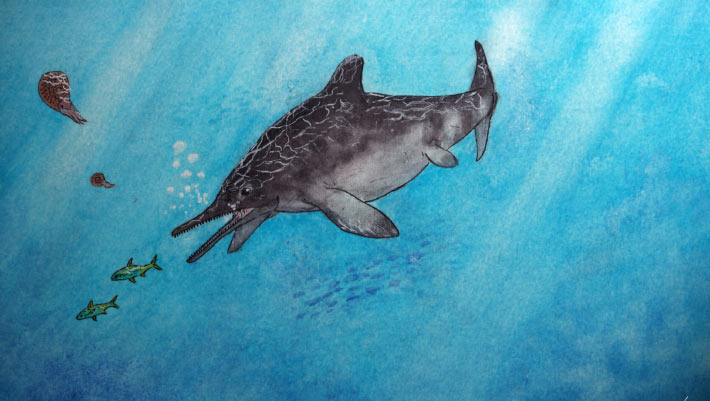
On le croyait roi des océans au Jurassique : une vertèbre percée raconte un combat d’une violence extrême
os dent vertèbre chasse musée Jurassique fossile Ichthyosauria Ichthyosaurus Pliosaurus comportement
Oublié pendant plus d’un siècle dans les tiroirs d’un musée, un fossile refait aujourd’hui surface et raconte une scène de violence extrême dans les océans du Jurassique. Une vertèbre d’ichtyosaure, marquée par l’impact d’une dent brisée, révèle peut-être l’attaque d’un des plus redoutables...
17/06/2026 futura-terre
Un cétiosaure aurait-il pu quitter la plus longue piste de sauropode ?
Royaume-Uni Bathonien Jurassique Jurassique moyen empreintes Cetiosauria Dinosauria
Récemment, nous avons publié un article mettant en avant les recherches en cours sur la remarquable « autoroute des dinosaures » de l'Oxfordshire.  Une carrière de calcaire conserve les restes de nombreuses traces de dinosaures.  Les traces sont conservées dans des strates déposées au Jurassique moyen.  Les paléontologues estiment que les traces ont environ 166 millions d'années (stade faunique bathonien).  Dans une récente radio
14/06/2026 everythingdinosaur ⚙ Traduction automatique
La piste des dinosaures de l'Oxfordshire pourrait être la plus longue piste de sauropodes connue
Royaume-Uni Jurassique empreintes Cetiosauria Dinosauria découverte
Les scientifiques qui étudient la célèbre « autoroute des dinosaures » de l'Oxfordshire ont annoncé que l'une des voies géantes pourrait représenter la plus longue voie de sauropode connue découverte au monde. La séquence remarquable d'empreintes de pas, découverte à la carrière de Dewars Farm, pourrait avoir été faite par un seul Cétiosaure alors qu'il errait dans une vasière jurassique autour de 166 millions d'années.
11/06/2026 everythingdinosaur ⚙ Traduction automatique
New Jurassic Pterosaur Unearthed in Germany
Un nouveau ptérosaure du Jurassique découvert en Allemagne
Allemagne Jurassique fossile Monofenestrata Pterosauria nouvelle espèce squelette
Les paléontologues ont décrit un nouveau genre et une nouvelle espèce de ptérosaure monofenestratan précoce sur la base d'un squelette fossile presque complet et bien conservé découvert en Bavière, en Allemagne. L'article Un nouveau ptérosaure jurassique découvert en Allemagne est apparu en premier sur Sci.News : Breaking Science News.
19/05/2026 sci-news ⚙ Traduction automatique
1 2 3 4 5