Jurassique

Intervalle géologique

107 image(s) · 21 Actualités

Voir la fiche

Galerie d'images

A lampshell of the genus Acanthothiris, Class Rhynchonellata, Order Rhynchonellida, Family Acanthothirididae, 20mm along the axis, view of the hinge, from Woodeaton, Oxfordshire, UK, middle Middle Jurassic (Bathonian)

A lampshell of the genus Acanthothiris, Class Rhynchonellata, Order Rhynchonellida, Family Acanthothirididae, 20mm along the axis, view of the hinge, from Woodeaton, Oxfordshire, UK, middle Middle Jurassic (Bathonian)

Royaume-Uni Bathonien Jurassique Jurassique moyen
A lampshell of the genus Acanthothiris, Class Rhynchonellata, Order Rhynchonellida, Family Acanthothirididae, 20mm along the axis, view of the brachial valve, from Woodeaton, Oxfordshire, UK, middle Middle Jurassic (Bathonian)
Intervalles Bathonian

A lampshell of the genus Acanthothiris, Class Rhynchonellata, Order Rhynchonellida, Family Acanthothirididae, 20mm along the axis, view of the brachial valve, from Woodeaton, Oxfordshire, UK, middle Middle Jurassic (Bathonian)

Royaume-Uni Bathonien Jurassique Jurassique moyen
An atypical (without intertidal and supratidal environment) carbonate platform settles down along the margin. Shallow water oolithes and oncoids are deposited in a narrow zone between a basin with Cancellophycus to the north and a marine/swampy plain with abundants mollusc fauna. However the Mytilus formation, rich in bathonian and callovian foraminifera (Septfontaine, 1984 etc.), develop thick limestone beds tenth of meter above, wrongly attributed to the upper Jurassic. See discussion in Septfontaine (1984).

An atypical (without intertidal and supratidal environment) carbonate platform settles down along the margin. Shallow water oolithes and oncoids are deposited in a narrow zone between a basin with Cancellophycus to the north and a marine/swampy plain with abundants mollusc fauna. However the Mytilus formation, rich in bathonian and callovian foraminifera (Septfontaine, 1984 etc.), develop thick limestone beds tenth of meter above, wrongly attributed to the upper Jurassic. See discussion in Septfontaine (1984).

Bathonien Callovien Jurassique formation
Coelurus fragilis, a coelurosaur from the Late Jurassic of North America, pencil drawing, digital coloring
Taxons Coeluridae

Coelurus fragilis, a coelurosaur from the Late Jurassic of North America, pencil drawing, digital coloring

dessin Jurassique Jurassique supérieur Coeluria +3
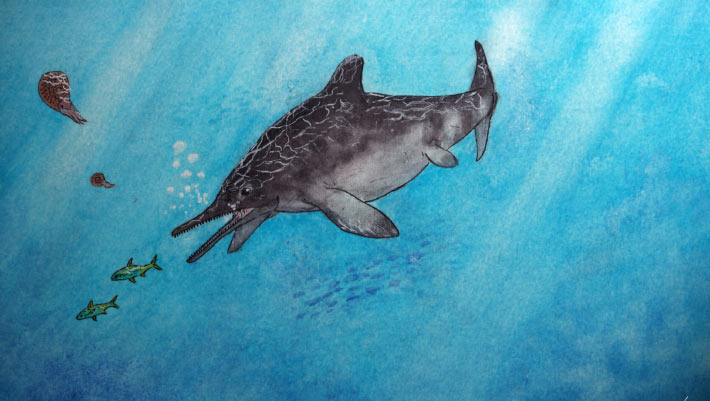
Life restoration of the German Jurassic ichthyosaur Suevoleviathan disinteger. The dorsal and caudal fins are loosely based on those of Stenopterygius.
References
Maisch, M.W. (2020). "The best-preserved skeleton of Suevoleviathan integer (Bronn, 1844)(Reptilia: Ichthyosauria) from the lower Jurassic of south-western Germany, with a discussion of the genus". Neues Jahrbuch für Geologie und Paläontologie, Abhandlungen 297 (2): 153–172.
Maisch, M.W. (1998). "A new ichthyosaur genus from the Posidonia Shale (Lower Toarcian, Jurassic) of Holzmaden, SW-Germany with comments on the phylogeny of post-Triassic ichthyosaurs". Neues Jahrbuch für Geologie und Paläontologie-Abhandlungen 209 (1): 47–78.

Life restoration of the German Jurassic ichthyosaur Suevoleviathan disinteger. The dorsal and caudal fins are loosely based on those of Stenopterygius. References Maisch, M.W. (2020). "The best-preserved skeleton of Suevoleviathan integer (Bronn, 1844)(Reptilia: Ichthyosauria) from the lower Jurassic of south-western Germany, with a discussion of the genus". Neues Jahrbuch für Geologie und Paläontologie, Abhandlungen 297 (2): 153–172. Maisch, M.W. (1998). "A new ichthyosaur genus from the Posidonia Shale (Lower Toarcian, Jurassic) of Holzmaden, SW-Germany with comments on the phylogeny of post-Triassic ichthyosaurs". Neues Jahrbuch für Geologie und Paläontologie-Abhandlungen 209 (1): 47–78.

Allemagne Posidonia Shale Jurassique Toarcien +6
Muraenosaurus? Reedii, Sp. Nov. and Tricleidus? Laramiensis Knight, American Jurassic Plesiosaurs

Muraenosaurus? Reedii, Sp. Nov. and Tricleidus? Laramiensis Knight, American Jurassic Plesiosaurs

Maurice Jurassique Muraenosaurus Pantosaurus +2
Fossil samples – e.g. ‘primitive’ bony fish (1, 2), a skull of a temnospondyl ‘amphibian’ (probably a metoposauroid) in dorsal view (3), a skull of an archosaur of the crocodile lineage (probably a phytosaur) in palatal view (4), holotype of the “gliding reptile” Icarosaurus siefkeri [1] (5) and Atreipus-Grallator-type dinosaur tracks (bottom right) – from the Newark Supergroup, i.e. a series of mainly Late Triassic to Early Jurassic sedimentary rocks of eastern North America


↑ Edwin H. Colbert: A gliding reptile from the Triassic of New Jersey. American Museum Novitates, 2230. American Museum of Natural History, New York 1966, digitallibrary.amnh.org, cf. fig. 3 therein.

Fossil samples – e.g. ‘primitive’ bony fish (1, 2), a skull of a temnospondyl ‘amphibian’ (probably a metoposauroid) in dorsal view (3), a skull of an archosaur of the crocodile lineage (probably a phytosaur) in palatal view (4), holotype of the “gliding reptile” Icarosaurus siefkeri [1] (5) and Atreipus-Grallator-type dinosaur tracks (bottom right) – from the Newark Supergroup, i.e. a series of mainly Late Triassic to Early Jurassic sedimentary rocks of eastern North America ↑ Edwin H. Colbert: A gliding reptile from the Triassic of New Jersey. American Museum Novitates, 2230. American Museum of Natural History, New York 1966, digitallibrary.amnh.org, cf. fig. 3 therein.

musée Jurassique inférieur Jurassique Trias supérieur +8
Paddle of the British Jurassic pliosaurid plesiosaur Eardasaurus housed at the Oxford University Natural History Museum.

Paddle of the British Jurassic pliosaurid plesiosaur Eardasaurus housed at the Oxford University Natural History Museum.

musée Jurassique Peloneustes Plesiosauria +1
A map showing the distribution of paraves in Late Jurassic with the respective paleogeographic setting.

A map showing the distribution of paraves in Late Jurassic with the respective paleogeographic setting.

Jurassique Jurassique supérieur Paraves
Figure 1. Evolution of macroecological traits in Dinosauria. Large scale event in dinosaur evolution (a); the origin of dinosaurs (star), hyperthermals (volcano), the earliest fossil Avialae (bird), the earliest fossil angiosperm (flower), the Cretaceous/Palaeogene mass extinction (asteroid). Phylogeny of dinosaurs (b) redrawn from Sereno and adapted to the current consensus and upon which an ancestral state reconstruction of temperature niche (mean annual temperature) after Chiarenza et al. is plotted; Mesozoic palaeogeographies (c) for Triassic (T), Jurassic (J) and Cretaceous (K). Silhouette colours symbolize body mass for each of the taxa represented; information on dietary habits are plotted after Barrett and Zanno & Makovicky; numbers represent clades discussed through this study: 1, Ornithischia; 2, Thyreophora; 3, Ornithopoda; 4, Hadrosauroidea; 5, Marginocephalia; 6, Ceratopsia; 7, Saurischia; 8, Sauropodomorpha; 9, Sauropoda; 10, Theropoda; 11, Ceratosauria; 12, Tetanurae; 13, Coelurosauria; 14, Maniraptoriformes; 15, Maniraptora; 16, Deinonychosauria; 17, Avialae; 18, Ornithothoraces. Palaeogeographies modified from original plots via R package ‘mapast’ using plate models by Scotese.

Figure 1. Evolution of macroecological traits in Dinosauria. Large scale event in dinosaur evolution (a); the origin of dinosaurs (star), hyperthermals (volcano), the earliest fossil Avialae (bird), the earliest fossil angiosperm (flower), the Cretaceous/Palaeogene mass extinction (asteroid). Phylogeny of dinosaurs (b) redrawn from Sereno and adapted to the current consensus and upon which an ancestral state reconstruction of temperature niche (mean annual temperature) after Chiarenza et al. is plotted; Mesozoic palaeogeographies (c) for Triassic (T), Jurassic (J) and Cretaceous (K). Silhouette colours symbolize body mass for each of the taxa represented; information on dietary habits are plotted after Barrett and Zanno & Makovicky; numbers represent clades discussed through this study: 1, Ornithischia; 2, Thyreophora; 3, Ornithopoda; 4, Hadrosauroidea; 5, Marginocephalia; 6, Ceratopsia; 7, Saurischia; 8, Sauropodomorpha; 9, Sauropoda; 10, Theropoda; 11, Ceratosauria; 12, Tetanurae; 13, Coelurosauria; 14, Maniraptoriformes; 15, Maniraptora; 16, Deinonychosauria; 17, Avialae; 18, Ornithothoraces. Palaeogeographies modified from original plots via R package ‘mapast’ using plate models by Scotese.

écaille Crétacé Jurassique Mésozoïque +23
Diagram illustrating the "Temporal paradox" in paleontology. First given it's nickname by Alan Feduccia, the paradox is made up by the fact that almost all feathered dinosaurs are dated to have lived millions of years after Archaeopteryx, the oldest bird (late Jurassic, believed to have existed about 150 million years ago). Only a few of the feathered dinosaurs/birdlike dinosaurs are given an older date than Archaeopteryx.

Diagram illustrating the "Temporal paradox" in paleontology. First given it's nickname by Alan Feduccia, the paradox is made up by the fact that almost all feathered dinosaurs are dated to have lived millions of years after Archaeopteryx, the oldest bird (late Jurassic, believed to have existed about 150 million years ago). Only a few of the feathered dinosaurs/birdlike dinosaurs are given an older date than Archaeopteryx.

Jurassique Jurassique supérieur Archaeopteryx Coelurosauria +2
Restoration of Early Jurassic environment preserved at the SGDS, with the theropod Dilophosaurus wetherilli in bird-like resting pose, demonstrating the manufacture of SGDS.18.T1 resting trace.

Restoration of Early Jurassic environment preserved at the SGDS, with the theropod Dilophosaurus wetherilli in bird-like resting pose, demonstrating the manufacture of SGDS.18.T1 resting trace.

Jurassique inférieur Jurassique Dilophosaurus Neotheropoda +1
Geographic and geologic map showing the location and involved strata of the studied fossil sites in the Xinhe Formation. (A, B) location of the fossiliferous localities in the Gansu Province. (C) Geological map of the involved strata of the studied fossil site (from State Bureau of Surveying and Mapping, GS (2016)2884). White star=Jinchuanloong niedu. Black star=plesiosaur fossils. (D) Stratigraphic chart of the Jurassic at the localities.

Geographic and geologic map showing the location and involved strata of the studied fossil sites in the Xinhe Formation. (A, B) location of the fossiliferous localities in the Gansu Province. (C) Geological map of the involved strata of the studied fossil site (from State Bureau of Surveying and Mapping, GS (2016)2884). White star=Jinchuanloong niedu. Black star=plesiosaur fossils. (D) Stratigraphic chart of the Jurassic at the localities.

Jurassique fossile Jinchuanloong Plesiosauria +1
Life restoration of Tanycolagreus topwilsoni.
Based on Figure 2.16 of "New small theropod from the Upper Jurassic Morrison Formation of Wyoming" by Kenneth Carpenter, Clifford Miles, and Karen Cloward (The Carnivorous Dinosaurs pp. 23-48, Indiana University Press).

Life restoration of Tanycolagreus topwilsoni. Based on Figure 2.16 of "New small theropod from the Upper Jurassic Morrison Formation of Wyoming" by Kenneth Carpenter, Clifford Miles, and Karen Cloward (The Carnivorous Dinosaurs pp. 23-48, Indiana University Press).

Morrison Jurassique Coeluridae Dinosauria +2
Pencil drawing of Coelurus, a coelurosaurian dinosaur that lived from the Late Jurassic period (North America).

Pencil drawing of Coelurus, a coelurosaurian dinosaur that lived from the Late Jurassic period (North America).

dessin Jurassique Jurassique supérieur Coeluria +3
Coelurus fragilis, a coelurosaur from the Late Jurassic of North America, pencil drawing, digital coloring
Taxons Coeluridae

Coelurus fragilis, a coelurosaur from the Late Jurassic of North America, pencil drawing, digital coloring

dessin Jurassique Jurassique supérieur Coeluria +3
1 2 3 4 5 6 7

Actualités

Yi: Beast of the Week
Yi : la bête de la semaine
Chine Jurassique Jurassique supérieur Dinosauria Yi évolution
 Cette semaine, nous allons découvrir un dinosaure si inhabituel qu'il a complètement changé ce que nous pensions savoir sur l'évolution des dinosaures.  Découvrez Yi qi ! (prononcé « EE-chee ») Yi était un petit dinosaure théropode qui vivait dans ce qui est aujourd'hui le Hebei, dans le nord-est de la Chine, à la fin du Jurassique, il y a environ 159 millions d'années.  Du museau à la queue, il ne mesurait qu'environ 30 cm de long et son envergure mesurait environ 60 cm de large.  Le genre est venu, "Yi" se traduit du mandarin par "aile" et
21/06/2026 prehistoricbeastoftheweek ⚙ Traduction automatique
On le croyait roi des océans au Jurassique : une vertèbre percée raconte un combat d’une violence extrême
os dent vertèbre chasse musée Jurassique fossile Ichthyosauria Ichthyosaurus Pliosaurus comportement
Oublié pendant plus d’un siècle dans les tiroirs d’un musée, un fossile refait aujourd’hui surface et raconte une scène de violence extrême dans les océans du Jurassique. Une vertèbre d’ichtyosaure, marquée par l’impact d’une dent brisée, révèle peut-être l’attaque d’un des plus redoutables...
17/06/2026 futura-terre
Un cétiosaure aurait-il pu quitter la plus longue piste de sauropode ?
Royaume-Uni Bathonien Jurassique Jurassique moyen empreintes Cetiosauria Dinosauria
Récemment, nous avons publié un article mettant en avant les recherches en cours sur la remarquable « autoroute des dinosaures » de l'Oxfordshire.  Une carrière de calcaire conserve les restes de nombreuses traces de dinosaures.  Les traces sont conservées dans des strates déposées au Jurassique moyen.  Les paléontologues estiment que les traces ont environ 166 millions d'années (stade faunique bathonien).  Dans une récente radio
14/06/2026 everythingdinosaur ⚙ Traduction automatique
La piste des dinosaures de l'Oxfordshire pourrait être la plus longue piste de sauropodes connue
Royaume-Uni Jurassique empreintes Cetiosauria Dinosauria découverte
Les scientifiques qui étudient la célèbre « autoroute des dinosaures » de l'Oxfordshire ont annoncé que l'une des voies géantes pourrait représenter la plus longue voie de sauropode connue découverte au monde. La séquence remarquable d'empreintes de pas, découverte à la carrière de Dewars Farm, pourrait avoir été faite par un seul Cétiosaure alors qu'il errait dans une vasière jurassique autour de 166 millions d'années.
11/06/2026 everythingdinosaur ⚙ Traduction automatique
New Jurassic Pterosaur Unearthed in Germany
Un nouveau ptérosaure du Jurassique découvert en Allemagne
Allemagne Jurassique fossile Monofenestrata Pterosauria nouvelle espèce squelette
Les paléontologues ont décrit un nouveau genre et une nouvelle espèce de ptérosaure monofenestratan précoce sur la base d'un squelette fossile presque complet et bien conservé découvert en Bavière, en Allemagne. L'article Un nouveau ptérosaure jurassique découvert en Allemagne est apparu en premier sur Sci.News : Breaking Science News.
19/05/2026 sci-news ⚙ Traduction automatique
1 2 3 4 5