25 image(s) · 7 Actualités
Diuqin is an unenlagiine dinosaur from the Late Cretaceous of what is now Argentina. Unenlagiines, known exclusively from South America, are usually classified as dromaeosaurs though this is sometimes debated. Like dromaeosaurs, they were covered in feathers, carnivorous, and had the large sickle-like claw on the inner toe of each foot. Unique to unenlagiines is their elongated snout, suggesting a piscivorous diet. Diuqin was a medium-sized unenlagiine, at about 4 m in length.
The saltasaurine sauropod Neuquensaurus australis, from the Anacleto Formation (Upper Cretaceous), Patagonia, Argentina. Restoration of the skeleton mounted at the Museo de La Plata, Argentina.
Articulated tibia, fibula, astragalus and calcaneum of Xenotarsosaurus (UNPSJB PV 194/1; Universidad Nacional de la Patagonia ‘San Juan Bosco’, Chubut, Argentina). Scale bar: 5 cm.
Reconstruction of the Abelisaurus skull with original bones of the holotype. Museo Provincial Carlos Ameghino, Cipolletti, Argentina. Scale = 10 cm
Speculative reconstruction of Aoniraptor'’ from the Late Cretaceous of Argentina, here restored as a megaraptoran as recovered by most studies
Fig. 2. Selected cranial elements of Bicentenaria argentina nov. gen. et nov. sp. A, left lateral view of preserved caudal half of skull and jaws; B, right lateral view of preserved caudal half of skull and jaws; C, left quadrate and lower jaw in caudal view; D, fragmentary premaxillae with teeth in left lateral view; E, fragmentary left maxilla with tooth in lateral view. Abbreviations: an, angular; antf, antorbital fossa; art, articular; bs, basipterygoid process of basisphenoid; ch, notch for the chorda tympanica; gl, glenoid fossa; j, jugal; lc, lateral condyle of quadrate; lr, longitudinal ridge; ect, ectopterygoid; prar, right prearticular; pral, left prearticular; ptq, pterygoid ramus of quadrate; q, quadrate; qj, quadratojugal; sanl, left surangular; sanr, right surangular; rart, retroarticular process; t, tooth. Scale bars = 1 centimeter.
Cervical vertebrae of rebbachisaurid sauropod Katepensaurus goicoecheai Ibiricu, Casal, Martínez, Lamanna, Luna, and Salgado, 2013a from the Cenomanian–Turonian Bajo Barreal Formation of Chubut Province, Argentina. A. UNPSJB-PV 1007/1, anterior cervical vertebra in anterior (A1) and right ventrolateral (A2) views. B. UNPSJB-PV 1007/2, anterior cervical vertebra in right lateral view. C. UNPSJB-PV 1007/3, middle cervical vertebra in right lateral view. Lateral fossae of the centrum (hypothesized as pneumatic in origin) indicated by arrows.
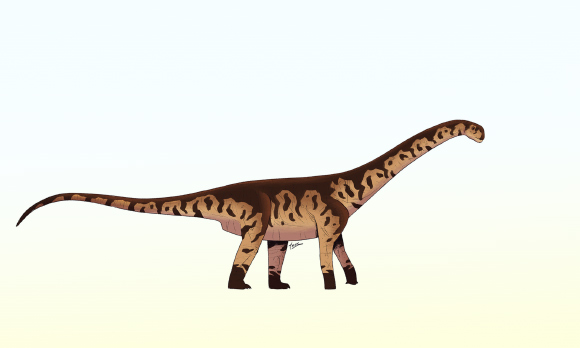
Reconstruction of Bravasaurus arreirosorum a titanosaur dinosaur from the Late Cretaceous of Argentina
Fig. 5. Forelimb bones of the titanosaurian sauropod Bustingorrytitan shiva gen. et sp. nov. from “Bustingorry II” site, Neuquén Province, Argentina, upper Cenomanian. A. Left coracoid (holotype, MMCH-Pv 59/13) in lateral view. B. Left scapula (holotype, MMCH-Pv 59/11) in lateral view. C. Left humerus (holotype, MMCH-Pv 59/21) in proximal (C1), anterior (C2), and distal (C3) views. D. Right radius (holotype, MMCH-Pv 59/22) in posterior view. E. Left sternal plate (holotype, MMCH-Pv 59/15) in dorsal view. F. Articulated metacarpals I–V (holotype, MMCH-Pv 59/25–29) in proximal (F1), anterior (F2) and distal (F3) views. G. Right ulna (holotype, MMCH-Pv 59/23) in medial (G1) and proximal (G2) views. Abbreviations: cf, coracoid foramen; gas, glenoid articular surface; igl, infraglenoid lip; I–V, metacarpals. Scale bars 200 mm.
Palaeogeographic distribution of late Early and early Late Cretaceous pterosaur assemblages. Taxonomic composition of assemblages shown on Fig. 1. Palaeogeography based on Smith et al. 1994. Abbreviations: 1. Cambridge Greensand, England: 2. Lower Chalk, England: 3. Züümbayan Svita, Khuren-Dukh, Mongolia: 4. Lysaya Gora, Saratov, Russia: 5. Kem Kem red beds, Morocco: 6. Paw Paw Formation, Texas, USA: 7. Lagarcito Formation, San Luis, Argentina: 8. Santana and Crato Formations, Ceara, Brazil: 9. Toolebuc Formation, Queensland, Australia.
Paleogeography and paleoclimate of the Late Jurassic - 150 Ma with dinosaur fossil localities: A = Tendaguru Formation, Tanzania C1 = Shishugou & Kalazha Formations, China C2 = Shangshaximiao (Upper Shaximiao) Formation, China E1 = Sables de Glos, Argiles d’Octeville, Marnes de Bléville, Kimmeridge Clay, Calcareous Grit, Corallian Oolite, Oxford Clay, Portland Stone, England & France E2 = Villar del Arzobispo, Alcobaça, Guimarota, Sobral, Amoreira-Porto Novo, Bombarral, Freixial, Lourinhã Formations, Spain & Portugal M1-6 = Morrison Formation, United States S1 = Toquí & Cañadón Calcáreo Formations, Chile & Argentina