United States

Country

77 image(s) · 19 News

Image gallery

Khaan fossil holotype IGM 100/1127.
Taxa Khaan

Khaan fossil holotype IGM 100/1127.

United States fossil holotype Khaan
Falcarius skeleton reconstruction, Utah Museum of Natural History.
Taxa Falcarius

Falcarius skeleton reconstruction, Utah Museum of Natural History.

museum United States Falcarius skeleton
Achelousaurus horneri skull, collected in Glacier County, Montana, at the Museum of the Rockies in Bozeman, Montana.
The Ceratopsidae are those dinosaurs with head frills.  There are three large subgroups of Ceratopsidae: Centrosaurinae, Ceratopsinae, and Chasmosaurinae. The Triceratopsini are a "tribe" of the Chasmosaurinae -- a genus so vast that it gets the special name "tribe".  The Pachyrhinosaurini are a "tribe" within the Centrosaurinae.

Achelousaurus is a genus within the Pachyrhinosaurini.  So far, only three skulls and some limited skeletal remains have been collected anywhere in the world -- and all of them in Montana.  Their bony frills are quite similar to the Styracosaurus albertensis, although their other skull features (such as big bony bosses on the nose and behind the eyes) are not.
Taxa Achelousaurus

Achelousaurus horneri skull, collected in Glacier County, Montana, at the Museum of the Rockies in Bozeman, Montana. The Ceratopsidae are those dinosaurs with head frills. There are three large subgroups of Ceratopsidae: Centrosaurinae, Ceratopsinae, and Chasmosaurinae. The Triceratopsini are a "tribe" of the Chasmosaurinae -- a genus so vast that it gets the special name "tribe". The Pachyrhinosaurini are a "tribe" within the Centrosaurinae. Achelousaurus is a genus within the Pachyrhinosaurini. So far, only three skulls and some limited skeletal remains have been collected anywhere in the world -- and all of them in Montana. Their bony frills are quite similar to the Styracosaurus albertensis, although their other skull features (such as big bony bosses on the nose and behind the eyes) are not.

museum United States Achelousaurus Centrosaurinae +8
Anhanguerid pterosaur Uktenadactylus wadleighi (Lee, 1994), SMU 73058, Tarrant County, Texas, USA, Albian. In anterior (A1), leftlateral (A2), palatal (A3) and right lateral (A4), and dorsal (A5) views. Photographs by BH
Taxa Uktenadactylus

Anhanguerid pterosaur Uktenadactylus wadleighi (Lee, 1994), SMU 73058, Tarrant County, Texas, USA, Albian. In anterior (A1), leftlateral (A2), palatal (A3) and right lateral (A4), and dorsal (A5) views. Photographs by BH

United States Albian Anhangueridae Pterosauria +1
Cast of a Scaphognathus crassirostris, a kind of pterosaur. On display as part of the exhibit "Pterosaurs: Flight in the Age of Dinosaurs" at the Cleveland Natural History Museum in Cleveland, Ohio, in the United States.
This animal lived about 150 million years ago. This fossil was found in the Solnhofen formation in Germany. This is a cast; the fossil itself is held by the Institute of Geology and Paleontology at the University of Bonn.
Taxa Scaphognathus

Cast of a Scaphognathus crassirostris, a kind of pterosaur. On display as part of the exhibit "Pterosaurs: Flight in the Age of Dinosaurs" at the Cleveland Natural History Museum in Cleveland, Ohio, in the United States. This animal lived about 150 million years ago. This fossil was found in the Solnhofen formation in Germany. This is a cast; the fossil itself is held by the Institute of Geology and Paleontology at the University of Bonn.

flight museum Germany United States +7
Blue Dinosaur Royal Ontario Museum
Taxa Lognkosauria

Blue Dinosaur Royal Ontario Museum

museum United States Dinosauria Lognkosauria
Mounted skeleton of Allosaurus fragilis, on display at the Carnegie Museum of Natural History, Pittsburgh, Pennsylvania, USA
Taxa Allosauridae

Mounted skeleton of Allosaurus fragilis, on display at the Carnegie Museum of Natural History, Pittsburgh, Pennsylvania, USA

museum United States Allosauria Allosauridae +1
Chert & phosphorite in the Permian of Wyoming, USA.
The Permian-aged Phosphoria Formation has a significant component of phosphorite, a scarce, phosphate-rich sedimentary rock.  This material is mined in southern Idaho as a source of phosphorus for the fertilizer industry, the fireworks industry, and other uses.
Phosphorites are generally considered to have >15-20% phosphate content.  Texturally, phosphorites can be obviously granular, with fossil fragments or oolites or peloids or lithic fragments, or they can be composed of extremely fine-grained, phosphate-rich mud.  Compositionally, the phosphate component in phosphorites is principally a mix of apatite minerals: chlorapatite (Ca5(PO4)3Cl), fluorapatite (Ca5(PO4)3F), hydroxyapatite (Ca5(PO4)3OH)), and carbonate fluorapatite (Ca10(PO4,CO3)6F2-3).
Phosphorites are generally marine sedimentary rocks.  They range in age from Precambrian to Holocene.  In modern oceans, they tend to occur along the eastern margins of some ocean basins where deep-water upwelling occurs under areas of high biologic productivity.
Stratigraphy: Rex Chert Member over Meade Peak Member, Phosphoria Formation, Roadian Stage to Wordian Stage, lower Guadalupian Series, mid-Permian

Locality: roadcut on the northern side of Route 26/Route 89 at the town of Astoria Hot Springs, Snake River Canyon, southern Teton County, northwestern Wyoming, USA

Chert & phosphorite in the Permian of Wyoming, USA. The Permian-aged Phosphoria Formation has a significant component of phosphorite, a scarce, phosphate-rich sedimentary rock. This material is mined in southern Idaho as a source of phosphorus for the fertilizer industry, the fireworks industry, and other uses. Phosphorites are generally considered to have >15-20% phosphate content. Texturally, phosphorites can be obviously granular, with fossil fragments or oolites or peloids or lithic fragments, or they can be composed of extremely fine-grained, phosphate-rich mud. Compositionally, the phosphate component in phosphorites is principally a mix of apatite minerals: chlorapatite (Ca5(PO4)3Cl), fluorapatite (Ca5(PO4)3F), hydroxyapatite (Ca5(PO4)3OH)), and carbonate fluorapatite (Ca10(PO4,CO3)6F2-3). Phosphorites are generally marine sedimentary rocks. They range in age from Precambrian to Holocene. In modern oceans, they tend to occur along the eastern margins of some ocean basins where deep-water upwelling occurs under areas of high biologic productivity. Stratigraphy: Rex Chert Member over Meade Peak Member, Phosphoria Formation, Roadian Stage to Wordian Stage, lower Guadalupian Series, mid-Permian Locality: roadcut on the northern side of Route 26/Route 89 at the town of Astoria Hot Springs, Snake River Canyon, southern Teton County, northwestern Wyoming, USA

United States Guadalupian Holocene Permian +5
Life restoration of the large, Middle Triassic Nevadan ichthyosaur Cymbopsondylus petrinus. This illustration is primarily based on specimen UCMP 9950, with much of the tail restored following UCMP 9947. The size of the eye was reconstructed based on UCMP 9954 and UCMP 9913. The unknown distal portions of the flippers, as well as some of the tail, was reconstructed after the related genus Xinminosaurus.
References
Merriam, J. C. (1908)       Triassic Ichthyosauria: With special reference to the American forms, Berkley, California:  Berkley: The University Press  
Klein, N.; Schmitz, L.; Wintrich, T.; Sander, P. M. (2020). "A new cymbospondylid ichthyosaur (Ichthyosauria) from the Middle Triassic (Anisian) of the Augusta Mountains, Nevada, USA". Journal of Systematic Palaeontology 18 (14): 1167-1191. DOI:10.1080/14772019.2020.1748132.
Jiang, D.; Motani, R.; Hao, W.; Schmitz, L.; Rieppel, O.; Sun, Y.; Sun, Z. (2008). "New primitive ichthyosaurian (Reptilia, Diapsida) from the Middle Triassic of Panxian, Guizhou, southwestern China and its position in the Triassic biotic recovery". Progress in Natural Science 18 (10): 1315. DOI:10.1016/j.pnsc.2008.01.039.
Taxa Xinminosaurus

Life restoration of the large, Middle Triassic Nevadan ichthyosaur Cymbopsondylus petrinus. This illustration is primarily based on specimen UCMP 9950, with much of the tail restored following UCMP 9947. The size of the eye was reconstructed based on UCMP 9954 and UCMP 9913. The unknown distal portions of the flippers, as well as some of the tail, was reconstructed after the related genus Xinminosaurus. References Merriam, J. C. (1908) Triassic Ichthyosauria: With special reference to the American forms, Berkley, California: Berkley: The University Press Klein, N.; Schmitz, L.; Wintrich, T.; Sander, P. M. (2020). "A new cymbospondylid ichthyosaur (Ichthyosauria) from the Middle Triassic (Anisian) of the Augusta Mountains, Nevada, USA". Journal of Systematic Palaeontology 18 (14): 1167-1191. DOI:10.1080/14772019.2020.1748132. Jiang, D.; Motani, R.; Hao, W.; Schmitz, L.; Rieppel, O.; Sun, Y.; Sun, Z. (2008). "New primitive ichthyosaurian (Reptilia, Diapsida) from the Middle Triassic of Panxian, Guizhou, southwestern China and its position in the Triassic biotic recovery". Progress in Natural Science 18 (10): 1315. DOI:10.1016/j.pnsc.2008.01.039.

China United States Anisian Middle Triassic +6
Dinosaur National Monument is a United States National Monument located on the southeast flank of the Uinta Mountains on the border between Colorado and Utah at the confluence of the Green and Yampa Rivers. Although most of the monument area is in Moffat County, Colorado, the Dinosaur Quarry is located in Utah just to the north of the town of Jensen, Utah.
The nearest communities are Jensen, Utah, and Dinosaur, Colorado. The park contains over 800 paleontological sites and has fossils of dinosaurs including Allosaurus, Deinonychus, Abydosaurus (a nearly complete skull, lower jaws and first four neck vertebrae of the specimen DINO 16488 found here at the base of the Mussentuchit Member of the Cedar Mountain Formation is the holotype for the description) and various long-neck, long-tail sauropods. It was declared a National Monument on October 4, 1915.
The rock layer enclosing the fossils is a sandstone and conglomerate bed of alluvial or river bed origin known as the Morrison Formation from the Jurassic Period some 150 million years old. The dinosaurs and other ancient animals were carried by the river system which eventually entombed their remains in Utah.
The pile of sediments were later buried and lithified into solid rock. The layers of rock were later uplifted and tilted to their present angle by the mountain building forces that formed the Uintas during the Laramide orogeny. The relentless forces of erosion exposed the layers at the surface to be found by paleontologists.
The dinosaur fossil beds (bone beds) were discovered in 1909 by Earl Douglass, a paleontologist working and collecting for the Carnegie Museum of Natural History. He and his crews excavated thousands of fossils and shipped them back to the museum in Pittsburgh, Pennsylvania for study and display. President Woodrow Wilson proclaimed the dinosaur beds as Dinosaur National Monument in 1915. The monument boundaries were expanded in 1938 from the original 80-acre (320,000 m2) tract surrounding the dinosaur quarry in Utah, to its present extent of over 200,000 acres (800 km²) in Utah and Colorado, encompassing the spectacular river canyons of the Green and Yampa.
Though lesser-known than the fossil beds, the petroglyphs in Dinosaur National Monument are another treasure the monument holds. Due to problems with vandals, many of the sites are not listed on area maps.
The "Wall of Bones" located within the Dinosaur Quarry building in the park consists of a steeply tilted (67° from horizontal) rock layer which contains hundreds of dinosaur fossils. The enclosing rock has been chipped away to reveal the fossil bones intact for public viewing. In July 2006, the Quarry Visitor Center was closed due to structural problems that since 1957 had plagued the building because it was built on unstable clay. The decision was made to build a new facility elsewhere in the monument to house the visitor center and administrative functions, making it easier to resolve the structural problems of the quarry building while still retaining a portion of the historic Mission 66 era exhibit hall. It was announced in April 2009 that Dinosaur National Monument would receive $13.1 million to refurbish and reopen the gallery as part of the Obama administration's $750 billion stimulus plan. The Park Service successfully rebuilt the Quarry Exhibit Hall, supporting its weight on 70-foot steel micropile columns that extend to the bedrock below the unstable clay. The Dinosaur Quarry was reopened in Fall 2011.
en.wikipedia.org/wiki/Dinosaur_National_Monument

en.wikipedia.org/wiki/Wikipedia:Text_of_Creative_Commons_...
Taxa Abydosaurus

Dinosaur National Monument is a United States National Monument located on the southeast flank of the Uinta Mountains on the border between Colorado and Utah at the confluence of the Green and Yampa Rivers. Although most of the monument area is in Moffat County, Colorado, the Dinosaur Quarry is located in Utah just to the north of the town of Jensen, Utah. The nearest communities are Jensen, Utah, and Dinosaur, Colorado. The park contains over 800 paleontological sites and has fossils of dinosaurs including Allosaurus, Deinonychus, Abydosaurus (a nearly complete skull, lower jaws and first four neck vertebrae of the specimen DINO 16488 found here at the base of the Mussentuchit Member of the Cedar Mountain Formation is the holotype for the description) and various long-neck, long-tail sauropods. It was declared a National Monument on October 4, 1915. The rock layer enclosing the fossils is a sandstone and conglomerate bed of alluvial or river bed origin known as the Morrison Formation from the Jurassic Period some 150 million years old. The dinosaurs and other ancient animals were carried by the river system which eventually entombed their remains in Utah. The pile of sediments were later buried and lithified into solid rock. The layers of rock were later uplifted and tilted to their present angle by the mountain building forces that formed the Uintas during the Laramide orogeny. The relentless forces of erosion exposed the layers at the surface to be found by paleontologists. The dinosaur fossil beds (bone beds) were discovered in 1909 by Earl Douglass, a paleontologist working and collecting for the Carnegie Museum of Natural History. He and his crews excavated thousands of fossils and shipped them back to the museum in Pittsburgh, Pennsylvania for study and display. President Woodrow Wilson proclaimed the dinosaur beds as Dinosaur National Monument in 1915. The monument boundaries were expanded in 1938 from the original 80-acre (320,000 m2) tract surrounding the dinosaur quarry in Utah, to its present extent of over 200,000 acres (800 km²) in Utah and Colorado, encompassing the spectacular river canyons of the Green and Yampa. Though lesser-known than the fossil beds, the petroglyphs in Dinosaur National Monument are another treasure the monument holds. Due to problems with vandals, many of the sites are not listed on area maps. The "Wall of Bones" located within the Dinosaur Quarry building in the park consists of a steeply tilted (67° from horizontal) rock layer which contains hundreds of dinosaur fossils. The enclosing rock has been chipped away to reveal the fossil bones intact for public viewing. In July 2006, the Quarry Visitor Center was closed due to structural problems that since 1957 had plagued the building because it was built on unstable clay. The decision was made to build a new facility elsewhere in the monument to house the visitor center and administrative functions, making it easier to resolve the structural problems of the quarry building while still retaining a portion of the historic Mission 66 era exhibit hall. It was announced in April 2009 that Dinosaur National Monument would receive $13.1 million to refurbish and reopen the gallery as part of the Obama administration's $750 billion stimulus plan. The Park Service successfully rebuilt the Quarry Exhibit Hall, supporting its weight on 70-foot steel micropile columns that extend to the bedrock below the unstable clay. The Dinosaur Quarry was reopened in Fall 2011. en.wikipedia.org/wiki/Dinosaur_National_Monument en.wikipedia.org/wiki/Wikipedia:Text_of_Creative_Commons_...

bone description museum United States +13
Close up of the Eulithomyrmex rugosus holotype head.  Museum of Comparative Zoology  specimen UCM17019.
Priabonian; Florissant Formation, Colorado, USA
Intervals Priabonian

Close up of the Eulithomyrmex rugosus holotype head. Museum of Comparative Zoology specimen UCM17019. Priabonian; Florissant Formation, Colorado, USA

museum United States Priabonian holotype +2
Outcrops of the Late Cretaceous (Campanian) aged Aguja Formation, Big Bend National Park, Texas, USA

Outcrops of the Late Cretaceous (Campanian) aged Aguja Formation, Big Bend National Park, Texas, USA

United States Aguja Campanian Cretaceous +2
Restored skeleton of Anzu wyliei (previously labelled as a specimen of Chirostenotes)

Restored skeleton of Anzu wyliei (previously labelled as a specimen of Chirostenotes)

United States specimen Anzu Chirostenotes +1
Ceratosaurus skeleton mount, Wisconsin

Ceratosaurus skeleton mount, Wisconsin

United States Averostra Ceratosauria skeleton
Ceratosaurus skeleton mount, Wisconsin

Ceratosaurus skeleton mount, Wisconsin

United States Averostra Ceratosauria skeleton
Anhanguera skeleton, North American Museum of Ancient Life.

Anhanguera skeleton, North American Museum of Ancient Life.

museum United States Anhanguera skeleton
1 2 3 4 5

News

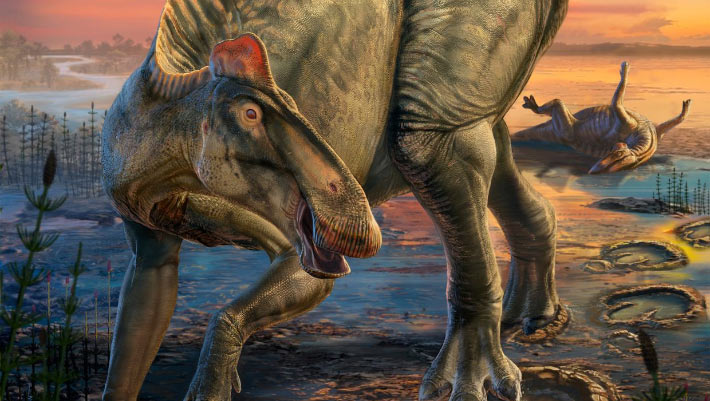
Tyrannosaurus rex Scavenged Duck-Billed Dinosaurs in Ancient Wyoming, Bite Marks Reveal
bone feeding hunting United States Cretaceous Canardia Dinosauria Edmontosaurus Tyrannosaurus behavior
Thousands of fossilized bones from a Cretaceous-period bonebed in Wyoming, the United States, offer rare physical evidence that Tyrannosaurus rex fed on the carcasses of a duck-billed dinosaur species called Edmontosaurus annectens. The post Tyrannosaurus rex Scavenged Duck-Billed Dinosaurs in Ancient Wyoming, Bite Marks Reveal appeared first on Sci.News: Breaking Science News.
16/07/2026 sci-news
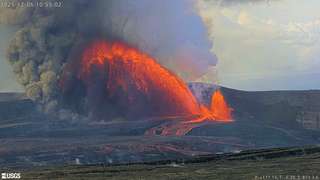
Des fontaines de lave géantes filmées en direct : ce volcan hawaïen en est déjà à 50 épisodes éruptifs en 18 mois !
Giant lava fountains filmed live: this Hawaiian volcano has already had 50 eruptive episodes in 18 months!
United States geology volcanism
Since the start of this eruption, on December 23, 2024, the activity has been episodic: pauses of one to three weeks separate phases of sustained activity of a few hours inside the summit caldera of the volcano. Fifty episodes followed one another in a year and a half,...
30/06/2026 futura-terre ⚙ Auto-translated
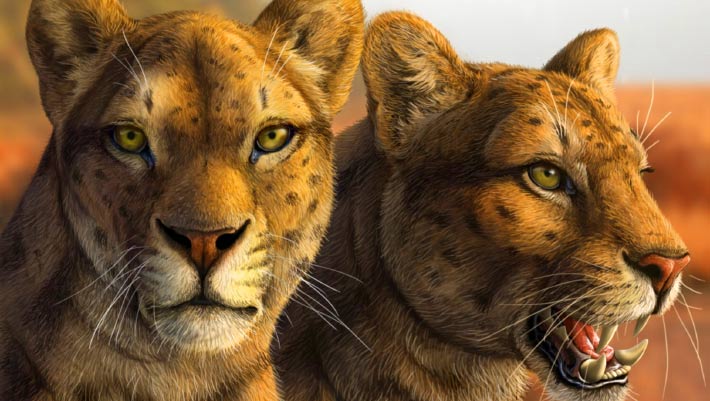
Early Saber-Toothed Cat Gets New Face after Decades of Mystery
tooth paleoart reconstitution United States Pliocene mammals skull
A nearly complete skull unearthed decades ago in Arizona has given paleontologists their clearest look yet at Adelphailurus kansensis, an enigmatic felid species that inhabited North America more than 5 million years ago and occupied an early branch of the saber-toothed cat family tree. The post Early Saber-Toothed Cat Gets New Face after Decades of Mystery appeared first on Sci.News: Breaking Science News.
29/06/2026 sci-news
Sauroposeidon: Beast of the Week
United States Cretaceous Early Cretaceous Dinosauria Sauroposeidon
 This week we will be checking out a huge dinosaur with an equally impressive name.  Enter Sauroposeidon proteles!Sauroposeidon was a sauropod dinosaur (long neck) that lived in what is now Oklahoma, Texas, and Wyoming, USA, during the early Cretaceous period, about 113 million years ago.  Its genus name translates to "Lizard Earthquake God" after the Greek god, Poseidon, who in addition to his more famous association with the ocean, was also the god of earthquakes in Greek mythology. Since not
14/06/2026 prehistoricbeastoftheweek
The 1,100-year-old mystery of Montana’s lost bison hunting site finally solved
hunting United States Homo sapiens mammals
For nearly 700 years, Indigenous hunters repeatedly used a bison kill site in central Montana—then suddenly stopped, even though bison were still abundant. Researchers uncovered evidence that recurring, decades-long droughts likely made the site less practical by reducing access to the water needed to process large numbers of animals. At the same time, hunting groups were shifting toward larger, more coordinated operations that required dependable resources and specialized locations.
11/06/2026 sciencedaily-fossils
1 2 3 4