Galerie d'images
Toutes les images de la base — taxons, formations et intervalles géologiques.
⚠ La fonctionnalité de récupération des images est en cours de test, des images non pertinentes peuvent apparaître.
4,274 image(s)

Skeletal reconstruction of Heyuannia yanshini (previously Ajancingenia yanshini). Specimens as: blue: MPC-D 100/30 (holotype); green: MPC-D 100/31; red: MPC-D 100/32; tan: MPC-D 100/20 (holotype skull of Conchoraptor gracilis).


Restored profile of the oviraptorid dinosaur Heyuannia yanshini by Matt Martyniuk.


Ajancingenia mounted cast (labeled as Ingenia), on display at the Museum of Ancient Life, Utah.

Ajancingenia mounted cast (labeled as Ingenia), detail of pelvis, on display at the Museum of Ancient Life, Utah.


B) The holotype of Lamprosauroides goepperti, a right maxilla (MGU Wr 3871s) from Krappitz in Upper Silesia, in lateral view. C) Close-up of the two posteriormost preserved teeth (6th and 7th counted from anterior) of MGU Wr 3871s. D) Close-up of the enlarged fang (3rd counted from anterior) of MGU Wr 3871s. E) A left maxilla (GPIT-PV-31630) in lateral view referable to Lamprosauroides goepperti from Gogolin in Upper Silesia. The image of GPIT-PV-31630 was kindly provided by Agnes Fatz (GPIT) and has been mirrored for direct comparison with the holotype.

The skull of Janusaurus lundi (PMO 222.654). A: Photo in right lateral view of the skull. B: Right lateral view with interpretation of the individual elements. Abbreviations: a, angular; art, articular; d, dentary; en, external naris; j, jugal; l, lacrimal; mx, maxilla; n, nasal; or, orbit; p, parietal; pmx, premaxilla; po, postorbital; pof, postfrontal; prf, prefrontal; q, quadrate; qj, quadratojugal; sa, surangular; st, supratemporal. Scale = 5 cm.

Silhouette of M.intrepidus showing recovered elements. Isolated indet. tyrannosauroid premaxillary tooth (NCSM 33393) recovered from nearby strata in (d) occlusal, (e) mesiodistal, and (f) lingual views. Holotype specimen of M.intrepidus (NCSM 33392) composed of (g) femur, (h) tibia, (i) fourth metatarsal, (j) second metatarsal, and (k) pedal phalanges of the fourth digit. Scale bar (c) 1 m, (g–k) 5 mm. (d–f) Enlarged to show detail, not to scale

Reconstruction of Bissektipelta archibaldi an ankylosaurid dinosaur from the Late Cretaceous of Uzbekistan

Reconstruction of the carnivorous abelisaurid theropod Niebla antiqua.


Huaxiazhoulong is a fairly large ankylosaurid dinosaur, at around 6 m in length. It was a robust quadruped with a beak and teeth adapted for processing its herbivorous diet. Huaxiazhoulong had an armor of osteoderms, and the characteristic ankylosaurid tail club which was likely used in defense against predators, as well as intraspecific combat.

Calvarius is a genus of styracosternan ornithopod from the Late Cretaceous of Spain. The name alludes to its chronostratigraphic proximity to the extinction event that wiped out the non-avian dinosaurs at the end of the Cretaceous. The highly modified metatarsal that is known from shows an example of convergent evolution, as it is more similar to non-iguanodontian ornithopods than to other styracosternans. It is thought that this is due to fulfilling a niche in its island habitat, resulting in Calvarius becoming a small-bodied animal, capable of rapid locomotion.

Size comparison of the genus within Carnotaurinae. Silhouette sources: Carnotaurus: File:Carnotaurus_Size_Chart.png Abelisaurus: File:Carnotaurus_reconstruction_Headden.jpg Pycnonemosaurus: File:Pycnonemosaurus_nevesi_skeletal_simple.jpg Aucasaurus: File:Aucasaurus_garridoi_by_Paleocolour.jpg Quilmesaurus: File:Quilmesaurus_curriei.jpg Ilokelesia: File:Rahiolisaurus_size.jpg Skorpiovenator: File:Skorpiovenator_bustingorryi.jpg Ekrixinatosaurus: File:Ekrixinatosaurus_novasi_by_Henrique_Paes.png Viavenator: File:Viavenator.jpg Thanos: File:Thanos_simonattoi.png


Life restoration of Amargatitanis based on the holotype specimen and the skeletal diagram of Amargasaurus by Scott Hartman.

Holotype of Argentinonectes calafatensis (MPM-PV 1002) housed in Museo Argentino de Ciencias Naturales

An illustration of the pterosaur Normannognathus wellnhoferi

Original description: The diagram is based on strict consensus of five minimum-length trees using 13 ingroup taxa and 102 unordered characters (CI = 0.76; RI = 0.78) (Text S5). Scaled icons represent a diplodocid (Apatosaurus) [11], dicraeosaurid (Dicraeosaurus) [51], and a rebbachisaurid (Nigersaurus). Geographic distributions include Laurasian diplodocoids (western North America—Apatasaurus, Diplodocus, Suuwassea; Europe—Histriasaurus, Spanish rebbachisaurid) and Gondwanan diplodocoids (South America—Cathartesaura, Limaysaurus, Zapalasaurus; Africa—Rebbachisaurus, Nigersaurus). Temporal boundaries based on a recent timescale [52]. Color scheme: Laurasia (orange); Gondwana (blue); North America (solid orange); Europe (striped orange); South America (blue); Africa (striped blue).

Astigmasaura is a medium-sized rebbachisaurid sauropod dinosaur from the Late Cretaceous period of what is now Argentina. Rebbachisaurids had highly pneumatized bones that helped them to hold their weight on their four pillar-like legs, and extremely long tails. Astigmasaura was likely a ground-level browsing herbivore.

Rebbachisaurids are the latest known sauropod dinosaurs outside the titanosaur lineage. Cienciargentina is a rebbachisaurid from the Late Cretaceous, making it among the most recent. It had many hollow bones, and likely had batteries of teeth used for chewing, a rebbachisaurid feature unique among sauropods.


Campananeyen is a rebbachisaurid sauropod that lived approximately 100 million years ago in the Late Cretaceous of what is now Argentina. Rebbachisaurids are the main group of diplodocoidea to have lived past the Jurassic, and had a more horizontal posture than contemporary sauropods, mainly the titanosaurs. They are unique among sauropods for having batteries of teeth used for chewing, rather than the typical peglike teeth sauropods used to strip leaves off branches.


Beg tse - skull and drawing. a Skull in lateral view. b Schematic drawing of skull in left lateral view. Abbreviations: af, antorbital fossa; an, angular; de, dentary; fr, frontal; j, jugal; la, lacrimal; mx, maxilla; na, nasal; or, orbit; pd, predentary; pf, prefrontal; pm, premaxilla; po, postorbital; qu, quadrate; sa, surangular.


Original caption: "Calibrated phylogeny of Neosauropoda. Summarized strict consensus tree showing the relationships among neosauropod dinosaurs and the phylogenetic position of Tapuiasaurus macedoi gen. n. sp. n. The support values (Bremer/Bootstrap) for the nodes labelled in the figure are: Neosauropoda (1/-), Somphospondyli (2/68), Titanosauria (2/58), Lithostrotia (3/68), “advanced titanosaurians” (3/65), Nemegtosauridae (1/-), Saltasauridae (1/-). See Figure S4 for a complete strict consensus tree including all sauropod terminal taxa used in the analysis. Age of first appearance for taxa used in the calibrated phylogeny are given in Text S4."

A silhouette of Antetonitrus, based on the material described and figured in McPhee et al. 2014, missing portions reconstructed using Lessemsaurus, Ingentia, Ledumahadi, Melanorosaurus, and Blikanasaurus.


Balaenognathus maeuseri gen. et sp. nov.: comparative interpretive drawings of the skulls of suspension feeding ctenochasmatoid pterosaurs in dorsal aspect. Balaenognathus this paper; Pterodaustro based on Bonaparte (1978); Plateleorhynchus based on Howse and Milner (1995); Gnathosaurus based on specimen JME-SOS 4580; Ctenochasma based on (2007 Fig. 2F)

Samrukia nesovi was originally described as a giant bird, but is now considered a pterodactyloid pterosaur of uncertain placement and validity. References: Naish, D., Dyke, G., Cau, A., Escuillié, F., & Godefroit, P. (2011). A gigantic bird from the Upper Cretaceous of Central Asia. Biology Letters, 8(1), 97–100. doi:10.1098/rsbl.2011.0683 Buffetaut, E. (2011). Samrukia nessovi, from the Late Cretaceous of Kazakhstan: A large pterosaur, not a giant bird. Annales de Paléontologie, 97(3–4), 133–138. doi:10.1016/j.annpal.2011.10.001

Eshanosaurus deguchiianus (IVPP V11579) right dentary in lateral view

Preserved elements of Tataouinea hannibalis (ONM DT 1–48). A, quarry map showing the orientation of collected elements. B, field photograph of the elements collected at the end of 2011, and C, of elements collected in 2013. Ca, caudal vertebra 1–17; S, sacral vertebra 1–5; r il, right ilium; l il, left ilium.

A simple paleoart reconstruction of the basal ichthyosaur parvinatator.

A reconstruction of Erythrovenator jacuiensis based on a skeletal by Maurissauro. This basal theropod comes from the Late Triassic Candelária Formation of Brazil.

A new plesiosaur, Leurospondylus, from the Edmonton Cretaceous of Alberta

Skeletal reconstruction of Maraapunisaurus fragillimus, with restored dorsal vertebra in posterior view. Scaled from Lavocatisaurus, Agustinia, Comahuesaurus, Amazonsaurus, & other basal rebbachisaurids, with neck extended allometrically following Stevens & Parrish (2006). Human silhouette is myself.
Skeletal reconstruction of Maraapunisaurus fragillimus, with restored dorsal vertebra in posterior view. Scaled from Lavocatisaurus, Agustinia, Comahuesaurus, Amazonsaurus, & other basal rebbachisaurids, with neck extended allometrically following Stevens & Parrish (2006). Human silhouette is myself.


Skeletal reconstruction of Saurornithoides junior (now Zanabazar) showing the known elements on a black silhouette.

Dzharacursor is an ornithomimid theropod dinosaur from the Late Cretaceous of what is now Uzbekistan. Ornithomimids like Dzharacursor are known for their long legs lending to a cursorial, or running, lifestyle. They had a feathered covering, and were likely omnivorous, or possibly herbivorous. Adult Dzharacursor could grow to approximately 3.5 m in length.


Fossil material of the Jormungandr holotype (Nicknamed Eustace)

Holotype of Alcione elainus. Fig. 6 of: Longrich, N. R., Martill, D. M., & Andres, B. (2018). Late Maastrichtian pterosaurs from North Africa and mass extinction of Pterosauria at the Cretaceous-Paleogene boundary. PLoS biology, 16(3), e2001663. --- Original figure legend: A. elainus FSAC-OB 2, holotype partial skeleton and FSAC-OB 217, metacarpal IV. (A) Holotype right humerus in anterior view, (B) holotype right ulna and radius in anterior view, respectively, (C) holotype sternum in left lateral view, (D) referred metacarpal IV, (E) holotype, distal end of left metacarpal IV and left scapulocoracoid, and (F) holotype right femur in posterior view. Abbreviations: co, coracoid; cr, cristospine; dc, distal condyle; dpc, deltopectoral crest; ect, ectepicondyle; fh, femoral head; gl, glenoid; gt, greater trochanter; hh, humeral head; hum, humerus; mcIV, metacarpal IV, pc, proximal cotyle; pf, pneumatic foramen; rad, radius; scpr, supracondylar process; ste, sternum; uln, ulna.

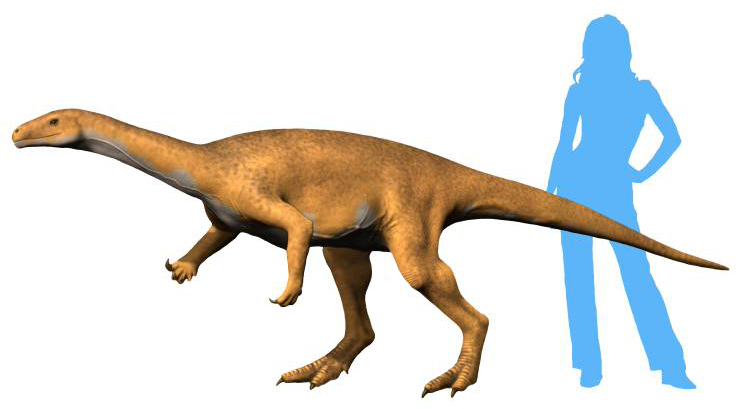
Restoration of Bagualosaurus agudoensis. (The female may not be to scale, the total length of Bagualosaurus in the original publication is given in a graph with a scale of 20 cm, and can be inferred to be about 1.6 m. See File:Bagualosaurus Scale.svg for a closer comparison)

Ahvaytum is a saturnaliid sauropodomorph from the Late Triassic of what is now Wyoming. It is the oldest known dinosaur from the northern continent of Laurasia, challenging previous hypotheses of dinosaur origins and dispersal. Typical of basal dinosaurs from the Triassic, Ahvaytum was a small slender biped, reaching about 1 m in body length.

Recreación de Saltillomimus rapidus, un género sin nombrar de Coahuila, México.

Huashanosaurus is a basal sauropod dinosaur that lived from the Early to Middle Jurassic periods of what is now China. It was a long-necked herbivore which still exhibited many basal traits of the earlier sauropodomorphs, while transitioning to obligate quardupedality. Huashanosaurus grew to approximately 12 m in length, and weighed around 10 t.