Dinosauria

Taxon

285 image(s) · 193 Actualités

Voir la fiche

Galerie d'images

Theiophytalia kerri Brill & Carpenter, 2006 - ornithopod dinosaur skull from the Cretaceous of Colorado, USA. (YPM 1887, public display, Garden of the Gods visitor center, Colorado Springs, Colorado, USA)
This skull is the holotype and only known specimen of an entire genus of ornithopod dinosaurs, Theiophytalia.  Ornithopods were herbivorous dinosaurs.


From exhibit signage:
A Brand New Dinosaur Species Theiophytalia kerri
What we know about the dinosaur fossil - so far:
It is the only Theiophytalia kerri fossil known to exist in the world.
It is a brand new genus and species of dinosaur.
Theiophytalia kerri means "belonging to the Garden of the Gods".  "Theios" is a Greek word that means "belonging to the gods" and "phytalia" means "garden".  "kerri" honors James Hutchinson Kerr (pronounced "Care"), who discovered the dinosaur fossil.
Theiophytalia was a medium-sized dinosaur, measuring about 30 feet from head to tail.
It was found in 1878 in the Garden of the Gods in the lower Lytle Member of the Purgatoire Rock Formation of the Dakota Group.
The dinosaur fossil skull is from the Aptian-Albian Age of the Cretaceous Ear, 125 - 100 million years old.
Look closely at the fossil skull.  Where are the teeth located?  You can see the teeth in the back of the jaw.  There are no teeth in the front of the dinosaur's beak-like mouth.  This is evidence that the Theiophytalia was a plant eater.  It could nip and tear plants, then grind them between its tightly-packed back teeth, similar to plant-eaters of today.
Timeline:
Dinosaur Fossil Discovered, then Forgotten
1878 - James Kerr, geology professor at Colorado College, finds a fossil skull "in one of the ridges east of the red rocks of the Garden of the Gods."
1886 - O.C. Marsh, famous 1800s dinosaur collector from Yale University, obtains the fossil skull from James Kerr, identifies it as a Camptosaurus dinosaur, and sends the fossil to the Yale Peabody Museum in New Haven, Connecticut.
1886 - 1995 - While the dinosaur fossil skull safely rests in the Yale Museum for many decades, knowledge of its existence is forgotten in Colorado Springs.
Rediscovery - 117 years later
1994 - Colorado Springs City park staff research new exhibits for the Garden of the Gods Visitor and Nature Center, set to open in 1995.  They meet with Doctor Kirk Johnson, curator of paleontology at the Denver Museum of Nature & Science.
1995 - Kirk Johnson refers the park staff to his museum colleague Doctor Ken Carpenter, expert dinosaur scientist.  Doctor Carpenter remembers seeing in his files "something about a dinosaur fossil found in Garden of the Gods" and mails the following article to park staff.
Camptosaurus amplus No. 1887, Yale Museum, consisting of portions of the skull and lower jaw.  It was collected from deposits in the Garden of the Gods, Colorado Springs, Colorado.  With this specimen was found the following note in Professor O.C. Marsh's handwriting, "Part of this animal and various Sauropoda bones were taken out by Professor Kerr in 1878."
A Case of Mistaken Identity Reveals a Brand New Dinosaur!
1996 - Kirk Johnson (a Yale alumnus) secures permission to hand-carry the Camptosaurus fossil from the Yale Peabody Museum to Denver so that Ken Carpenter can make a cast (a precise replica) of the fossil.
Doctor Carpenter notices irregularities in the Camptosaurus fossil and decides to re-examine the fossil when his schedule permits.
1997 - The Camptosaurus fossil replica is given to the City of Colorado Springs and is exhibited at the Garden of the Gods Visitor and Nature Center.
2006 - Doctor Carpenter and his associate Kathleen Brill reassess the fossil skull and note that it differs from other Camptosaurus skulls in several significant ways, such as the narrower mouth and snout, and the position of the nasal openings, and the bony structures over the eyes.
Also, microscopic identification of the rock matrix clinging to the fossil, and research of archival maps, reveal that the fossil skull was actually found in the lower Dakota Rock Formation, not the Morrison Formation as originally reported in the 1800s.  The skull is from a dinosaur that lived in the Cretaceous Ear and can't be a Jurassic Era Camptosaurus.
Doctor Carpenter's exacting research reveals that the dinosaur skull is a brand new genus and species of dinosaur!  He names it Theiophytalia kerri.
2008 - The Theiophytalia kerri is proudly re-exhibited at the Garden of the Gods Visitor and Nature Center.


Classification: Animalia, Chordata, Vertebrata, Dinosauria, Ornithischia, Ornithopoda
Stratigraphy: lower Lytle Member, Purgatoire Formation, Dakota Group, Aptian to Albian Stages, upper Lower Cretaceous
Locality: Garden of the Gods, Colorado Springs, Colorado, USA


See info. at:
en.wikipedia.org/wiki/Theiophytalia
and

en.wikipedia.org/wiki/Ornithopoda
Taxons Theiophytalia

Theiophytalia kerri Brill & Carpenter, 2006 - ornithopod dinosaur skull from the Cretaceous of Colorado, USA. (YPM 1887, public display, Garden of the Gods visitor center, Colorado Springs, Colorado, USA) This skull is the holotype and only known specimen of an entire genus of ornithopod dinosaurs, Theiophytalia. Ornithopods were herbivorous dinosaurs. From exhibit signage: A Brand New Dinosaur Species Theiophytalia kerri What we know about the dinosaur fossil - so far: It is the only Theiophytalia kerri fossil known to exist in the world. It is a brand new genus and species of dinosaur. Theiophytalia kerri means "belonging to the Garden of the Gods". "Theios" is a Greek word that means "belonging to the gods" and "phytalia" means "garden". "kerri" honors James Hutchinson Kerr (pronounced "Care"), who discovered the dinosaur fossil. Theiophytalia was a medium-sized dinosaur, measuring about 30 feet from head to tail. It was found in 1878 in the Garden of the Gods in the lower Lytle Member of the Purgatoire Rock Formation of the Dakota Group. The dinosaur fossil skull is from the Aptian-Albian Age of the Cretaceous Ear, 125 - 100 million years old. Look closely at the fossil skull. Where are the teeth located? You can see the teeth in the back of the jaw. There are no teeth in the front of the dinosaur's beak-like mouth. This is evidence that the Theiophytalia was a plant eater. It could nip and tear plants, then grind them between its tightly-packed back teeth, similar to plant-eaters of today. Timeline: Dinosaur Fossil Discovered, then Forgotten 1878 - James Kerr, geology professor at Colorado College, finds a fossil skull "in one of the ridges east of the red rocks of the Garden of the Gods." 1886 - O.C. Marsh, famous 1800s dinosaur collector from Yale University, obtains the fossil skull from James Kerr, identifies it as a Camptosaurus dinosaur, and sends the fossil to the Yale Peabody Museum in New Haven, Connecticut. 1886 - 1995 - While the dinosaur fossil skull safely rests in the Yale Museum for many decades, knowledge of its existence is forgotten in Colorado Springs. Rediscovery - 117 years later 1994 - Colorado Springs City park staff research new exhibits for the Garden of the Gods Visitor and Nature Center, set to open in 1995. They meet with Doctor Kirk Johnson, curator of paleontology at the Denver Museum of Nature & Science. 1995 - Kirk Johnson refers the park staff to his museum colleague Doctor Ken Carpenter, expert dinosaur scientist. Doctor Carpenter remembers seeing in his files "something about a dinosaur fossil found in Garden of the Gods" and mails the following article to park staff. Camptosaurus amplus No. 1887, Yale Museum, consisting of portions of the skull and lower jaw. It was collected from deposits in the Garden of the Gods, Colorado Springs, Colorado. With this specimen was found the following note in Professor O.C. Marsh's handwriting, "Part of this animal and various Sauropoda bones were taken out by Professor Kerr in 1878." A Case of Mistaken Identity Reveals a Brand New Dinosaur! 1996 - Kirk Johnson (a Yale alumnus) secures permission to hand-carry the Camptosaurus fossil from the Yale Peabody Museum to Denver so that Ken Carpenter can make a cast (a precise replica) of the fossil. Doctor Carpenter notices irregularities in the Camptosaurus fossil and decides to re-examine the fossil when his schedule permits. 1997 - The Camptosaurus fossil replica is given to the City of Colorado Springs and is exhibited at the Garden of the Gods Visitor and Nature Center. 2006 - Doctor Carpenter and his associate Kathleen Brill reassess the fossil skull and note that it differs from other Camptosaurus skulls in several significant ways, such as the narrower mouth and snout, and the position of the nasal openings, and the bony structures over the eyes. Also, microscopic identification of the rock matrix clinging to the fossil, and research of archival maps, reveal that the fossil skull was actually found in the lower Dakota Rock Formation, not the Morrison Formation as originally reported in the 1800s. The skull is from a dinosaur that lived in the Cretaceous Ear and can't be a Jurassic Era Camptosaurus. Doctor Carpenter's exacting research reveals that the dinosaur skull is a brand new genus and species of dinosaur! He names it Theiophytalia kerri. 2008 - The Theiophytalia kerri is proudly re-exhibited at the Garden of the Gods Visitor and Nature Center. Classification: Animalia, Chordata, Vertebrata, Dinosauria, Ornithischia, Ornithopoda Stratigraphy: lower Lytle Member, Purgatoire Formation, Dakota Group, Aptian to Albian Stages, upper Lower Cretaceous Locality: Garden of the Gods, Colorado Springs, Colorado, USA See info. at: en.wikipedia.org/wiki/Theiophytalia and en.wikipedia.org/wiki/Ornithopoda

États-Unis Crétacé fossile holotype +4
Sanxiasaurus modaoxiensis, a neornithischian dinosaur.
Taxons Sanxiasaurus

Sanxiasaurus modaoxiensis, a neornithischian dinosaur.

Dinosauria Neornithischia Sanxiasaurus
Nevadadromeus schmitti, a neornithischian dinosaur.
Taxons Nevadadromeus

Nevadadromeus schmitti, a neornithischian dinosaur.

Dinosauria Neornithischia Nevadadromeus
Changmiania liaoningensis, an ornithopod dinosaur from the Lower Cretaceous of Lujiatun (Liaoning Province, China).
(A) Holotype PMOL AD00114 in dorsal view; (B) anterior part of the holotype PMOL AD00114 in caudolateral view; (C) referred specimen PMOL LFV022 in dorsal view. Red arrows indicate the emplacement of the gastrolith clusters.
Taxons Changmiania

Changmiania liaoningensis, an ornithopod dinosaur from the Lower Cretaceous of Lujiatun (Liaoning Province, China). (A) Holotype PMOL AD00114 in dorsal view; (B) anterior part of the holotype PMOL AD00114 in caudolateral view; (C) referred specimen PMOL LFV022 in dorsal view. Red arrows indicate the emplacement of the gastrolith clusters.

Chine Crétacé holotype spécimen +2
Changchunsaurus parvus, a neornithischian dinosaur.
Taxons Changchunsaurus

Changchunsaurus parvus, a neornithischian dinosaur.

Changchunsaurus Dinosauria Neornithischia
Impression in stone of small dinosaur "nodosaur".
Taxons Propanoplosaurus

Impression in stone of small dinosaur "nodosaur".

Dinosauria Propanoplosaurus
Vectipelta at Dinosaur Isle Museum, Isle of Wight, England
Taxons Vectipelta

Vectipelta at Dinosaur Isle Museum, Isle of Wight, England

musée Dinosauria Vectipelta
Jiangxititan a titanosaurian sauropod from the Late Cretaceous of China. Typical for a sauropod, it had a long neck and stood on four pillar-like legs to support its massive body. Jiangxititan is a member of the Lognkosauria, which include some of the largest dinosaurs known, and is one of the few from mainland Asia. The discovery of Jiangxititan demonstrates the presence of both early-diverging and late-diverging titanosauriform sauropods in that area during the Late Cretaceous.
Taxons Jiangxititan

Jiangxititan a titanosaurian sauropod from the Late Cretaceous of China. Typical for a sauropod, it had a long neck and stood on four pillar-like legs to support its massive body. Jiangxititan is a member of the Lognkosauria, which include some of the largest dinosaurs known, and is one of the few from mainland Asia. The discovery of Jiangxititan demonstrates the presence of both early-diverging and late-diverging titanosauriform sauropods in that area during the Late Cretaceous.

Chine Crétacé Crétacé supérieur Dinosauria +5
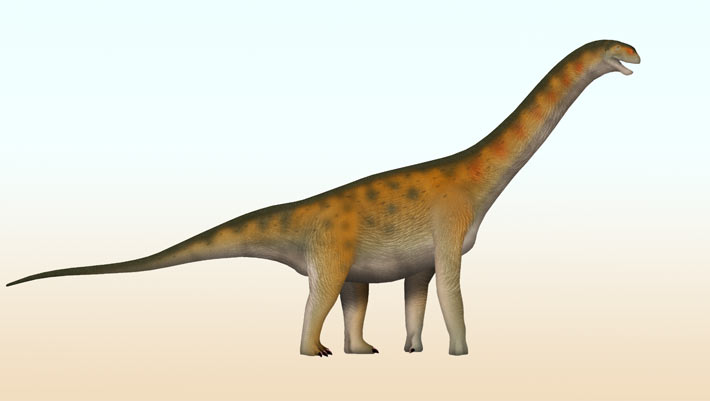
Garumbatitan is a sauropod dinosaur from the Early Cretaceous of what is now Spain. It is classified as a basal somphospondylan - a Titanosauriform, but not a true Titanosaur.
Taxons Garumbatitan

Garumbatitan is a sauropod dinosaur from the Early Cretaceous of what is now Spain. It is classified as a basal somphospondylan - a Titanosauriform, but not a true Titanosaur.

Espagne Crétacé Crétacé inférieur Dinosauria +4
Blue Dinosaur Royal Ontario Museum
Taxons Argentinosauridae

Blue Dinosaur Royal Ontario Museum

musée États-Unis Argentinosauria Argentinosauridae +3
Blue Dinosaur Royal Ontario Museum
Taxons Argentinosauria

Blue Dinosaur Royal Ontario Museum

musée États-Unis Argentinosauria Argentinosauridae +3
Reconstruction of Bravasaurus arreirosorum a titanosaur dinosaur from the Late Cretaceous of Argentina
Taxons Bravasaurus

Reconstruction of Bravasaurus arreirosorum a titanosaur dinosaur from the Late Cretaceous of Argentina

Argentine Crétacé Crétacé supérieur Bravasaurus +2
Gandititan is a basal titanosaurian sauropod dinosaur from the Late Cretaceous of what is now China. It was a long-necked herbivore, typical of sauropods, with a relatively short tail, a characteristic of titanosaurs compared to other sauropods. Titanosauria have a wide range of body sizes, and Gandititan falls around the middle, slightly on the smaller side. Discovered with a fairly well articluated spine from neck to tail, Gandititan is estimated at about 14 m in total body length.
Taxons Gandititan

Gandititan is a basal titanosaurian sauropod dinosaur from the Late Cretaceous of what is now China. It was a long-necked herbivore, typical of sauropods, with a relatively short tail, a characteristic of titanosaurs compared to other sauropods. Titanosauria have a wide range of body sizes, and Gandititan falls around the middle, slightly on the smaller side. Discovered with a fairly well articluated spine from neck to tail, Gandititan is estimated at about 14 m in total body length.

Chine Crétacé Crétacé supérieur Dinosauria +2
Skeletal reconstruction of the Sauropod dinosaur Abdarainurus barsboldi based on holotype PIN 5669/1, as figured in Averianov and Lopatin, 2020. Outline is based on related Sauropods, modified from SlvrHwk.
Taxons Abdarainurus

Skeletal reconstruction of the Sauropod dinosaur Abdarainurus barsboldi based on holotype PIN 5669/1, as figured in Averianov and Lopatin, 2020. Outline is based on related Sauropods, modified from SlvrHwk.

holotype Abdarainurus Dinosauria
This file represents a possible life appearance of the Indian Titanosaurian Sauropod dinosaur Jainosaurus septentrionalis from the Late Cretaceous (Maastrichtian) of India, belonging to the Lameta Formation.
References used: 
Huene & Matley (1933)
Hunt et al. (1995)
Gunnar Bivens' skeletal diagram

Wilson et al. (2008) "Reassessment of Sauropod Dinosaur Jainosaurus (="Antarctosaurus") Septentrionalis from the Upper Cretaceous of India"
Taxons Jainosaurus

This file represents a possible life appearance of the Indian Titanosaurian Sauropod dinosaur Jainosaurus septentrionalis from the Late Cretaceous (Maastrichtian) of India, belonging to the Lameta Formation. References used: Huene & Matley (1933) Hunt et al. (1995) Gunnar Bivens' skeletal diagram Wilson et al. (2008) "Reassessment of Sauropod Dinosaur Jainosaurus (="Antarctosaurus") Septentrionalis from the Upper Cretaceous of India"

Inde Lameta Crétacé Crétacé supérieur +6
Qunkasaura is a titanosaurian sauropod dinosaur that lived approximately 75 million years ago in the Late Cretaceous of what is now Spain. Specifically, it is a saltasaurid titanosaur, and its discovery marks the first instance of two distinct lineages of this group present in the same locality. In the Late Cretaceous, Europe was a large archipelago, and the coexistence of these differing lineages indicates that saltasaurids arrived in the Iberian Peninsula much later than other groups of dinosaurs.
Taxons Qunkasaura

Qunkasaura is a titanosaurian sauropod dinosaur that lived approximately 75 million years ago in the Late Cretaceous of what is now Spain. Specifically, it is a saltasaurid titanosaur, and its discovery marks the first instance of two distinct lineages of this group present in the same locality. In the Late Cretaceous, Europe was a large archipelago, and the coexistence of these differing lineages indicates that saltasaurids arrived in the Iberian Peninsula much later than other groups of dinosaurs.

Espagne Crétacé Crétacé supérieur Dinosauria +4
1 2 3 4 5 6 7 8 9 10 11 12 13 14 15 16 17 18

Actualités

Que mangeaient les dinosaures ? Un guide utile sur les régimes alimentaires des dinosaures
os mâchoire dent fossile Dinosauria étude
Vous êtes-vous déjà demandé ce que mangeaient les dinosaures ? C’est l’une des questions les plus fréquemment posées chez Everything Dinosaur. La réponse est étonnamment variée. Certains dinosaures étaient de féroces mangeurs de viande, tandis que d’autres se nourrissaient de plantes. D'autres étaient omnivores (mangant à la fois des plantes et de la viande). Les scientifiques étudient les dents fossiles, les os de la mâchoire, le contenu de l'estomac et même les fossiles
22/06/2026 everythingdinosaur ⚙ Traduction automatique
Paléontologie et paléoart connectés dans un événement exclusif
paléoart Dinosauria évolution
Les clients de Everything Dinosaur sont invités à rejoindre Mike pour une interview spéciale en direct explorant le lien entre la paléontologie et le paléoart.  Cette interview exclusive (événement Zoom) a lieu la semaine prochaine (mercredi). Le titre « Paléontologie et Paléoart Connecté » met en avant les différentes disciplines impliquées dans la conception de la gamme de modèles Everything Dinosaur Evolution. Mike de
21/06/2026 everythingdinosaur ⚙ Traduction automatique
Yi: Beast of the Week
Yi : la bête de la semaine
Chine Jurassique Jurassique supérieur Dinosauria Yi évolution
 Cette semaine, nous allons découvrir un dinosaure si inhabituel qu'il a complètement changé ce que nous pensions savoir sur l'évolution des dinosaures.  Découvrez Yi qi ! (prononcé « EE-chee ») Yi était un petit dinosaure théropode qui vivait dans ce qui est aujourd'hui le Hebei, dans le nord-est de la Chine, à la fin du Jurassique, il y a environ 159 millions d'années.  Du museau à la queue, il ne mesurait qu'environ 30 cm de long et son envergure mesurait environ 60 cm de large.  Le genre est venu, "Yi" se traduit du mandarin par "aile" et
21/06/2026 prehistoricbeastoftheweek ⚙ Traduction automatique
Plus grand que le T. rex, ce dinosaure géant savait-il vraiment nager ? Voici ce que révèle une nouvelle découverte
os locomotion Niger Dinosauria Spinosauria Spinosaurus comportement biomécanique découverte nouvelle espèce
Un os découvert au Niger en 2022 rouvre un dossier paléontologique parmi les plus épineux. Une nouvelle espèce de spinosaure vient d'être décrite dans la revue Science. Et avec elle, la question qui divise les chercheurs depuis des années refait surface : ce dinosaure géant nageait-il vraiment ?
20/06/2026 futura-terre
Aider les clients avec les livraisons dans le monde entier
membre Dinosauria
Aider les clients avec les livraisons fait partie du service primé fourni par Everything Dinosaur. Les membres de l'équipe, Mike et Sue, travaillent dur pour garantir que les colis parviennent en toute sécurité aux collectionneurs et aux fans de dinosaures. De plus, ils apportent soutien et réconfort tout au long du processus de livraison. Quelle que soit la destination d'un colis dans le monde, Mike et Sue
20/06/2026 everythingdinosaur ⚙ Traduction automatique
1 2 3 4 5 6 7 8 9 10 11 12 13 14 15 16 17 18 19 20 21 22 23 24 25 26 27 28 29 30 31 32 33 34 35 36 37 38 39