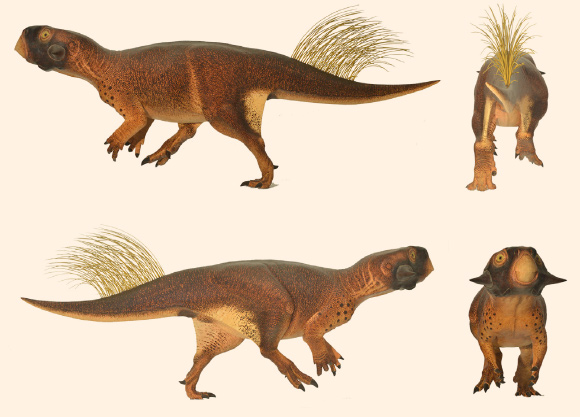
Dinosauria

Taxon

285 image(s) · 193 Actualités

Voir la fiche

Galerie d'images

Saltasaurus (which means "lizard from Salta") was a sauropod dinosaur of the Late Cretaceous Period. Relatively small among sauropods, though still massive by human standards, it was characterized by a diplodocid-like head
Taxons Saltasaurus

Saltasaurus (which means "lizard from Salta") was a sauropod dinosaur of the Late Cretaceous Period. Relatively small among sauropods, though still massive by human standards, it was characterized by a diplodocid-like head

Crétacé Crétacé supérieur Balochisauridae Dinosauria +7
Saltasaurus (which means "lizard from Salta") was a sauropod dinosaur of the Late Cretaceous Period. Relatively small among sauropods, though still massive by human standards, it was characterized by a diplodocid-like head
Taxons Lithostrotia

Saltasaurus (which means "lizard from Salta") was a sauropod dinosaur of the Late Cretaceous Period. Relatively small among sauropods, though still massive by human standards, it was characterized by a diplodocid-like head

Crétacé Crétacé supérieur Balochisauridae Dinosauria +7
Saltasaurus (which means "lizard from Salta") was a sauropod dinosaur of the Late Cretaceous Period. Relatively small among sauropods, though still massive by human standards, it was characterized by a diplodocid-like head
Taxons Titanosauridae

Saltasaurus (which means "lizard from Salta") was a sauropod dinosaur of the Late Cretaceous Period. Relatively small among sauropods, though still massive by human standards, it was characterized by a diplodocid-like head

Crétacé Crétacé supérieur Balochisauridae Dinosauria +7
Saltasaurus (which means "lizard from Salta") was a sauropod dinosaur of the Late Cretaceous Period. Relatively small among sauropods, though still massive by human standards, it was characterized by a diplodocid-like head
Taxons Saltasauridae

Saltasaurus (which means "lizard from Salta") was a sauropod dinosaur of the Late Cretaceous Period. Relatively small among sauropods, though still massive by human standards, it was characterized by a diplodocid-like head

Crétacé Crétacé supérieur Balochisauridae Dinosauria +7
Saltasaurus (which means "lizard from Salta") was a sauropod dinosaur of the Late Cretaceous Period. Relatively small among sauropods, though still massive by human standards, it was characterized by a diplodocid-like head
Taxons Saltasaurinae

Saltasaurus (which means "lizard from Salta") was a sauropod dinosaur of the Late Cretaceous Period. Relatively small among sauropods, though still massive by human standards, it was characterized by a diplodocid-like head

Crétacé Crétacé supérieur Balochisauridae Dinosauria +7
Saltasaurus (which means "lizard from Salta") was a sauropod dinosaur of the Late Cretaceous Period. Relatively small among sauropods, though still massive by human standards, it was characterized by a diplodocid-like head
Taxons Balochisauridae

Saltasaurus (which means "lizard from Salta") was a sauropod dinosaur of the Late Cretaceous Period. Relatively small among sauropods, though still massive by human standards, it was characterized by a diplodocid-like head

Crétacé Crétacé supérieur Balochisauridae Dinosauria +7
Saltasaurus (which means "lizard from Salta") was a sauropod dinosaur of the Late Cretaceous Period. Relatively small among sauropods, though still massive by human standards, it was characterized by a diplodocid-like head
Taxons Saltasaurini

Saltasaurus (which means "lizard from Salta") was a sauropod dinosaur of the Late Cretaceous Period. Relatively small among sauropods, though still massive by human standards, it was characterized by a diplodocid-like head

Crétacé Crétacé supérieur Balochisauridae Dinosauria +7
A visual representation of Yamanasaurus lojaensis, first dinosaur discovered in Ecuador
Taxons Yamanasaurus

A visual representation of Yamanasaurus lojaensis, first dinosaur discovered in Ecuador

Équateur Dinosauria Yamanasaurus
Reconstruction of the holotype skull (PIN 3906/2) of the Late Cretaceous sauropod Quaesitosaurus orientalis. Based on Kurzanov & Bannikov 1983,[1] missing elements restored after Nemegtosaurus.[2]
Color Key
  Preserved
  Missing
References

↑ (1983). "A new sauropod from the Upper Cretaceous of Mongolia". Paleontological Journal 2: 90−96.

↑ (2005). "Redescription of the mongolian sauropod Nemegtosaurus mongoliensis nowinski (dinosauria: Saurischia) and comments on late cretaceous sauropod diversity". Journal of Systematic Palaeontology 3 (3): 283−318. DOI:10.1017/S1477201905001628.
Taxons Quaesitosaurus

Reconstruction of the holotype skull (PIN 3906/2) of the Late Cretaceous sauropod Quaesitosaurus orientalis. Based on Kurzanov & Bannikov 1983,[1] missing elements restored after Nemegtosaurus.[2] Color Key   Preserved   Missing References ↑ (1983). "A new sauropod from the Upper Cretaceous of Mongolia". Paleontological Journal 2: 90−96. ↑ (2005). "Redescription of the mongolian sauropod Nemegtosaurus mongoliensis nowinski (dinosauria: Saurischia) and comments on late cretaceous sauropod diversity". Journal of Systematic Palaeontology 3 (3): 283−318. DOI:10.1017/S1477201905001628.

Mongolie Crétacé Crétacé supérieur holotype +5
Restoration of Borealosaurus a potentially titanosaur dinosaur from the Cretaceous of China
Taxons Borealosaurus

Restoration of Borealosaurus a potentially titanosaur dinosaur from the Cretaceous of China

Chine Crétacé Borealosaurus Dinosauria +1
Map of the localities in the Bauru Basin where the sauropod dinosaurs were collected.
Taxons Ibirania

Map of the localities in the Bauru Basin where the sauropod dinosaurs were collected.

Dinosauria Ibirania
(A) A phylogenetic principal-component analysis (PCA) represents the projection of the Dinosauria supertree (STAR Methods) into a PCA of climatic variables. PC1 axis shows strong positive correlation with maximum temperature ([temp max), low positive correlation with precipitation seasonality ( precip season), strong negative correlation with minimum temperature (Ytemp min), and strong negative correlation with minimum precipitation (Yprecip min). PC2 axis shows strong positive correlation with minimum temperature ([temp min) and negative correlation with precipitation seasonality (Yprecip season). Shadows around points highlight the relative density in the principal compo- nent space of non-dinosaurian Dinosauromorpha (gray), Ornithischia (blue), Sauropodomorpha (green), and Theropoda (red).
(B) Lower left plot shows 95% confidence interval convex hulls for each dinosauromorph subclade. Blue thermometer (top left corner) symbolizes the direction of the vector in the PC space region for cold temper- atures; yellow thermometer (top right corner) indicates the direction of the vector in PC space for warm tem- peratures; brown shrub (top right corner) depicts dry conditions, while the same with a gray, rainy cloud (mid, lower side of the graph) illustrates seasonal conditions.
Silhouettes represent the following taxa (clockwise from the higher left corner): Minmi, Edmontosaurus, Pachyrhinosaurus, Tyrannosaurus, Asilisaurus, Graci- liceratops, Harpymimus, Altirhinus, Gobititan, Suz- housaurus, Marasuchus, Pampadromaeus, Herrer- asaurus, Vulcanodon, Diplodocus, Giraffatitan,

Coelophysis, Dromomeron, Gondwanatitan, Tapuiasaurus, Anchisaurus, Siamotyrannus, Diodorus, Suchomimus, Phuwiangosaurus, Ouranosaurus, Irritator, Tangvayosaurus, Nanshiungosaurus, Aeolosaurus, Rebbachisaurus, Chuxiongosaurus, Tethyshadros, Koreanosaurus. Genyodectes, Mapusaurus, Vegavis, Goyocephale, and Rhoetosaurus.
Taxons Pampadromaeus

(A) A phylogenetic principal-component analysis (PCA) represents the projection of the Dinosauria supertree (STAR Methods) into a PCA of climatic variables. PC1 axis shows strong positive correlation with maximum temperature ([temp max), low positive correlation with precipitation seasonality ( precip season), strong negative correlation with minimum temperature (Ytemp min), and strong negative correlation with minimum precipitation (Yprecip min). PC2 axis shows strong positive correlation with minimum temperature ([temp min) and negative correlation with precipitation seasonality (Yprecip season). Shadows around points highlight the relative density in the principal compo- nent space of non-dinosaurian Dinosauromorpha (gray), Ornithischia (blue), Sauropodomorpha (green), and Theropoda (red). (B) Lower left plot shows 95% confidence interval convex hulls for each dinosauromorph subclade. Blue thermometer (top left corner) symbolizes the direction of the vector in the PC space region for cold temper- atures; yellow thermometer (top right corner) indicates the direction of the vector in PC space for warm tem- peratures; brown shrub (top right corner) depicts dry conditions, while the same with a gray, rainy cloud (mid, lower side of the graph) illustrates seasonal conditions. Silhouettes represent the following taxa (clockwise from the higher left corner): Minmi, Edmontosaurus, Pachyrhinosaurus, Tyrannosaurus, Asilisaurus, Graci- liceratops, Harpymimus, Altirhinus, Gobititan, Suz- housaurus, Marasuchus, Pampadromaeus, Herrer- asaurus, Vulcanodon, Diplodocus, Giraffatitan, Coelophysis, Dromomeron, Gondwanatitan, Tapuiasaurus, Anchisaurus, Siamotyrannus, Diodorus, Suchomimus, Phuwiangosaurus, Ouranosaurus, Irritator, Tangvayosaurus, Nanshiungosaurus, Aeolosaurus, Rebbachisaurus, Chuxiongosaurus, Tethyshadros, Koreanosaurus. Genyodectes, Mapusaurus, Vegavis, Goyocephale, and Rhoetosaurus.

Dinosauria Ornithischia Pampadromaeus Sauropodomorpha +1
Simplified cladogram of Iguanodontia, drawn by me, based on Norman 2004 ("Basal Iguanodontia" in The Dinosauria 2nd Edition).

Simplified cladogram of Iguanodontia, drawn by me, based on Norman 2004 ("Basal Iguanodontia" in The Dinosauria 2nd Edition).

Dinosauria Iguanodontia Mochlodon
Herbivorous dinosaur found in the Al-khoudh area.  This dinosaur is similar to the Zalmoxes and Rhabdodon dinosaurs.  The skeleton in the Bait Al Baranda Museum was assembled from bones borrowed from several museums.

Herbivorous dinosaur found in the Al-khoudh area. This dinosaur is similar to the Zalmoxes and Rhabdodon dinosaurs. The skeleton in the Bait Al Baranda Museum was assembled from bones borrowed from several museums.

os musée Dinosauria Mochlodon +3
Locality map for Australian eurypodan thyreophoran fossils.

1, Stegosaurian? footprint (QM F5701), Walloon Coal Measures, Balgowan Colliery, Balgowan (Bajocian–Bathonian); 2, Minmi paravertebra holotype (QM F10329) (Molnar, 1980), Minmi Member, Bungil Formation (Valanginian–Barremian); 3, Thyreophoran trackways, Broome Sandstone, Dampier Peninsula, Western Australia (Valanginian–Barremian); 4, Ankylosauria indet. (see Barrett et al., 2010) ‘Flat Rocks’ Wonthaggi Formation (upper Hauterivian–Albian); 5, NMV P216739, ‘Lake Copco–Dinosaur Cove’ Eumeralla Formation (middle upper Aptian to lower middle Albian) (Barrett et al., 2010); 6, QM F33286; 7, AM F119849 and AM F35259; 8, Kunbarrasaurus ieversi gen. et sp. nov. (formerly Minmi sp.) (QM F18101); 9, QM F33565 and QM F33566; 10, QM F44324-28. Legend: Dark Green, Toolebuc Formation (late middle–early late Albian); Green, Allaru Formation (upper Albian–(?)lower Cenomanian); Light green, Mackunda Formation (upper Albian–lower Cenomanian); Lightest green, Winton Formation (late Albian–early Turonian).
Formations Toolebuc

Locality map for Australian eurypodan thyreophoran fossils. 1, Stegosaurian? footprint (QM F5701), Walloon Coal Measures, Balgowan Colliery, Balgowan (Bajocian–Bathonian); 2, Minmi paravertebra holotype (QM F10329) (Molnar, 1980), Minmi Member, Bungil Formation (Valanginian–Barremian); 3, Thyreophoran trackways, Broome Sandstone, Dampier Peninsula, Western Australia (Valanginian–Barremian); 4, Ankylosauria indet. (see Barrett et al., 2010) ‘Flat Rocks’ Wonthaggi Formation (upper Hauterivian–Albian); 5, NMV P216739, ‘Lake Copco–Dinosaur Cove’ Eumeralla Formation (middle upper Aptian to lower middle Albian) (Barrett et al., 2010); 6, QM F33286; 7, AM F119849 and AM F35259; 8, Kunbarrasaurus ieversi gen. et sp. nov. (formerly Minmi sp.) (QM F18101); 9, QM F33565 and QM F33566; 10, QM F44324-28. Legend: Dark Green, Toolebuc Formation (late middle–early late Albian); Green, Allaru Formation (upper Albian–(?)lower Cenomanian); Light green, Mackunda Formation (upper Albian–lower Cenomanian); Lightest green, Winton Formation (late Albian–early Turonian).

Australie Broome Sandstone Eumeralla Toolebuc +18
Original figure caption: .mw-parser-output .smallcaps{font-variant:small-caps}The Middletown Slab covered with the Footprints of Carnivorous Dinosaurs. The tracks are in high relief. Additional notes: Most if not all of these tridactylous (i.e. three-toed) footprints/tracks (but not the actual trackmaker!) are referred to as Grallator or as Grallator-type trace fossils. “High relief” means that these are actually casts of footprints forming a positive relief on the lower surface of the sandstone slab (so-called positive hyporelief). The material that originally formed the mud over which the dinosaurs walked was too friable to be recovered from the quarry in one piece. The slab consists of so called ‘brownstone’ which is the trading name of the sandstone quarried at Middletown, Connecticut. This sandstone belongs to the Lower Jurassic Portland Formation of the Hartford Basin (“Connecticut Valley”) and thus to the upper part of the Newark Supergroup. The trackmakers probably were relatively small ‘primitive’ theropod dinosaurs (coelophysoids) such as Podokesaurus the remains of which were recovered from Lower Jurassic deposits of the Hartford Basin.
Formations Portland

Original figure caption: .mw-parser-output .smallcaps{font-variant:small-caps}The Middletown Slab covered with the Footprints of Carnivorous Dinosaurs. The tracks are in high relief. Additional notes: Most if not all of these tridactylous (i.e. three-toed) footprints/tracks (but not the actual trackmaker!) are referred to as Grallator or as Grallator-type trace fossils. “High relief” means that these are actually casts of footprints forming a positive relief on the lower surface of the sandstone slab (so-called positive hyporelief). The material that originally formed the mud over which the dinosaurs walked was too friable to be recovered from the quarry in one piece. The slab consists of so called ‘brownstone’ which is the trading name of the sandstone quarried at Middletown, Connecticut. This sandstone belongs to the Lower Jurassic Portland Formation of the Hartford Basin (“Connecticut Valley”) and thus to the upper part of the Newark Supergroup. The trackmakers probably were relatively small ‘primitive’ theropod dinosaurs (coelophysoids) such as Podokesaurus the remains of which were recovered from Lower Jurassic deposits of the Hartford Basin.

Portland Jurassique moulage fossile +4
1 2 3 4 5 6 7 8 9 10 11 12 13 14 15 16 17 18

Actualités

Small Sauropod Dinosaur from Jurassic Period Discovered in India
Un petit dinosaure sauropode du Jurassique découvert en Inde
bassin Inde Jurassique Jurassique moyen Dinosauria partiel squelette
Des paléontologues indiens ont mis au jour un squelette partiel d’un petit dinosaure néosauropode jusqu’alors inconnu dans les roches du Jurassique moyen du bassin de Kachchh, dans le Gujarat. L'article Petit dinosaure sauropode de la période jurassique découvert en Inde apparaît en premier sur Sci.News : Breaking Science News.
21/07/2026 sci-news ⚙ Traduction automatique
Modèles de dinosaures DinoCon 2026 – Réservez le vôtre avec Everything Dinosaur
Royaume-Uni Dinosauria
Everything Dinosaur a hâte d’assister à la DinoCon 2026 ce week-end. Mike et Sue exposeront à nouveau dans le Vendors Hall (tableau 7), où ils rencontreront des clients, des collectionneurs et des passionnés d'animaux préhistoriques de tout le Royaume-Uni. Nous offrirons aux collectionneurs la possibilité de réserver des modèles de dinosaures DinoCon 2026. Micro
21/07/2026 everythingdinosaur ⚙ Traduction automatique
Certains dinosaures pourraient s'élever comme des géants jusqu'à devenir trop gros
prédateur Dinosauria biomécanique
Deux sauropodes sud-américains de la taille d'un éléphant étaient exceptionnellement bien bâtis pour se tenir debout sur leurs pattes postérieures. Des tests numériques ont montré que leurs fémurs robustes supportaient mieux les énormes forces que ceux des espèces plus grandes, en particulier lorsque les dinosaures étaient jeunes. La pose verticale les a peut-être aidés à atteindre la cime des arbres, à effrayer les prédateurs ou à impressionner des partenaires potentiels.
20/07/2026 sciencedaily ⚙ Traduction automatique
Les commentaires incroyables des clients cinq étoiles aident Everything Dinosaur à maintenir un historique de service exceptionnel
Dinosauria
Recevoir des commentaires clients cinq étoiles est toujours une merveilleuse façon de commencer une journée de vente en ligne de dinosaures. Sue et moi recevons un nombre incroyable de critiques cinq étoiles. Chez Everything Dinosaur, nous sommes ravis de partager une autre excellente critique de l’un de nos précieux clients. Les commentaires indépendants des clients nous aident à mesurer et à maintenir nos performances. De plus,
19/07/2026 everythingdinosaur ⚙ Traduction automatique
Impressionnant art de sable d’animaux préhistoriques
Dinosauria Plesiosauria Spinosauria
Chez Everything Dinosaur, nous sommes toujours ravis de voir à quel point les animaux préhistoriques inspirent la créativité. Récemment, nous avons reçu d'incroyables œuvres d'art sur sable d'animaux préhistoriques créées par le jeune artiste talentueux Caldey. Caldey a utilisé du sable pour créer deux magnifiques sculptures sur le thème de la préhistoire. L’œuvre d’art présentait un plésiosaure gracieux et un spinosaure spectaculaire. Ces créations fantastiques démontrent comment les dinosaures
18/07/2026 everythingdinosaur ⚙ Traduction automatique
1 2 3 4 5 6 7 8 9 10 11 12 13 14 15 16 17 18 19 20 21 22 23 24 25 26 27 28 29 30 31 32 33 34 35 36 37 38 39