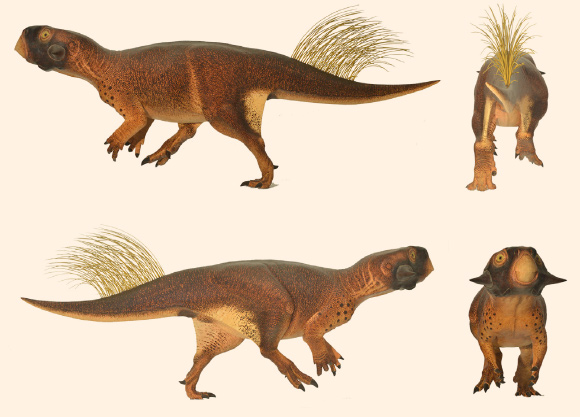
Dinosauria

Taxon

285 image(s) · 193 Actualités

Voir la fiche

Galerie d'images

fossil Europasaurus, Aathal Dinosaur Museum.
Taxons Europasaurus

fossil Europasaurus, Aathal Dinosaur Museum.

musée fossile Dinosauria Europasaurus
Right hind limb of the sauropodomorph dinosaur Musankwa sanyatiensis gen. et sp. nov. (NHMZ 2521) from the Pebbly Arkose Formation (Norian, Upper Triassic) of Spurwing Island, Zimbabwe. A. Right femur in posterior (A1), lateral (A2), anterior (A3), medial (A4), proximal (A5), and distal (A6) views. B. Right tibia with conjoined astragalus in anterior (B1), lateral (B2), posterior (B3), medial (B4), and proximal (B5) views.
Taxons Musankwa

Right hind limb of the sauropodomorph dinosaur Musankwa sanyatiensis gen. et sp. nov. (NHMZ 2521) from the Pebbly Arkose Formation (Norian, Upper Triassic) of Spurwing Island, Zimbabwe. A. Right femur in posterior (A1), lateral (A2), anterior (A3), medial (A4), proximal (A5), and distal (A6) views. B. Right tibia with conjoined astragalus in anterior (B1), lateral (B2), posterior (B3), medial (B4), and proximal (B5) views.

membre Zimbabwe Norien Trias +3
Reconstruction of Tuebingosaurus maierfritzorum gen. et sp. nov. as a quadruped dinosaur, using the outline of Riojasaurus as a base ‒ next to the silhouette of Friedrich von Huene. The drawing of the bones is based on and modified from the original illustrations of specimen “GPIT IV” in von Huene (1932, pl. 38) that have been replicated in the literature. The right fibula is marked in grey as it was found nearby with similar measurements to the left fibula and has been assumed to be part of the same individual.
Taxons Tuebingosaurus

Reconstruction of Tuebingosaurus maierfritzorum gen. et sp. nov. as a quadruped dinosaur, using the outline of Riojasaurus as a base ‒ next to the silhouette of Friedrich von Huene. The drawing of the bones is based on and modified from the original illustrations of specimen “GPIT IV” in von Huene (1932, pl. 38) that have been replicated in the literature. The right fibula is marked in grey as it was found nearby with similar measurements to the left fibula and has been assumed to be part of the same individual.

os dessin spécimen Dinosauria +2
Selmasaurus johnsoni mounted skull in the Rocky Mountain Dinosaur Resource Center in Woodland Park, Colorado

Selmasaurus johnsoni mounted skull in the Rocky Mountain Dinosaur Resource Center in Woodland Park, Colorado

Dinosauria Selmasaurus crâne
The Natural Science Museum at El Chocón, in the northwestern Argentine Patagonia (the Comahue region). Fossil of dinosaur

The Natural Science Museum at El Chocón, in the northwestern Argentine Patagonia (the Comahue region). Fossil of dinosaur

musée Argentine fossile Dinosauria +1
Picture of Justin Hofmann holding the right hindlimb of his self-named dinosaur, Nedcolbertia justinhofmanni.

Picture of Justin Hofmann holding the right hindlimb of his self-named dinosaur, Nedcolbertia justinhofmanni.

Dinosauria Nedcolbertia
Known fossil pieces after Aviatyrannis jurassica (Dinosauria, Theropoda, Coelurosauria, Tyrannosauroidea).[1]
Sources

↑ Rauhut O.W.M. (2003), "A tyrannosaurid dinosaur from the Upper Jurassic of Portugal", Paleontology 46(5): p. 903-910.

Known fossil pieces after Aviatyrannis jurassica (Dinosauria, Theropoda, Coelurosauria, Tyrannosauroidea).[1] Sources ↑ Rauhut O.W.M. (2003), "A tyrannosaurid dinosaur from the Upper Jurassic of Portugal", Paleontology 46(5): p. 903-910.

Portugal Jurassique fossile Aviatyrannis +5
Achelousaurus horneri skull, collected in Glacier County, Montana, at the Museum of the Rockies in Bozeman, Montana.
The Ceratopsidae are those dinosaurs with head frills.  There are three large subgroups of Ceratopsidae: Centrosaurinae, Ceratopsinae, and Chasmosaurinae. The Triceratopsini are a "tribe" of the Chasmosaurinae -- a genus so vast that it gets the special name "tribe".  The Pachyrhinosaurini are a "tribe" within the Centrosaurinae.

Achelousaurus is a genus within the Pachyrhinosaurini.  So far, only three skulls and some limited skeletal remains have been collected anywhere in the world -- and all of them in Montana.  Their bony frills are quite similar to the Styracosaurus albertensis, although their other skull features (such as big bony bosses on the nose and behind the eyes) are not.

Achelousaurus horneri skull, collected in Glacier County, Montana, at the Museum of the Rockies in Bozeman, Montana. The Ceratopsidae are those dinosaurs with head frills. There are three large subgroups of Ceratopsidae: Centrosaurinae, Ceratopsinae, and Chasmosaurinae. The Triceratopsini are a "tribe" of the Chasmosaurinae -- a genus so vast that it gets the special name "tribe". The Pachyrhinosaurini are a "tribe" within the Centrosaurinae. Achelousaurus is a genus within the Pachyrhinosaurini. So far, only three skulls and some limited skeletal remains have been collected anywhere in the world -- and all of them in Montana. Their bony frills are quite similar to the Styracosaurus albertensis, although their other skull features (such as big bony bosses on the nose and behind the eyes) are not.

musée États-Unis Achelousaurus Centrosaurinae +8
Line diagram of the holotype specimen (ZPAL MgD-I/117) of the protoceratopsid Breviceratops kozlowskii. Based on Maryańska & Osmólska 1975,[1] and Czepiński 2019.[2]
References

↑ (1975). "Protoceratopsidae (Dinosauria) of Asia". Palaeontologia Polonica 33: 134−143. Archived from the original on 2018-09-21. Retrieved on 2021-07-25.

↑ (2019). "Ontogeny and variation of a protoceratopsid dinosaur Bagaceratops rozhdestvenskyi from the Late Cretaceous of the Gobi Desert". Historical Biology: 1−28. DOI:10.1080/08912963.2019.1593404. Archived from the original on 2021-07-08. Retrieved on 2021-07-25.
Taxons Breviceratops

Line diagram of the holotype specimen (ZPAL MgD-I/117) of the protoceratopsid Breviceratops kozlowskii. Based on Maryańska & Osmólska 1975,[1] and Czepiński 2019.[2] References ↑ (1975). "Protoceratopsidae (Dinosauria) of Asia". Palaeontologia Polonica 33: 134−143. Archived from the original on 2018-09-21. Retrieved on 2021-07-25. ↑ (2019). "Ontogeny and variation of a protoceratopsid dinosaur Bagaceratops rozhdestvenskyi from the Late Cretaceous of the Gobi Desert". Historical Biology: 1−28. DOI:10.1080/08912963.2019.1593404. Archived from the original on 2021-07-08. Retrieved on 2021-07-25.

ontogenèse Crétacé Crétacé supérieur holotype +5
Reconstructed skull of Jaxartosaurus aralensis Riabinin, 1937. Only a posterior portion of the skull, as well as a surangular is known, with the rest of the skull being based mostly upon File:Aralosaurus skull.png. Jaxartosaurus is currently classified as a basal lambeosaurine, more derived than Aralosaurini, but more primitive than Parasaurolophini and Lambeosaurini. It might be more derived than Tsintaosaurini (Godefroit et al., 2004). References: 
Riabinin, A.M. (1937). "A New Finding of Dinosaurs in the Trans-Baikal Region". Ezhegodn. Vserossijskogo Palaeont. Obstcg. 11: 142–144
Godefroit, P.; Bolotsky, Y.L.; Van Itterbeeck, J. (2004). "The lambeosaurine dinosaur Amurosaurus riabinini, from the
Maastrichtian of Far Eastern Russia". Acta Palaeontologica Polonica 49(4): 585–618
Taxons Jaxartosaurus

Reconstructed skull of Jaxartosaurus aralensis Riabinin, 1937. Only a posterior portion of the skull, as well as a surangular is known, with the rest of the skull being based mostly upon File:Aralosaurus skull.png. Jaxartosaurus is currently classified as a basal lambeosaurine, more derived than Aralosaurini, but more primitive than Parasaurolophini and Lambeosaurini. It might be more derived than Tsintaosaurini (Godefroit et al., 2004). References: Riabinin, A.M. (1937). "A New Finding of Dinosaurs in the Trans-Baikal Region". Ezhegodn. Vserossijskogo Palaeont. Obstcg. 11: 142–144 Godefroit, P.; Bolotsky, Y.L.; Van Itterbeeck, J. (2004). "The lambeosaurine dinosaur Amurosaurus riabinini, from the Maastrichtian of Far Eastern Russia". Acta Palaeontologica Polonica 49(4): 585–618

Russie Maastrichtien Amurosaurus Aralosaurini +7
Yandusaurus hongheensis, a neornithischian dinosaur.

Yandusaurus hongheensis, a neornithischian dinosaur.

Dinosauria Neornithischia Yandusaurus
Rendition of possible appearance of the dinosaur genus Nyasasaurus from the Middle Triassic, possibly the earliest known dinosaur.  Black portions represent the partial skeletal fragments (a humerus and six vertebrae) from one specimen blue portions represent fragments from a second specimen (three cervical vertebrae) on which the current likely form of the animal is based.

Rendition of possible appearance of the dinosaur genus Nyasasaurus from the Middle Triassic, possibly the earliest known dinosaur. Black portions represent the partial skeletal fragments (a humerus and six vertebrae) from one specimen blue portions represent fragments from a second specimen (three cervical vertebrae) on which the current likely form of the animal is based.

humérus Trias moyen Trias spécimen +3
historická budova Národního muzea v Praze - západní dvorana s proskleným stropem a kostrou dinosaura / historic building of the National Museum in Prague - West hall with glass ceiling and dinosaur skeleton
location: Prague, Czech Republic
author: Jan Helebrant
www.juhele.blogspot.com

license CC0 Public Domain Dedication

historická budova Národního muzea v Praze - západní dvorana s proskleným stropem a kostrou dinosaura / historic building of the National Museum in Prague - West hall with glass ceiling and dinosaur skeleton location: Prague, Czech Republic author: Jan Helebrant www.juhele.blogspot.com license CC0 Public Domain Dedication

musée Tchéquie Amargasaurus Dinosauria +1
Dinosaur's Museum in Savannakhet, Laos
Taxons Tangvayosaurus

Dinosaur's Museum in Savannakhet, Laos

musée Laos Dinosauria Tangvayosaurus
Figure 1: Geographic provenance and speculative reconstruction of the gigantic titanosaurian sauropod dinosaur Notocolossus gonzalezparejasi gen. et sp. nov.
(a) Type locality of Notocolossus (indicated by star) in southern-most Mendoza Province, Argentina. (b) Reconstructed skeleton and body silhouette in right lateral view, with preserved elements of the holotype (UNCUYO-LD 301) in light green and those of the referred specimen (UNCUYO-LD 302) in orange. Scale bar, 1 m. (All images were hand drawn by the senior author [B.J.G.R.] and subsequently edited using Adobe Illustrator software.)

Figure 1: Geographic provenance and speculative reconstruction of the gigantic titanosaurian sauropod dinosaur Notocolossus gonzalezparejasi gen. et sp. nov. (a) Type locality of Notocolossus (indicated by star) in southern-most Mendoza Province, Argentina. (b) Reconstructed skeleton and body silhouette in right lateral view, with preserved elements of the holotype (UNCUYO-LD 301) in light green and those of the referred specimen (UNCUYO-LD 302) in orange. Scale bar, 1 m. (All images were hand drawn by the senior author [B.J.G.R.] and subsequently edited using Adobe Illustrator software.)

écaille Argentine holotype spécimen +4
Anterior dorsal vertebra of the sauropod dinosaur Tendaguria tanzaniensis.
Taxons Tendaguriidae

Anterior dorsal vertebra of the sauropod dinosaur Tendaguria tanzaniensis.

vertèbre Dinosauria Tendaguria Tendaguriidae
1 2 3 4 5 6 7 8 9 10 11 12 13 14 15 16 17 18

Actualités

Small Sauropod Dinosaur from Jurassic Period Discovered in India
Un petit dinosaure sauropode du Jurassique découvert en Inde
bassin Inde Jurassique Jurassique moyen Dinosauria partiel squelette
Des paléontologues indiens ont mis au jour un squelette partiel d’un petit dinosaure néosauropode jusqu’alors inconnu dans les roches du Jurassique moyen du bassin de Kachchh, dans le Gujarat. L'article Petit dinosaure sauropode de la période jurassique découvert en Inde apparaît en premier sur Sci.News : Breaking Science News.
21/07/2026 sci-news ⚙ Traduction automatique
Modèles de dinosaures DinoCon 2026 – Réservez le vôtre avec Everything Dinosaur
Royaume-Uni Dinosauria
Everything Dinosaur a hâte d’assister à la DinoCon 2026 ce week-end. Mike et Sue exposeront à nouveau dans le Vendors Hall (tableau 7), où ils rencontreront des clients, des collectionneurs et des passionnés d'animaux préhistoriques de tout le Royaume-Uni. Nous offrirons aux collectionneurs la possibilité de réserver des modèles de dinosaures DinoCon 2026. Micro
21/07/2026 everythingdinosaur ⚙ Traduction automatique
Certains dinosaures pourraient s'élever comme des géants jusqu'à devenir trop gros
prédateur Dinosauria biomécanique
Deux sauropodes sud-américains de la taille d'un éléphant étaient exceptionnellement bien bâtis pour se tenir debout sur leurs pattes postérieures. Des tests numériques ont montré que leurs fémurs robustes supportaient mieux les énormes forces que ceux des espèces plus grandes, en particulier lorsque les dinosaures étaient jeunes. La pose verticale les a peut-être aidés à atteindre la cime des arbres, à effrayer les prédateurs ou à impressionner des partenaires potentiels.
20/07/2026 sciencedaily ⚙ Traduction automatique
Les commentaires incroyables des clients cinq étoiles aident Everything Dinosaur à maintenir un historique de service exceptionnel
Dinosauria
Recevoir des commentaires clients cinq étoiles est toujours une merveilleuse façon de commencer une journée de vente en ligne de dinosaures. Sue et moi recevons un nombre incroyable de critiques cinq étoiles. Chez Everything Dinosaur, nous sommes ravis de partager une autre excellente critique de l’un de nos précieux clients. Les commentaires indépendants des clients nous aident à mesurer et à maintenir nos performances. De plus,
19/07/2026 everythingdinosaur ⚙ Traduction automatique
Impressionnant art de sable d’animaux préhistoriques
Dinosauria Plesiosauria Spinosauria
Chez Everything Dinosaur, nous sommes toujours ravis de voir à quel point les animaux préhistoriques inspirent la créativité. Récemment, nous avons reçu d'incroyables œuvres d'art sur sable d'animaux préhistoriques créées par le jeune artiste talentueux Caldey. Caldey a utilisé du sable pour créer deux magnifiques sculptures sur le thème de la préhistoire. L’œuvre d’art présentait un plésiosaure gracieux et un spinosaure spectaculaire. Ces créations fantastiques démontrent comment les dinosaures
18/07/2026 everythingdinosaur ⚙ Traduction automatique
1 2 3 4 5 6 7 8 9 10 11 12 13 14 15 16 17 18 19 20 21 22 23 24 25 26 27 28 29 30 31 32 33 34 35 36 37 38 39