←

musée

Type de contenu

449 image(s) · 46 Actualités

Galerie d'images

The mount of Troodon formosus on display at the Museum of the Rockies
Taxons Troodon

The mount of Troodon formosus on display at the Museum of the Rockies

musée Montanoceratops Troodon
Nothosaurier-Skelett (Gattung Nothosaurus) im Berliner Museum für Naturkunde, Mineralienabteilung
Taxons Nothosaurus

Nothosaurier-Skelett (Gattung Nothosaurus) im Berliner Museum für Naturkunde, Mineralienabteilung

musée Nothosauria
Fossil of Mosasaurus, an extinct mosasaur, reconstruction of the Mosasaurus of Bemelen. Took the photo at Natural History Museum of Maastricht
Taxons Mosasaurus

Fossil of Mosasaurus, an extinct mosasaur, reconstruction of the Mosasaurus of Bemelen. Took the photo at Natural History Museum of Maastricht

musée fossile Moanasaurus Mosasaurus
Galeamopus hayi (formerly Diplodocus) type specimen (HMNS 175, formerly CM 662)
Jurassic Period
140,000,000 years old
The animal was 78ft long, 12 ft high at the hips, and probably weighed 10-15 tons.

Wikipedia Loves Art at the Houston Museum of Natural Science
This photo of item # [1] at the Houston Museum of Natural Science was contributed under the team name "The_Wookies" as part of the Wikipedia Loves Art project in February 2009. Houston Museum of Natural Science

The original photograph on Flickr was taken by andytang20—please add a comment to the original Flickr page whenever a use has been made on Wikipedia or another project.
Project galleries on Flickr: this institution,  this team
Taxons Diplodocinae

Galeamopus hayi (formerly Diplodocus) type specimen (HMNS 175, formerly CM 662) Jurassic Period 140,000,000 years old The animal was 78ft long, 12 ft high at the hips, and probably weighed 10-15 tons. Wikipedia Loves Art at the Houston Museum of Natural Science This photo of item # [1] at the Houston Museum of Natural Science was contributed under the team name "The_Wookies" as part of the Wikipedia Loves Art project in February 2009. Houston Museum of Natural Science The original photograph on Flickr was taken by andytang20—please add a comment to the original Flickr page whenever a use has been made on Wikipedia or another project. Project galleries on Flickr: this institution, this team

musée Jurassique spécimen Diplodocia +2
Skull of Globidens dakotensis in the Field Museum of Natural History.
Taxons Globidensini

Skull of Globidens dakotensis in the Field Museum of Natural History.

musée Globidens Globidensini crâne
Megaloolithus at the Museum d'Histoire Naturelle Aix-en-Provence. Eggs of titanosaurid, possibly Hypselosaurus priscus.
Taxons Megaloolithus

Megaloolithus at the Museum d'Histoire Naturelle Aix-en-Provence. Eggs of titanosaurid, possibly Hypselosaurus priscus.

musée Hypselosaurus Megaloolithus Titanosauridae
Elangatoolithidae fossil dinosaur eggs, from China. Exhibit in the Academy of Natural Sciences, 1900 Benjamin Franklin Parkway, Philadelphia, Pennsylvania, USA. Photography was permitted in this area of the museum without restrictions.
Taxons Elongatoolithidae

Elangatoolithidae fossil dinosaur eggs, from China. Exhibit in the Academy of Natural Sciences, 1900 Benjamin Franklin Parkway, Philadelphia, Pennsylvania, USA. Photography was permitted in this area of the museum without restrictions.

musée Chine États-Unis fossile +2
Fossil specimen of Ornithomimus sp. (TMP 1995.110.1), Royal Tyrrell Museum. This specimen was recovered from the middle Dinosaur Park Formation of Alberta, Canada.
Taxons Ornithomimidae

Fossil specimen of Ornithomimus sp. (TMP 1995.110.1), Royal Tyrrell Museum. This specimen was recovered from the middle Dinosaur Park Formation of Alberta, Canada.

musée Canada Allemagne Dinosaur Park +6
Uses https://commons.wikimedia.org/wiki/File:Dromaeosaurus_in_Canadian_Museum_of_Nature.jpg
File:Alaskan_troodont_Perot_Museum.jpg
File:Unenlagia_fossils.jpg
File:Talos_sampsoni.png
https://en.wikipedia.org/wiki/File:Velociraptor_Wyoming_Dinosaur_Center.jpg
https://en.wikipedia.org/wiki/Saurornitholestes
File:Buitreraptor-Deinonychus.jpg

File:Dakotaraptor_lateral_Wiki.jpg
Taxons Deinonychosauria

Uses https://commons.wikimedia.org/wiki/File:Dromaeosaurus_in_Canadian_Museum_of_Nature.jpg File:Alaskan_troodont_Perot_Museum.jpg File:Unenlagia_fossils.jpg File:Talos_sampsoni.png https://en.wikipedia.org/wiki/File:Velociraptor_Wyoming_Dinosaur_Center.jpg https://en.wikipedia.org/wiki/Saurornitholestes File:Buitreraptor-Deinonychus.jpg File:Dakotaraptor_lateral_Wiki.jpg

musée fossile Buitreraptor Dakotaraptor +8
Triceratops skeleton at the Smithsonian museum of Natural History
Taxons Marginocephalia

Triceratops skeleton at the Smithsonian museum of Natural History

musée Marginocephalia Triceratops squelette
Duck-billed dinosaurs at the Royal Ontario Museum. A Maiasaura skeleton is visible on the foreground, with two Maiasaura juveniles at the foot of the skeletal mount. On the background, flushing with the wall, there's the two-dimensional mount of a Gryposaurus specimen. The unidentified skull of another duck-billed dinosaur is visible on the low right corner of the photograph.
Taxons Hadrosauridae

Duck-billed dinosaurs at the Royal Ontario Museum. A Maiasaura skeleton is visible on the foreground, with two Maiasaura juveniles at the foot of the skeletal mount. On the background, flushing with the wall, there's the two-dimensional mount of a Gryposaurus specimen. The unidentified skull of another duck-billed dinosaur is visible on the low right corner of the photograph.

musée juvénile spécimen Dinosauria +5
Duck-billed dinosaurs at the Royal Ontario Museum. A Maiasaura skeleton is visible on the foreground, with two Maiasaura juveniles at the foot of the skeletal mount. On the background, flushing with the wall, there's the two-dimensional mount of a Gryposaurus specimen. The unidentified skull of another duck-billed dinosaur is visible on the low right corner of the photograph.
Taxons Hadrosauridae

Duck-billed dinosaurs at the Royal Ontario Museum. A Maiasaura skeleton is visible on the foreground, with two Maiasaura juveniles at the foot of the skeletal mount. On the background, flushing with the wall, there's the two-dimensional mount of a Gryposaurus specimen. The unidentified skull of another duck-billed dinosaur is visible on the low right corner of the photograph.

musée juvénile spécimen Dinosauria +5
Cast at Montshire Museum of Science
Taxons Eusauropoda

Cast at Montshire Museum of Science

musée moulage Eusauropoda
Banded fine-grained pyrite in shale from the Precambrian of Australia. (public display, Leadville Mining Museum, Leadville, Colorado, USA)
A mineral is a naturally-occurring, solid, inorganic, crystalline substance having a fairly definite chemical composition and having fairly definite physical properties.  At its simplest, a mineral is a naturally-occurring solid chemical.  Currently, there are over 4900 named and described minerals - about 200 of them are common and about 20 of them are very common.  Mineral classification is based on anion chemistry.  Major categories of minerals are: elements, sulfides, oxides, halides, carbonates, sulfates, phosphates, and silicates.
The sulfide minerals contain one or more sulfide anions (S-2).  The sulfides are usually considered together with the arsenide minerals, the sulfarsenide minerals, and the telluride minerals.  Many sulfides are economically significant, as they occur commonly in ores.  The metals that combine with S-2 are mainly Fe, Cu, Ni, Ag, etc.  Most sulfides have a metallic luster, are moderately soft, and are noticeably heavy for their size.  These minerals will not form in the presence of free oxygen.  Under an oxygen-rich atmosphere, sulfide minerals tend to chemically weather to various oxide and hydroxide minerals.
Pyrite is a common iron sulfide mineral (FeS2).  It’s nickname is “fool's gold”.  Pyrite has a metallic luster, brassy gold color (in contrast to the deep rich yellow gold color of true gold - www.flickr.com/photos/jsjgeology/sets/72157651325153769/), dark gray to black streak, is hard (H=6 to 6.5), has no cleavage, and is moderately heavy for its size.  It often forms cubic crystals or pyritohedrons (crystals having pentagonal faces).
Pyrite is common in many hydrothermal veins, shales, coals, various metamorphic rocks, and massive sulfide deposits.
The rock shown above consists of numerous bands of fine-grained pyrite interbedded with dark shale.  Published research has shown that the pyrite is diagenetic, formed by sulfate reduction from sulfate-bearing groundwater that moved along bedding planes of the Urquhart Shale host rocks (see Painter et al., 1999).  The sulfate source was evaporitic gypsum-anhydrite-barite in the same stratigraphic unit.
Stratigraphy: Urquhart Shale, Mount Isa Group, Mesoproterozoic, ~1655 Ma
Age of metamorphism: peak greenschist-facies metamorphism at ~1505 Ma during the Isan Orogeny
Locality: Mount Isa Mines, northwestern Queensland, northeastern Australia


Some info. from:
Kawasaki & Symons (2010) - Dating of Mesoproterozoic metamorphism in the Mount Isa and George Fisher Zn-Pb-Cu-Ag deposits, Australia, by paleomagnetism.  American Geophysical Union, Fall Meeting 2010, Abstract GP33C-0953.
Painter et al. (1999) - Sedimentologic, petrographic, and sulfur isotope constraints on fine-grained pyrite formation at Mount Isa Mine and environs, northwest Queensland, Australia.  Economic Geology 94: 883-912.


Photo gallery of pyrite:

www.mindat.org/gallery.php?min=3314
Intervalles Mesoproterozoic

Banded fine-grained pyrite in shale from the Precambrian of Australia. (public display, Leadville Mining Museum, Leadville, Colorado, USA) A mineral is a naturally-occurring, solid, inorganic, crystalline substance having a fairly definite chemical composition and having fairly definite physical properties. At its simplest, a mineral is a naturally-occurring solid chemical. Currently, there are over 4900 named and described minerals - about 200 of them are common and about 20 of them are very common. Mineral classification is based on anion chemistry. Major categories of minerals are: elements, sulfides, oxides, halides, carbonates, sulfates, phosphates, and silicates. The sulfide minerals contain one or more sulfide anions (S-2). The sulfides are usually considered together with the arsenide minerals, the sulfarsenide minerals, and the telluride minerals. Many sulfides are economically significant, as they occur commonly in ores. The metals that combine with S-2 are mainly Fe, Cu, Ni, Ag, etc. Most sulfides have a metallic luster, are moderately soft, and are noticeably heavy for their size. These minerals will not form in the presence of free oxygen. Under an oxygen-rich atmosphere, sulfide minerals tend to chemically weather to various oxide and hydroxide minerals. Pyrite is a common iron sulfide mineral (FeS2). It’s nickname is “fool's gold”. Pyrite has a metallic luster, brassy gold color (in contrast to the deep rich yellow gold color of true gold - www.flickr.com/photos/jsjgeology/sets/72157651325153769/), dark gray to black streak, is hard (H=6 to 6.5), has no cleavage, and is moderately heavy for its size. It often forms cubic crystals or pyritohedrons (crystals having pentagonal faces). Pyrite is common in many hydrothermal veins, shales, coals, various metamorphic rocks, and massive sulfide deposits. The rock shown above consists of numerous bands of fine-grained pyrite interbedded with dark shale. Published research has shown that the pyrite is diagenetic, formed by sulfate reduction from sulfate-bearing groundwater that moved along bedding planes of the Urquhart Shale host rocks (see Painter et al., 1999). The sulfate source was evaporitic gypsum-anhydrite-barite in the same stratigraphic unit. Stratigraphy: Urquhart Shale, Mount Isa Group, Mesoproterozoic, ~1655 Ma Age of metamorphism: peak greenschist-facies metamorphism at ~1505 Ma during the Isan Orogeny Locality: Mount Isa Mines, northwestern Queensland, northeastern Australia Some info. from: Kawasaki & Symons (2010) - Dating of Mesoproterozoic metamorphism in the Mount Isa and George Fisher Zn-Pb-Cu-Ag deposits, Australia, by paleomagnetism. American Geophysical Union, Fall Meeting 2010, Abstract GP33C-0953. Painter et al. (1999) - Sedimentologic, petrographic, and sulfur isotope constraints on fine-grained pyrite formation at Mount Isa Mine and environs, northwest Queensland, Australia. Economic Geology 94: 883-912. Photo gallery of pyrite: www.mindat.org/gallery.php?min=3314

musée Australie États-Unis Mésoprotérozoïque +5
This image shows a 2.1 billion year old rock containing black-banded ironstone. The rock weighs about 8.5 tons, and is approximately two meters high, three meters wide, and one meter thick. It was found in North America and belongs to the National Museum of Mineralogy and Geology, Dresden, Germany. The rock is located at +51°2'34.84" +13°45'26.67".
Intervalles Rhyacian

This image shows a 2.1 billion year old rock containing black-banded ironstone. The rock weighs about 8.5 tons, and is approximately two meters high, three meters wide, and one meter thick. It was found in North America and belongs to the National Museum of Mineralogy and Geology, Dresden, Germany. The rock is located at +51°2'34.84" +13°45'26.67".

musée Allemagne géologie
Skeletal mount of Gobisaurus domoculus on display at the Baoding Natural History Museum.
Taxons Gobisaurus

Skeletal mount of Gobisaurus domoculus on display at the Baoding Natural History Museum.

musée Gobisaurus
1 2 3 4 5 6 7 8 9 10 11 12 13 14 15 16 17 18 19 20 21 22 23 24 25 26 27 28 29

Actualités

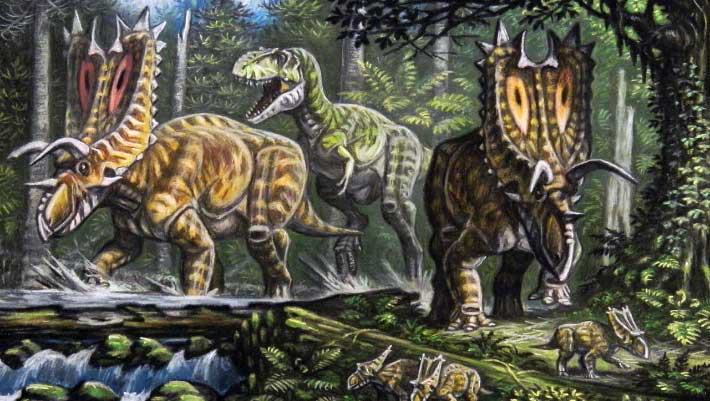
Giant Tyrannosaur Fossil Found in New Mexico
Un fossile de tyrannosaure géant découvert au Nouveau-Mexique
musée Mexique fossile Dinosauria Tyrannosauridae Tyrannosaurus
Un grand dinosaure tyrannosauridé aurait pu rôder dans les plaines inondables de ce qui est aujourd'hui le Nouveau-Mexique il y a près de 74 millions d'années, selon une équipe de paléontologues de l'Université de Bath, de l'Université d'État du Montana et du Musée d'histoire naturelle et des sciences du Nouveau-Mexique. L'article Un fossile de tyrannosaure géant découvert au Nouveau-Mexique est apparu en premier sur Sci.News : Breaking Science News.
15/05/2026 sci-news ⚙ Traduction automatique
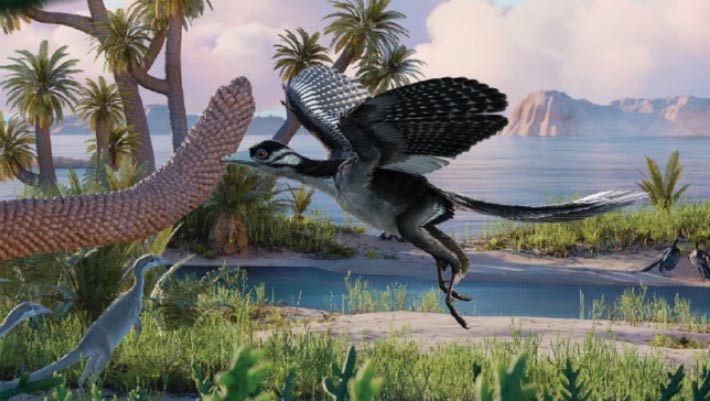
Paleontologists Reconstruct Ecology of Archaeopteryx
Des paléontologues reconstituent l'écologie de l'archéoptéryx
écologie musée fossile Archaeopteryx comportement étude
Une nouvelle étude complète réalisée par les paléontologues du Field Museum of Natural History rassemble les dernières preuves fossiles pour offrir le portrait le plus complet à ce jour de l’écologie, du comportement et de la vie quotidienne de l’Archaeopteryx. L'article Les paléontologues reconstruisent l'écologie de l'archéoptéryx apparaît en premier sur Sci.News : Breaking Science News.
08/05/2026 sci-news ⚙ Traduction automatique
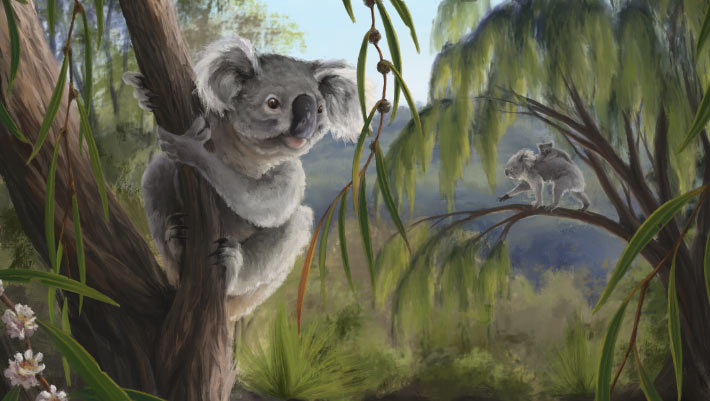
New Species of Fossil Koala Found in Museum Drawer
Une nouvelle espèce de koala fossile découverte dans un tiroir du musée
musée fossile découverte nouvelle espèce
Des fossiles longtemps négligés dans la collection du Western Australian Museum ont été identifiés comme une nouvelle espèce de koala. L'article Nouvelle espèce de koala fossile trouvé dans un tiroir de musée apparaît en premier sur Sci.News : Breaking Science News.
06/05/2026 sci-news ⚙ Traduction automatique
Magnifique squelette fossile d'Eryops exposé
prédateur musée Permien fossile squelette
Quand j'étais enfant, l'un de mes animaux préhistoriques préférés était le géant temnospondyl Eryops.  Cela me fait toujours plaisir de tomber sur des fossiles de ce prédateur du Permien inférieur.  En effet, le simple fait de voir un squelette reconstruit me fait sourire.  Quand je suis au Musée d'Histoire Naturelle de Londres, j'essaie de prendre le temps d'observer l'Eryops megacephalus.
06/05/2026 everythingdinosaur ⚙ Traduction automatique
La plus ancienne feuille de cannabis ? Un musée fait une étonnante découverte
musée découverte
Le Musée d'histoire naturelle de Berlin a daté ce qui semble être l'empreinte d'une plante du genre Cannabis dans de la boue séchée.
22/04/2026 sciencesetavenir
1 2 3 4 5 6 7 8 9 10