←

fossile

Nature du spécimen

226 image(s) · 215 Actualités

Galerie d'images

Reprodução a partir da gravura original do Holótipo, Hybodus acutus Agassiz, 1837, na publicação e prancha: L. Agassiz. 1837. Recherches sur les poissons fossiles Vol.3 (Atlas); Tab 10

Reprodução a partir da gravura original do Holótipo, Hybodus acutus Agassiz, 1837, na publicação e prancha: L. Agassiz. 1837. Recherches sur les poissons fossiles Vol.3 (Atlas); Tab 10

fossile poisson
Graph of relative Dinosaur fossil populations from each period of geologic time in the Mesozoic, ordered by major clade

Graph of relative Dinosaur fossil populations from each period of geologic time in the Mesozoic, ordered by major clade

Mésozoïque fossile Dinosauria
Fossil of the Decapod Cycleryon

Fossil of the Decapod Cycleryon

fossile
Fig 2. Geological section of the “Mittlerer Kimmeridge”.
This figure is based on Fischer and modified from Lallensack et al. Beds yielding terrestrial fossils are listed.

Fig 2. Geological section of the “Mittlerer Kimmeridge”. This figure is based on Fischer and modified from Lallensack et al. Beds yielding terrestrial fossils are listed.

fossile
Fossil shell of Aulacostephanus yo from France, on display at Gallery of Paleontology and Comparative Anatomy, Paris.
Intervalles Kimmeridgian

Fossil shell of Aulacostephanus yo from France, on display at Gallery of Paleontology and Comparative Anatomy, Paris.

France fossile anatomie
The GSSP for the Hirnantian stage in the ICS geological timescale (uppermost Ordovician stage), located in the Wangjiawan profile (an outcrop of black shale, brownishly weathered siliceous shale and chert layers of the Wufeng Formation) along the G241 road, about 40 km north of Yichang, Hubei, China. An exact golden spike is missing in the profile (2025) but a memorial plague marks the place. The GSSP occurs at the first appearance of fossils of the graptolite species Normalograptus extraordinarius. It was ratified in 2006.

The GSSP for the Hirnantian stage in the ICS geological timescale (uppermost Ordovician stage), located in the Wangjiawan profile (an outcrop of black shale, brownishly weathered siliceous shale and chert layers of the Wufeng Formation) along the G241 road, about 40 km north of Yichang, Hubei, China. An exact golden spike is missing in the profile (2025) but a memorial plague marks the place. The GSSP occurs at the first appearance of fossils of the graptolite species Normalograptus extraordinarius. It was ratified in 2006.

Chine Hirnantien Ordovicien fossile +1
Crioceratites fabreae fossils on display at the French National Museum of Natural History in Paris, France.

Crioceratites fabreae fossils on display at the French National Museum of Natural History in Paris, France.

musée France fossile
Crioceratites duvali fossil on display at the French National Museum of Natural History in Paris, France.

Crioceratites duvali fossil on display at the French National Museum of Natural History in Paris, France.

musée France fossile
“Sternberger Kuchen” (“Sternberg cake”), a large late Pleistocene glaciofluvial pebble of a highly fossiliferous, shallow marine sandstone of the North German Paleogene (Sülstorf beds, formerly known as “Sternberg rock”, Chattian, Oligocene, about 25 million years old). The fossil content is mainly made up of mollusks (pelecypods, gastropods, scaphopods). Provenance: Sternberg, Mecklenburg-Vorpommern, Northeast Germany.

“Sternberger Kuchen” (“Sternberg cake”), a large late Pleistocene glaciofluvial pebble of a highly fossiliferous, shallow marine sandstone of the North German Paleogene (Sülstorf beds, formerly known as “Sternberg rock”, Chattian, Oligocene, about 25 million years old). The fossil content is mainly made up of mollusks (pelecypods, gastropods, scaphopods). Provenance: Sternberg, Mecklenburg-Vorpommern, Northeast Germany.

Allemagne Chattien Pléistocène supérieur Oligocène +3
Fossil of Cainotherium, an extinct mammal https://hdl.handle.net/21.12123/66925 in ferruginous rock of Oligocene (Chattian) age from Ingolstadt in Bavaria, Germany - Took the photo at Museon museum, Den Haag
Intervalles Chattian

Fossil of Cainotherium, an extinct mammal https://hdl.handle.net/21.12123/66925 in ferruginous rock of Oligocene (Chattian) age from Ingolstadt in Bavaria, Germany - Took the photo at Museon museum, Den Haag

musée Allemagne Chattien Oligocène +1
A fossil tree from the Coal Creek region, Fruitland Formation, latest Cretaceous (Late Campanian), San Juan Basin, New Mexico

A fossil tree from the Coal Creek region, Fruitland Formation, latest Cretaceous (Late Campanian), San Juan Basin, New Mexico

Mexique Fruitland Campanien Crétacé +2
Glyptostrobus europaeus fossil leaves of Burdigalian stage in the early Miocene epoch, from a brown coal mine in Bilina, Czech Republic.

Glyptostrobus europaeus fossil leaves of Burdigalian stage in the early Miocene epoch, from a brown coal mine in Bilina, Czech Republic.

Tchéquie Burdigalien Miocène fossile
Brachipotherium aurelianense, from Rubí. Fossils. Collection of paleontology of the Geological Museum of the Barcelona Seminari (Museu Geològic del Seminari de Barcelona).

Brachipotherium aurelianense, from Rubí. Fossils. Collection of paleontology of the Geological Museum of the Barcelona Seminari (Museu Geològic del Seminari de Barcelona).

musée fossile
Ficus truncata fossil leaf from the early Miocene epoch 20 Ma, of the Třetihorní flóra from Bílina, Czech Republic.

Ficus truncata fossil leaf from the early Miocene epoch 20 Ma, of the Třetihorní flóra from Bílina, Czech Republic.

Tchéquie Miocène fossile
Comptonia acutiloba fossil leaves from the early Miocene epoch 20 Ma, of the Třetihorní flóra from Bílina, Czech Republic.

Comptonia acutiloba fossil leaves from the early Miocene epoch 20 Ma, of the Třetihorní flóra from Bílina, Czech Republic.

Tchéquie Miocène fossile
Berberis berberidifolia fossil leaf of Burdigalian stage in the early Miocene epoch, from a brown coal mine in Bilina, Czech Republic.
Intervalles Burdigalian

Berberis berberidifolia fossil leaf of Burdigalian stage in the early Miocene epoch, from a brown coal mine in Bilina, Czech Republic.

Tchéquie Burdigalien Miocène fossile
1 2 3 4 5 6 7 8 9 10 11 12 13 14 15

Actualités

Les chauves-souris auraient évolué pour la première fois en Europe il y a 65 millions d'années
vol fossile communication évolution mammifères étude
Une vaste étude génomique et fossile suggère que les chauves-souris ont évolué pour la première fois en Europe il y a environ 65 à 60 millions d’années avant de se propager à travers le monde. Les résultats indiquent également que le vol et l’écholocation sont apparus au début de l’évolution des chauves-souris, ce qui pourrait expliquer comment les chauves-souris sont devenues l’un des groupes de mammifères les plus prospères sur Terre.
30/09/2026 sciencedaily-paleo ⚙ Traduction automatique
Un nouveau taxon Dicynodonte pourrait transformer la chronologie des origines des dinosaures
Tanzanie Trias fossile Dinosauria nouvelle espèce
Les scientifiques ont décrit une nouvelle espèce de dicynodonte à partir de fossiles découverts en Tanzanie. Ces fossiles pourraient aider les paléontologues à affiner la chronologie de l’origine des dinosaures. La nouvelle espèce a été nommée Dinodontosaurus isiyavamanda. Il vivait il y a environ 240 millions d’années pendant la période du Trias. Il est important de noter que le Dinodontosaure n’était pas un dinosaure.
29/09/2026 everythingdinosaur ⚙ Traduction automatique
Ce fossile vieux de 245 millions d'années a encore son estomac et ses intestins
fossile découverte
Un fossile de reptile marin vieux de 245 millions d'années préserve une quantité étonnante de détails, notamment son estomac, son foie et ses intestins. La découverte révèle qu'Austronaga minuta était très adaptée à la nage même si son système digestif restait étonnamment simple.
29/09/2026 sciencedaily ⚙ Traduction automatique
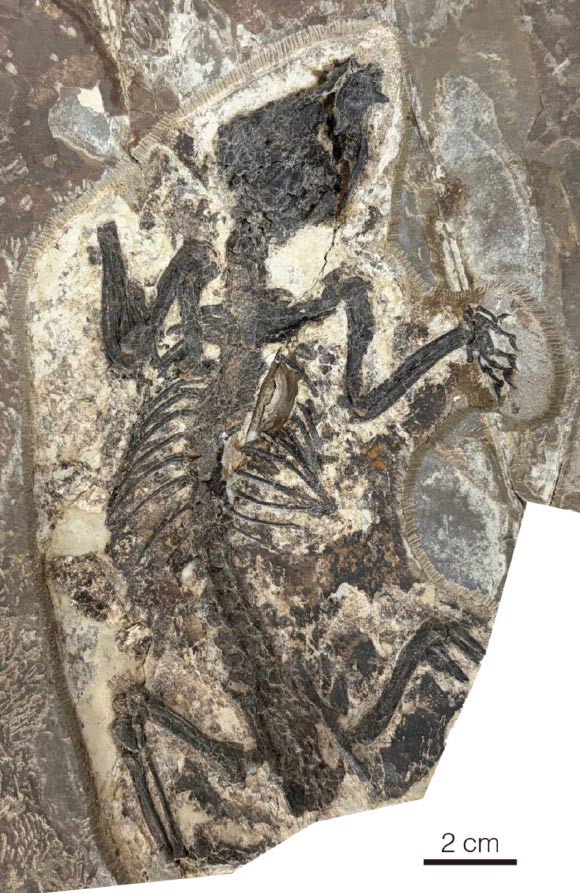
120-Million-Year-Old Fossil Pushes Back Origin of Marsupial Lineage
Un fossile vieux de 120 millions d’années repousse l’origine de la lignée marsupiale
Chine fossile mammifères nouvelle espèce
Une nouvelle espèce de mammifère deltathéroide de Chine pourrait être le plus ancien ancêtre confirmé de marsupiaux jamais découvert, offrant une nouvelle preuve que l'Asie a joué un rôle central dans la profonde division évolutive entre les marsupiaux et les mammifères placentaires. L'article Un fossile vieux de 120 millions d'années repousse l'origine de la lignée marsupiale est apparu en premier sur Sci.News : Breaking Science News.
28/09/2026 sci-news ⚙ Traduction automatique
Les scientifiques se sont trompés sur cet étrange mammifère pendant près de 40 ans
Mongolie Crétacé fossile mammifères
Un fossile magnifiquement conservé du désert de Gobi en Mongolie a résolu un mystère qui a intrigué les paléontologues pendant près de 40 ans. Tamirkhan balcarceli montre que les zhelestidés n'étaient pas les premiers parents des mammifères placentaires modernes, malgré leurs dents qui semblaient le suggérer. Au lieu de cela, l’animal ressemblant à un lapin appartenait à une lignée distincte de petits mammifères du Crétacé.
28/09/2026 sciencedaily ⚙ Traduction automatique
1 2 3 4 5 6 7 8 9 10 11 12 13 14 15 16 17 18 19 20 21 22 23 24 25 26 27 28 29 30 31 32 33 34 35 36 37 38 39 40 41 42 43