←

fossile

Nature du spécimen

226 image(s) · 216 Actualités

Galerie d'images

Reprodução a partir da gravura original do Holótipo, Hybodus acutus Agassiz, 1837, na publicação e prancha: L. Agassiz. 1837. Recherches sur les poissons fossiles Vol.3 (Atlas); Tab 10

Reprodução a partir da gravura original do Holótipo, Hybodus acutus Agassiz, 1837, na publicação e prancha: L. Agassiz. 1837. Recherches sur les poissons fossiles Vol.3 (Atlas); Tab 10

fossile poisson
Graph of relative Dinosaur fossil populations from each period of geologic time in the Mesozoic, ordered by major clade

Graph of relative Dinosaur fossil populations from each period of geologic time in the Mesozoic, ordered by major clade

Mésozoïque fossile Dinosauria
Fossil of the Decapod Cycleryon

Fossil of the Decapod Cycleryon

fossile
Fig 2. Geological section of the “Mittlerer Kimmeridge”.
This figure is based on Fischer and modified from Lallensack et al. Beds yielding terrestrial fossils are listed.

Fig 2. Geological section of the “Mittlerer Kimmeridge”. This figure is based on Fischer and modified from Lallensack et al. Beds yielding terrestrial fossils are listed.

fossile
Fossil shell of Aulacostephanus yo from France, on display at Gallery of Paleontology and Comparative Anatomy, Paris.
Intervalles Kimmeridgian

Fossil shell of Aulacostephanus yo from France, on display at Gallery of Paleontology and Comparative Anatomy, Paris.

France fossile anatomie
The GSSP for the Hirnantian stage in the ICS geological timescale (uppermost Ordovician stage), located in the Wangjiawan profile (an outcrop of black shale, brownishly weathered siliceous shale and chert layers of the Wufeng Formation) along the G241 road, about 40 km north of Yichang, Hubei, China. An exact golden spike is missing in the profile (2025) but a memorial plague marks the place. The GSSP occurs at the first appearance of fossils of the graptolite species Normalograptus extraordinarius. It was ratified in 2006.

The GSSP for the Hirnantian stage in the ICS geological timescale (uppermost Ordovician stage), located in the Wangjiawan profile (an outcrop of black shale, brownishly weathered siliceous shale and chert layers of the Wufeng Formation) along the G241 road, about 40 km north of Yichang, Hubei, China. An exact golden spike is missing in the profile (2025) but a memorial plague marks the place. The GSSP occurs at the first appearance of fossils of the graptolite species Normalograptus extraordinarius. It was ratified in 2006.

Chine Hirnantien Ordovicien fossile +1
Crioceratites fabreae fossils on display at the French National Museum of Natural History in Paris, France.

Crioceratites fabreae fossils on display at the French National Museum of Natural History in Paris, France.

musée France fossile
Crioceratites duvali fossil on display at the French National Museum of Natural History in Paris, France.

Crioceratites duvali fossil on display at the French National Museum of Natural History in Paris, France.

musée France fossile
“Sternberger Kuchen” (“Sternberg cake”), a large late Pleistocene glaciofluvial pebble of a highly fossiliferous, shallow marine sandstone of the North German Paleogene (Sülstorf beds, formerly known as “Sternberg rock”, Chattian, Oligocene, about 25 million years old). The fossil content is mainly made up of mollusks (pelecypods, gastropods, scaphopods). Provenance: Sternberg, Mecklenburg-Vorpommern, Northeast Germany.

“Sternberger Kuchen” (“Sternberg cake”), a large late Pleistocene glaciofluvial pebble of a highly fossiliferous, shallow marine sandstone of the North German Paleogene (Sülstorf beds, formerly known as “Sternberg rock”, Chattian, Oligocene, about 25 million years old). The fossil content is mainly made up of mollusks (pelecypods, gastropods, scaphopods). Provenance: Sternberg, Mecklenburg-Vorpommern, Northeast Germany.

Allemagne Chattien Pléistocène supérieur Oligocène +3
Fossil of Cainotherium, an extinct mammal https://hdl.handle.net/21.12123/66925 in ferruginous rock of Oligocene (Chattian) age from Ingolstadt in Bavaria, Germany - Took the photo at Museon museum, Den Haag
Intervalles Chattian

Fossil of Cainotherium, an extinct mammal https://hdl.handle.net/21.12123/66925 in ferruginous rock of Oligocene (Chattian) age from Ingolstadt in Bavaria, Germany - Took the photo at Museon museum, Den Haag

musée Allemagne Chattien Oligocène +1
A fossil tree from the Coal Creek region, Fruitland Formation, latest Cretaceous (Late Campanian), San Juan Basin, New Mexico

A fossil tree from the Coal Creek region, Fruitland Formation, latest Cretaceous (Late Campanian), San Juan Basin, New Mexico

Mexique Fruitland Campanien Crétacé +2
Glyptostrobus europaeus fossil leaves of Burdigalian stage in the early Miocene epoch, from a brown coal mine in Bilina, Czech Republic.

Glyptostrobus europaeus fossil leaves of Burdigalian stage in the early Miocene epoch, from a brown coal mine in Bilina, Czech Republic.

Tchéquie Burdigalien Miocène fossile
Brachipotherium aurelianense, from Rubí. Fossils. Collection of paleontology of the Geological Museum of the Barcelona Seminari (Museu Geològic del Seminari de Barcelona).

Brachipotherium aurelianense, from Rubí. Fossils. Collection of paleontology of the Geological Museum of the Barcelona Seminari (Museu Geològic del Seminari de Barcelona).

musée fossile
Ficus truncata fossil leaf from the early Miocene epoch 20 Ma, of the Třetihorní flóra from Bílina, Czech Republic.

Ficus truncata fossil leaf from the early Miocene epoch 20 Ma, of the Třetihorní flóra from Bílina, Czech Republic.

Tchéquie Miocène fossile
Comptonia acutiloba fossil leaves from the early Miocene epoch 20 Ma, of the Třetihorní flóra from Bílina, Czech Republic.

Comptonia acutiloba fossil leaves from the early Miocene epoch 20 Ma, of the Třetihorní flóra from Bílina, Czech Republic.

Tchéquie Miocène fossile
Berberis berberidifolia fossil leaf of Burdigalian stage in the early Miocene epoch, from a brown coal mine in Bilina, Czech Republic.
Intervalles Burdigalian

Berberis berberidifolia fossil leaf of Burdigalian stage in the early Miocene epoch, from a brown coal mine in Bilina, Czech Republic.

Tchéquie Burdigalien Miocène fossile
1 2 3 4 5 6 7 8 9 10 11 12 13 14 15

Actualités

Une étude remarquable révèle les origines de l'évolution des chauves-souris
vol fossile évolution étude
Une vaste étude internationale a apporté un nouvel éclairage sur l’évolution des chauves-souris. Les recherches suggèrent que les chauves-souris sont originaires d’Europe il y a environ 65 millions d’années. De plus, le vol propulsé et l’écholocation semblent avoir évolué très tôt dans leur histoire. L'étude représente la plus grande enquête à ce jour combinant les génomes des chauves-souris avec les preuves provenant des fossiles.
23/09/2026 everythingdinosaur ⚙ Traduction automatique
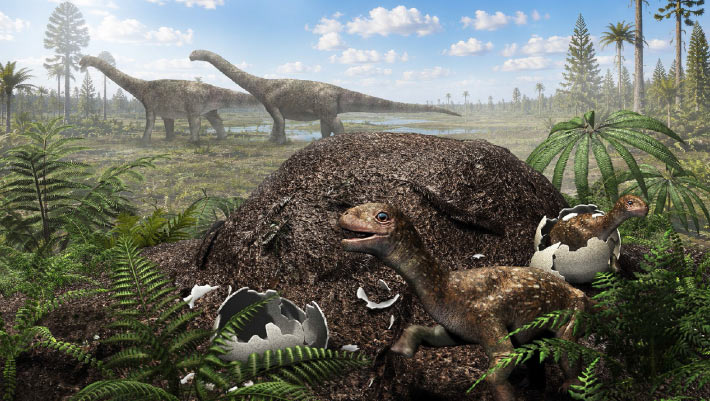
Titanosaurs Nested Far South of Equator, Fossil Eggshells Reveal
Des coquilles d'œufs fossiles révèlent que les titanosaures nichaient très au sud de l'équateur
nid Argentine Équateur fossile Dinosauria Titanosauria
Des paléontologues travaillant en Patagonie, en Argentine, ont découvert des coquilles d'œufs fossilisées qui poussent l'aire de nidification connue des dinosaures plus loin dans l'hémisphère sud que ce qui avait été documenté auparavant. L'article Titanosaures nichés à l'extrême sud de l'équateur, des coquilles d'œufs fossiles révélées sont apparus en premier sur Sci.News : Breaking Science News.
23/09/2026 sci-news ⚙ Traduction automatique
Des scientifiques découvrent le premier diplodocus jamais découvert en dehors de l'Amérique du Nord
os Espagne Jurassique Jurassique supérieur fossile Dinosauria Diplodocia
Un fossile de dinosaure vieux de 150 millions d'années provenant d'Espagne a été identifié comme le premier Diplodocus confirmé jamais découvert en dehors de l'Amérique du Nord. Le sauropode géant mesurait environ 25 mètres de long et était suffisamment bien conservé pour que les chercheurs puissent associer les caractéristiques distinctives de ses os de la queue au célèbre genre. Son apparition inattendue en Europe suggère que les dinosaures se déplaçaient entre les continents à la fin du Jurassique, peut-être via des connexions terrestres temporaires.
19/09/2026 sciencedaily ⚙ Traduction automatique
Sur l'origine de ma première espèce : Dinodontosaurus isiyavamanda
fossile Dinosauria nouvelle espèce
Je ne peux pas imaginer à quel point mon enfant de 9 ans aurait été ravi si je lui avais dit qu’il allait dévoiler au monde une nouvelle espèce fossile, sans parler de celle qui renseigne sur les plus anciens dinosaures. Moi aussi, j'ai 25 ans, je suis plutôt content du travail, mais pour être honnête, ce n'est pas du frisson ou de la joie que [&hellip
18/09/2026 palaeocast ⚙ Traduction automatique
Une découverte passionnante de fossiles fournit la première preuve définitive de Diplodocus en Europe
vertèbre Espagne fossile Dinosauria Diplodocia Diplodocus découverte étude
La découverte de Diplodocus en Europe a été confirmée suite à l'étude de fossiles de sauropodes de l'est de l'Espagne. Quatorze vertèbres caudales et plusieurs chevrons de Teruel ont été attribués au genre emblématique Diplodocus. Il s'agit de la première preuve définitive de l'existence de ce célèbre dinosaure en dehors de l'Amérique du Nord. Les fossiles proviennent du site de La Tejería
17/09/2026 everythingdinosaur ⚙ Traduction automatique
1 2 3 4 5 6 7 8 9 10 11 12 13 14 15 16 17 18 19 20 21 22 23 24 25 26 27 28 29 30 31 32 33 34 35 36 37 38 39 40 41 42 43 44