fossile

Nature du spécimen

223 image(s) · 128 Actualités

Galerie d'images

Title: A descriptive catalogue of the marine reptiles of the Oxford clay. Based on the Leeds Collection in the British Museum (Natural History), London ..
Identifier: descriptivecatal02brit (find matches)
Year: 1910 (1910s)
Authors: British Museum (Natural History). Dept. of Geology; Andrews, Charles William, 1866-1924
Subjects: Reptiles, Fossil
Publisher: London, Printed by order of the Trustees
Contributing Library: Smithsonian Libraries
Digitizing Sponsor: Biodiversity Heritage Library

View Book Page: Book Viewer
About This Book: Catalog Entry
View All Images: All Images From Book
Click here to view book online to see this illustration in context in a browseable online version of this book.

Text Appearing Before Image: 
CATAL.MARINE KEPT. OXFORD CLAY. PART II. PLATE I. pmcc.
Text Appearing After Image: 
>p77ia:. G.M.Woodward del. etlibh. West, Newman imp. PLIOSAURUS FEROX.

Note About Images

Please note that these images are extracted from scanned page images that may have been digitally enhanced for readability - coloration and appearance of these illustrations may not perfectly resemble the original work.

Title: A descriptive catalogue of the marine reptiles of the Oxford clay. Based on the Leeds Collection in the British Museum (Natural History), London .. Identifier: descriptivecatal02brit (find matches) Year: 1910 (1910s) Authors: British Museum (Natural History). Dept. of Geology; Andrews, Charles William, 1866-1924 Subjects: Reptiles, Fossil Publisher: London, Printed by order of the Trustees Contributing Library: Smithsonian Libraries Digitizing Sponsor: Biodiversity Heritage Library View Book Page: Book Viewer About This Book: Catalog Entry View All Images: All Images From Book Click here to view book online to see this illustration in context in a browseable online version of this book. Text Appearing Before Image: CATAL.MARINE KEPT. OXFORD CLAY. PART II. PLATE I. pmcc. Text Appearing After Image: >p77ia:. G.M.Woodward del. etlibh. West, Newman imp. PLIOSAURUS FEROX. Note About Images Please note that these images are extracted from scanned page images that may have been digitally enhanced for readability - coloration and appearance of these illustrations may not perfectly resemble the original work.

musée Oxford Clay fossile Liopleurodon +2
Fossil - Took The picture at Royal Belgian Institute of Natural Sciences, Brussels

Fossil - Took The picture at Royal Belgian Institute of Natural Sciences, Brussels

fossile Hainosaurus
Fossil - Took The picture at Royal Belgian Institute of Natural Sciences, Brussels

Fossil - Took The picture at Royal Belgian Institute of Natural Sciences, Brussels

fossile Hainosaurus
Fossil - Took The picture at Royal Belgian Institute of Natural Sciences, Brussels

Fossil - Took The picture at Royal Belgian Institute of Natural Sciences, Brussels

fossile Hainosaurus
Fossil of Hainosaurus, an extinct reptile  --  Took the photo at Natural History Museum of Bruxelles

Fossil of Hainosaurus, an extinct reptile -- Took the photo at Natural History Museum of Bruxelles

musée fossile Hainosaurus
Fossil of Anhanguera, an extinct reptile-- Took the photo at Natural History Museum, London

Fossil of Anhanguera, an extinct reptile-- Took the photo at Natural History Museum, London

musée fossile Anhanguera
Title: A dictionary of the fossils of Pennsylvania and neighboring states named in the reports and catalogues of the survey ..
Identifier: CUbiodiversity600397-9082 (find matches)
Year: 1889 (1880s)
Authors: Lesley, J. P. (J. Peter), 1819-1903; Pennsylvania. Board of Commissioners for the Second Geological Survey
Subjects: Paleontology
Publisher: Harrisburg, Board of Commissioners for the Geological Survey
Contributing Library: Cornell University Library
Digitizing Sponsor: Mann Library, Cornell

View Book Page: Book Viewer
About This Book: Catalog Entry
View All Images: All Images From Book
Click here to view book online to see this illustration in context in a browseable online version of this book.

Text Appearing Before Image: 
697 Plec. Plectropterna angusta, Hitchcock, Icht. Mass. page 110, lias. f-) itch cock ^ Idithuolo^ij McLSS.
Text Appearing After Image: 
I'lfrtroplerria,

Note About Images

Please note that these images are extracted from scanned page images that may have been digitally enhanced for readability - coloration and appearance of these illustrations may not perfectly resemble the original work.
Taxons Plectropterna

Title: A dictionary of the fossils of Pennsylvania and neighboring states named in the reports and catalogues of the survey .. Identifier: CUbiodiversity600397-9082 (find matches) Year: 1889 (1880s) Authors: Lesley, J. P. (J. Peter), 1819-1903; Pennsylvania. Board of Commissioners for the Second Geological Survey Subjects: Paleontology Publisher: Harrisburg, Board of Commissioners for the Geological Survey Contributing Library: Cornell University Library Digitizing Sponsor: Mann Library, Cornell View Book Page: Book Viewer About This Book: Catalog Entry View All Images: All Images From Book Click here to view book online to see this illustration in context in a browseable online version of this book. Text Appearing Before Image: 697 Plec. Plectropterna angusta, Hitchcock, Icht. Mass. page 110, lias. f-) itch cock ^ Idithuolo^ij McLSS. Text Appearing After Image: I'lfrtroplerria, Note About Images Please note that these images are extracted from scanned page images that may have been digitally enhanced for readability - coloration and appearance of these illustrations may not perfectly resemble the original work.

fossile Plectropterna
Crâne de mosasaure d'espèce Platecarpus tympaniticus (squamates, mosasaures).
Provenance : Smoky Hill Chalk, Kansas (aux Etats-Unis).
Date : Crétacé supérieur, période du Campanien, 88 millions d'années avant notre ère.
Collections du Muséum national d'histoire naturelle de Paris (France).
Exposé à l'occasion de l'exposition "Un T-Rex à Paris" au Muséum national d'histoire naturelle de Paris (France) du 6 juin au 2 septembre 2018.

Légende du fossile dans cette exposition : "Les mosasaures ne sont pas des dinosaures mais des reptiles marins, très répandus à la fin du Crétacé. Certains genres comme Globidens et Halisaurus sont connus aussi bien aux Etats-Unis qu'au Maroc. Ces animaux étaient d'excellents nageurs, capables de traverser l'Atlantique."

Crâne de mosasaure d'espèce Platecarpus tympaniticus (squamates, mosasaures). Provenance : Smoky Hill Chalk, Kansas (aux Etats-Unis). Date : Crétacé supérieur, période du Campanien, 88 millions d'années avant notre ère. Collections du Muséum national d'histoire naturelle de Paris (France). Exposé à l'occasion de l'exposition "Un T-Rex à Paris" au Muséum national d'histoire naturelle de Paris (France) du 6 juin au 2 septembre 2018. Légende du fossile dans cette exposition : "Les mosasaures ne sont pas des dinosaures mais des reptiles marins, très répandus à la fin du Crétacé. Certains genres comme Globidens et Halisaurus sont connus aussi bien aux Etats-Unis qu'au Maroc. Ces animaux étaient d'excellents nageurs, capables de traverser l'Atlantique."

France Maroc Campanien Crétacé +8
Fragmentary fossils of various tylosaurines MCM.M0009 (A ; Taniwhasaurus 'mikasaensis'), SAM-PK-5265 (B ; Taniwhasaurus 'capensis') and MNHN 1896-15 (C ; Tylosaurus gaudryi).

Fragmentary fossils of various tylosaurines MCM.M0009 (A ; Taniwhasaurus 'mikasaensis'), SAM-PK-5265 (B ; Taniwhasaurus 'capensis') and MNHN 1896-15 (C ; Tylosaurus gaudryi).

fossile Hainosaurus Taniwhasaurus Tylosaurus
Life restoration of the mosasaurine mosasaurid Eremiasaurus, with unknown portions and soft tissues based primarily on Prognathodon and supplemented with Mosasaurus where needed.
References
Leblanc, A.R.H.; Caldwell, M.W.; Bardet, N. (2012). "A new mosasaurine from the Maastrichtian (Upper Cretaceous) phosphates of Morocco and its implications for mosasaurine systematics". Journal of Vertebrate Paleontology 32 (1): 82–104.
Lindgren, J.; Kaddumi, H.; Polcyn, M. (2013). "Soft tissue preservation in a fossil marine lizard with a bilobed tail fin". Nature Communications 4: 2423. DOI:10.1038/ncomms3423.
Konishi, T.; Brinkman, D.; Massare, J.A.; Caldwell, M.W. (2011). "New exceptional specimens of Prognathodon overtoni (Squamata, Mosasauridae) from the upper Campanian of Alberta, Canada, and the systematics and ecology of the genus". Journal of Vertebrate Paleontology 31 (5): 1026–1046.
Russell, D.A. (1967). "Systematics and morphology of American mosasaurs". Bulletin of the Peabody Museum of Natural History 23: 1–241.

Life restoration of the mosasaurine mosasaurid Eremiasaurus, with unknown portions and soft tissues based primarily on Prognathodon and supplemented with Mosasaurus where needed. References Leblanc, A.R.H.; Caldwell, M.W.; Bardet, N. (2012). "A new mosasaurine from the Maastrichtian (Upper Cretaceous) phosphates of Morocco and its implications for mosasaurine systematics". Journal of Vertebrate Paleontology 32 (1): 82–104. Lindgren, J.; Kaddumi, H.; Polcyn, M. (2013). "Soft tissue preservation in a fossil marine lizard with a bilobed tail fin". Nature Communications 4: 2423. DOI:10.1038/ncomms3423. Konishi, T.; Brinkman, D.; Massare, J.A.; Caldwell, M.W. (2011). "New exceptional specimens of Prognathodon overtoni (Squamata, Mosasauridae) from the upper Campanian of Alberta, Canada, and the systematics and ecology of the genus". Journal of Vertebrate Paleontology 31 (5): 1026–1046. Russell, D.A. (1967). "Systematics and morphology of American mosasaurs". Bulletin of the Peabody Museum of Natural History 23: 1–241.

tissus écologie musée Canada +11
Fossil of Carinodens, an extinct mosasaur- Took the photo at Natural History Museum of Maastricht

Fossil of Carinodens, an extinct mosasaur- Took the photo at Natural History Museum of Maastricht

musée fossile Carinodens
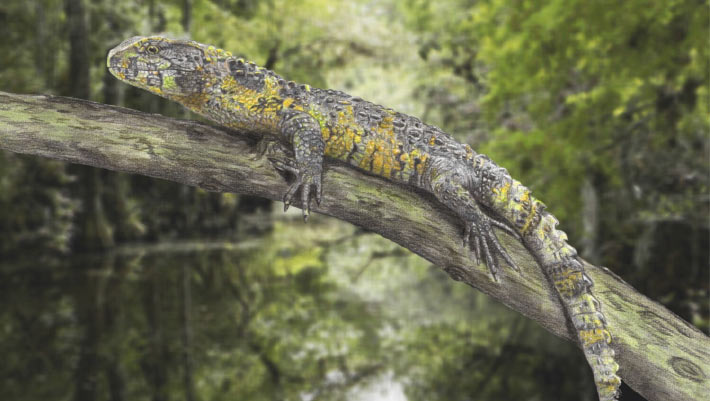
Restoration of Ambopteryx longibrachium based on known fossil elements

Restoration of Ambopteryx longibrachium based on known fossil elements

fossile Alnashetri Ambopteryx
A hypothetical life restoration of Ampelosaurus atacis

• Ampelosaurus is known from hundreds of fossil specimens which show most of the dinosaur's osteological details, however, there are few articulated remains or reconstructions of the material so its overall proportions and life appearance are uncertain.
• Ampelosaurus is known to have supported osteoderms, only four are currently known. The number of these osteoderms that an individual Ampelosaurus would have supported in life and their and position on the body is not currently known. It's thought that due to the rarity of titanosaur osteoderms that they would be quite sparse on the body. The position and layout of the osteoderms has been loosely based on this interpretation, which is based on the work of Vidal et al 2015. [1]
Taxons Dashanpusaurus

A hypothetical life restoration of Ampelosaurus atacis • Ampelosaurus is known from hundreds of fossil specimens which show most of the dinosaur's osteological details, however, there are few articulated remains or reconstructions of the material so its overall proportions and life appearance are uncertain. • Ampelosaurus is known to have supported osteoderms, only four are currently known. The number of these osteoderms that an individual Ampelosaurus would have supported in life and their and position on the body is not currently known. It's thought that due to the rarity of titanosaur osteoderms that they would be quite sparse on the body. The position and layout of the osteoderms has been loosely based on this interpretation, which is based on the work of Vidal et al 2015. [1]

fossile spécimen Ampelosaurus Bagualosauria +6
Lower Triassic fossil footprint (ichnite) of the ichnogenus Chirotherium, probably caused by an early archosaur, and first discovered 1833 in Hildburghausen (Thuringia, Germany). This specimen, however, ist from the Helsby Sandstone of the Storeton Quarry near Liverpool. Its species name is Chirotherium storetonense.[1]
Taxons Abelichnus

Lower Triassic fossil footprint (ichnite) of the ichnogenus Chirotherium, probably caused by an early archosaur, and first discovered 1833 in Hildburghausen (Thuringia, Germany). This specimen, however, ist from the Helsby Sandstone of the Storeton Quarry near Liverpool. Its species name is Chirotherium storetonense.[1]

Allemagne Trias fossile spécimen +9
Lower Triassic fossil footprint (ichnite) of the ichnogenus Chirotherium, probably caused by an early archosaur, and first discovered 1833 in Hildburghausen (Thuringia, Germany). This specimen, however, ist from the Helsby Sandstone of the Storeton Quarry near Liverpool. Its species name is Chirotherium storetonense.[1]
Taxons Anticheiropus

Lower Triassic fossil footprint (ichnite) of the ichnogenus Chirotherium, probably caused by an early archosaur, and first discovered 1833 in Hildburghausen (Thuringia, Germany). This specimen, however, ist from the Helsby Sandstone of the Storeton Quarry near Liverpool. Its species name is Chirotherium storetonense.[1]

Allemagne Trias fossile spécimen +9
Lower Triassic fossil footprint (ichnite) of the ichnogenus Chirotherium, probably caused by an early archosaur, and first discovered 1833 in Hildburghausen (Thuringia, Germany). This specimen, however, ist from the Helsby Sandstone of the Storeton Quarry near Liverpool. Its species name is Chirotherium storetonense.[1]
Taxons Argoides

Lower Triassic fossil footprint (ichnite) of the ichnogenus Chirotherium, probably caused by an early archosaur, and first discovered 1833 in Hildburghausen (Thuringia, Germany). This specimen, however, ist from the Helsby Sandstone of the Storeton Quarry near Liverpool. Its species name is Chirotherium storetonense.[1]

Allemagne Trias fossile spécimen +9
1 2 3 4 5 6 7 8 9 10 11 12 13 14

Actualités

Un fossile d'ambre vieux de 16 millions d'années vient de révéler la plus petite fourmi prédatrice jamais trouvée
prédateur fossile évolution extinction
Une fourmi fossilisée des Caraïbes, Basiceros enana, conservée dans de l'ambre dominicain, révèle l'ancienne aire de répartition de l'espèce et renverse les hypothèses sur l'évolution de sa taille. L’imagerie avancée montre qu’il possédait déjà les adaptations de camouflage de ses parents modernes, offrant de nouvelles perspectives sur les stratégies d’extinction et de survie.
09/08/2025 sciencedaily-human-evo ⚙ Traduction automatique
Un poisson vieux de 400 millions d'années révèle une grave erreur dans notre compréhension de l'évolution
fossile découverte évolution
Un poisson considéré comme la capsule temporelle de l’évolution vient de surprendre les scientifiques. Une dissection détaillée du cœlacanthe – une espèce vieille de 400 millions d’années souvent appelée « fossile vivant » – a révélé que les muscles clés censés faire partie de l’évolution précoce des vertébrés étaient en réalité des ligaments mal identifiés. Cela signifie que les hypothèses fondamentales sur la façon dont les vertébrés, y compris les humains, ont évolué pour manger et respirer, devront peut-être être réécrites. La découverte corrige des décennies d'erreurs anatomiques et remodèle l'histoire de s
29/07/2025 sciencedaily-human-evo ⚙ Traduction automatique
Un fossile vieux de 500 millions d’années vient de réécrire l’histoire de l’araignée
fossile
Il y a un demi-milliard d’années, une étrange créature marine appelée Mollisonia symetrica aurait ouvert la voie aux araignées modernes. Grâce à une analyse détaillée du cerveau des fossiles, les chercheurs ont découvert des schémas neuronaux étonnamment similaires à ceux des arachnides d'aujourd'hui, ce qui suggère que les araignées ont évolué dans l'océan et non sur terre comme on le pensait auparavant. Cette structure cérébrale fait même allusion à un saut évolutif critique qui a permis aux araignées d’acquérir leur fameuse vitesse, leur dextérité et leurs prouesses à tisser des toiles. Les résultats constituent un défi de longue date
24/07/2025 sciencedaily-human-evo ⚙ Traduction automatique
1 2 3 4 5 6 7 8 9 10 11 12 13 14 15 16 17 18 19 20 21 22 23 24 25 26