←

Chine

Pays

82 image(s) · 38 Actualités

Galerie d'images

Changmiania liaoningensis, an ornithopod dinosaur from the Lower Cretaceous of Lujiatun (Liaoning Province, China).
(A) Holotype PMOL AD00114 in dorsal view; (B) anterior part of the holotype PMOL AD00114 in caudolateral view; (C) referred specimen PMOL LFV022 in dorsal view. Red arrows indicate the emplacement of the gastrolith clusters.
Taxons Changmiania

Changmiania liaoningensis, an ornithopod dinosaur from the Lower Cretaceous of Lujiatun (Liaoning Province, China). (A) Holotype PMOL AD00114 in dorsal view; (B) anterior part of the holotype PMOL AD00114 in caudolateral view; (C) referred specimen PMOL LFV022 in dorsal view. Red arrows indicate the emplacement of the gastrolith clusters.

Chine Crétacé holotype spécimen +2
Life restoration of the Triassic ichthyosaur Callawayia neoscapularis. Three specimens of this ichthyosaur are known, the holotype, ROM 41993, and two referred specimens, TMP 94.380.11 and 94.382.2. The skull is primarily based on ROM 41993, cross-checked against TMP 94.380.11 and TMP 94.382.2. The vertebral column is based primarily on TMP 94.382.2 as it is the most complete of these specimens, while the ribs were based on ROM 41993. The forelimbs were mainly based on those of ROM 41993, with TMP 94.380.11 used to determine their breadth. The hindlimbs were based on TMP 94.380.11, especially the more complete right hindlimb.
ROM 41993 was cross-scaled with TMP 94.380.11 by the dimensions of the forelimb epipodials, which produced similar vertebral dimensions. The two TMP specimens were cross-scaled based on femoral length, also producing similar vertebral dimensions. Nicholls & Manabe (2001) stated that no wedge-shaped caudal centra supporting a tailbend were found and that there was no evidence of a bend being present, though considered that they might have existed in the gap in the preserved caudals. Since various other Triassic ichthyosaurs have since been found to have tail bends, one was illustrated here. A modest downturn of roughly 15° was illustrated, comparable to that in Guanlingsaurus, and the location of the bend within the gap in the preserved vertebrae matches well with the location of the bend in Guizhouichthyosaurus.

References
McGowan, C. (1994). "A new species of Shastasaurus (Reptilia: Ichthyosauria) from the Triassic of British Columbia: The most complete exemplar of the genus". Journal of Vertebrate Paleontology 14 (2): 168–179. DOI:10.1080/02724634.1994.10011550.
Nicholls, E. L.; Manabe, M. (2001). "A new genus of ichthyosaur from the Late Triassic Pardonet Formation of British Columbia: Bridging the Triassic-Jurassic gap". Canadian Journal of Earth Sciences 38 (6): 983–1002.
Ji, C.; Jiang, D.Y.; Hao, W.; Sun, Y. (2011). "True tailbend occurred in the Late Triassic: Evidence from ichthyosaur skeletons of South China". Acta Scientiarum Naturalium Universitatis Pekinensis 47 (2): 309–314.
Shang, Q. H.; Li, C. (2009). "On the occurrence of the ichthyosaur Shastasaurus in the Guanling biota (Late Triassic), Guizhou, China". Vertebrata PalAsiatica 47 (3): 178–193.
Taxons Guanlingsaurus

Life restoration of the Triassic ichthyosaur Callawayia neoscapularis. Three specimens of this ichthyosaur are known, the holotype, ROM 41993, and two referred specimens, TMP 94.380.11 and 94.382.2. The skull is primarily based on ROM 41993, cross-checked against TMP 94.380.11 and TMP 94.382.2. The vertebral column is based primarily on TMP 94.382.2 as it is the most complete of these specimens, while the ribs were based on ROM 41993. The forelimbs were mainly based on those of ROM 41993, with TMP 94.380.11 used to determine their breadth. The hindlimbs were based on TMP 94.380.11, especially the more complete right hindlimb. ROM 41993 was cross-scaled with TMP 94.380.11 by the dimensions of the forelimb epipodials, which produced similar vertebral dimensions. The two TMP specimens were cross-scaled based on femoral length, also producing similar vertebral dimensions. Nicholls & Manabe (2001) stated that no wedge-shaped caudal centra supporting a tailbend were found and that there was no evidence of a bend being present, though considered that they might have existed in the gap in the preserved caudals. Since various other Triassic ichthyosaurs have since been found to have tail bends, one was illustrated here. A modest downturn of roughly 15° was illustrated, comparable to that in Guanlingsaurus, and the location of the bend within the gap in the preserved vertebrae matches well with the location of the bend in Guizhouichthyosaurus. References McGowan, C. (1994). "A new species of Shastasaurus (Reptilia: Ichthyosauria) from the Triassic of British Columbia: The most complete exemplar of the genus". Journal of Vertebrate Paleontology 14 (2): 168–179. DOI:10.1080/02724634.1994.10011550. Nicholls, E. L.; Manabe, M. (2001). "A new genus of ichthyosaur from the Late Triassic Pardonet Formation of British Columbia: Bridging the Triassic-Jurassic gap". Canadian Journal of Earth Sciences 38 (6): 983–1002. Ji, C.; Jiang, D.Y.; Hao, W.; Sun, Y. (2011). "True tailbend occurred in the Late Triassic: Evidence from ichthyosaur skeletons of South China". Acta Scientiarum Naturalium Universitatis Pekinensis 47 (2): 309–314. Shang, Q. H.; Li, C. (2009). "On the occurrence of the ichthyosaur Shastasaurus in the Guanling biota (Late Triassic), Guizhou, China". Vertebrata PalAsiatica 47 (3): 178–193.

Chine Jurassique Trias supérieur Trias +12
Prismatoolithus tiantaiensis eggs (IVPP V16515) on display at the Paleozoological Museum of China.
Taxons Prismatoolithidae

Prismatoolithus tiantaiensis eggs (IVPP V16515) on display at the Paleozoological Museum of China.

musée Chine Prismatoolithidae Prismatoolithus
Prismatoolithus tiantaiensis eggs (IVPP V16515) on display at the Paleozoological Museum of China.
Taxons Prismatoolithus

Prismatoolithus tiantaiensis eggs (IVPP V16515) on display at the Paleozoological Museum of China.

musée Chine Prismatoolithidae Prismatoolithus
Prismatoolithus tiantaiensis eggs (IVPP V16515) on display at the Paleozoological Museum of China.
Taxons Prismatoolithus

Prismatoolithus tiantaiensis eggs (IVPP V16515) on display at the Paleozoological Museum of China.

musée Chine Prismatoolithidae Prismatoolithus
Elangatoolithidae fossil dinosaur eggs, from China. Exhibit in the Academy of Natural Sciences, 1900 Benjamin Franklin Parkway, Philadelphia, Pennsylvania, USA. Photography was permitted in this area of the museum without restrictions.
Taxons Elongatoolithidae

Elangatoolithidae fossil dinosaur eggs, from China. Exhibit in the Academy of Natural Sciences, 1900 Benjamin Franklin Parkway, Philadelphia, Pennsylvania, USA. Photography was permitted in this area of the museum without restrictions.

musée Chine États-Unis fossile +2
Earth during the Middle Ordivician Period @ 460 Ma. Gondwana is seen above the equator (Australia & South China) and bellow the equator (North China, Kazakh terranes, Tarim, Antartica, India, Madagascar, Africa and South America). Laurentia, Baltica & Sibera are seperate continents, with Avalonia on its way to collide Baltica to form the Calledonian Orogeny, and Acadia on its way to collide Laurentia to form the Acadian Orogeny.
Legend:

Dark blue = ocean
Light blue = shallow seas
Tan = landmass
Black outlines = modern day coastlines showing their respective positions
Intervalles Darriwilian

Earth during the Middle Ordivician Period @ 460 Ma. Gondwana is seen above the equator (Australia & South China) and bellow the equator (North China, Kazakh terranes, Tarim, Antartica, India, Madagascar, Africa and South America). Laurentia, Baltica & Sibera are seperate continents, with Avalonia on its way to collide Baltica to form the Calledonian Orogeny, and Acadia on its way to collide Laurentia to form the Acadian Orogeny. Legend: Dark blue = ocean Light blue = shallow seas Tan = landmass Black outlines = modern day coastlines showing their respective positions

Australie Chine Inde Madagascar +1
West of Chilton Chine The coastline west of the chine is accessible at lowish tides.  The various rock strata in the Wealden Beds can be seen, with the chalk of Highdown Cliffs SZ3285 beyond.
Formations Wessex

West of Chilton Chine The coastline west of the chine is accessible at lowish tides. The various rock strata in the Wealden Beds can be seen, with the chalk of Highdown Cliffs SZ3285 beyond.

Chine
Fossil of Mei long (holotype), on temporary display at the Shanghai Natural History Museum as part of the exhibition "China's Dinosaur World". Shot on July 22, 2025.
Taxons Mei

Fossil of Mei long (holotype), on temporary display at the Shanghai Natural History Museum as part of the exhibition "China's Dinosaur World". Shot on July 22, 2025.

musée Chine fossile holotype +1
Fossil specimen (IVPP V17903) of Corpulentapus lilasia on display at the Paleozoological Museum of China.
Taxons Corpulentapus

Fossil specimen (IVPP V17903) of Corpulentapus lilasia on display at the Paleozoological Museum of China.

musée Chine fossile spécimen +1
Holotype of Ikrandraco avatar on display at the Paleozoological Museum of China.
Taxons Ikrandraco

Holotype of Ikrandraco avatar on display at the Paleozoological Museum of China.

musée Chine holotype Ikrandraco +1
Holotype specimen (GMV2128) of Dendrorhynchoides curvidentatus on display at the Geological Museum of China.
Taxons Dendrorhynchoides

Holotype specimen (GMV2128) of Dendrorhynchoides curvidentatus on display at the Geological Museum of China.

musée Chine holotype spécimen +1
Holotype skeleton of Jianchangnathus robustus on display at the Paleozoological Museum of China.
Taxons Jianchangnathus

Holotype skeleton of Jianchangnathus robustus on display at the Paleozoological Museum of China.

musée Chine holotype Jianchangnathus +1
Holotype skeleton (AGB 6257) of Cartorhynchus lenticarpus on display at the Geological Museum of China.

Holotype skeleton (AGB 6257) of Cartorhynchus lenticarpus on display at the Geological Museum of China.

musée Chine holotype squelette
Reconstruction of skeleton; Lower Cretaceous (120 mio. Years); Jungar Basin, China.
Taxons Dsungaripteridae

Reconstruction of skeleton; Lower Cretaceous (120 mio. Years); Jungar Basin, China.

Chine Crétacé Dsungaripteridae Dsungaripterus +1
Reconstruction of skeleton; Lower Cretaceous (120 mio. Years); Jungar Basin, China.
Taxons Dsungaripterus

Reconstruction of skeleton; Lower Cretaceous (120 mio. Years); Jungar Basin, China.

Chine Crétacé Dsungaripteridae Dsungaripterus +1
1 2 3 4 5 6

Actualités

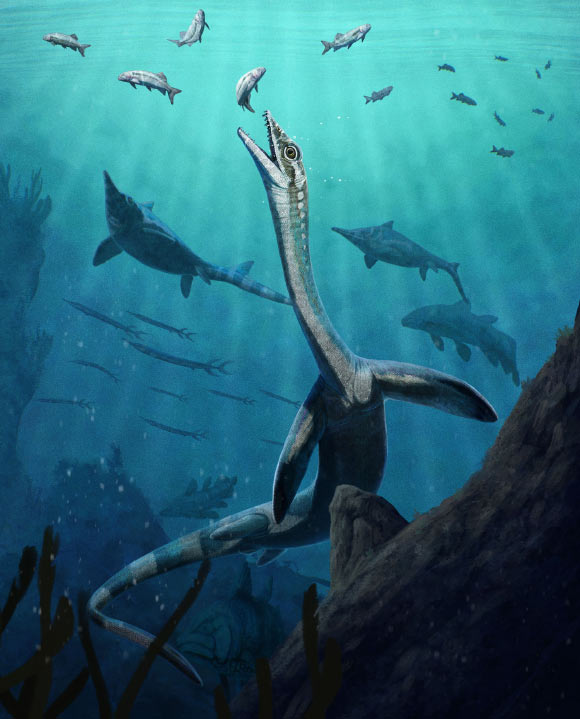
Spoon-Toothed, Short-Headed Marine Reptile Unearthed in China
Un reptile marin à dents de cuillère et à tête courte découvert en Chine
dent Chine Trias Sauropterygia nouvelle espèce autres reptiles squelette
Un nouveau genre et une nouvelle espèce de reptile sauroptérygien ayant vécu pendant la période du Trias, il y a environ 245 millions d'années, ont été identifiés à partir d'un squelette presque complet trouvé en Chine. L'article Un reptile marin à dents de cuillère et à tête courte découvert en Chine est apparu en premier sur Sci.News : Breaking Science News.
20/08/2026 sci-news ⚙ Traduction automatique
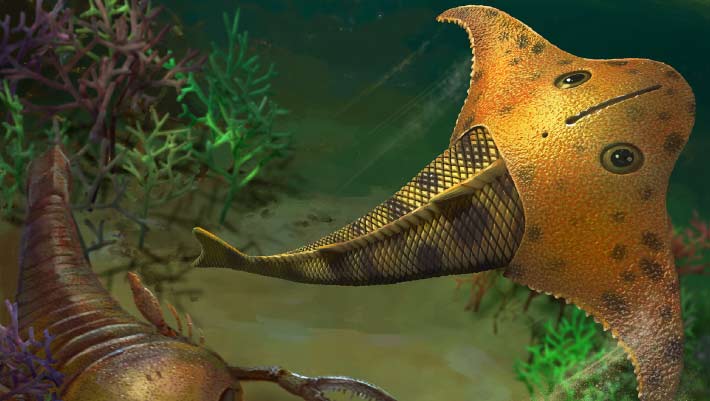
Meet Bataspis crux, Jawless Fish that Cruised Devonian Seas with Batwing Head
Rencontrez Bataspis crux, un poisson sans mâchoire qui naviguait dans les mers du Dévonien avec une tête de chauve-souris
mâchoire Chine Dévonien Dévonien poisson nouvelle espèce crâne
Des paléontologues chinois ont identifié une nouvelle espèce de poisson blindé et sans mâchoire provenant de roches vieilles d'environ 419 millions d'années, dont le crâne avait la forme d'une aile de chauve-souris et dont la tête inhabituelle en faisait un planeur efficace dans les mers du Dévonien. L'article Rencontrez Bataspis crux, un poisson sans mâchoire qui a navigué dans les mers du Dévonien avec une tête de chauve-souris est apparu en premier sur Sci.News : Breaking Science News.
18/08/2026 sci-news ⚙ Traduction automatique
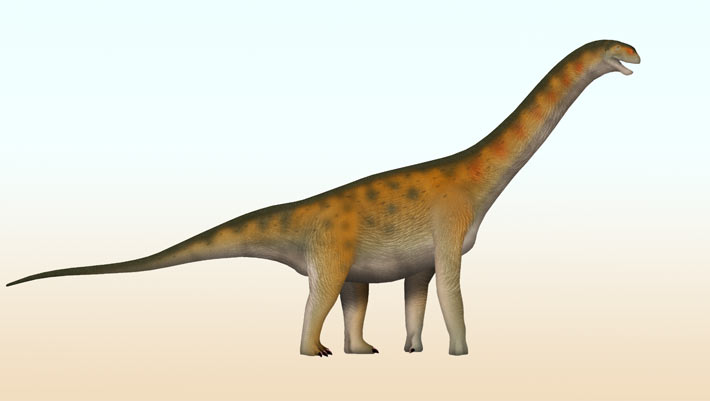
Fossil Find in China Reveals Dinosaur Family Never Before Seen in East Asia
Une découverte de fossiles en Chine révèle une famille de dinosaures jamais vue auparavant en Asie de l'Est
Chine fossile Dinosauria découverte nouvelle espèce
Des paléontologues travaillant dans le sud de la Chine ont identifié une nouvelle espèce de dinosaure sauropode qui semble appartenir à un groupe jamais documenté auparavant en Asie de l'Est. L'article Une découverte de fossiles en Chine révèle une famille de dinosaures jamais vue auparavant en Asie de l'Est est apparu en premier sur Sci.News : Breaking Science News.
04/08/2026 sci-news ⚙ Traduction automatique
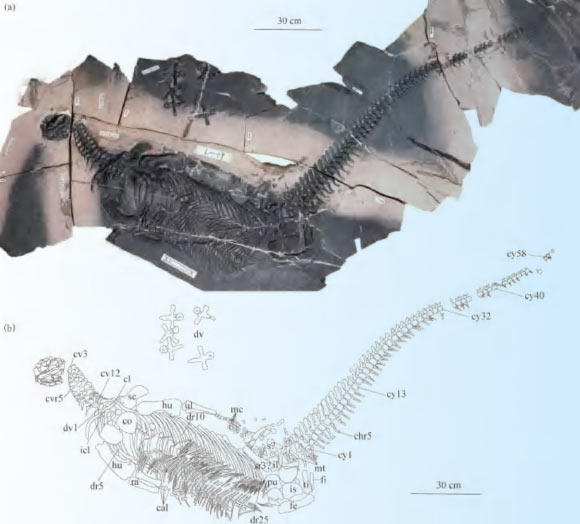
244-Million-Year-Old Fossil Preserves Earliest Reptilian Digestive System
Un fossile vieux de 244 millions d’années préserve le premier système digestif reptilien
Chine Trias fossile spécimen
Un spécimen superbement conservé d'Austronaga minuta, un petit reptile marin au long cou du Trias chinois, contient un estomac, un foie et des intestins fossilisés, offrant aux paléontologues leur plus ancien aperçu détaillé de la façon dont les premiers reptiles digéraient la nourriture. L'article Un fossile vieux de 244 millions d'années préserve le premier système digestif reptilien est apparu en premier sur Sci.News : Breaking Science News.
04/08/2026 sci-news ⚙ Traduction automatique
Les fossiles remarquables d'Eoceras shaanxiense réécrivent l'évolution des céphalopodes
Chine Cambrien Étage 3 du Cambrien fossile évolution formation
Les chercheurs ont identifié de minuscules fossiles de la formation Shuijingtuo (stade cambrien 3) du sud de la Chine qui pourraient transformer notre compréhension de l'évolution des céphalopodes. L'espèce nouvellement décrite, Eoceras shaanxiense, fournit la plus ancienne preuve connue d'un siphoncle primordial, une caractéristique anatomique cruciale qui a permis aux céphalopodes de réguler la flottabilité et de devenir finalement certains des océans.
03/08/2026 everythingdinosaur ⚙ Traduction automatique
1 2 3 4 5 6 7 8