←

Dinosauria

Taxon

251 image(s) · 248 Actualités

Voir la fiche

Galerie d'images

Reconstruction of Tuebingosaurus maierfritzorum gen. et sp. nov. as a quadruped dinosaur, using the outline of Riojasaurus as a base ‒ next to the silhouette of Friedrich von Huene. The drawing of the bones is based on and modified from the original illustrations of specimen “GPIT IV” in von Huene (1932, pl. 38) that have been replicated in the literature. The right fibula is marked in grey as it was found nearby with similar measurements to the left fibula and has been assumed to be part of the same individual.
Taxons Tuebingosaurus

Reconstruction of Tuebingosaurus maierfritzorum gen. et sp. nov. as a quadruped dinosaur, using the outline of Riojasaurus as a base ‒ next to the silhouette of Friedrich von Huene. The drawing of the bones is based on and modified from the original illustrations of specimen “GPIT IV” in von Huene (1932, pl. 38) that have been replicated in the literature. The right fibula is marked in grey as it was found nearby with similar measurements to the left fibula and has been assumed to be part of the same individual.

os dessin spécimen Dinosauria +2
Reconstruction of Bravasaurus arreirosorum a titanosaur dinosaur from the Late Cretaceous of Argentina
Taxons Bravasaurus

Reconstruction of Bravasaurus arreirosorum a titanosaur dinosaur from the Late Cretaceous of Argentina

Argentine Crétacé Crétacé supérieur Bravasaurus +2
Shri rapax 3D skeletal reconstruction by Alex Pritchard of Dinosaur Skeletons.
Taxons Shri

Shri rapax 3D skeletal reconstruction by Alex Pritchard of Dinosaur Skeletons.

Dinosauria Shri squelette
Reconstructed skull of Jaxartosaurus aralensis Riabinin, 1937. Only a posterior portion of the skull, as well as a surangular is known, with the rest of the skull being based mostly upon File:Aralosaurus skull.png. Jaxartosaurus is currently classified as a basal lambeosaurine, more derived than Aralosaurini, but more primitive than Parasaurolophini and Lambeosaurini. It might be more derived than Tsintaosaurini (Godefroit et al., 2004). References: 
Riabinin, A.M. (1937). "A New Finding of Dinosaurs in the Trans-Baikal Region". Ezhegodn. Vserossijskogo Palaeont. Obstcg. 11: 142–144
Godefroit, P.; Bolotsky, Y.L.; Van Itterbeeck, J. (2004). "The lambeosaurine dinosaur Amurosaurus riabinini, from the
Maastrichtian of Far Eastern Russia". Acta Palaeontologica Polonica 49(4): 585–618
Taxons Jaxartosaurus

Reconstructed skull of Jaxartosaurus aralensis Riabinin, 1937. Only a posterior portion of the skull, as well as a surangular is known, with the rest of the skull being based mostly upon File:Aralosaurus skull.png. Jaxartosaurus is currently classified as a basal lambeosaurine, more derived than Aralosaurini, but more primitive than Parasaurolophini and Lambeosaurini. It might be more derived than Tsintaosaurini (Godefroit et al., 2004). References: Riabinin, A.M. (1937). "A New Finding of Dinosaurs in the Trans-Baikal Region". Ezhegodn. Vserossijskogo Palaeont. Obstcg. 11: 142–144 Godefroit, P.; Bolotsky, Y.L.; Van Itterbeeck, J. (2004). "The lambeosaurine dinosaur Amurosaurus riabinini, from the Maastrichtian of Far Eastern Russia". Acta Palaeontologica Polonica 49(4): 585–618

Russie Maastrichtien Amurosaurus Aralosaurini +7
Line diagram of the holotype specimen (ZPAL MgD-I/117) of the protoceratopsid Breviceratops kozlowskii. Based on Maryańska & Osmólska 1975,[1] and Czepiński 2019.[2]
References

↑ (1975). "Protoceratopsidae (Dinosauria) of Asia". Palaeontologia Polonica 33: 134−143. Archived from the original on 2018-09-21. Retrieved on 2021-07-25.

↑ (2019). "Ontogeny and variation of a protoceratopsid dinosaur Bagaceratops rozhdestvenskyi from the Late Cretaceous of the Gobi Desert". Historical Biology: 1−28. DOI:10.1080/08912963.2019.1593404. Archived from the original on 2021-07-08. Retrieved on 2021-07-25.
Taxons Breviceratops

Line diagram of the holotype specimen (ZPAL MgD-I/117) of the protoceratopsid Breviceratops kozlowskii. Based on Maryańska & Osmólska 1975,[1] and Czepiński 2019.[2] References ↑ (1975). "Protoceratopsidae (Dinosauria) of Asia". Palaeontologia Polonica 33: 134−143. Archived from the original on 2018-09-21. Retrieved on 2021-07-25. ↑ (2019). "Ontogeny and variation of a protoceratopsid dinosaur Bagaceratops rozhdestvenskyi from the Late Cretaceous of the Gobi Desert". Historical Biology: 1−28. DOI:10.1080/08912963.2019.1593404. Archived from the original on 2021-07-08. Retrieved on 2021-07-25.

ontogenèse Crétacé Crétacé supérieur holotype +5
Megacephalosaurus eulerti reconstructed skull in the Rocky Mountain Dinosaur Resource Center, Woodland Park, Colorado.
Taxons Megacephalosaurus

Megacephalosaurus eulerti reconstructed skull in the Rocky Mountain Dinosaur Resource Center, Woodland Park, Colorado.

Dinosauria Megacephalosaurus crâne
Dinosaur's Museum in Savannakhet, Laos
Taxons Tangvayosaurus

Dinosaur's Museum in Savannakhet, Laos

musée Laos Dinosauria Tangvayosaurus
Caririchnium leonardii - dinosaur track from the Cretaceous of Colorado, USA. (replica; public display, Red Rocks Amphitheater visitor center, west of Denver, Colorado, USA)
Dinosaur Ridge, Colorado has numerous dinosaur fossils, including bones and tracks.  The most common track type at the site is Caririchnium leonardii, which was made by an iguanodontid dinosaur.  The large, wide, three-toed print was produced by a hindfoot.
Stratigraphy: Dakota Sandstone, upper Lower Cretaceous

Provenance: eastern side of Dinosaur Ridge, Dakota Hogback, west of Denver, north-central Colorado, USA
Taxons Caririchnium

Caririchnium leonardii - dinosaur track from the Cretaceous of Colorado, USA. (replica; public display, Red Rocks Amphitheater visitor center, west of Denver, Colorado, USA) Dinosaur Ridge, Colorado has numerous dinosaur fossils, including bones and tracks. The most common track type at the site is Caririchnium leonardii, which was made by an iguanodontid dinosaur. The large, wide, three-toed print was produced by a hindfoot. Stratigraphy: Dakota Sandstone, upper Lower Cretaceous Provenance: eastern side of Dinosaur Ridge, Dakota Hogback, west of Denver, north-central Colorado, USA

os États-Unis Denver Crétacé +6
Elongatoolithus excellens in the exhibition "Dinosaures. Tresors del desert de Gobi" ("Dinosaurs. Treasures of Gobi Desert") in CosmoCaixa, Barcelona.
Taxons Elongatoolithus

Elongatoolithus excellens in the exhibition "Dinosaures. Tresors del desert de Gobi" ("Dinosaurs. Treasures of Gobi Desert") in CosmoCaixa, Barcelona.

Dinosauria Elongatoolithus
Elangatoolithidae fossil dinosaur eggs, from China. Exhibit in the Academy of Natural Sciences, 1900 Benjamin Franklin Parkway, Philadelphia, Pennsylvania, USA. Photography was permitted in this area of the museum without restrictions.
Taxons Elongatoolithidae

Elangatoolithidae fossil dinosaur eggs, from China. Exhibit in the Academy of Natural Sciences, 1900 Benjamin Franklin Parkway, Philadelphia, Pennsylvania, USA. Photography was permitted in this area of the museum without restrictions.

musée Chine États-Unis fossile +2
Fossil specimen of Ornithomimus sp. (TMP 1995.110.1), Royal Tyrrell Museum. This specimen was recovered from the middle Dinosaur Park Formation of Alberta, Canada.
Taxons Ornithomimidae

Fossil specimen of Ornithomimus sp. (TMP 1995.110.1), Royal Tyrrell Museum. This specimen was recovered from the middle Dinosaur Park Formation of Alberta, Canada.

musée Canada Allemagne Dinosaur Park +6
Uses https://commons.wikimedia.org/wiki/File:Dromaeosaurus_in_Canadian_Museum_of_Nature.jpg
File:Alaskan_troodont_Perot_Museum.jpg
File:Unenlagia_fossils.jpg
File:Talos_sampsoni.png
https://en.wikipedia.org/wiki/File:Velociraptor_Wyoming_Dinosaur_Center.jpg
https://en.wikipedia.org/wiki/Saurornitholestes
File:Buitreraptor-Deinonychus.jpg

File:Dakotaraptor_lateral_Wiki.jpg
Taxons Deinonychosauria

Uses https://commons.wikimedia.org/wiki/File:Dromaeosaurus_in_Canadian_Museum_of_Nature.jpg File:Alaskan_troodont_Perot_Museum.jpg File:Unenlagia_fossils.jpg File:Talos_sampsoni.png https://en.wikipedia.org/wiki/File:Velociraptor_Wyoming_Dinosaur_Center.jpg https://en.wikipedia.org/wiki/Saurornitholestes File:Buitreraptor-Deinonychus.jpg File:Dakotaraptor_lateral_Wiki.jpg

musée fossile Buitreraptor Dakotaraptor +8
Duck-billed dinosaurs at the Royal Ontario Museum. A Maiasaura skeleton is visible on the foreground, with two Maiasaura juveniles at the foot of the skeletal mount. On the background, flushing with the wall, there's the two-dimensional mount of a Gryposaurus specimen. The unidentified skull of another duck-billed dinosaur is visible on the low right corner of the photograph.
Taxons Hadrosauridae

Duck-billed dinosaurs at the Royal Ontario Museum. A Maiasaura skeleton is visible on the foreground, with two Maiasaura juveniles at the foot of the skeletal mount. On the background, flushing with the wall, there's the two-dimensional mount of a Gryposaurus specimen. The unidentified skull of another duck-billed dinosaur is visible on the low right corner of the photograph.

musée juvénile spécimen Dinosauria +5
Duck-billed dinosaurs at the Royal Ontario Museum. A Maiasaura skeleton is visible on the foreground, with two Maiasaura juveniles at the foot of the skeletal mount. On the background, flushing with the wall, there's the two-dimensional mount of a Gryposaurus specimen. The unidentified skull of another duck-billed dinosaur is visible on the low right corner of the photograph.
Taxons Hadrosauridae

Duck-billed dinosaurs at the Royal Ontario Museum. A Maiasaura skeleton is visible on the foreground, with two Maiasaura juveniles at the foot of the skeletal mount. On the background, flushing with the wall, there's the two-dimensional mount of a Gryposaurus specimen. The unidentified skull of another duck-billed dinosaur is visible on the low right corner of the photograph.

musée juvénile spécimen Dinosauria +5
Six maniraptoran dinosaurs (top to bottom):  the Zamyn Khondt oviraptorosaur, Sinornithosaurus, the Alaskan troodontid, Patagonykus, a short-tailed albatross, Nothronychus
Taxons Maniraptora

Six maniraptoran dinosaurs (top to bottom): the Zamyn Khondt oviraptorosaur, Sinornithosaurus, the Alaskan troodontid, Patagonykus, a short-tailed albatross, Nothronychus

Coelurosauria Dinosauria Maniraptora Nothronychus +4
Map of Cretaceous-aged dinosaur fossil localities of Mongolia.
Gobihadros mongoliensis was collected from Bayshin Tsav in Area C. Open squares indicate Late Cretaceous sites, solid squares represent Early Cretaceous localities. Abbreviations: A, Localities of Western Gobi Desert in Mongolia, mainly group of localities of Nemegtian age (early Maastrichtian), Late Cretaceous; B, Localities of Central Gobi Desert in Mongolia, mainly Djadokhtian age (Campanian), Late Cretaceous; C & D- Localities of Eastern Gobi Desert in Mongolia, mainly Baynshirenian age (Cenomanian-Santonian), Late Cretaceous. Figure has been modified from Tsogtbaatar et al. 2014, Figure 1 [24].
Formations Baynshire

Map of Cretaceous-aged dinosaur fossil localities of Mongolia. Gobihadros mongoliensis was collected from Bayshin Tsav in Area C. Open squares indicate Late Cretaceous sites, solid squares represent Early Cretaceous localities. Abbreviations: A, Localities of Western Gobi Desert in Mongolia, mainly group of localities of Nemegtian age (early Maastrichtian), Late Cretaceous; B, Localities of Central Gobi Desert in Mongolia, mainly Djadokhtian age (Campanian), Late Cretaceous; C & D- Localities of Eastern Gobi Desert in Mongolia, mainly Baynshirenian age (Cenomanian-Santonian), Late Cretaceous. Figure has been modified from Tsogtbaatar et al. 2014, Figure 1 [24].

Mongolie Campanien Cénomanien Crétacé +8
1 2 3 4 5 6 7 8 9 10 11 12 13 14 15 16

Actualités

Model Collector propose un examen exclusif des bêtes de l'Allosaure mésozoïque à l'échelle 1:35
écaille Mésozoïque Allosauria Dinosauria
Nos remerciements au collectionneur dévoué de modèles de dinosaures qui a envoyé à Everything Dinosaur une revue des bêtes du Mésozoïque, Allosaurus fragilis.  L'Allosaure est l'un de nos dinosaures préférés et nous sommes également de grands fans de la gamme de modèles Les Bêtes du Mésozoïque.  C'est génial d'avoir les Bêtes du Mésozoïque
21/05/2026 everythingdinosaur ⚙ Traduction automatique
Une nouvelle étude résout le mystère des minuscules bras de dinosaures théropodes
membre Dinosauria Tyrannosaurus étude
Pourquoi le T. rex avait-il des bras minuscules ?  C’est une question qu’on nous pose souvent chez Everything Dinosaur.  Ironiquement, plusieurs lignées de théropodes non étroitement apparentées présentent une réduction des membres antérieurs. Le Tyrannosaure rex possédait des armes légères, tout comme de nombreux autres grands dinosaures carnivores. Une nouvelle étude suggère que les petits bras de certains théropodes
20/05/2026 everythingdinosaur ⚙ Traduction automatique
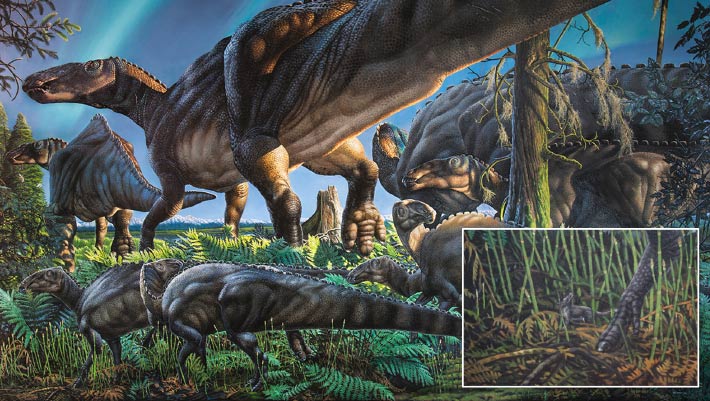
Before Dinosaur Extinction, Rodent-Like Mammals were Already Flourishing in Ancient Arctic
Avant l’extinction des dinosaures, les mammifères ressemblant à des rongeurs prospéraient déjà dans l’Arctique antique
Dinosauria extinction mammifères
Les paléontologues ont décrit trois espèces jusqu'alors inconnues de mammifères multituberculés – nommés Camurodon borealis, Qayaqgruk peregrinus et Kaniqsiqcosmodon polaris – qui vivaient dans les forêts polaires il y a environ 73 millions d'années. L'article Avant l'extinction des dinosaures, les mammifères ressemblant à des rongeurs prospéraient déjà dans l'Arctique antique est apparu en premier sur Sci.News : Breaking Science News.
20/05/2026 sci-news ⚙ Traduction automatique
Mystery of Tyrannosaurus rex’s Tiny Arms May Finally Have an Answer
Le mystère des petits bras du Tyrannosaurus rex pourrait enfin avoir une réponse
os mâchoire prédateur proie Dinosauria Tyrannosaurus
Les paléontologues de l'University College de Londres et de l'Université de Cambridge affirment que les bras minuscules des grands dinosaures prédateurs ont évolué aux côtés de têtes massives et de mâchoires broyantes, ce qui suggère que les anciens prédateurs comptaient de plus en plus sur la morsure plutôt que sur la saisie de leurs proies. L’article Le mystère des petits bras du Tyrannosaurus rex pourrait enfin avoir une réponse apparaît en premier sur Sci.News : Breaking Science News.
20/05/2026 sci-news ⚙ Traduction automatique
Les petits bras du T. rex pourraient avoir évolué pour une raison étonnamment brutale
mâchoire membre chasse prédateur proie Dinosauria crâne
Pourquoi le T. rex avait-il des bras si petits ? Les scientifiques pensent désormais que c’est parce que sa tête géante est devenue l’outil de chasse ultime. Dans plusieurs groupes de dinosaures, des crânes plus forts et des mâchoires écrasantes ont évolué parallèlement à des membres antérieurs rétrécis, en particulier chez les prédateurs chassant d'énormes proies. En d’autres termes, une fois que la morsure est devenue suffisamment mortelle, les bras ont peut-être cessé d’avoir de l’importance.
20/05/2026 sciencedaily ⚙ Traduction automatique
1 2 3 4 5 6 7 8 9 10 11 12 13 14 15 16 17 18 19 20 21 22 23 24 25 26 27 28 29 30 31 32 33 34 35 36 37 38 39 40 41 42 43 44 45 46 47 48 49 50