←

Dinosauria

Taxon

300 image(s) · 316 News

View page

Image gallery

Skeletal reconstruction of the Sauropod dinosaur Abdarainurus barsboldi based on holotype PIN 5669/1, as figured in Averianov and Lopatin, 2020. Outline is based on related Sauropods, modified from SlvrHwk.
Taxa Abdarainurus

Skeletal reconstruction of the Sauropod dinosaur Abdarainurus barsboldi based on holotype PIN 5669/1, as figured in Averianov and Lopatin, 2020. Outline is based on related Sauropods, modified from SlvrHwk.

holotype Abdarainurus Dinosauria
Reconstructed skull of Duriavenator hesperis showing known material (white) of the holotype and only known specimen. Unknown bones based on related Eustreptospondylus oxoniensis. Scale bar is 10cm, image is 10px/cm. Cranial anatomy based on Benson (2008) "A redescription of "Megalosaurus" hesperis (Dinosauria, Theropoda) from the Inferior Oolite (Bajocian, Middle Jurassic) of Dorset, United Kingdom"
Taxa Duriavenator

Reconstructed skull of Duriavenator hesperis showing known material (white) of the holotype and only known specimen. Unknown bones based on related Eustreptospondylus oxoniensis. Scale bar is 10cm, image is 10px/cm. Cranial anatomy based on Benson (2008) "A redescription of "Megalosaurus" hesperis (Dinosauria, Theropoda) from the Inferior Oolite (Bajocian, Middle Jurassic) of Dorset, United Kingdom"

bone scale United Kingdom Bajocian +11
Reconstructed skull of Wiehenvenator albati based on holotype specimen (white). Scale bar is 10cm, image if 10px/cm. Unknown material based on related Torvosaurus tanneri. Cranial anatomy based on Rauhut et al (2016) "A new megalosaurid theropod dinosaur from the late Middle Jurassic (Callovian) of north-western Germany: implications for theropod evolution and faunal turnover in the Jurassic"
Taxa Wiehenvenator

Reconstructed skull of Wiehenvenator albati based on holotype specimen (white). Scale bar is 10cm, image if 10px/cm. Unknown material based on related Torvosaurus tanneri. Cranial anatomy based on Rauhut et al (2016) "A new megalosaurid theropod dinosaur from the late Middle Jurassic (Callovian) of north-western Germany: implications for theropod evolution and faunal turnover in the Jurassic"

scale Germany Callovian Jurassic +10
Original caption: "Calibrated phylogeny of Neosauropoda. Summarized strict consensus tree showing the relationships among neosauropod dinosaurs and the phylogenetic position of Tapuiasaurus macedoi gen. n. sp. n. The support values (Bremer/Bootstrap) for the nodes labelled in the figure are: Neosauropoda (1/-), Somphospondyli (2/68), Titanosauria (2/58), Lithostrotia (3/68), “advanced titanosaurians” (3/65), Nemegtosauridae (1/-), Saltasauridae (1/-). See Figure S4 for a complete strict consensus tree including all sauropod terminal taxa used in the analysis. Age of first appearance for taxa used in the calibrated phylogeny are given in Text S4."

Original caption: "Calibrated phylogeny of Neosauropoda. Summarized strict consensus tree showing the relationships among neosauropod dinosaurs and the phylogenetic position of Tapuiasaurus macedoi gen. n. sp. n. The support values (Bremer/Bootstrap) for the nodes labelled in the figure are: Neosauropoda (1/-), Somphospondyli (2/68), Titanosauria (2/58), Lithostrotia (3/68), “advanced titanosaurians” (3/65), Nemegtosauridae (1/-), Saltasauridae (1/-). See Figure S4 for a complete strict consensus tree including all sauropod terminal taxa used in the analysis. Age of first appearance for taxa used in the calibrated phylogeny are given in Text S4."

Dinosauria Lithostrotia Nemegtosauridae Neosauropoda +6
Duonychus tsogtbaatari in Dinosaur Expo 2019 at Nationail Science Museum in Tokyo
Taxa Duonychus

Duonychus tsogtbaatari in Dinosaur Expo 2019 at Nationail Science Museum in Tokyo

museum Dinosauria Duonychus
This file represents a possible life appearance of the Indian Titanosaurian Sauropod dinosaur Jainosaurus septentrionalis from the Late Cretaceous (Maastrichtian) of India, belonging to the Lameta Formation.
References used: 
Huene & Matley (1933)
Hunt et al. (1995)
Gunnar Bivens' skeletal diagram

Wilson et al. (2008) "Reassessment of Sauropod Dinosaur Jainosaurus (="Antarctosaurus") Septentrionalis from the Upper Cretaceous of India"
Taxa Jainosaurus

This file represents a possible life appearance of the Indian Titanosaurian Sauropod dinosaur Jainosaurus septentrionalis from the Late Cretaceous (Maastrichtian) of India, belonging to the Lameta Formation. References used: Huene & Matley (1933) Hunt et al. (1995) Gunnar Bivens' skeletal diagram Wilson et al. (2008) "Reassessment of Sauropod Dinosaur Jainosaurus (="Antarctosaurus") Septentrionalis from the Upper Cretaceous of India"

India Lameta Cretaceous Late Cretaceous +6
Dinosaur Vectaerovenator Reconstruction
Taxa Vectaerovenator

Dinosaur Vectaerovenator Reconstruction

Dinosauria Vectaerovenator
Wyoming Dinosaur Center
Taxa Medusaceratops

Wyoming Dinosaur Center

Dinosauria Medusaceratops
Reconstruceted skull of Dubreuillosaurus illustrating known (white) and unknown (grey) material. Scale bar is 10cm. Based of figures and description of Allain (2002) "Discovery of megalosaur (Dinosauria, Theropoda) in the middle Bathonian of Normandy (France) and its implications for the phylogeny of basal Tetanurae"
Taxa Dubreuillosaurus

Reconstruceted skull of Dubreuillosaurus illustrating known (white) and unknown (grey) material. Scale bar is 10cm. Based of figures and description of Allain (2002) "Discovery of megalosaur (Dinosauria, Theropoda) in the middle Bathonian of Normandy (France) and its implications for the phylogeny of basal Tetanurae"

scale description France Bathonian +8
Malefica is a hadrosaurid dinosaur from the Late Cretaceous of Texas in the United States. Like other hadrosaurs, Malefica was herbivorous, processing plant matter with their broad beaks and battery of teeth in the back of the mouth. It could grow to around 6 m in length, and weighed about 1 t. The discovery of Malefica helped to understand the distribution of hadrosaurs in Cretaceous North America, as well as evolutionary lineages between basal hadrosaurs and the more derived saurolophids.
Taxa Malefica

Malefica is a hadrosaurid dinosaur from the Late Cretaceous of Texas in the United States. Like other hadrosaurs, Malefica was herbivorous, processing plant matter with their broad beaks and battery of teeth in the back of the mouth. It could grow to around 6 m in length, and weighed about 1 t. The discovery of Malefica helped to understand the distribution of hadrosaurs in Cretaceous North America, as well as evolutionary lineages between basal hadrosaurs and the more derived saurolophids.

United States Cretaceous Late Cretaceous Dinosauria +5
Dzharacursor is an ornithomimid theropod dinosaur from the Late Cretaceous of what is now Uzbekistan. Ornithomimids like Dzharacursor are known for their long legs lending to a cursorial, or running, lifestyle. They had a feathered covering, and were likely omnivorous, or possibly herbivorous. Adult Dzharacursor could grow to approximately 3.5 m in length.

Dzharacursor is an ornithomimid theropod dinosaur from the Late Cretaceous of what is now Uzbekistan. Ornithomimids like Dzharacursor are known for their long legs lending to a cursorial, or running, lifestyle. They had a feathered covering, and were likely omnivorous, or possibly herbivorous. Adult Dzharacursor could grow to approximately 3.5 m in length.

Uzbekistan Cretaceous Late Cretaceous Dinosauria +2
Skeletal mount of the spinosaurine species Ichthyovenator laosensis at the Giga Dinosaur Exhibition in the National Museum of Nature and Science, Tokyo.
Taxa Ichthyovenator

Skeletal mount of the spinosaurine species Ichthyovenator laosensis at the Giga Dinosaur Exhibition in the National Museum of Nature and Science, Tokyo.

museum Dinosauria Ichthyovenator
Skeletal reconsturion of alvarezsaurian dinosaur Shishugounykus inexpectus. Scale bar, 200 mm.
Taxa Shishugounykus

Skeletal reconsturion of alvarezsaurian dinosaur Shishugounykus inexpectus. Scale bar, 200 mm.

scale Alvarezsauria Dinosauria Shishugounykus
Impression in stone of small dinosaur "nodosaur".
Taxa Propanoplosaurus

Impression in stone of small dinosaur "nodosaur".

Dinosauria Propanoplosaurus
Ahvaytum is a saturnaliid sauropodomorph from the Late Triassic of what is now Wyoming. It is the oldest known dinosaur from the northern continent of Laurasia, challenging previous hypotheses of dinosaur origins and dispersal. Typical of basal dinosaurs from the Triassic, Ahvaytum was a small slender biped, reaching about 1 m in body length.

Ahvaytum is a saturnaliid sauropodomorph from the Late Triassic of what is now Wyoming. It is the oldest known dinosaur from the northern continent of Laurasia, challenging previous hypotheses of dinosaur origins and dispersal. Typical of basal dinosaurs from the Triassic, Ahvaytum was a small slender biped, reaching about 1 m in body length.

Late Triassic Triassic Ahvaytum Dinosauria +1
Huashanosaurus is a basal sauropod dinosaur that lived from the Early to Middle Jurassic periods of what is now China. It was a long-necked herbivore which still exhibited many basal traits of the earlier sauropodomorphs, while transitioning to obligate quardupedality. Huashanosaurus grew to approximately 12 m in length, and weighed around 10 t.

Huashanosaurus is a basal sauropod dinosaur that lived from the Early to Middle Jurassic periods of what is now China. It was a long-necked herbivore which still exhibited many basal traits of the earlier sauropodomorphs, while transitioning to obligate quardupedality. Huashanosaurus grew to approximately 12 m in length, and weighed around 10 t.

China Jurassic Middle Jurassic Dinosauria +1
1 2 3 4 5 6 7 8 9 10 11 12 13 14 15 16 17 18 19

News

This tiny mammal survived the dinosaur apocalypse and changed life on Earth
fossil Dinosauria extinction mammals
A newly discovered prehistoric mammal may hold clues to how life survived the dinosaur-killing extinction. The tiny species, Cimolodon desosai, lived 75 million years ago and had traits—like a small body and varied diet—that likely boosted survival odds. Found in Baja California, the fossil includes rare skeletal remains that reveal how it moved and lived. Researchers believe its lineage helped mammals endure one of Earth’s deadliest events.
27/04/2026 sciencedaily
Blood vessels found in T. rex bones are rewriting dinosaur science
bone DNA fossil Dinosauria Tyrannosaurus
Dinosaur DNA may still be out of reach, but scientists are uncovering something almost as exciting—ancient blood vessels hidden inside fossilized bones. In a massive Tyrannosaurus rex nicknamed Scotty, researchers discovered a network of preserved vessels within a rib that once fractured and began healing 66 million years ago. Using powerful synchrotron X-rays from particle accelerators, they were able to peer inside the dense fossil without damaging it, revealing intricate, iron-rich structures
26/04/2026 sciencedaily
Giant octopuses ruled the oceans 100 million years ago, study finds
jaw predator prey fossil Dinosauria study
Giant, fearsome octopuses may have once ruled the ancient seas, according to new research that flips the script on their evolutionary past. By uncovering exquisitely preserved fossil jaws hidden inside rock, scientists revealed that early octopuses from the age of dinosaurs weren’t shy, soft-bodied drifters—they were massive apex predators, possibly stretching up to 20 meters long and crushing prey with powerful bites.
25/04/2026 sciencedaily-paleo
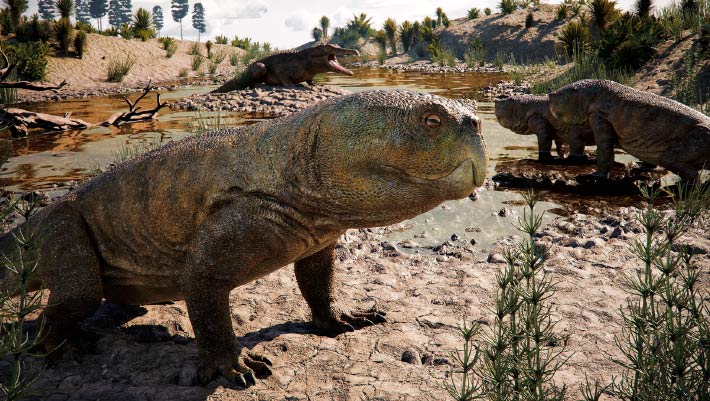
New Fossil from Brazil Reveals Unexpected Diversity among Pre-Dinosaur Herbivores
jaw Brazil Triassic fossil Dinosauria new species partial skull
Paleontologists in Brazil have identified a new genus and species of hyperodapedontine rhynchosaur -- an extinct lineage of beaked, herbivorous reptiles -- based on a partial skull and lower jaws recovered from Triassic rocks. The post New Fossil from Brazil Reveals Unexpected Diversity among Pre-Dinosaur Herbivores appeared first on Sci.News: Breaking Science News.
23/04/2026 sci-news
Stunning 132 million-year-old dinosaur tracks are rewriting history
fossil tracks Dinosauria discovery
A long-standing mystery in southern Africa’s fossil record is beginning to unravel. After massive lava flows 182 million years ago seemed to erase evidence of dinosaurs in the region, scientists have now uncovered surprising new clues along the Western Cape coast. Dozens of dinosaur tracks, about 132 million years old, have been discovered in a tiny stretch of rock near Knysna—making them the youngest ever found in southern Africa.
23/04/2026 sciencedaily
1 2 3 4 5 6 7 8 9 10 11 12 13 14 15 16 17 18 19 20 21 22 23 24 25 26 27 28 29 30 31 32 33 34 35 36 37 38 39 40 41 42 43 44 45 46 47 48 49 50 51 52 53 54 55 56 57 58 59 60 61 62 63 64